
Difference in Arrangements: Far-Right Developments Within Europe
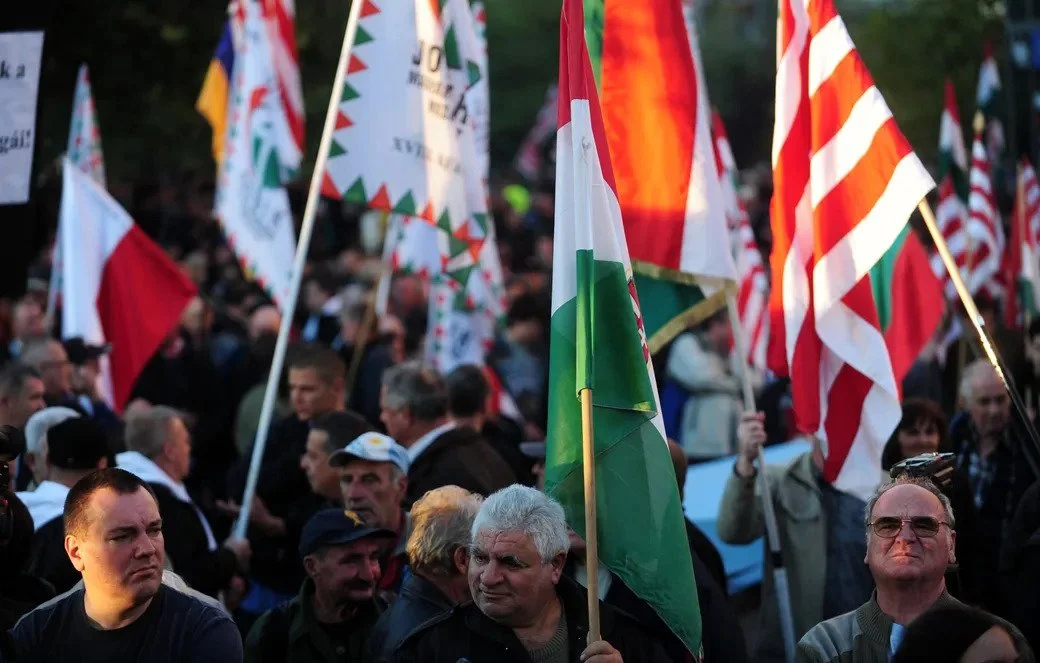
If one looks at the state of European politics today, they will be met with a barrage of news headlines detailing the rise of far-right parties. The culmination of far-right entrenchment in Europe has a long-standing history that not even the greatest academic could disseminate succinctly. This article will not attempt to take on such an endeavor, and certainly will not cover country-specific mechanisms of ideological progression. However, it will follow the unique, large-scale configuration of far-right politics in the Eastern European bloc, a pattern that heavily contrasts with developments in Western Europe, as some scholars of this topic like to overlook.
The two guiding questions that informed this research are as follows: What are the origins and extent of entrenchment of far-right parties in Eastern Europe? And, how do Eastern and Western European far-right politics differ in causes, organizational forms, and targets?
Before any historical analysis can be conducted, it will be necessary to define what far-right politics encompasses in the current day. The far-right contains a wide breadth of ideologies that normally fall under nativism, authoritarianism, and exclusionary nationalism. Old right-wing parties contain fascist undertones, while recently born parties don’t typically have formal fascist ties but instead contain anti-system attitudes. Common within such parties are appeals to law-and-order, traditional social values, and xenophobia towards immigrants. Additionally, they often rely on the construction of an in-group mentality based on a shared characteristic like ethnicity, nationality, and/or religion.
Recent Far Right Party Developments in Eastern Europe
Referring to happenings in the last decade, major conservative parties in Hungary and Poland have adopted far-right agendas. These radicalization processes are nothing new in Eastern European history, especially since the democratization of the region 40 years ago. And following the democratic transitions that took place at the tail end of the ‘80s, radical-right parties have been swiftly incorporated into governing coalitions across several Eastern European countries: Romania (1992-1996), Slovakia (1992-1998, 2006-2010, and 2016 onward), Poland (2006-2007), and Latvia (since 2011).
There has been a trend that has been emerging in Eastern Europe where far-right parties court mainstream ones, causing a radicalization of the mainstream to occur rather than taming of the radical-right. Subsequently, voters following far-right parties are then funneled into mainstream parties. Tangible policy shifts sweep regions even as nationalist extremists with marginal electoral success fade into insignificance. And as a country’s politics makes this shift, this realignment has the tendency of remaining firmly in place.
Mainstream right-leaning political actors currently active in Eastern Europe have exhibited this extreme radicalization process. Both Hungary’s Fidesz and Poland’s Law and Justice (PiS) parties, which first succeeded as conventional conservative groups, are now conditioned in nationalistic rhetoric, the demonization of minorities, and the attack on democratic norms. A nationalist sentiment is present in most, if not all, political parties in Eastern Europe. Originally a liberal youth party in 1988, Fidesz under Viktor Orbán pivoted to nationalist rhetoric in the post-1988 election defeats, capturing 53% of the vote in 2018 via typical far-right propaganda. This mirrors Poland’s PiS, which blended Church alliances with judicial reforms, clashing European Union (EU) norms from 2005 onwards.
A Distinctly Eastern European Politic
While many Western European mainstream parties adopt stringent measures on immigration and domestic terrorism, their Eastern European counterparts are much more comfortable with their radical right cousins. The reasoning for this is quite simple. Generally, Western trajectories of nation-building were propelled by liberal or bourgeois revolutions, producing stable democracies. Whereas in the East, nation-building processes largely emerged from the dissolution of empires that shaped the region for centuries (i.e. Habsburg, Russian, and Ottoman Empires). Thus, national identities were formed without a stable infrastructure of the nation-state. It is within these under-institutionalized systems that political structures manifest into hotbeds where new and radical parties can succeed. Eastern European candidates from both radical-right and radicalized mainstream-right parties claim succession from prior nationalist movements. Such movements often tie to state independence and territorial unity - both classic right-wing talking points.
It is the distinct distaste for democratic principles in which Eastern European far-right trends remain more wayward than Western ones. Opposition to liberal democracy stems from the rejection of its core tenets of protection for ethnic, social, and sexual minorities, coupled with a disdain for diversity. Massive protests directed towards minorities in many Eastern European countries, especially regarding local Romani populations, with religious actors fueling the flames, is quite common, especially in countries like Poland and Romania.
Two variants of radical right mobilization against minorities can be identified within Eastern European politics. The first one transpires in ethnically homogenous countries like Albania, the Czech Republic, Hungary, Lithuania, Poland, and Slovenia, where groups mobilize based on shared affinity towards socially conservative values. Such values can include animosity towards sexual minorities or targeting ethnic minorities with limited political organization capacity. In ethnically pluralistic societies, parties target large, politicized ethnic groups for votes. Modern-day examples in the latter category include Bulgaria, Croatia, Estonia, Latvia, Macedonia, Romania, Serbia, Slovakia, and Ukraine.
Western and Central European countries are relatively more ethnically diverse. Yet, when faced with the brunt of the 2015 migration crisis, far-right tendencies have tainted these countries’ politics. The 2015 debacle saw an influx of around 1.3 million migrants, namely from Afghanistan, Iraq, and Syria, in that year alone. This is partly the reason for the creation of Alternative für Deutschland (AfD) in Germany and the Rassemblement National (RN) in France - 2 still electorally-competitive parties in their respective countries. This increased supply of nativist ideologies has attracted support for the far right from people who otherwise are not politically active. Immigrant influx is a common scapegoat used in Western Europe, atypical for post-communist democracies. Instead, minorities from neighboring countries are the primary bogeymen in Eastern Europe.
Economic disruptions do not dictate far-right voting; voters pivot rightward when such shifts upend the status quo. Ethnic competition theory states that people hold nativist attitudes if they believe they are the losers of economic globalism and are forced to compete with immigrants for resources. Empirical findings confirm this socioeconomic deprivation pattern across continental Europe. Far-right voters lag behind center-right peers in perceived income and education everywhere, yet unemployment links only to Western support of the far-right, not Eastern.
Notably, far-right voters share economic hardship and unemployment levels with left-wingers across Europe, undercutting the economic loser stereotypes as uniquely right-wing. Radical-right candidates have a knack for weaponizing economic problems to assert certain moral propositions about dangerous outsider influences on society, however. For instance, Hungary’s Viktor Orban proclaimed that recent economic crises demonstrate the “failure of liberal democracy.”
It is therefore striking that Eastern Europe features high volatility with frequent party emergence and demise. The same radical-right factions have run in the national elections more or less since the 1980s in Western Europe. Yet, the average lifespan of an Eastern European radical-right party, gauged by securing at least 1% in national parliamentary elections, falls just shy of 10 years. Slovakia’s Slovenská Národná Strana (or SNS) party stands alone as the region’s sole consistent performer, exceeding 3% in every election since 1990. But far-right sentiment is alive and well, sustained by movements, protests, religious networks, and radicalized mainstream adoption despite party churn.
A Shared Sense of Othering
Along with rightward contagion fundamentally transforming mainstream parties, shared Euroscepticism, or skepticism towards the EU, has allowed Eastern far-right parties to get friendly with Western ones. The first East-West block in the European Parliament was established in 2007, coined as the Identity, Tradition, and Sovereignty (ITS) block. It leveraged the EU accession of Bulgaria and Romania, but dissolved after tensions boiled over between the Italian and Romanian radical right in 2009. Currently, the European Parliament contains groups like the European Conservatives and Reformists (ECR) and the Identity and Democracy (ID), representing continent-wide conservatives and radical-right parties, respectively.
Far-right parties in Eastern Europe frequently attack international organizations to what they believe are synonymous with liberal democracy. For example, 17 out of 22 post-communist democracies signed the Council of Europe’s Charter for Regional or Minority Languages. These countries are now required to recognize and protect historical non-immigrant (regional, minority) languages, leading to an increase in minority schooling and budget-allocation. Additionally, the Copenhagen criteria, a requirement for joining the EU, necessitate members to improve the rights of ethnic/social minorities. Both the EU and the Council of Europe’s policies on minorities have politicized these issues in a way that creates an opening for far-right parties to advance with their own agendas.
Past studies demonstrate that Euroscepticism significantly drives far-right voting, with a comparable impact across Eastern and Western Europe. Far-right voters in both mature and post-communist democracies exhibit markedly lower trust in national and supranational institutions than their center-right or left-wing counterparts. Governments like Poland’s and Hungary’s have repeatedly clashed with Brussels over judicial independence, immigration, and national sovereignty.
Amid the political and economic repercussions of Brexit, European radical-right parties, while still Eurosceptic, are not advocating for the complete dissolution of the EU as much anymore. Instead, they vocalize for change within. They envision an EU as a loose coalition of leading nations that derive policies and stances from Christian roots and conservative values. It is evident that EU membership and liberal democratic institutions fail to curb the radical right’s anti-liberal and anti-minority impulses.
Any reversal of liberal democratic governance in Eastern Europe would likely stem not from minor radical-right parties, but from major radicalized mainstream ones venturing into uncharted authoritarian terrain. Do radical-right parties hasten mainstream radicalization by seeding new issues, or do they curb democratic erosion by siphoning discontent? Further research in this regard is needed, especially within the context of Eastern Europe. Eastern European research has equated post-1989 radical-right parties with Western pathological normalcy. Yet, as Eastern European parties continue to erode constitutional checks, this approach proves to be imprudent and perhaps even dangerous