
Saudi-UAE Clash in Yemen
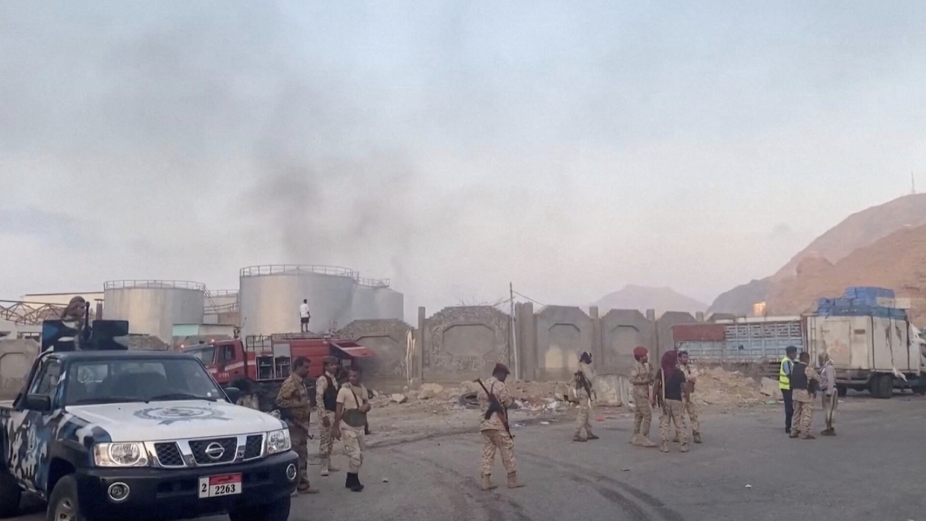
On December 30, 2025, the United Arab Emirates (UAE) announced it would withdraw its remaining military forces from Yemen. This announcement came hours after Saudi Arabia—a nominal partner of the UAE—bombed an Emirati weapons shipment in the Yemeni port city of Mukalla. This bombing was a response to recent territorial gains made by the UAE-backed Southern Transitional Council (STC), a separatist group calling for an autonomous South Yemen, which came at the expense of the Saudi-backed National Shield Forces (NSF) near the Yemen-Saudi border.
At the same time as the Mukalla bombing, NSF forces were rapidly pushing the STC back, regaining control of Hadramout and eventually, the southern capital city of Aden, which had previously been held by STC forces. The STC’s leader, Aidarous al-Zubaidi, then reportedly fled to the UAE. Shortly after this, the STC announced its dissolution. This was a complete reversal of its quick gains made only weeks earlier. After this announcement, protests broke out in Aden calling for an independent South Yemen. These events were the culmination of a long-simmering rivalry between the two Gulf States, once regarded as allies, now publicly feuding with each other.
The origin of this feud goes back to 2015, when Saudi Arabia and the UAE decided to jointly intervene in Yemen to restore President Abdrabbuh Mansur Hadi’s government after the Houthis seized the country’s capital, Sanaa, the year prior. Over time, their priorities in Yemen diverged, with the Saudis more focused on reducing their direct involvement and maintaining border stability, while the UAE put its backing behind the STC. In 2018, Saudi Arabia reached an agreement with the Houthis in an attempt to wind down its involvement in Yemen, and eventually folded the STC into the Yemeni government in 2020, seemingly solidifying the status quo until recently.
The most recent explosion of tensions in Yemen has broader implications for the region and beyond. While Saudi Arabia and the UAE have long been considered a close duo—cooperating in their intervention in Libya, blockading Qatar, and containing Iran—they are increasingly divided on their strategy and outlook for the future. The Saudis have been strengthening their relationships with Egypt and Turkey, as well as mending their relations with Qatar and working more closely with Oman. Meanwhile, the UAE has adopted an opposing strategy focused on controlling ports along the Red Sea and the Gulf of Aden through local allies and proxies. This is most noticeable in its support for the Rapid Support Forces (RSF) in Sudan’s Civil War. The RSF are in opposition to the Sudanese Armed Forces, a military group supported by Saudi Arabia.
The breakdown between Saudi Arabia and the UAE will have a significant effect on regional politics, especially regarding Israel. Israel’s increasing aggressiveness across the region since 2024 has affected how Saudi Arabia views regional dynamics, especially considering the 2020 Abraham Accords, which strengthened ties between Israel and the UAE. In December, the UAE was the only Arab League member not to condemn Israel’s recognition of Somaliland. These all signal a shift in the region, with the UAE and the local groups it funds aligning more with Israel, while Saudi Arabia grows closer to Egypt and Turkey and builds its relationships with Oman and Qatar. Going forward, these two opposing blocs will likely keep competing for influence in similar battleground countries, foreboding uncertain futures for those in Yemen and beyond.
This will likely change the nature of security and strategy in the Middle East, with the old paradigm of Saudi, UAE, and Israeli rivalry with Iran replaced by these two new opposing blocs competing for influence in the region and beyond. Domestically, both Saudi Arabia and the UAE have pursued large propaganda campaigns to portray the other as duplicitous to their citizens. The close business ties between Saudi Arabia and the UAE are also likely to be affected, especially as the two countries continue to compete for investment opportunities and tourism in their pursuit of development. This could hamper both countries’ attempts to diversify their economies and reduce dependencies on oil, including Saudi Arabia’s Vision 2030 and the UAE’s Abu Dhabi Economic Vision 2030. Oil itself is another important factor in this feud as both countries are major oil producers and members of OPEC, which pumps around half of the world’s oil. This feud could extend into OPEC’s decision-making on oil production, potentially causing volatility in oil prices, harming the entire world economy.
The hidden feud between the UAE and Saudi Arabia is starting to show some visible cracks. If their relationship gets increasingly antagonistic, it will affect the entire strategic make-up of the region, creating new competition among geopolitical blocs, as well as impacting both countries’ desire to be the regional hub for investment and innovation.