
Minnesota’s Cold War
A KILLING IN CONTEXT
Another killing by federal agents in Minneapolis, Minnesota has brought tensions in the city to a boiling point, as the Trump Administration’s Twin Cities deportation operation approaches its third month. Alexander Pretti, a 37-year old U.S. citizen, was shot dead at the hands of Border Patrol agents on January 24th. Prior to the shooting, Pretti, who had a handgun on his person but does not seem to have been holding it, had been filming the agents while supporting a person whom they had just shoved. Pretti was then tackled by multiple agents, one of whom stripped him of his handgun. Seconds later, agents stepped back and fired at least ten shots into Pretti’s prone body.
Pretti’s death is only the most recent in a string of shootings involving members of the Minneapolis deportation task force. Earlier this month, Renee Good, another 37-year old U.S. citizen, was shot and killed by Immigration and Customs Enforcement (ICE) officers while attempting to leave the scene of a traffic stop. Subsequently, local leaders claimed that Good had been acting as a legal observer at the time of the shooting. In a third incident, taking place between the two deadly shootings, federal agents reportedly shot and wounded Julio Cesar Sosa-Celis, a Venezuelan migrant who allegedly struck an ICE agent with a broomstick while trying to prevent another immigrant from being arrested.
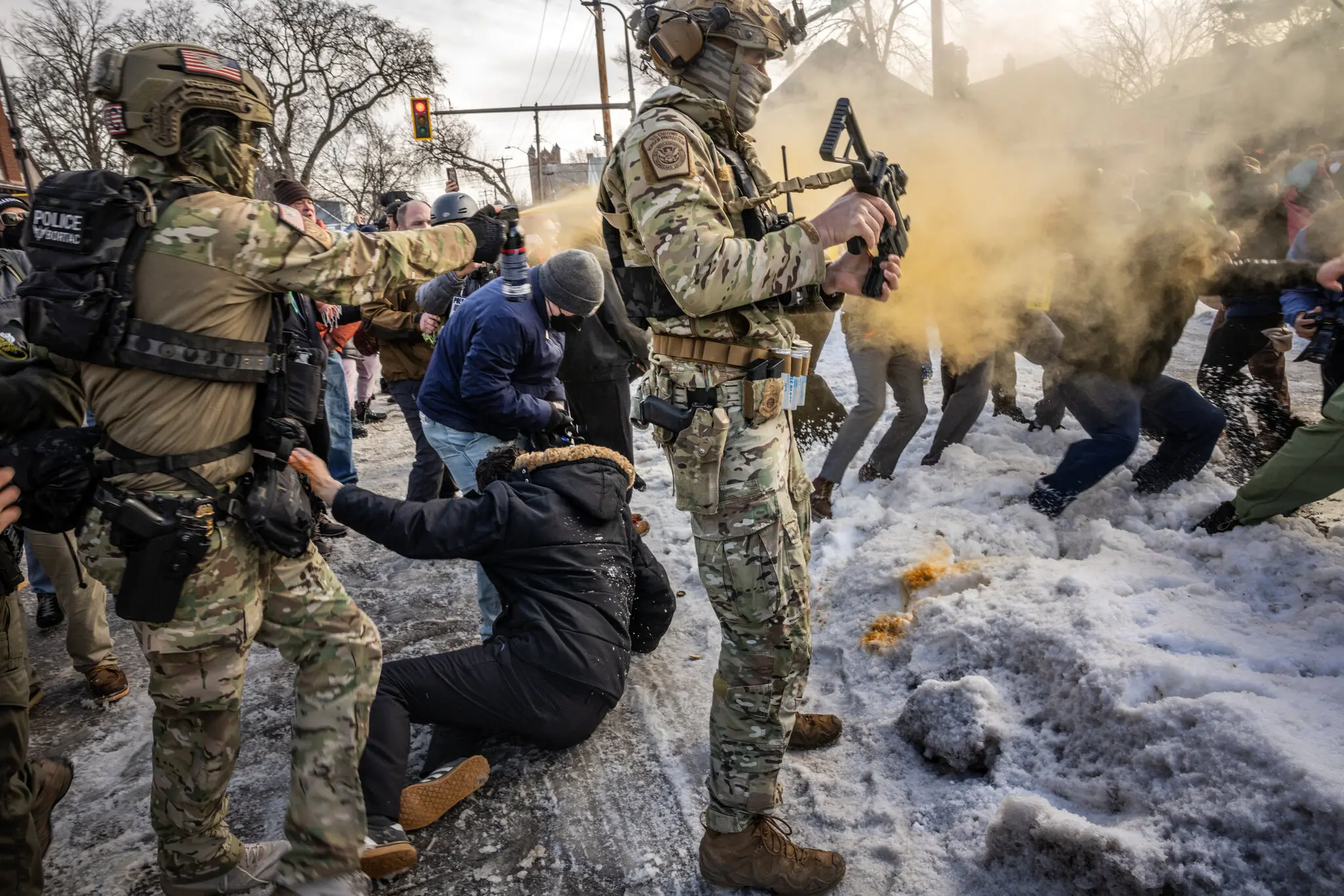
The shootings have added fuel to the pro-immigration protest movement in Minneapolis and elsewhere. For the past two months, pro-immigration demonstrators have squared off with federal police from Border Patrol, ICE, and other agencies as the agents seek to detain and deport immigrants living in the city. The deportation operations, collectively referred to by the Trump Administration as Metro Surge, were initially prompted by claims of welfare fraud involving Minnesota’s large Somali immigrant population, but have targeted immigrants of all backgrounds. Roughly 3,000 agents are involved in Metro Surge, which is concentrated in Minneapolis and its twin city St. Paul but also involves operations elsewhere in the state of Minnesota. Per back of the envelope math, the 3,000 federal agents outnumber local police in the Twin Cities by over a thousand officers, making Metro Surge the largest operation in Department of Homeland Security (DHS) history. According to DHS Secretary Kristi Noem, the operation has resulted in roughly 3,000 arrests over its six-week timespan.
Metro Surge has upended daily life for many in the Twin Cities. Fear of immigration operations has kept many children home from school. Following the appearance of Border Patrol agents at Minneapolis’ Roosevelt High School, where they detained several people and deployed chemical irritants against bystanders, classes throughout the school district were cancelled for the next several days and all students were offered the option to attend classes virtually until at least February 12th. Fear of immigration police has also kept many from seeking medical attention, according to some doctors. While specific numbers are hard to come by, it is widely understood that there are thousands of immigrants throughout the Twin Cities–both those who are undocumented and those with some form of legal status, such as those on parole prior to receiving an asylum decision–who spend nearly all of their time hiding in their places of residence, only emerging when they feel it is absolutely necessary.
Local activists have mobilized in response to Metro Surge. Volunteers have brought food to migrants too afraid to leave their residences and driven their children to school. Many people now blow whistles or set off their car alarms when they see immigration agents. Others have adopted a more confrontational approach. Some groups, using loose, largely anonymous networks organized on the telecommunications app Signal, have begun to actively seek out and follow federal agents in their vehicles, oftentimes honking their horns to alert others to the agents’ presence. Agents seeking to make immigration arrests have often found themselves facing large crowds of people that gather within minutes of the agents’ arrival. Much of the time, such crowds are mostly composed of people filming on their phones, shouting at the agents, and blowing whistles. Other times, crowds have grown more aggressive, pelting agents with snowballs, obstructing their ability to move, and attacking their vehicles. In at least one incident, demonstrators looted abandoned vehicles belonging to the deportation task force.
These tactics have been met with an escalating federal response. They have aggressively confronted the crowds that have so often gathered around them, both attacking them physically and deploying chemical irritants. They have shattered the windows of vehicles and arrested drivers that they suspect to be following them or blocking them in. Likely because following federal agents in public is generally legal, at least some of those arrested have been released without charge after spending hours in detention. At least twice, federal agents have attacked vehicles whose occupants claimed that they were merely traveling in the vicinity of a protest, rather than participating in it. In one of those instances, a six-month old baby was rendered unconscious by tear gas that the agents deployed, according to the child’s parents.
At the same time as they have escalated their tactics against demonstrators, federal agents have taken increasingly drastic measures to track down and arrest migrants. They have staked out food banks, searching both for migrants coming to pick up food and volunteers coming to pick up food on their behalf. In another incident, they reportedly detained several members of the Oglala Sioux tribe and, according to tribal leadership, attempted to use them as leverage to coerce the tribe into signing an immigration agreement with ICE.
DEMOCRATS SEEK TO AVOID CONFLAGRATION
Through it all, Minnesota’s elected officials, the majority of whom are Democrats, have largely walked a fine line. They have sought to both empathize with their constituents’ rage over the federal operation while also avoiding a repeat of the 2020 riots that shook the state following the murder of George Floyd, a Black man and Minneapolis native, at the hands of local police. The 2020 riots damaged or destroyed over 500 businesses in the Minneapolis/St. Paul area, resulting in over $500 million in damages, the majority of which were not covered by insurance. This time, any outbreak of rioting would invite an additional threat: President Trump has hinted that he might invoke the Insurrection Act to deploy active-duty military personnel into Minnesotan streets in response to any unrest.
Minnesotan political leaders are conscious of this threat. After Renee Good was killed, Minnesota’s most prominent Democrat, Governor and former Vice Presidential candidate Tim Walz, referred to Metro Surge as an “occupation” and encouraged Minnesotans to film federal officers in order to preserve “evidence for future prosecution.” However, he simultaneously prepared the Minnesota National Guard for deployment under state orders in case of unrest. Minneapolis Mayor Jacob Frey, a Democrat, has warned that Trump will use any disorder as an excuse to further the occupation of the city, repeatedly referring to acts of violence and disorder as “taking the bait.” Frey has also been stringent in his denunciations of the federal operation, calling justifications for Renee Good’s shooting “bullshit” and demanding that federal agents “get the fuck out of Minneapolis.” However, Frey and other local leaders have little to no ability to directly affect the activities of the federal government and federal agents in the short term, besides largely symbolic acts like banning them from using city parking lots.
Any attempts to hold federal agents accountable for alleged legal violations committed during Metro Surge would be complicated by the Supremacy Clause, a Constitutional provision aimed to prevent state interference in the enforcement of federal law. The Supremacy Clause prevents state-level officials from simply making it illegal for federal agents to make immigration arrests or operate in their state. Additionally, case law has long established that federal officials are immune from state prosecution if they are both acting in a capacity authorized by federal law and their actions are “necessary and proper” in performance of that capacity. While this does not completely preclude state-level prosecution of members of the Metro Surge task force, it likely ensures that any prosecution would be lengthy and challenging and thus unsuited for use as a short-term deterrent against federal agents.
Despite these barriers to the formal prosecution of federal agents, local and federal police have increasingly been on a collision course. Brian O’Hara, Minneapolis’ police chief, has largely matched the tone taken by Mayor Frey, who, alongside the city council, appointed him. While O’Hara has criticized federal agents on multiple occasions and encouraged lawful demonstrations, he has sought to contain any unrest originating from Minneapolis’ civilian population. Sometimes, this has resulted in Minneapolis police officers defending immigration agents from angry crowds. More often, however, video evidence seems to indicate the federal task force has been left on their own to handle demonstrators. This has not gone unnoticed, and federal officials from then-Border Patrol chief Gregory Bovino to President Trump have criticized the Minneapolis police for their perceived unwillingness to protect federal agents from violence.
With many avenues of direct confrontation with the federal government precluded by the Supremacy Clause, Minnesota Democrats and public officials seem to have settled on a strategy for combatting the federal deployment indirectly. This strategy has two main components. Firstly, in order to keep the rage of their constituents directed away from them, Minnesota officials, including law enforcement professionals like O’Hara, have sought to avoid association with immigration enforcement to the extent possible. Secondly, they have sought to prevent any serious incidents of violence, using rhetoric when possible and force when that fails. The rhetorical strategy includes both encouragement of peaceful and legal forms of protest and denunciations of illegal or violent kinds. Their willingness to use force encompasses both local police actions against demonstrators and Walz’s threatened deployment of the National Guard.
In addition to concerns about property damage, loss of life, and Trump’s threat to deploy troops under the Insurrection Act, there are other compelling reasons for Democrats to encourage demonstrations while seeking to prevent 2020-style riots. Firstly, a growing body of evidence suggests that, in many cases, nonviolent anti-government protest campaigns may have a higher likelihood of success than violent campaigns, even when the government that they are facing is willing to use violence. Part of the reason that this is the case may be that nonviolent movements outcompete violent ones in their capacity to mobilize mass support across social boundaries, possibly because there are fewer moral and practical barriers to entry. Many observers have noted that the Minneapolis protest movement has attracted solidarity from wide-ranging constituencies that cross racial lines, from longtime progressive activists to non-activists with little previous experience protesting. Another advantage of nonviolent mass movements is their ability to draw defections from state security forces. In contrast, violent demonstrations might foster a siege mentality and encourage security forces to band together for safety. While there is little evidence of mass defections from ICE, Border Patrol, and other federal agencies, there is evidence that the widespread perception of federal overreach has deepened divisions between local and federal police, as well as undermined morale among the Metro Surge task force.
In addition to believing in the comparative efficacy of nonviolent resistance, Democrats may also be seeking to position their party favorably in the lead-up to the 2026 midterm elections. Civil unrest could lend credence to President Trump’s frequent assertion that his opponents are violent enemies of America and direct attention away from perceived federal overreach and abuses, thus undermining the Democrats’ political position. Minnesota Democrats might hope that their federal colleagues, who are currently favored to win back at least the House of Representatives, might use their positions to cut funding to DHS or the individual federal law enforcement agencies involved in Metro Surge. While House Democrats, in the minority and hampered by seven defections, recently failed to block DHS funding, the department is widely unpopular within the Democratic caucus. In the recent vote, the vast majority of House Democrats voted against DHS funding. If the party were to increase its margins in the House, severe cuts to or a total end to funding for deportation operations is almost inevitable. Additionally, this current round of DHS funding faces a major hurdle in the Senate, where minority leader Chuck Schumer (D-NY) has threatened to block it. In order for the bill to receive the 60 votes necessary for it to avoid the filibuster, seven Democratic senators would need to vote in support of the measure. Significant unrest in Minneapolis could jeopardize Democrats’ ability or willingness to strike at the mass deportation effort, either by harming Democrats’ chances in the midterms or by decreasing skittish moderate senators’ resolve to vote down the DHS funding legislation.
Taken together, belief in the efficacy of nonviolent resistance and concern about threats to the party’s short-term political future provide compelling justifications for Minnesota Democrats to maintain their current strategy. However, as tensions in Minneapolis approach their breaking point, doing so may become increasingly difficult. Following the killing of Alexander Pretti by Border Patrol officers, the Minnesotan public and their officials have increasingly regarded Operation Metro Surge as an act of state-sanctioned terror and murder. According to Mayor Frey, video of the incident shows federal agents “pummeling one of our constituents and shooting him to death.” Governor Walz denounced Metro Surge as “a campaign of organised brutality against the people of our state.” Just before the shooting, Chief O’Hara and other local police officials held a press conference where they accused the federal task force of violating both professional policing standards and the U.S. Constitution. They also claimed that off-duty officers from their departments had been stopped by federal agents and asked to prove their U.S. citizenship. After Pretti’s shooting, O’Hara ordered Minneapolis police to remain on the scene of the shooting in order to preserve evidence even after federal agents ordered the police to leave. Governor Walz promised that Minnesota would launch an investigation into the shooting, and officers from Minnesota’s Bureau of Criminal Apprehension were ordered to the scene to begin collecting evidence. However, despite the fact that they had received a judicial search warrant for the crime scene, the state officers were blocked from accessing the scene by federal agents, a move that is nearly unprecedented in recent U.S. history.
It remains to be seen whether Democrats will continue to be able to keep the peace while encouraging protestors to keep the pressure on the deportation task force. In the hours after Pretti’s killing, Walz deployed 1,500 soldiers of the Minnesota National Guard at the request of local police in Minneapolis and the surrounding county. The soldiers were stationed around the scene of the shooting as well as at the Whipple Federal Courthouse, where federal detainees, including those arrested by immigration agents, are held. As of now, their interactions with the public seem to have been mostly cordial, with some soldiers handing out coffee and snacks to protestors. The Trump Administration has placed another 1,500 active-duty soldiers on alert to possibly deploy to Minnesota, but has not deployed them or invoked the Insurrection Act. So far, the same fragile peace that has prevailed in Minneapolis and throughout Minnesota for the past few months seems to be holding, with furious demonstrators mostly continuing to express their frustrations peacefully. At a recent press conference, Walz celebrated this achievement, directing his gloating towards President Trump:
"What's the plan, Donald Trump? What is the plan?...What do we need to do to get these federal agents out of our state? If fear, violence and chaos is what you wanted from us, then you clearly underestimated the people of this state and nation. We are tired, but we're resolved. We're peaceful, but we'll never forget. We're angry, but we won't give up hope. And above all else, we are clearly unified."