
Indictments for Former Prime Minister and President of South Korea
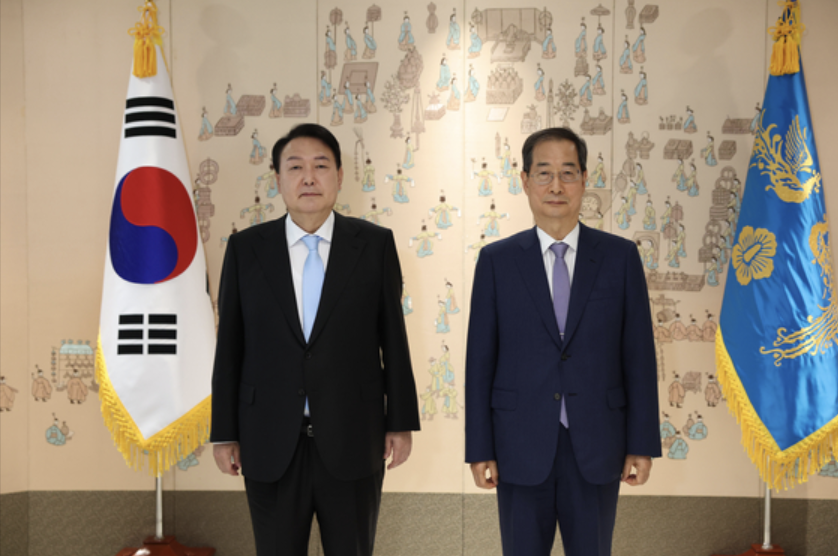
On January 21st, former South Korean Prime Minister Han Duk-soo was sentenced to 23 years in jail for his involvement in former President Yoon Seok-yeol's imposition of martial law on December 3rd, 2024. Han initially acted as president after Yoon was impeached, then Han was later impeached for refusing to fill vacant seats on the Constitutional Court, which oversaw Yoon’s impeachment trial. He was sentenced for assisting in the passage of the martial law decree by the Cabinet Council, lying under oath, and falsifying parts of a martial law document. Han is the first of Yoon's associates to be convicted of rebellion charges in relation to the decree. Other associates involved include former Defense Minister Kim Yong-hyun, Major General Kim Yong-dae, and Army Chief of Staff General Park An-su, who took on the role of Martial Law Commander.
Nine months since former South Korean President Yoon Seok-yeol was removed from office, Yoon faces eight trials for imposing martial law, which is considered to involve “anti-state activities.” In South Korea, rebellion is one of the most severe offenses due to its role in impacting overall stability. An independent counsel team led by prosecutor Cho Eun-seok is calling for Yoon to receive the death penalty based on rebellion charges. The death penalty has not been used in South Korea since 1997.
Former South Korean President Yoon Seok-yeol was able to impose martial law for six hours before lawmakers were able to gather and vote to end the decree. The National Assembly voted to impeach Yoon, with a majority of 204 of 300 officials. The investigation over the former leader’s intentions ended in December of 2025 and revealed that he had been planning to use martial law to eliminate political rivals and maintain power. By imposing martial law, Yoon attempted to “[restrict] the freedom of speech, publication, assembly and association,” and apply “special changes to the authority of governments or courts.” Yoon, currently in jail, has explained that the purpose of imposing martial law was to alert the public to opposition from the Democratic Party. He specifically cited their opposition as “legislative dictatorship,” based on 22 impeachment attempts since he took office in 2022, reductions in the government’s budget, and proceedings to impeach other officials. This raises the legal question of whether a president’s emergency powers are safe from being considered rebellion. Rebellion is defined in legal terms as an action undertaken with the intention of “overthrowing constitutional order or seizing national territory,” and is considered “a mens rea–driven crime.”
Yoon’s call for martial law evoked panic due to the historic use of martial law in South Korea in the 1970s and 1980s. Post-Korean War dictatorships imposed martial law against protesters and critics of the country’s leadership. The Gwangju Uprising, for example, is considered to be the largest massacre under the military dictatorship of Chun Doo-hwan, which lasted from 1979 to 1988. Chun was initially sentenced to death by the Seoul District Court in 1996 for treason, then imprisoned for life and later pardoned by former President Kim Young-sam as requested by the then President-elect Kim Dae-jung.
The former leader’s first trial covered charges relating to Yoon’s resistance to investigation and detainment, for which he was sentenced to five years in prison. The next trials will address charges regarding corruption, rebellion, and abusing power. Yoon is expected to be in a pretrial hearing over alleged interference in a Marine death probe on February 10th. Special counsel Lee Myeong-heon’s team claims that the former president “made unlawful orders to the defense ministry and the presidential office,” and indicted Yoon last year for other interference-related charges.