
Minnesota’s Cold War
A KILLING IN CONTEXT
Another killing by federal agents in Minneapolis, Minnesota has brought tensions in the city to a boiling point, as the Trump Administration’s Twin Cities deportation operation approaches its third month. Alexander Pretti, a 37-year old U.S. citizen, was shot dead at the hands of Border Patrol agents on January 24th. Prior to the shooting, Pretti, who had a handgun on his person but does not seem to have been holding it, had been filming the agents while supporting a person whom they had just shoved. Pretti was then tackled by multiple agents, one of whom stripped him of his handgun. Seconds later, agents stepped back and fired at least ten shots into Pretti’s prone body.
Pretti’s death is only the most recent in a string of shootings involving members of the Minneapolis deportation task force. Earlier this month, Renee Good, another 37-year old U.S. citizen, was shot and killed by Immigration and Customs Enforcement (ICE) officers while attempting to leave the scene of a traffic stop. Subsequently, local leaders claimed that Good had been acting as a legal observer at the time of the shooting. In a third incident, taking place between the two deadly shootings, federal agents reportedly shot and wounded Julio Cesar Sosa-Celis, a Venezuelan migrant who allegedly struck an ICE agent with a broomstick while trying to prevent another immigrant from being arrested.
The shootings have added fuel to the pro-immigration protest movement in Minneapolis and elsewhere. For the past two months, pro-immigration demonstrators have squared off with federal police from Border Patrol, ICE, and other agencies as the agents seek to detain and deport immigrants living in the city. The deportation operations, collectively referred to by the Trump Administration as Metro Surge, were initially prompted by claims of welfare fraud involving Minnesota’s large Somali immigrant population, but have targeted immigrants of all backgrounds. Roughly 3,000 agents are involved in Metro Surge, which is concentrated in Minneapolis and its twin city St. Paul but also involves operations elsewhere in the state of Minnesota. Per back of the envelope math, the 3,000 federal agents outnumber local police in the Twin Cities by over a thousand officers, making Metro Surge the largest operation in Department of Homeland Security (DHS) history. According to DHS Secretary Kristi Noem, the operation has resulted in roughly 3,000 arrests over its six-week timespan.
Metro Surge has upended daily life for many in the Twin Cities. Fear of immigration operations has kept many children home from school. Following the appearance of Border Patrol agents at Minneapolis’ Roosevelt High School, where they detained several people and deployed chemical irritants against bystanders, classes throughout the school district were cancelled for the next several days and all students were offered the option to attend classes virtually until at least February 12th. Fear of immigration police has also kept many from seeking medical attention, according to some doctors. While specific numbers are hard to come by, it is widely understood that there are thousands of immigrants throughout the Twin Cities–both those who are undocumented and those with some form of legal status, such as those on parole prior to receiving an asylum decision–who spend nearly all of their time hiding in their places of residence, only emerging when they feel it is absolutely necessary.
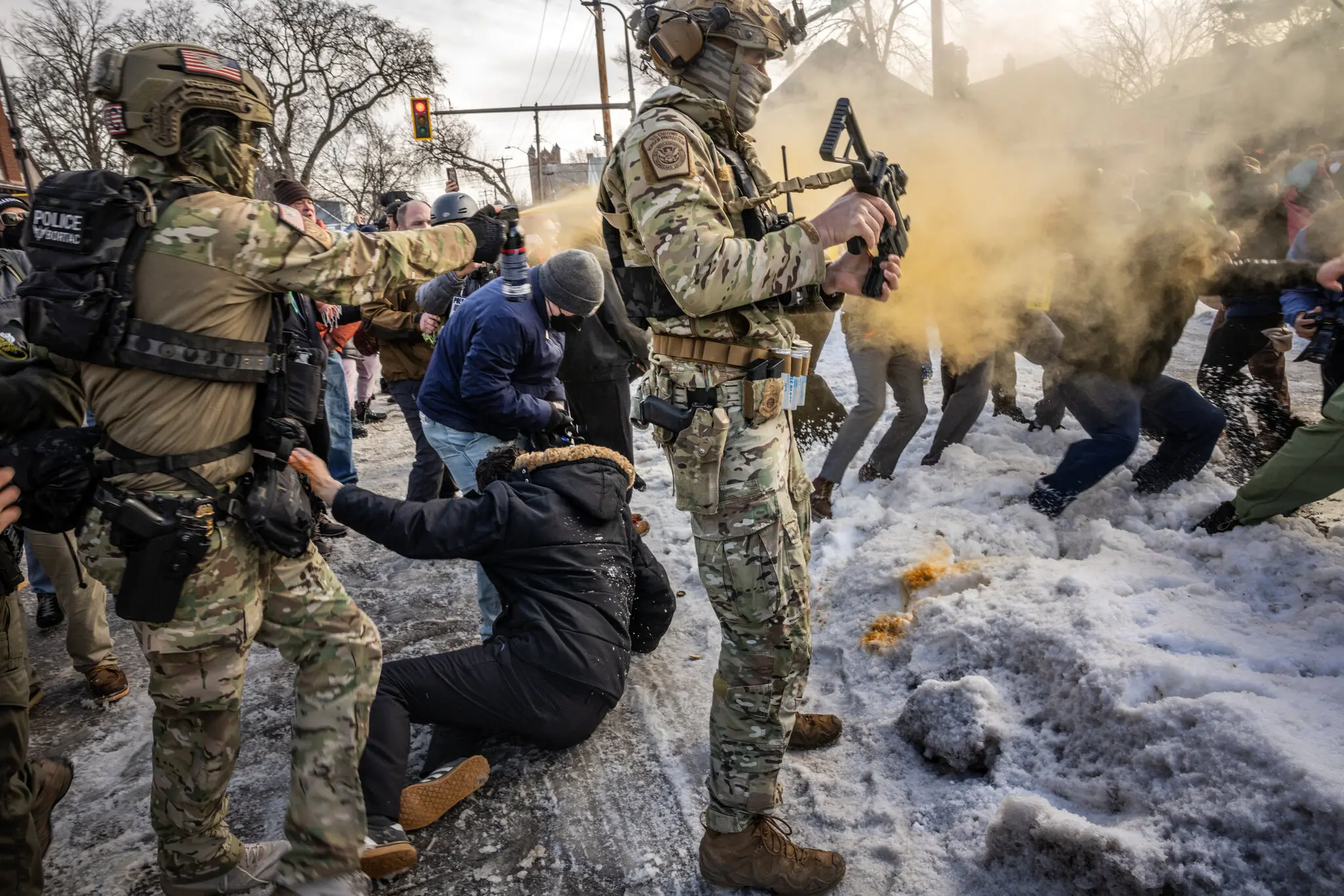
Local activists have mobilized in response to Metro Surge. Volunteers have brought food to migrants too afraid to leave their residences and driven their children to school. Many people now blow whistles or set off their car alarms when they see immigration agents. Others have adopted a more confrontational approach. Some groups, using loose, largely anonymous networks organized on the telecommunications app Signal, have begun to actively seek out and follow federal agents in their vehicles, oftentimes honking their horns to alert others to the agents’ presence. Agents seeking to make immigration arrests have often found themselves facing large crowds of people that gather within minutes of the agents’ arrival. Much of the time, such crowds are mostly composed of people filming on their phones, shouting at the agents, and blowing whistles. Other times, crowds have grown more aggressive, pelting agents with snowballs, obstructing their ability to move, and attacking their vehicles. In at least one incident, demonstrators looted abandoned vehicles belonging to the deportation task force.
These tactics have been met with an escalating federal response. They have aggressively confronted the crowds that have so often gathered around them, both attacking them physically and deploying chemical irritants. They have shattered the windows of vehicles and arrested drivers that they suspect to be following them or blocking them in. Likely because following federal agents in public is generally legal, at least some of those arrested have been released without charge after spending hours in detention. At least twice, federal agents have attacked vehicles whose occupants claimed that they were merely traveling in the vicinity of a protest, rather than participating in it. In one of those instances, a six-month old baby was rendered unconscious by tear gas that the agents deployed, according to the child’s parents.
At the same time as they have escalated their tactics against demonstrators, federal agents have taken increasingly drastic measures to track down and arrest migrants. They have staked out food banks, searching both for migrants coming to pick up food and volunteers coming to pick up food on their behalf. In another incident, they reportedly detained several members of the Oglala Sioux tribe and, according to tribal leadership, attempted to use them as leverage to coerce the tribe into signing an immigration agreement with ICE.
DEMOCRATS SEEK TO AVOID CONFLAGRATION
Through it all, Minnesota’s elected officials, the majority of whom are Democrats, have largely walked a fine line. They have sought to both empathize with their constituents’ rage over the federal operation while also avoiding a repeat of the 2020 riots that shook the state following the murder of George Floyd, a Black man and Minneapolis native, at the hands of local police. The 2020 riots damaged or destroyed over 500 businesses in the Minneapolis/St. Paul area, resulting in over $500 million in damages, the majority of which were not covered by insurance. This time, any outbreak of rioting would invite an additional threat: President Trump has hinted that he might invoke the Insurrection Act to deploy active-duty military personnel into Minnesotan streets in response to any unrest.
Minnesotan political leaders are conscious of this threat. After Renee Good was killed, Minnesota’s most prominent Democrat, Governor and former Vice Presidential candidate Tim Walz, referred to Metro Surge as an “occupation” and encouraged Minnesotans to film federal officers in order to preserve “evidence for future prosecution.” However, he simultaneously prepared the Minnesota National Guard for deployment under state orders in case of unrest. Minneapolis Mayor Jacob Frey, a Democrat, has warned that Trump will use any disorder as an excuse to further the occupation of the city, repeatedly referring to acts of violence and disorder as “taking the bait.” Frey has also been stringent in his denunciations of the federal operation, calling justifications for Renee Good’s shooting “bullshit” and demanding that federal agents “get the fuck out of Minneapolis.” However, Frey and other local leaders have little to no ability to directly affect the activities of the federal government and federal agents in the short term, besides largely symbolic acts like banning them from using city parking lots.
Any attempts to hold federal agents accountable for alleged legal violations committed during Metro Surge would be complicated by the Supremacy Clause, a Constitutional provision aimed to prevent state interference in the enforcement of federal law. The Supremacy Clause prevents state-level officials from simply making it illegal for federal agents to make immigration arrests or operate in their state. Additionally, case law has long established that federal officials are immune from state prosecution if they are both acting in a capacity authorized by federal law and their actions are “necessary and proper” in performance of that capacity. While this does not completely preclude state-level prosecution of members of the Metro Surge task force, it likely ensures that any prosecution would be lengthy and challenging and thus unsuited for use as a short-term deterrent against federal agents.
Despite these barriers to the formal prosecution of federal agents, local and federal police have increasingly been on a collision course. Brian O’Hara, Minneapolis’ police chief, has largely matched the tone taken by Mayor Frey, who, alongside the city council, appointed him. While O’Hara has criticized federal agents on multiple occasions and encouraged lawful demonstrations, he has sought to contain any unrest originating from Minneapolis’ civilian population. Sometimes, this has resulted in Minneapolis police officers defending immigration agents from angry crowds. More often, however, video evidence seems to indicate the federal task force has been left on their own to handle demonstrators. This has not gone unnoticed, and federal officials from then-Border Patrol chief Gregory Bovino to President Trump have criticized the Minneapolis police for their perceived unwillingness to protect federal agents from violence.
With many avenues of direct confrontation with the federal government precluded by the Supremacy Clause, Minnesota Democrats and public officials seem to have settled on a strategy for combatting the federal deployment indirectly. This strategy has two main components. Firstly, in order to keep the rage of their constituents directed away from them, Minnesota officials, including law enforcement professionals like O’Hara, have sought to avoid association with immigration enforcement to the extent possible. Secondly, they have sought to prevent any serious incidents of violence, using rhetoric when possible and force when that fails. The rhetorical strategy includes both encouragement of peaceful and legal forms of protest and denunciations of illegal or violent kinds. Their willingness to use force encompasses both local police actions against demonstrators and Walz’s threatened deployment of the National Guard.
In addition to concerns about property damage, loss of life, and Trump’s threat to deploy troops under the Insurrection Act, there are other compelling reasons for Democrats to encourage demonstrations while seeking to prevent 2020-style riots. Firstly, a growing body of evidence suggests that, in many cases, nonviolent anti-government protest campaigns may have a higher likelihood of success than violent campaigns, even when the government that they are facing is willing to use violence. Part of the reason that this is the case may be that nonviolent movements outcompete violent ones in their capacity to mobilize mass support across social boundaries, possibly because there are fewer moral and practical barriers to entry. Many observers have noted that the Minneapolis protest movement has attracted solidarity from wide-ranging constituencies that cross racial lines, from longtime progressive activists to non-activists with little previous experience protesting. Another advantage of nonviolent mass movements is their ability to draw defections from state security forces. In contrast, violent demonstrations might foster a siege mentality and encourage security forces to band together for safety. While there is little evidence of mass defections from ICE, Border Patrol, and other federal agencies, there is evidence that the widespread perception of federal overreach has deepened divisions between local and federal police, as well as undermined morale among the Metro Surge task force.
In addition to believing in the comparative efficacy of nonviolent resistance, Democrats may also be seeking to position their party favorably in the lead-up to the 2026 midterm elections. Civil unrest could lend credence to President Trump’s frequent assertion that his opponents are violent enemies of America and direct attention away from perceived federal overreach and abuses, thus undermining the Democrats’ political position. Minnesota Democrats might hope that their federal colleagues, who are currently favored to win back at least the House of Representatives, might use their positions to cut funding to DHS or the individual federal law enforcement agencies involved in Metro Surge. While House Democrats, in the minority and hampered by seven defections, recently failed to block DHS funding, the department is widely unpopular within the Democratic caucus. In the recent vote, the vast majority of House Democrats voted against DHS funding. If the party were to increase its margins in the House, severe cuts to or a total end to funding for deportation operations is almost inevitable. Additionally, this current round of DHS funding faces a major hurdle in the Senate, where minority leader Chuck Schumer (D-NY) has threatened to block it. In order for the bill to receive the 60 votes necessary for it to avoid the filibuster, seven Democratic senators would need to vote in support of the measure. Significant unrest in Minneapolis could jeopardize Democrats’ ability or willingness to strike at the mass deportation effort, either by harming Democrats’ chances in the midterms or by decreasing skittish moderate senators’ resolve to vote down the DHS funding legislation.
Taken together, belief in the efficacy of nonviolent resistance and concern about threats to the party’s short-term political future provide compelling justifications for Minnesota Democrats to maintain their current strategy. However, as tensions in Minneapolis approach their breaking point, doing so may become increasingly difficult. Following the killing of Alexander Pretti by Border Patrol officers, the Minnesotan public and their officials have increasingly regarded Operation Metro Surge as an act of state-sanctioned terror and murder. According to Mayor Frey, video of the incident shows federal agents “pummeling one of our constituents and shooting him to death.” Governor Walz denounced Metro Surge as “a campaign of organised brutality against the people of our state.” Just before the shooting, Chief O’Hara and other local police officials held a press conference where they accused the federal task force of violating both professional policing standards and the U.S. Constitution. They also claimed that off-duty officers from their departments had been stopped by federal agents and asked to prove their U.S. citizenship. After Pretti’s shooting, O’Hara ordered Minneapolis police to remain on the scene of the shooting in order to preserve evidence even after federal agents ordered the police to leave. Governor Walz promised that Minnesota would launch an investigation into the shooting, and officers from Minnesota’s Bureau of Criminal Apprehension were ordered to the scene to begin collecting evidence. However, despite the fact that they had received a judicial search warrant for the crime scene, the state officers were blocked from accessing the scene by federal agents, a move that is nearly unprecedented in recent U.S. history.
It remains to be seen whether Democrats will continue to be able to keep the peace while encouraging protestors to keep the pressure on the deportation task force. In the hours after Pretti’s killing, Walz deployed 1,500 soldiers of the Minnesota National Guard at the request of local police in Minneapolis and the surrounding county. The soldiers were stationed around the scene of the shooting as well as at the Whipple Federal Courthouse, where federal detainees, including those arrested by immigration agents, are held. As of now, their interactions with the public seem to have been mostly cordial, with some soldiers handing out coffee and snacks to protestors. The Trump Administration has placed another 1,500 active-duty soldiers on alert to possibly deploy to Minnesota, but has not deployed them or invoked the Insurrection Act. So far, the same fragile peace that has prevailed in Minneapolis and throughout Minnesota for the past few months seems to be holding, with furious demonstrators mostly continuing to express their frustrations peacefully. At a recent press conference, Walz celebrated this achievement, directing his gloating towards President Trump:
"What's the plan, Donald Trump? What is the plan?...What do we need to do to get these federal agents out of our state? If fear, violence and chaos is what you wanted from us, then you clearly underestimated the people of this state and nation. We are tired, but we're resolved. We're peaceful, but we'll never forget. We're angry, but we won't give up hope. And above all else, we are clearly unified."

Judge Bars Abrupt Deportation of Guatemalan Children

The Globe and Mail - Moises Castillo/The Associated Press
On August 31st, District Court Judge Sparkle Sooknanan issued a temporary restraining order blocking the deportation of 10 Guatemalan migrant children back to their country of origin. The National Immigration Law Center filed the case L.G.M.L. v. Noem, arguing that the deportation of the children, all of whom are between the ages of 10 and 17, violates protections under the Trafficking Victims Protection Reauthorization Act (TVPRA) and the right to due process. The center issued a statement explaining that the case does not fall under the “limited circumstances” for expedited removal. The case brings a delicate issue forward that involves migration law and concerns for children’s mental and emotional well-being.
Sooknanan’s decision extends to around 600 other Guatemalan children who are detained and have been identified for deportation. Becky Wolozin, senior attorney at the National Center for Youth Law (NCYL), explained that there was little to no “advance notice that this was happening,” and that the children were deported without their cases being heard in court, in violation of the proper procedure for deporting minors.
Guatemalan President Bernardo Arévalo and lawyers from the U.S. Justice Department claimed that the children were being sent to reunite with their families. Concerned families waited at a reception centre for returned migrants, only to be told that the children would not be coming home as planned. The children are currently being held in the Office of Refugee Resettlement’s (ORR) custody. The ORR is responsible for holding and caring for minors apprehended by agencies like ICE.
The experience of relocating to a different country and then suddenly being removed could have a significant psychological and material impact on the children involved in the case, especially given their age group. The children who arrived in the US alone experienced the emotional strain of being separated from their families and being under federal care in a foreign country. Research shows that sudden separation from family increases the risk of developing chronic mental health conditions and negatively impacts overall development. Being sheltered by the ORR may already be overwhelming for the children to acclimate to in a different country. The additional stress of experiencing sudden deportation, without warning or preparation, would inflict lasting trauma on children of a young age.
Furthermore, the lawsuit claims that if returned to Guatemala, the children would “face abuse, neglect, persecution, or torture.” The children represented by the National Immigration Law Center expressed that they wish to stay in the United States, due to unsafe conditions in Guatemala and neglectful and abusive treatment from their families. According to the lawsuit's argument, the children would be at risk of serious human rights abuses. The NILC also states that the children’s deportation would violate the government’s legal responsibility to protect minors from mistreatment or trafficking and the due process clause of the Fifth Amendment.
Senior NCYL attorney Wolozin goes on to say that, "The government is trying to spin this as child protection, but it's not, it's child abuse. It wasn't orderly; it skipped all of the procedural protections." On the other hand, the Trump Administration still holds firm to its claim that deportation is important for family reunification. As White House Deputy Chief of Staff and advisor on immigration, Stephen Miller stated, “a Democrat judge is refusing to let them reunify with their parents.”
The arguments for L.G.M.L. v. Noem reflect conflict between the prioritization of family reunification for the Guatemalan children and providing legal protections and due process in immigration cases. The developments following the temporary ban on their deportation may have consequences for future immigration cases that have to do with legal protections for minors.

Macron’s Meeting With Trump

Despite myriad disagreements between U.S. President Donald Trump and French President Emmanuel Macron over the years, the two politicians put their differences aside at a recent White House meeting in February–an encounter which France24 called a “bromance.”
While Trump is a far-right populist and Macron is more center-left, the two might not have much to agree on. Yet over their respective two presidential terms, Trump and Macron have mastered this form of friendly diplomacy, getting along well while also remaining firm in their beliefs and agendas.
For instance, rather than getting upset at Macron for speaking in French at the White House– as happened previously at the Eiffel Tower– Trump cut him off with a compliment and a firm pat on the thigh, stating: “That is the most beautiful language.”
Piers Morgan, a British broadcaster and longtime friend of Trump, insists Macron is skilled at dealing with Trump. “No world leader handles Trump as well as Macron. Friendly but firm, respectful but not afraid to stand up to him when he thinks he’s wrong. And Trump respects him for it.”
During their meeting Trump and Macron agreed on a few important points, with Trump even stating that Putin would support European peacekeeping forces entering Ukraine once the war is over–a claim that the Kremlin has since denied. Anticipating pushback, Macron prefaced that these forces “would not be along the frontlines. They would not be part of any conflict. They would be there to ensure that the peace is respected.”
Although Trump’s talk with Macron went well, there was no such “bromance” between Trump and Ukrainian president Volodymyr Zelenskyy when the two met on February 28. Trump said one thing with Macron and another with Zelenskyy, demonstrating his lack of commitment to diplomacy and how easily he can be swayed by politicians he gets along with. After being berated by Trump and vice president JD Vance, Zelenskyy walked out of the meeting leaving the US-Ukraine minerals deal unsigned.
Was the groundwork Macron laid regarding Ukraine all in vain? Trump may have ruined his chances with Ukraine by disrespecting Zelenskyy and not taking the suffering and demands of his people seriously.
Given Trump’s unreliable diplomacy, even his relationship with Macron is not always smooth. This is clearly illustrated in Macron’s exclusion from Trump’s inauguration. Instead, fringe far-right French politician Éric Zemmour attended, and not even Marine Le Pen– the more established right-wing politician who finished in second place in the 2022 French presidential election– was invited.
While Trump has recognized that the conflict must end before it escalates into a Third World War, he felt that a possible solution could include Ukraine surrendering territory to Russia. However, Macron stressed the need for a strong peace agreement and underlined that a good solution would not include the capitulation of Ukraine.
With the United States announcing on March 3 that it will suspend military aid to Ukraine, only time will tell whether Macron’s strategy with Trump worked. Those on the left are horrified at the consequences this change of policy may have. Senator Jeanne Shaheen (D-NH) of the Senate Foreign Relations Committee insisted that in “freezing military aid to Ukraine, President Trump has kicked the door wide open for Putin to escalate his violent aggression against innocent Ukraine.”
Much of Europe shares this anxiety, including Macron’s close ally François Bayrou, France’s prime minister since December who stated “If Russia stops fighting, the war stops. If Ukraine stops fighting, Ukraine disappears.”
While Bayrou has been clear of his disdain for Trump and his politics with Ukraine, Macron took a more restrained response to American military aid suspension: “The United States, our ally, has changed its position on this war, is less supportive of Ukraine and is casting doubt on what will happen next… I want to believe that the United States will remain by our side, but we need to be ready if that were not the case.”
While the relationship might not be strong enough to be labeled a “bromance,” Macron has affirmed his commitment to supporting the American president and his dedication to Franco-American relations.
However, as the situation in Ukraine unfolds–especially after the halting of American military aid–the world will watch for the fate of the Ukrainian people and the response of Europe’s leaders in light of the president’s withdrawal.

NATO Confirms Assassination Plot on CEO of German Defence Firm Rheinmetall

Ina Fassbender/AFP via Getty Images
On January 28, 2025, NATO Deputy Assistant Secretary-General James Appathurai confirmed that Russian operatives plotted to assassinate Armin Papperger, CEO of German defence firm Rheinmetall. This revelation was made during a European Parliament committee meeting on hybrid warfare, where Apparthurai detailed Moscow’s ongoing covert operations targeting Western defence infrastructure. The plot against Papperger was part of a broader campaign of sabotage and political destabilisation across NATO member states. Rheinmetall and Russia have declined to comment on the confirmation.
NATO officials have linked the assassination attempt to a series of recent Russian hybrid attacks, including arson, train derailments, and acts of political intimidation across Europe. Rheinmetall, Germany’s largest arms manufacturer, is a likely focus of Russian espionage and sabotage efforts against European defence, especially as the company announced plans to ramp up production by building a tank factory in Ukraine.
NATO’s confirmation of the assassination plot emphasises the escalating hybrid warfare tactics used by Russia, reflecting Moscow’s belief that they are at war with the entire West. Western intelligence agencies have expressed alarm over the increased danger of Russian activities. These “grey zone” attacks aim to spread chaos among Ukraine’s partners, disrupt military supplies to Kyiv, and widen societal divisions.
Ultimately, this development highlights the need for NATO and its allies to strengthen their defences against hybrid threats and other similar covert operations. Through its use of hybrid tactics, Russia is able to harm the alliance without triggering Article V of the North Atlantic Treaty, which states that an armed attack on one state is an attack on all NATO states. In this case, Russia’s attack on important public figures illustrates that their efforts to destabilize NATO states aren’t limited to political attacks. As the United States and Russia discuss an end to the war in Ukraine, it remains to be seen how Russia interacts with their Western neighbors. Looking to the days ahead, the alliance is expected to agree on a strategy for tackling the hybrid threats by the summer, with the hopes of deterring further acts of sabotage and protecting key industry leaders essential to Europe’s security infrastructure. Given Trump’s shift away from the alliance, however, we could expect a sooner response, especially if Russia continues to escalate their attacks.

Retribution Returns to Washington

Enrique Tarrio and other Proud Boys gather in Washington D.C. in December 2020. Tarrio, whose sentence was commuted by Trump, had been sentenced to 22 years in prison on seditious conspiracy charges related to the January 6th Capitol attack. Victor J. Blue for the New York Times
During the 2023 Conservative Political Action Conference (CPAC), Donald Trump made a promise to his supporters: “I am your justice…I am your retribution.” At that time, Trump and his political movement were in exile, having made a disgraceful exit after an election loss that many of them believed had been caused by a nebulous “deep state” embedded inside the federal government. Now, Trump and his movement have returned to the halls of power, bringing justice for their friends and retribution for their enemies in equal measure.
Soon after the inauguration, before cheering crowds at the Capital One arena, Trump signed his first wave of executive orders, presidential pardons, and commutations. The initial pardons and commutations went to over 1500 participants in the January 6th Capitol riot, including rioters convicted of violent felonies and militia leaders convicted of seditious conspiracy. Four days later, Trump pardoned 23 anti-abortion activists who had blocked the entrance of an abortion clinic and accosted patients and staff. The message was clear: in Trump’s America, the legal system, once the bane of his most radical supporters, will no longer restrict their activities. Former Proud Boys leader Enrique Tarrio, fresh out of prison, echoed the sentiment: “Now it’s our turn.”
Trump has also sought to render the federal government more pliable to his wishes. During his first term, a group of officials colloquially known as the “adults in the room” often tried to restrain what they saw as Trump’s worst impulses. Trump’s first executive actions seek to exact revenge against these and other former officials, and to prevent the rise of any successor movement by installing loyal functionaries throughout the federal bureaucracy. Trump has reinstated Schedule F, a classification developed at the end of his first term that makes it easier to fire certain kinds of federal employees and replace them with political appointees. Additionally, Trump has begun directly removing officials who he believes may exhibit an ideological bias against him or otherwise hinder his agenda, including Coast Guard commandant Admiral Linda Fagan, 17 inspectors general, and several high-level Justice Department officials. Trump’s efforts thus far have seemingly found success; as of yet, there is no talk of resistance from within the federal ranks.
Trump’s animus is not limited to individuals currently serving in the government. Trump removed federal security protection from at least four former officials who served in his previous administration: former CDC director Dr. Anthony Fauci, former Secretary of State Mike Pompeo, former National Security Advisor John Bolton, and former Iran envoy Brian Hook. This comes despite evidence that Bolton, Pompeo, and Hook have been targeted for assassination by Iran. Additionally, Trump has stripped security clearances from dozens of former intelligence officials, including three ex-CIA directors, who signed an open letter warning that the Hunter Biden laptop story might be Russian disinformation.
Less than a week into his presidency, Trump has already made an indelible mark. Enemies beware as a new elite, armed with the full power of the American state, pursues justice and retribution with vindictive urgency.

Trump’s Day One Executive Orders on Immigration

Trump signs a series of executive orders. Avery Lotz, Axios
Within hours of taking office, President Donald Trump has signed 26 executive orders into existence, the largest number to be signed on a president’s Inauguration Day ever. Not only have these orders rescinded 78 previously implemented orders by the Biden administration, but they also have far-ranging effects, impacting an assortment of areas including foreign policy, social programs, immigration, the environment and energy, and criminal justice.
Of these executive orders, eight are focused on immigration rights, refugee laws, and the situation along the US-Mexico border. Chief among these was his move to declare the crisis at the border a national emergency, allowing Trump to swiftly and easily redirect funds and deploy military troops into the area. To give this additional support, he also passed a second order “clarifying the military’s role” in national security, referring specifically and repeatedly to the borders and the military’s role in guarding against an invasion. In doing so, he grants the Secretary of Defense the power to mobilize thousands of troops to send to the border.
In addition to executive orders focused on the southern border, Trump also passed an order regarding “protection from foreign terrorists,” introducing new criteria for screening across agencies for those trying to enter the country. Some of these new criteria include being screened to the “maximum degree,” requiring immense background information and identification requirements that many immigrants can’t provide.
Of the other five orders, three speak specifically on guarding against invasions, with one stating that Homeland Security Task Forces will be deployed in all states, and another saying entry immigration into the US has been halted until further notice. The third suspends the United States Refugee Admission Program (USRAP), eliminating the pathway for refugees to enter the country. Finally, a fourth ends birthright citizenship, meaning that even though someone might be born in the United States, that does not automatically make them a US citizen.
Along with all these executive orders, Trump also promised numerous times throughout his campaign to begin a “mass deportation” campaign targeting 1.4 million illegal immigrants in the U.S.. Local police and departments across the country have pushed back on these orders, saying they will not engage in harsh deportation raids. Yet when comparing the number of ICE arrests made over the past couple of months (283 in September 2024 versus 500 within Trump’s first three days in office), it appears that Trump’s plan is already in full swing.
Worries remain high across the country surrounding these immigration orders, especially within families with children in school after Trump overturned the 2011 policy banning immigration arrests at schools. In cities such as Chicago, previously busy areas have significantly dropped in foot traffic, and general sentiment throughout the streets has shifted remarkably. Despite Trump’s short time in office, the effects of his actions have reverberated throughout the country, and his administration has made one thing clear: this is only the beginning.

The Tech Oligarchy: Cut a Check and Watch Trumpian Policy Bend to You

Photo taken by Julia Demaree Nikhinson | Credit: AP News
Following former President Biden’s warning of the rise of the tech billionaire oligarchy in his farewell speech, the second inauguration of President Trump confirmed the reality that the wealthy tech elite hold immense power over US politics. While the ultra-wealthy have long held significant influence in the political sphere, the blatant display of President Trump’s priorities was rather jarring.
Traditionally, the seats closest to the president are held for guests of honor or family of the president. This year, the prestigious spots were taken by an impressive lineup of CEOs, including Meta CEO Mark Zuckerberg, Amazon CEO Jeff Bezos, Google CEO Sundar Pichai, and of course, SpaceX and Tesla CEO Elon Musk.
Trump’s administration is clearly operating under a “pay to win” ideology. Meta, Google, Microsoft, OpenAI and Amazon all donated $1 million each to the inauguration fund. Elon Musk spent $277 million backing the campaigns of Trump and other Republicans. As the world’s wealthiest man, and the newly announced head of the Department of Government Efficiency (DOGE), Musk’s investment into the Trump administration lacks any subtlety.
In the flurry of executive orders signed by Trump and other actions taken in his first few days back in office, a notable and unsurprising pattern has emerged across the various policy decisions: profit for corporations over the public interest.
With a whole slew of actions taken since his inauguration as evidence of his willingness to cater to corporations, it’s clear that the entanglement of Trump and the tech industry is one of the most prominent relationships setting the tone for the next four years. The ordeal regarding the TikTok ban, which was upheld by the Supreme Court and later paused by Trump’s executive order, seems to be a political theatre-esque ploy to gain support from younger generations by painting Trump as the savior of TikTok. When users were kicked off during the app’s blackout, they were met with a message of hope in President Trump: “A law banning TikTok has been enacted in the U.S. Unfortunately, that means you can't use TikTok for now. We are fortunate that President Trump has indicated that he will work with us on a solution to reinstate TikTok once he takes office.” After TikTok was put back online for US servers, users were then greeted with another Trump-praising pop-up message, “As a result of President Trump's efforts, TikTok is back in the U.S.”
Post-blackout, some users suspect that TikTok’s algorithm has undergone changes in favor of pro-Trump content. While data privacy is problematic and serves as a valid source of scrutiny against TikTok, a digital platform independent of and decentralized from the US government presents the ability to share unsuppressed criticism of US politics and the dissemination of a vast variety of political perspectives outside the mainstream media. Without space to explore an assortment of viewpoints and interact with diverse creators, unregulated or intentionally structured algorithms can promote biased content, push political narratives and agendas, and garner massive support from unparalleled exposure.
It seems TikTok has now conformed to the practice of flattering Trump in pursuit of its own self-interest, mirroring the rest of the social media and tech industry. With the fall of fact-checking and content moderation on Meta platforms, Twitter’s backslide into chaos under Musk, coupled with TikTok’s newfound affinity for President Trump, he has arguably monopolized influence over social media. While there are alternative platforms emerging, such as Bluesky, Twitter’s biggest counterpart and competitor, they lack the seniority and social establishment that Meta platforms hold from years of user engagement. Exemplifying the networking effect, the value of Twitter currently still outweighs that of Bluesky, as the majority of users have yet to migrate from Twitter to competitors. However, Bluesky did recently hit 27 million users, and Twitter is indeed experiencing a mass exodus— so perhaps the tide will turn as word of the Twitter alternative spreads.
The rich have pulled strings behind politics for decades, but the nature and unique power held by social media giants is cause for major concern. Controlling the narrative on political topics and suppressing opposing viewpoints can manipulate users to shift their opinions or prohibit them from discovering new ones. The power of the algorithm is the supreme influence over what content people are exposed to; by pushing individually specified content, the potential for creating echo chambers is quite high.
In response to the immense power Big Tech holds over US political processes, tech reform advocacy organizations have called for concrete policy solutions, in particular updating “the law that created the internet”: Section 230. Enacted by Congress in 1996, it protects social media and tech companies from being held liable for user posts on their platforms, while simultaneously giving them free reign over their content moderation. Initially intended to protect platforms and websites from legal risk by allowing them to host user forums and discussions without fear of liability, Section 230 gives far too much unregulated power to platforms acting out of political interest and profit. A high standard of regulation, fact-checking, and transparency is necessary to mitigate rampant political corruption. The rise of Big Tech’s influence in US politics cannot be ignored, and must be addressed as soon as possible.

Canada’s Political Crisis: What Happened and What’s Next?

Trudeau in his resignation speech. Sean Kilpatrick, The Canadian Press
On January 6, Canadian Prime Minister Justin Trudeau announced his intention to resign, as both Prime Minister and leader of the country’s Liberal Party, after his party selects his successor. Trudeau, who had previously balked at calls for resignation, eventually succumbed to mounting pressure from Liberal Members of Parliament, tanking numbers in opinion polls, and resignations of high-level officials.
The resignation of the PM’s former ally Chrystia Freeland, the deputy prime minister and head of finance, over concerns regarding U.S. President Donald Trump’s planned imposition of tariffs, signaled the growing internal resentment among the party. Beyond that, in response to the country’s cost of living crisis, Trudeau’s approval ratings have tanked and Liberal MPs have increasingly called upon him to step down, to best position the party for the elections scheduled later this year. Parliamentary members in the opposition parties have also indicated that they would move for a vote of no-confidence upon Parliament’s return in late January. A move which, if successful, could have triggered federal elections at a time when the Conservative Party, led by Pierre Poilievre, had a demanding lead in polls.
In his resignation speech, Trudeau cited struggles with internal cohesion among the Liberal party, noting that, to best position the party for the upcoming elections, he must step down. The PM said his “one regret” was that the country never instituted a system of ranked-choice voting, which could have alleviated political polarization.
Trudeau also announced that Mary Simon, Canada’s governor general, accepted his request to prorogue Parliament, suspending all votes and proceedings until March 24. In recent days, however, the Federal Court of Canada expedited a suit challenging the constitutional validity of Trudeau’s prorogation, citing the urgency of a response to Trump’s foreign policy. The hearing to prorogue could be held as early as February 13 or 14th, and the result could bring Parliament back earlier than expected.
In the meantime, the Liberal Party will need to act decisively, because upon its return, the first item on the Parliament’s agenda will be a confidence motion put forward by the Conservative Party. If the Liberal Party loses the vote, the party’s leader will resign or dissolve Parliament, either of which would trigger a federal election.
A number of individuals, including Freeland and Liberal House leader Karina Gould, have announced their intention to be Trudeau’s successor, and the final vote to pick a candidate will be on March 9th. Meanwhile, Poilievre has emerged as an early favorite among Conservatives, who want someone to push back against Trump.
Trudeau’s decision to step down mirrors President Biden’s move to drop out of the race for the 2024 U.S. presidential election. Together, they mark the end of the liberal trifecta of heads of state in North America. Trudeau’s resignation is another instance of the anti-incumbent trend–a global movement wherein the incumbent leader is punished electorally for the lasting impacts of COVID-era troubles. If other democracies are any indication, this could lay the foundation for the election of a right-wing populist with an economic focus–the exact characterization of Pierre Polievre. Regardless, Trudeau’s successor will have to navigate an economic crisis and frosty US-Canada relations amid increased tensions from Trump’s aggressive stance on tariffs and calls for Canada to be the 51st U.S. state. Their decisiveness and efficacy will be critical, as it will determine whether they serve the country for years or face a similar fate to Trudeau.

Mexico: $10 billion lawsuit against U.S. gunmakers goes forward while more arms flow across the border
Written by: Luke Wagner; Edited by: Chloe Baldauf
Early this week, a U.S. federal appeals court ruled that a $10 billion case brought forward by Mexico’s government against multiple American gun manufacturers did not violate U.S. law.
This ruling had reversed a lower court’s 2022 decision to dismiss the case for violating the Protection of Lawful Commerce in Arms Act (PLCAA), which provides gunmakers broad civil protections against lawsuits for the misuse of their products. Mexico’s lawyers argued successfully that the PLCAA does not legally shield manufacturers from their argument that the manufacturers facilitated the trafficking of weapons across the U.S.-Mexico border.
Mexican Foreign Secretary Alicia Bárcena called the ruling “great news,” and the country’s U.S. lawyer in the case, Steve Shadowen, called it “an important step forward in holding the gun industry accountable.”
Mexican cartels have long bragged about their ability to acquire U.S. weaponry. They have not been shy to post images on social media of gang members in tactical gear posing with their military-grade firepower. Last June, the Mexican army said that it had seized 221 fully automatic machine guns, 56 grenade launchers, and a dozen rocket launchers from cartels since 2018. However, these weapons are not sold for civilian use in the United States.
On Monday, Foreign Secretary Bárcena publicly conveyed to Washington that an investigation is “very urgent” to determine how weapons that are “for the exclusive use of the U.S. army” have entered Mexico.
U.S. Ambassador to Mexico Ken Salazar confirmed Monday his awareness of the issue and that the United States is committed to working with Mexico’s Defense Department “to see what's going on.”
Recent Articles