
NATO after Davos: What changed and What Comes Next?
The North Atlantic Treaty Organization (NATO) has long been the heart of the pan-American and European security order, a bulwark designed to ensure collective defense and strategic stability across the Atlantic. Yet recent upheavals and growing unpredictability in U.S. foreign policy have fueled a renewed skepticism about the alliance’s long-term cohesion and credibility. Concerns intensified in the aftermath of the Venezuela operation, driven by renewed U.S. posturing toward Greenland, which sparked unease across European capitals. Fears of potential hostile action further stirred Europe, forcing the deployment of European military personnel to Greenland. Although this deployment was limited in practical effect, the event underscored broader anxieties about the reliability of the alliance despite efforts at de-escalation.
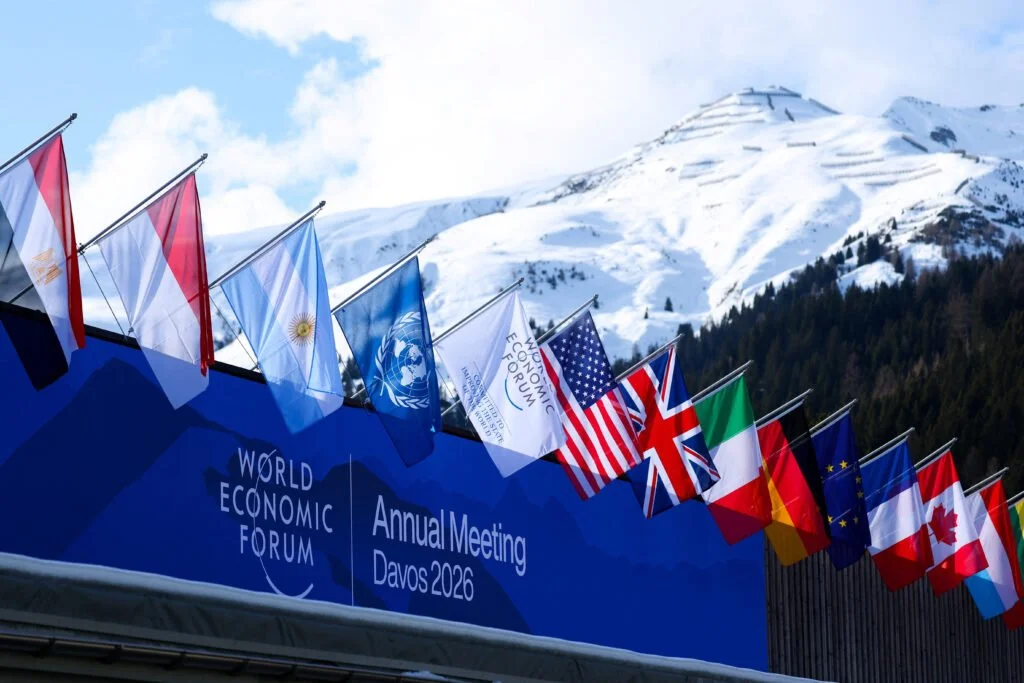
The 2026 World Economic Forum in Davos marked a notable convergence in allied messaging. Officials from across the Euro-Atlantic alliance used public remarks and follow-on engagements to reaffirm NATO’s priorities amid the prolonged war in Ukraine, mounting industrial strain, and uncertainty surrounding long-term transatlantic political cohesion. Even though Davos isn’t a security forum and doesn’t create binding policies, it has become a place where leaders reinforce shared strategic messages rather than create new ones, as well as discuss potential future policy.
NATO’s Post-Davos Messaging Shift
In the weeks following Davos, allied officials emphasized NATO’s continuity and endurance rather than escalation. Public statements from NATO leaders and member states reinforced the alliance’s commitment to collective defense while recalibrating expectations. The focus was not particularly on dramatic policy shifts or confrontational posturing toward Washington and the current administration, but on preserving deterrence over time in a shifting security environment. More aggressive rhetoric risked deepening transatlantic friction at a moment when the alliance's cohesion is paramount to its survival. NATO leaders leaned into statements that directly addressed the long-standing U.S. concerns about burden sharing and mutual military readiness. Former Secretary General Jens Stoltenberg repeatedly stressed that support for Ukraine would require “long-term commitment”, while current Secretary General Mark Rutte has emphasized the need to boost defense production and move to a “wartime mindset.” By stressing higher defense spending and industrial expansion, NATO positioned itself as responsive and proactive to American pressure.
This approach appears to be particularly effective in managing relations with the Trump administration, which has consistently criticized allied nations' shrinking in their responsibilities for defense spending. By highlighting the number of allies that now meet or exceed the 2 percent spending target, the alliance has begun to reduce grounds for confrontation while preserving its directional goals.
Historically, NATO has favored a calculated and calibrated deterrence strategy and avoided overt confrontation, preferring to operate under firm U.S. leadership. What distinguishes today's NATO is not necessarily a break in tone but a shift in the alliance's substance. The alliance remains cautious in rhetoric, yet it is more radical on issues pertaining to long-term military buildup, defense industrial coordination, and collective resilience. In that sense, NATO’s strategy reflects not only its continuity but its evolution in the changing world stage by being steady in posture, but increasingly structured to withstand volatility in Washington while reinforcing European responsibility within the alliance.
Ukraine
Following Davos, NATO also began to adjust how it framed its support for Ukraine. Rather than leaning on crisis-driven, short-term aid rhetoric, alliance messaging shifted toward a long-term framework, emphasizing sustained assistance in combating Russian adventurism in the east. NATO Secretary General Mark Rutte highlighted that allies continue to coordinate weapons deliveries and training with a long-term view, saying essentially that NATO will be with Ukraine on training and arms supply while ensuring strong security guarantees over time.
This is a subtle shift from the earlier phases of the war, when allied support was often presented as an emergency response. As the conflict approaches its fourth year and costs rise, NATO is increasingly incorporating aid to Ukraine into its planning arrangements. NATO’s Prioritised Ukraine Requirements List (PURL) and the NATO Security Assistance and Training for Ukraine command are some of the many examples of structures designed to sustain support beyond one-off pledges.
NATO stresses that continuous and sustained deterrence, as well as capability provisions, are necessary to ensure Ukraine can bargain from a position of strength in any future negotiations. European and allied leaders recently reconfirmed broad backing for Ukraine as the war’s fourth anniversary was marked, even as debates over peace proposals and future strategy continue.
Defense Industry and Burden Sharing
As stated earlier, under pressure from the Trump administration, NATO’s burden-sharing debate became more concrete and data-driven. Trump repeatedly pushed allies to increase defense spending and even advocated for a 5% of GDP benchmark by 2035, a notable rise from the long-standing 2% guideline. This pressure helped shift NATO discussions from abstract concerns about free-riding to a concrete plan on a fixed budget with reasonable commitments. At the 2025 Hague Summit, alliance leaders agreed to pursue a 5% spending target with stronger reporting requirements, a move highlighted by both allies and U.S. officials as a response to Trump’s long-standing pressure.
The effects on defense spending are visible. According to SIPRI, according to NATO estimates, 23 allies were expected to meet or exceed the 2% benchmark in 2024, compared to just 11 in 2023, and several Eastern European states were spending well above it. For example, Poland was estimated at 4.5% of GDP, while Lithuania and Latvia were also significantly above target. For comparison, historically lower spenders like Germany have been steadily increasing defense budgets and reached near or above the 2% mark in recent years.
This dynamic has helped NATO reduce its friction with Washington by showing measurable progress on burden-sharing. Rather than confrontation, NATO leaned on quantifiable increases in allied spending and capability investments to address Trump’s critiques without undermining cohesion. The result is a gradual but notable shift toward institutionalized long-term deterrence.
Why It Matters
NATO is confronting a more uncertain strategic environment marked by wavering U.S. support, persistent Russian threats, and rising internal political volatility among member states. For example, Trump’s shifts in U.S.-Russia policy have unnerved NATO’s eastern flank and raised questions about Washington’s long-term commitment to European security, which in turn pressures European capitals to reconsider their own roles in collective defense. Simultaneously, the concerns on uneven burden-sharing and domestic pushback, such as criticism of NATO spending targets by leaders like Slovakia’s Robert Fico and Spain’s resistance to higher defense spending, highlight how populist and sovereigntist politics can undercut alliance cohesion. At the same time, Russia’s large-scale war in Ukraine, expanded defense spending, and aggressive posture along NATO’s borders continue to underscore the need for a strong deterrence.
To address these challenges, NATO’s updated approach emphasizes predictable, long-term deterrence and collective resilience over one-off crisis-response. Allied leaders have agreed to boost defense investment and modernize planning, reflecting sustained strategic competition rather than short-term threats. By doing so, NATO is reinforcing its foundational role in transatlantic security while adapting to a landscape where great-power competition, domestic politics, and resource constraints shape how deterrence must be sustained.