
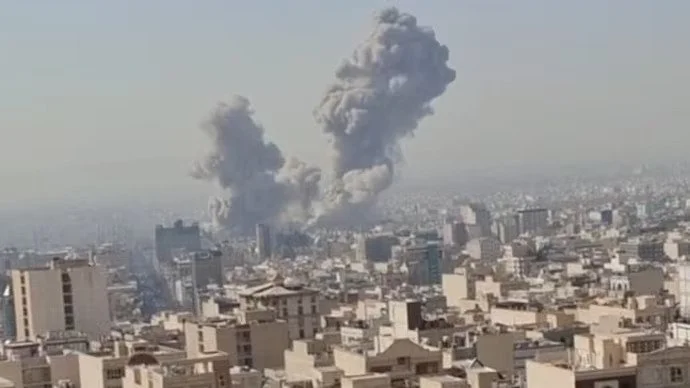
In the early afternoon of February 28th, Jordanian air raid sirens went off all across the country. Those sirens, which I heard from my apartment in downtown Amman, went off following the launch of US and Israeli missiles towards Iran over Jordanian airspace.
Mid-morning this Saturday, President Trump announced that the United States and Israel had begun “major combat operations” against Iran. The president claims that these attacks— referred to as “Operation Epic Fury”—are meant to neutralise the threat of Iran's military and nuclear programme. Only a few minutes later, after the President posted a video to the social media site Truth Social claiming that the US government “can’t take” the Iranian threat anymore, the Israeli government announced that it would also be launching strikes against Iran.
Strikes between the US-Israel alliance and Iran have become increasingly common in recent years. However, this latest round of strikes could indicate the beginning of a larger and longer regional war.
The US attack came early on Saturday morning—a weekday in Iran—as hundreds of Iranians were travelling to school or work. President Trump warned Iranians to shelter at home and claimed to support them by openly calling for regime change. Israel also issued a warning for Iranian civilians to move away from government areas. These warnings were hamstrung by the fact that many US and Israeli missiles targeted buildings in the middle of residential areas. In at least one case, it had extremely deadly effects. During the first wave of strikes, at least 153 Iranian civilians, including 40 young girls, were killed as a result of an Israeli-US strike on a girls’ primary school in a busy residential neighborhood. The timing and locations of the strikes ensured that more people would be on the streets and strengthened the likelihood of civilian casualties from the strikes. At the moment, the total number of wounded and killed is unknown, but the Red Crescent has said that at least 742 civilians are dead, including 176 children, and countless more are injured.
Another shift in the nature of this attack came in its first wave. In an unprecedented move, one of the first rounds of missiles fired by the United States struck the house of Supreme Leader Ayatollah Ali Khamenei. While it is unclear if the Ayatollah was in his house at the time, sources later confirmed that the Ayatollah was killed during this attack. After news of the death of Ayatollah and at least four other high-ranking government officials, Iranian officials said that this attack crossed “a very dangerous red line” indicating that Iran’s plans to retaliate are of unprecedented scope.
Both the killing of the Ayatollah and the increase in civilian deaths have increased the stakes for Iran. That is clear in the nation's response. The Revolutionary Guard—Iran's paramilitary force—has stated that Iran's “response will be crushing.” Iran has since launched an unprecedented series of missile and drone attacks on Israel and on US bases in neighbouring states. This wide-scale attack on multiple countries could shift the political balance in the region.
While Iran has retaliated against Israel, that is not all that it has done. Iran has also launched several attacks towards the Gulf states. While some reports are still unconfirmed, explosions from Iranian missiles have been heard in Kuwait, the United Arab Emirates (UAE), Qatar, and Bahrain. In the UAE, one person is confirmed to be dead, and others are injured. The targets of the attacks in Qatar are unclear, as were the targets of the attacks in the UAE and Kuwait, although both countries’ international airports were bombed. In Bahrain, however, it seems as though Iran is following up on its promise to retaliate against US military bases. The Bahraini state news agency has announced that missiles struck the US naval base in the nation, which is the headquarters of the US Fifth Fleet.
In response to these attacks, Bahrain and the UAE have both released statements condemning the attacks as “flagrant violation[s]” of their sovereignty and affirming their right to retaliate in the case of further aggression. In addition to releasing a similar statement, Kuwait has summoned Iran’s ambassador for talks concerning the attacks and to assert Kuwait's right to self-defense in person.
Qatar has also released a statement regarding the Iranian strikes in its territory. In this statement, Qatar similarly affirmed its right to defend itself and condemned Iran’s infringement on its territory and sovereignty. In the statement, Qatar reaffirmed its intent to remain distant from the conflict between the US and Israel and Iran, but the state also noted that if bilateral relations between Qatar and Iran were to fail, this distance would become unsustainable. Qatar’s role as a neutral site for negotiation between MENA actors has been significant. If the threat of Iranian attacks forces Qatar to arm itself and stop allowing for negotiations to take place inside its borders, brokering peace in the region could become significantly more complicated.
Another action that Iran has taken in response to these attacks is to close off the Strait of Hormuz. The Hormuz Strait is one of the most important oil trade paths in the world and it provides many Asian countries with a majority of their fuel. India—a country that gets around 50% of its oil through the strait—has already had to activate contingency plans to safeguard its energy. By closing off the Strait, oil prices around the world could rise to over $100 per barrel. Already, oil has risen by 8% up to around $75 per barrel. This spike could continue to grow if the strait remains closed.
China, one of Iran’s largest buyers of oil, gets a large portion of its fuel through the Strait of Hormuz. This consumption has only increased since the US capture of Venezuelan president and Chinese ally Nicolás Maduro on January 3rd cut China off from the nation’s other major oil supplier. The country has been a longtime ally of Iran, and in the immediate aftermath of the attacks, announced its continued support for Iran. While the country has been building its oil reserves for some time, if Iran maintains its closure of the Strait of Hormuz and China’s oil supply dwindles, the country could become a wild card in the region.
If the joint US-Israeli attacks persist and if Iran continues to bomb US bases in neutral or uninvolved states like Jordan, the UAE, and Bahrain, the tensions in the Middle East could increase to a breaking point. President Trump has claimed that the US operation will last weeks instead of days. As Iran responds in turn, the conflict between the two blocs could boil over into other countries, inside the region and out, and plunge the region even deeper into instability and war.