The College Campus and Its Discontents: How Edmund Burke Can Explain the Political Dissonance Between College Campuses and the Trump Phenomenon
Staff Writer Kevin Weil explains the contention between college students and Trump’s base.
It is impossible to overlook the current sentiment being expressed on the American college campus following the 2016 election cycle. Acute anger, frustration, and denial has consumed the campus and its politically cognizant college students while intensifying and even radicalizing their partisan ideologies. It is not, however, outlandish to perceive these campuses as bubbles, who trapped inside, are the newest and youngest minds of the intellectual community that have come to vocalize their dissent of the recent election. The intellectual hubs of the United States – Boston, New York City, Washington D.C., as well as some newly recognized regions – have become entrenched in the mystique of their elite collegiate statuses, and yet seem to remain the most ideologically narrow. The observable campus radicalism on these campuses have come to define the dissonance following the election of President Trump. One can begin to understand how the average college undergraduate perceives the world differently from the “forgotten men and women” of the United States who delivered the election to Donald Trump; but perhaps something is being overlooked, particularly within the mores of a typical millennial college student. In considering the mores of the millennial college student within a campus bubble, the question naturally arises: what is inciting this reaction?
My answer to this question is entirely rooted in Burkean-conservative thought. But before attempting to pinpoint the chief influence that is exciting the mores of millennial undergraduates, one should first note the characteristics of a modern college campus and what kind of environment it engenders. The twenty-first century college campus takes elements of a standard collegiate institution and adds aspects of diversity, tolerance, and secularization – each a hallmark of the millennial generation. It is crucial to understand that the average college campus in 2016 is comprised of millennial students who tend to be both left-leaning in ideology as well as the most vocal and particularly criticalof the 2016 election outcome. Now, within the Trump administration’s first one hundred days, this vocal criticism has intensified with the assistance of social media (Facebook, Twitter, etc.) as well as late-night television, most notably Saturday Night Live, which has recently come to impersonate and satirizePresident Trump with more frequency and playful malice. These factors are substantially intertwined with the mores of the millennial generation; college undergraduates’ frequent use of the internet provides a forum of communication and information exchange (in which they interact with likeminded individuals) and also access to material that discounts oppositional opinions – ultimately reinforces their disposition.
This piece is not an analysis of the uncanny success of the Trump campaign; nor is it one on the unforeseen failure of the Clinton campaign. Rather, its aim is to examine the typical college campus and to understand what, exactly, is driving its discontent and frustration with regard to the recent election. One should not seek the obvious answer – an answer that is validated through disdainful name-calling, stark rejection of dissenting opinions, and emotionally charged positions that compose an intellectually lacking characterization of the Trump administration so far. This discourse only serves to divide the political climate further and contributes little to a constructive dialogue. In actuality, characterizing the Trump administration is such an apprehensive and dismissive fashion only serves to cloud the reasonable mind from understanding the election and the trajectory of United States politics.
Although any millennial undergraduate’s refutation of President Trump’s platform may, on its face, be in reaction to what appears to be rhetoric-driven and partisan policy initiatives, there is a universal and instinctive aura that transcends this campus spiritedness. This intangible and distinctly reactionary sentiment is difficult to understand for we tend to misperceive it as simple anger and frustration. Beyond the messiness of politics, theory provides a clear explanation to why the college campus has become so radical; after all, understanding the theoretical aspects driving the millennial voting bloc’s behavior may reveal questions previously unknown from direct behavioral observation.
As I stated earlier, my ultimate contention in this piece is to assert that the campus sentiment following the election of Donald Trump (and well into his administration) is a backlash premised in conservative thought. It is common to attribute contemporary conservatism to the Republican party; this notion should be discounted, especially within the context this assertion is framed around because this millennial sentiment is, in truth, liberal. Conservatism is not an ideology, but rather a disposition that can be embodied in any movement and reveals itself only in response to a threat. To a millennial college student, the concept of a threat deviates from the typical threats that most conservative strands tend to form their principles against, such as the degradation of tradition, family/community, and faith. Millennial undergraduates, particularly those born in the latter half of the 1990s, hold principles of diversity, tolerance, and secularism as essential aspects of a fulfilling society. They perceive anything contradictory to these principles as a threat to the progressive principles they became politically cognizant under and, also, within which they formed their perception of government and its role in society.
Dealing in absolutes is rather restrictive in any phenomenal examination. Isolating the cause of millennial generation’s reaction is of no exception to this maxim; thus, the millennial backlash against the election of President Trump can be seen as a reaction to the threat to both core progressive beliefs and to establishment politics. Here, I add my conjecture that many moderate Republicans, who make up a smaller portion of millennials but may not hold their bloc’s attributed principles as dear, would also find issue with President Trump’s election. It would be prudent, though, that before assessing the threats to millennial principles, the concept of threats and appropriate reactionary measures are recognized through the founder of modern conservatism: Edmund Burke.
Burkean theory and the conservative disposition can largely be understood from Burke’s ideas within his work “Reflections on the Revolution of France.” In this, he is critical of the French Revolution, believing that the French abused the option to revolt against their monarchical government. It is here Burkean theory manifests; Burke conceives of a society that respects and acknowledges the traditions it was founded upon, preserving these core traditions for posterity. Here, Burke argues that society is, indeed, an intergenerational “social contract” that instills in each generation the principles and traditions of past generations; this is not to say society is to mindlessly follow the traditions of its ancestors, for Burke also contends that “a state without the means of some change is without the means of its conservation.” Burkean theory is largely premised on this concept of adaptability, but also situationalism. To Burke, there is no metaphysical ism that can be construed, abused, and philosophically understood and implemented. Rather, conservative Burkean theory holds the traditions of the past in reference to all unfolding situations, reconciling them with the trends of modernity, and transmitting them for preceding generations.
Understandably, most contemporary conservatives will rebuke the argumentative point that left-leaning millennials, who have come to be major proponents of contemporary progressivism, can be characterized as conservative. One must understand that the characterization of a conservative reaction is entirely different than labeling an entire generation as one that embodies a conservative disposition. It is particularly relevant, though, to recognize the millennial generation as a one of a new political basis – generation that has come to believe social welfare, big government, and aspects of diversity, tolerance, and secularization are all institutions of American society rather than debatable features; that these aspects must be enforced by a centralized authority in order for them to be perceived as legitimate. Therefore, when the argument is made that a nationwide millennial campus reaction is indeed conservative, it implies that these progressive institutions are their traditions and principles.
It is still necessary to understand why millennial undergraduates are having such an adverse conservative reaction to the election on Donald Trump. Of course, it is doubtful that this same reaction would be observed if a mainstream Republican candidate was elected; the issue, then, must be inherent in Trump phenomenon, specifically its refutation of progressive sentiment and its explicit intention of dismantling establishment politics.
A closer look at the progressive sentiments that millennial college students hold as a generational principle will reveal the foundation for their conservative backlash. Implementation of these progressive principles into public life characterizes the progressive movement. And although the modern left carries traces of Wilsonian progressivism, it is currently being cultivated under new trends of diversity, tolerance, and secularization by modern political figures like Barack Obama, Elizabeth Warren, and Bernie Sanders. Each of these figures had a major influence on the 2016 election, primarily for the Democratic Party and its ultimate nomination of Hillary Clinton, and can essentially be seen as epitomized progressive leaders that are praised by millennials. Yet, it is precisely these figures that Donald Trump used to emphasize his own political doctrine of refuting the nation’s public discourse of liberalism.
Millennial undergraduates, nonetheless, are steadfast in affirming their core progressive beliefs; they participate in protests and often use social media as a platform for sharing their political beliefs. It is not uncommon to meet a college undergraduate who is an avid supporter of diversity/minority organizations or, more broadly, one who just supports broad progressive reform. Social media, primarily Twitter, is an advantage to them; they use hashtags (#BlackLivesMatter, #ShePersisted, #Resist, etc.) as a protest tool to grant their shared sentiment legitimacy in the public eye. Twitter, as a whole, has become an interesting forum in the 2016 election cycle being used by both the left and the right, the most notable (and controversial) figure being President Trump.
Perhaps, in some sense, it is here that millennial undergraduates feel threatened for not only are their core beliefs threatened by President Trump’s diametrically opposed policy mandates, but their public platform, too, is being compromised. The normalization of unwelcome ideas on a platform dominated by millennial sentiment can only cause disharmony within the campus bubble – an environment that embodies and champions progressive principles. This concept is rather Burkean in nature; the millennial generation from a young and malleable age has grown to understand social media as a key aspect of modern life. As they age and become politically cognizant they take on their political leanings (which tend to be progressive) in tandem with their use of social media. The mores of the millennial become established and cultivated under the trends of modernity. With the introduction of the Trump phenomenon, their progressive-based forum, as well as the mores, are compromised. Naturally, as Burke would understand it, the inclination to preserve one’s principles is warranted – which gives rise to the current campus atmosphere around the United States.
Establishment politics, which is mutually held as a desirable aspect of centralized government by moderate portions of the left and the right, has also been perceived as a threat by millennials. In a way, the millennial generation’s progressive ideals work in conjunction with establishment politics – in order for one generation to pass on progressive principles to the next, there needs to be an established order. This order has come to be recognized as centralized established politics, or beltway politics. The idea of order and the centralized establishment largely is Cartesian in nature and conflicts with traditional conservatism which holds the family, community, and localities as the main forum to maintain tradition and principle. Cartesian school of thought, established by thinkers like René Descartes and Jean Jacques Rousseau, can be seen as a juxtaposition to contemporary conservatism in that it sees society as a distinct entity from the individual and understands social processes (or centralized government) as a way to serve human ends. Yet, to millennial progressives (and some moderates), order and establishment through a centralized power represent a consistent method to influence society as a whole, for progressivism is inherently forward looking and continually adaptingto trends of modernity.
President Trump’s commandeering of an American populist platform has come to enrage the millennial college campus. His intention disseminate centralized power to localities and rural America are observed by millennials as a both backtracking the Obama administration’s progressive policies and as a threat to any established progressive principles. The Trump campaign branded itself as the anti-establishment movement and ran on the mandate of draining “the swamp.” In essence, the campaign sought to delegitimize establishment politics that has been institutionalized in Washington D.C. and utilized by various progressive movements – like the Woman’s Suffrage Movement and the Civil Rights Movement. Phasing out intermediaries like special interests groups that organize centralized Washington politics becomes a driving force in the Trump campaign and a core issue for his administration. One can imagine the naturally adverse reaction from the millennial generation that has grew in congruence with establishment politics and perceiving its role in society as a positive force. The Obama administration, particularly, can be well understood as the main vehicle of reinforcement, for millennial undergraduates established their partisan and ideological leanings during his campaigns and his two administrative terms. Burkean thought, specifically the intergenerational social contract, would add validity to this claim; the millennial generation has come to believe that establishment politics is principled tradition. They became politically cognizant under establishment politics, believing it is how to effectively implement policy in order to maintain their progressive principles; they are, therefore, in their right to maintain the institution in order to transfer it to the succeeding generations.
The American college campus, therefore, should be seen as having experienced an abrupt conservative backlash. The Trump phenomenon has shaken the foundation of the progressivism and the millennial generation’s principles, even though the overlaps between the Trump platform and progressivism cannot be discounted. For instance, many progressives came to support Senator Bernie Sanders for the Democratic nomination; his platform was similar to Trump’s, specifically in trade policy, special interests, and military intervention overseas. This policy “crossover” between the Trump and Sanders campaign can be explained by another conservative school of thought: paleoconservatism. Paleoconservatism, finds issue with both contemporary establishment Republicans as well as the progressive left Democrats. It detests Republicans for acquiescing on modern issues like lenient immigration policies and promoting a free market. Paleoconservatism advocates for nationalism and isolationism, and restrictions on free trade. Progressivism, interestingly enough, supports similar positions like non-interventionism (although still maintaining a globalist position), and more restrictive trade to benefit the working class. This gives reason to the fact that many of Sanders primary supporters voiced their intentto cast a vote for Trump in the general election. Trump’s platform may be plainly detested by most progressive who believe in opposing policies, but there are observable similarities between both policy preferences of Trump and progressives.
Burke’s ideas of adaptable tradition and its reconciliation with the trend of modernity can attest to the concept of a millennial conservative reaction, though not to the progressive movement as a whole. What should be taken from this analysis of the average college campus and millennial undergraduate is the fact that modern political discourse (that is, up until 2016) has followed a liberal progressive trend. It has not faced a formidable opponent until the rise of Donald Trump who, with his exploitation of rhetoric and demagoguery, was able to overtake establishment politics. Perhaps this signals a newly emerging dynamic in modern political discourse; the ambiguity of the political climate among the divided major parties along with their traditions and principles implies a time strife, reorganization, and an emergence of new leaders. The college campus, although in conservative revolt, may actually be facilitating a reorganization of progressive principles which will come to defend the progressive trends they feel are threatened under a Trump administration. The oppositional dynamic of the intellectual elite and the “forgotten men and women” of America will be put on full display within the next few years and, with it, the contention of how to “Make America Great Again.”
Invitation or Invasion? America’s Opioid Epidemic, Politics, and, Poverty
Staff Writer Angela Pupino examines America’s opioid crisis.
During the tumultuous 2016 election season in the United States, the opioid abuse epidemic sweeping the nation became a political talking point. Politicians, journalists, and activists alike have tried to capture the sense of helplessness and hopelessness that opioid addiction has brought to the nation’s heartland.
Then-presidential candidates Donald Trump and Hillary Clinton laid out plans for combating addiction to heroin and other opioids across the Midwest. Meanwhile, journalists pondered whether opioid addiction may have swung the election in President Trump’s favor. Activists expressed concern over the difficulties addicts face in accessing rehabilitation and treatment. Author J.D. Vance, best known for capturing life in America’s Rust Belt in his memoir Hillbilly Elegy, described heroin as an invader that crept into his small Ohio town “not by invasion but by invitation” of his town’s hunger for the drug’s pain numbing effects.
Opioids are a class of drug that includes heroin as well as painkillers such as fentanyl, codeine, morphine, and oxycontin. Opioid painkillers are often prescribed to patients suffering from burns and other injuries and those recovering from surgery. They are also used to ease suffering in patients with terminal diseases like cancer. These substances provide pain relief coupled with a sense of euphoria, and that’s one of the factors that make them so addictive.
The World Health Organization lists lower socioeconomic status (SES) as a risk factor for prescription opioid overdose. While low SES individuals are by no means the only users of opioids, they are more likely than higher SES individuals to face negative health outcomes because of their drug use. As Galea and Vlahow explain, poorer injecting drug users are less likely to receive medical help for their addiction, less likely to receive information on risk reduction, and more likely to engage in higher risk drug use. It is unsurprising, then, that the epicenter of opioid addiction and overdose in the United States coincides largely with areas of the nation which have been devastated by decades economic decline, decreasing job opportunities, and deindustrialization. These areas hardest hit by an influx of opioid addiction include West Virginia, Ohio, Kentucky, Indiana, as well parts of New Hampshire.
It is important for the United States to pay attention to rising rates of opioid addiction and overdose deaths. According to the CDC, prescription opioids were involved in 22,000 deaths in 2015, working out to 62 deaths per day. Importantly, that number does not include deaths from heroin overdoses. Opioid-related deaths are straining healthcare systems and emergency services across the nation. According to an article on opioid addiction from the National Institute on Drug Abuse (NIDA), it is estimated that healthcare expenses associated with opioid pain relievers taken non-medically cost the insurance industry average $72.5 billion every year. Dependence on prescription opioids has also been tied to heroin dependence. Half of injecting heroin users surveyedby NIDA had used prescription opioids first, some even switching to heroin because it was cheaper. As the opioid epidemic continues to spread, these negative impacts are growing as well.
But opioid abuse does not just ruin lives and livelihoods in downtrodden communities in the United States. Although the opioid abuse epidemic in the United States is a localized issue, the effects of the drug’s trafficking and production spills over into the international realm. Globally, opioid abuse in the United States encourages the production of illicit opioids such as heroin, degrades environmental systems in production areas by way of deforestation and soil depletion, disrupts life in poorer communities, and renders treatment inaccessible to those who most need opioid pain relievers. In order to effectively combat the opioid abuse crisis, the international community must recognize and grapple with both the local and international costs of opium addiction.
One way that opioids negatively affect the environment is through deforestation. In order to cultivate opium poppies, large swathes of suitable land must be cleared. The United Nations Office on Drugs and Crime estimatesthat 281,800 hectares of land worldwide were being used to cultivate opioids in 2015. Deforestation has also been linked to areas of drug trafficking. In the case of drug trafficking, deforestation can occur during the development of infrastructure for illicit crop cultivation. This includes the creation of landing strips and roads to transport drugs such as opium more quickly.
The production of illicit opiates has impacted the global environment in other ways as well. Opium production in the rainforests of Thailand and Burma has been found to cause soil depletion. Soil depletion creates obvious problems for rainforest ecosystems, which may struggle to recover following opium cultivation. But depleted soil also affects the ability of poorer communities, such as small landowners and subsistence farmers, to live off of these lands. The relationship between soil depletion and opioid production is also the case in Afghanistan, where failing opium crops leave poor farmers with no alternative livelihoods.
Illegal opium cultivation and opioid production does not just damage ecosystems in the developing world; it can damage community structures as well. In Afghanistan, the world’s largest opium producer, the connection between opium production and the nation’s violent insurgencies has been welldocumented. In war-ravaged Afghanistan, the success of opium crops is tied to the need for better development policy. Opium is a cash crop, allowing struggling farmers to generate the income they need to support their families. In the absence of other means of supporting themselves in a destabilized nation, farmers will continue to grow opium. Opium cultivation has, in short, helped fund an armed insurgency that destabilizes the nation and makes it difficult for farmers to produce other crops.
It is important to note that there is a difference between the environmental and social impacts of legally and illegally produced opium crops. Legal opium crops are grown under strict government supervision in places like India, Spain, and Australia. In places where opium is being legally cultivated for production into opioid painkillers, the impacts of deforestation and soil depletion on ecosystems are regulated by the government. Legally produced opium also does not bring violence into these international communities, as access to the crop is often tightly controlled. Legal opium crops are only sold to companies that produce legal painkillers, as opposed to armed groups that traffic in illegal opium. It is the illegal production of opium for illegal drugs including heroin and counterfeit painkillers that presents problems for ecosystems and communities.
While the United States suffers from the harmful effects of over-prescribing potentially addictive opioid painkillers, people in many other parts of the world are unable to access opioid pain medications. In a 2011 study published in the Journal of Pain & Palliative Care Pharmacotherapy, researchers found that 83% of the world’s population lives in a nation with little to no access to opioid pain medications. In fact, the researchers discovered that only 7% of the world’s population had adequate access to opioid pain medications. In places where these painkillers are not easily accessible, individuals, even those suffering from excruciating pain, must go without.
Why are so many people around the world unable to access opioid painkillers? Research suggests that American addiction may play a role in this disparity as well. Americans alone consume some 80% of the world’s opioids. Those who become addicted to painkillers and heroin are willing to spend vast sums of money on legal and illegal opioid products. The RAND Corporation estimatesthat American users spent 27 billion dollars on heroin alone between 2002 and 2010. Opioid addiction in the developed world can inflate the price of opioids and impact on the ability of individuals in the rest of the world to afford opioid medications. In the United States, just 50 milliliters of morphine can cost 38 dollars. Other painkillers, such as fentanyl, are even more expensive. Take into account that long-term patients suffering from diseases such as cancer can require much more than 50 milliliters of morphine and it is easy to see how that price may burden already cash-strapped healthcare systems in the developing world.
While the environmental and social problems stemming from illegal opioid production may make banning or reducing opioid production altogether seem like a promising solution to America’s opioid epidemic, this is not the case. The majority of the world’s population still lacks access to life-saving opioid painkillers, meaning that policies focusing only on the supply-side are not the solution the global poor need. Solutions to the myriad problems caused by America’s addiction to opioids must come instead from reductions in the nation’s demand for opioids.
When J.D. Vance remarked that heroin had been invited into his community, he was recognizing the role that America’s demand for opioids plays in exacerbating the crisis domestically. In order to reduce the nation’s dependence on opioids, America must come to terms with the factors that led doctors across the nation to overprescribe opioids. This includes encouraging the prescription of non-opioid painkillers, better communication between doctors, pharmacies, and law enforcement organizations, and working to make rehabilitation programs more accessible for users. Unless demand-side policies are utilized to reduce America’s addiction to opioids, the global poor will continue to suffer.
Trump’s Budget Proposal: A Massive International Affairs Mistake
Staff Writer Benjamin Shaver explains the shortcomings of the Trump administration’s budget proposal for American foreign policy.
Early in March, President Trump released his budget outline for 2018. Among other things, the proposal cut spending on the State Department and USAID by around 35% while it asked Congress for a $54 billion increase in spending for the military, which amounts to about a 10% increase. Trump’s proposal is a political document, and Congress is unlikely to enact it, at least in its entirety. However, this proposal gives insight into the White House’s apparent preference for using hard power when addressing issues abroad, and it is incredibly disheartening that Secretary of State Rex Tillerson has thrown his support behind the proposal.
Diplomacy and warfare are not different ways of solving a problem, and are most successful when they are used in conjunction. As Former Ambassador to Iraq James Jeffrey said, “[d]iplomacy is not an alternative to military force; it is the use of all elements of U.S. force in a coordinated, cumulative way to achieve our results in other countries.” The use of soft power is critical to the continued success of U.S. hard power. By cutting an already tight State Department and USAID budget by more than a third, Trump and his team are demonstrating that they do not see diplomacy and warfare as two components of the same strategy, and by doing so are making a critical mistake.
Although the budget proposal is in no way written in stone, there is potential for real consequences because of the line of thinking that it demonstrates. In particular, USAID and the State Department can play a critical role in the rebuilding of institutions of war-torn countries post-conflict. In recent years, the US has embarked on many projects abroad that include some components of rebuilding a society post-conflict, often a conflict that the U.S. was directly involved in. When the State Department and USAID are not properly funded, the responsibility of conducting these political and diplomatic operations falls upon people who do not have the same training and experience.
One example of this phenomenon was the war in Afghanistan. The U.S. invasion of Afghanistan began in 2001, but in 2009 another military surge began. The military surge was supposed to be coupled with a “civilian surge” that would have included experts who could help rebuild the country. Unfortunately, the “civilian surge” never materialized because the agencies didn’t have the necessary funding. This led to troops trying to fill the gaps, but they lacked the training in local languages and culture that a Foreign Service Officer would possess, which meant they were not able to accomplish as much as FSOs would have been able to.
The failure of this “civilian surge,” among many other things, is why the U.S. is still engaged in a war in Afghanistan, nearly 16 years after first invading. If this war could be won by training Afghan soldiers and killing Taliban leaders, hard power actions, it would have been won. But, as the continuation of the conflict demonstrates, military action is not the only thing that is necessary to achieve the U.S.’s goals abroad, there needs to be knowledgeable diplomatic effort as well.
Although the budget proposal does not give the specifics of which programs would be impacted by the budget cuts, a 2016 report by the Heritage Foundation, entitled “How to Make the State Department More Effective at Implementing U.S. Foreign Policy,” gives insight into what programs might potentially face cuts. Although the counterterrorism bureau likely will not face large cuts, divisions that deal with arms control, military affairs, and cultural programs likely will. These cuts are in addition to many other likely cuts to a variety of key functions of the U.S. State Department, but that don’t particularly fall within the scope of U.S. military actions. These divisions are critical to the U.S.’s military efforts, particularly if the U.S. wants to do any form of state or nation building.
Although Trump has been skeptical of “nation building” in the past, there are crises around the world that will need to be dealt with that will demand the use of the State Department and USAID in this fashion. One such situation is ISIL. One of the few campaign promises Trump has kept is a firm on is his commitment to defeating ISIL, and as one Foreign Policy article put it, he is succeeding. Of course, while the elimination of ISIL is a worthy goal in pursuit of a safer world, it is not a matter of simply defeating them. Instead, one must ask whether anyone will simply take ISIL’s place in the event that they are eliminated, just as ISIL’s success could partially be explained by the power vacuum caused by the U.S. invasion of Iraq. This same power vacuum will exist after the demise of ISIL, and it is highly likely that it could potentially lead to a similar group emerging unless actions are taken to help rebuild the countries who have been most impacted by ISIL allowing them to defend themselves. This is a role that is better suited to the State Department and USAID than it is to the US military, but if they do not have the requisite funding, they will not be able to do it.
This same lack of understanding will cause problems for Trump on another foreign policy issue he will need to address while President, the ongoing civil war on Syria. It is harder to discern what Trump’s goals are regarding this conflict as he will need to reconcile two positions that are the antithesis of each other, his desire to work with Russia, and his desire to contain Iran. While on the campaign trail Trump often stated that he was not interested in getting the US involved militarily in the Middle East, however, in response to Assad’s use of chemical weapons against Syrian civilians, the White House ordered the use of Tomahawk cruise missiles to bomb Syrian airbases, saying that “something should happen” in regard to Assad. It is impossible to say what the White House’s long term goal is in Syria, however, in recent days a consensus has seemed to appear within the Trump administration that a solution will not come to Syria while Assad is in power, with U.S. Ambassador to the U.N. saying, “We don’t see a peaceful Syria with Assad in there.” Whether or not the U.S. pursues a foreign policy that involves deposing Assad or not, in a crisis where 11 million people have had to flee their homes and hundreds of thousands have been killed, large amounts of state building will need to occur post-conflict. But will a State Department and USAID who have had their funding severely cut be up to the task? I think it’s highly unlikely.
To be fair, Trump is hardly the first president to make this mistake. In fact, this is an endemic problem that has existed for many years, which is why the War in Afghanistan is a good example of the perils of underfunding the international affairs apparatus. Each year, Congress passes the National Defense Authorization Act, which sets funding parameters for the Pentagon. In contrast, a State Department authorization bill has not been passed in years. A widespread mistake is being made, over and over again, which is why for years, Secretaries of Defense have called on Congress to give the State Department and USAID the necessary funding they need to do their jobs. And it is why 120 retired US generals called upon Congress to fully fund the international affairs budget. Time and again, Congress has failed to deliver.
This question of funding is not a zero-sum game. An increase in spending on the State Department does not need to come at the expense of spending on the military, or vice versa. Although they are far, far better funded, the military has still experienced problems as a result of sequestration, especially in the civilian components of the Office of the Secretary of Defense. But when the military that receives the most funding on earth is getting an increase in spending, while an already underfunded State Department and USAID is getting a massive pay decrease, something needs to change.
In 2013, at a Senate Armed Services Committee hearing, then Marine General James Mattis said “If you don’t fund the State Department fully then I need to buy more ammunition ultimately…the more we put into the State Department’s diplomacy, hopefully the less we have to put into a military budget as we deal with the outcome of apparent American withdrawal from the international scene.” Mattis is now the Secretary of Defense, but it appears his advice has been ignored. Of course, the U.S. has the choice not to engage in wars that will lead to the rebuilding of countries after the conflict, but it seems highly unlikely that that is something that will be pursued. Even if Trump has said he wants to avoid getting entangled in messy conflicts abroad, which seems unlikely in light of his quick reversal on Syria, things will happen during his presidency that will force his hand. Simply put, cutting the international affairs budget will not help solve any problems, except to assuage domestic voters who believe there is too much discretionary spending in the U.S., it will make them worse. A well-funded State Department and USAID is critical to the success of the US military. To underfund them is to make the military conflicts that much longer and more challenging. Hopefully the Trump administration realizes that, or they are doomed repeat the same mistakes as previous administrations.
Book Review: Writing the War on Terrorism, Richard Jackson
Contributing Editor William Kakenmaster reviews Writing the War on Terrorism by Richard Jackson.
Book Review: Writing the War on Terrorism. Richard Jackson. Manchester: University of Manchester Press, March 2005. 240 pp. £15.99
Richard Jackson’s Writing the War on Terrorism is a useful study into American political discourse surrounding terrorism and counter-terrorism but ultimately self-defeating in simply trying to argue against the dominant narrative with its own idea of the truth, and ineffective in its proposed alternatives. In mapping the power relations between the dominant and non-dominant discourses, Jackson argues that “the ‘war on terrorism’ is now the dominant political narrative in America,” and is thus “highly successful” in both generating consent for U.S. military campaigns and normalizing militaristic counter-terrorism practices (pp. 2). However, Jackson’s critique of the “war on terrorism” fails to address the underlying power structure he himself cites, and which marginalizes alternative discourses. Furthermore, Jackson’s broader thesis—that such a discourse was not inevitable, but rather strategically deployed—and corresponding alternatives do not necessarily imply greater protection for human rights.
Jackson solves two important puzzles for post-9/11 U.S. foreign policy debate. First, he identifies the specific language of the “war on terrorism.” The “war on terrorism,” according to Jackson, consists of a multi-layered discourse which constructs the attacks on 9/11 as an act of war which victimized America; the “enemy” terrorists as an intrinsically inferior, barbarian “other;” the threat of attack as all-encompassing across time and space; and military aggression as a “just war” (pp. 31, 61, 96, 122). Jackson suggests these attacks were deliberate—although sometimes hyperbolic—constructed elements of the discourse, aimed to generate an artificial political consensus for both domestic policies, like the PATRIOT Act, and military operations abroad, such as the Iraq Invasion (pp. 181). He further suggests these linguistic instances are part of “a dialectical relationship between” language and policy, which thus explains the explicit and implicit worldviews embedded in U.S. policymaking (pp. 24). In fact, labelling the debate itself as pertaining to terrorism, not “a long-running cycle of violence and counter-violence between the American government and al Qaeda” decontextualizes the 9/11 attacks in favor of a political narrative that enables the invasions of Iraq and Afghanistan (pp. 43). The utility in Jackson’s work here lies in its locating U.S. political discourse. In other words, citizens understandably want to know and understand their national leaders’ positions. Therefore, Jackson usefully holds contemporary U.S. policymakers accountable for the conscious and unconscious, explicit and implicit meanings they fix to the 9/11 attacks, terror actors, the threat of terror, and military warfare through their use of language.
The second achievement in Jackson’s work lies in his mapping the relations between discourses, therefore explaining the characteristics of the “war on terrorism,” as well as its dominance over alternative foreign policy discourses. To that end, Jackson relates the dominant discourse—“the war on terrorism”—to alternative discourses, “such as pacifist, human rights based, feminist, environmentalist, or anti-globalization discourses,” of which he provides several examples (pp. 19). For example, Jackson argues that, whereas the war on terrorism created “a myth of exceptional grievance,” an alternative discourse could have “emphasized solidarity with victims of violence in other countries” (pp. 37-38). However, to the extent that “the public debate uses mainly the language, terms, ideas, and ‘knowledge’” of the war on terrorism, it dominates the proposed alternative solidarist discourse (pp. 19). If citizens deserve to know what their national leaders believe, then they also deserve to know how much weight those beliefs hold in the current U.S. political discourse. Clearly, because the language a discourse (re)produces leads to specific policy outcomes, identifying the elements of the discourse of the “war on terrorism” and its relation to other discourses indeed represents a useful achievement in Jackson’s work.
However useful Jackson’s mapping of the discursive landscape may be, though, his central critique of the dominant discourse and his proposed alternatives ultimately fail to interrogate the underlying power structure of U.S. policy discourse itself. He further fails to propose clearly effectual alternative discourses that could potentially lead to less emphasis on security, that problematically curtails civil liberties and problematically constructs those responsible for the 9/11 attacks as irrational, hateful, and fundamentally opposed to “our way of life.” Jackson critiques the “war on terrorism” in suggesting that U.S. policymakers deliberately exploited the fear caused by the attacks on 9/11 to represent terrorists as irrational, hateful savages, and the U.S. as alternatively victimized and justified in violating human rights both domestically and abroad (pp. 181). But this relates only to the “war on terrorism” discourse itself, not the system of unequal power relations that oppresses and marginalizes alternative discourses. Jackson proposes a clear “normative commitment to positive social change” in his book, as did Bush and other top leaders in proposing to protect “our way of life” from a perceived terrorist threat (pp. 25, 47). The Bush Administration might have had dubious intentions, but then Jackson’s intentions seem similarly untrustworthy, given the lack of credible external sources to validate them. After all, his alternatives explicitly seek to supplant “the war on terrorism” as the hegemonic discourse without seeking to eradicate or fundamentally alter the discursive power structure that allows hegemonic discourses to marginalize subaltern discourses in the first place.
Jackson’s proposed alternatives read more as self-defeating writings of post-9/11 U.S. foreign policy than ones that could radically alter the U.S. political landscape. This is further evidenced by the ineffectiveness of Jackson’s alternatives in protecting human rights. For example, Jackson proposes constructing the 9/11 attacks as criminal acts, not acts of war (pp. 40). However, to the extent that, for example, the War on Drugs and the systematic police brutality against black Americans rely exclusively on discursive constructions of criminality, Jackson’s alternative does not necessarily imply greater protection for human rights in their resultant policies. Jackson’s claim that the “war on terrorism” was not inevitable, moreover, ignores the specific institutional contexts and modalities through which the discourse was constructed (pp. 107). For instance, the near religious-like zeal with which Republican policymakers vindicated the U.S. defense budget for years before the attacks likely played a role in the intentional framing of the 9/11 attacks as an act of war, yet the alternatives Jackson suggests downplay the ways in which these institutional thought processes manifest themselves in discourse by claiming that such discourses were not inevitable (pp. 38). Essentially, in both his critique of the dominant discourse and his alternatives, Jackson contradicts its own premise that dominant discourses result in negative outcomes by marginalizing subaltern discourses.
On the one hand, Jackson’s work locates the dominant discourse’s place within U.S. political climate and its relations to other discourses. This serves an important and useful explanatory function in holding national leaders responsible and informing the public on their positions. On the other hand, however, Jackson ultimately defeats his work’s central tenet, as his alternatives seek to supplant the “war on terrorism” as the hegemonic discourse without addressing the underlying structure of discursive power relations itself.
Bibliography
Jackson, Richard. 2005. Writing the War on Terrorism: Language, Politics, and Counter-Terrorism. Manchester: Manchester University Press.
The Man, The Myth, The Director: James Comey in Profile
Staff Writer Annmarie Conboy-DePasquale explores the history of former FBI director James Comey.
As the 2016 Presidential Election rushed toward its inevitable conclusion, James Comey stepped back into the spotlight and played his hand. A long-time Republican, the timing of his announcement that the Hillary Clinton email saga was in fact, not over, seemed to cement the Director’s position in Donald Trump’s camp. In the months since the election though, his party pendulum has swung; with his recent testimony before the House Intelligence Committee, Comey garnered democratic support and republican ire when only 6 months ago the opposite was true. To view the Director only through the lense of the 2016 campaigns and subsequent administration would be akin to assembling a puzzle while missing the majority of the pieces. At only 52 years of age, Comey’s rise through the Department of Justice has been nothing short of meteoric, and it began long before Trump filed his primary registration forms.
James “Jim” Brien Comey Jr., was born on December 14th 1960, the second of four Irish children in a small borough of Bergen County, New Jersey, where his father worked in real estate and served on the town council. The mayor described the family as being very involved in community organizations, from church events to Girl Scout troops. His first brush with the criminal world came in 1977 when Comey, then a 17 year-old high school senior and his younger brother were held hostage by a suspected serial rapist and robber.
The assailant broke into the house while the brothers were alone for the night; the two managed to escape and were nearly recaptured before successfully fleeing and calling the police as the attacker vanished into the night. In speaking about the experience Comey said, “At one point, I thought—I knew—that I was going to die that night…It gave me a sense of how precious and short life is. Second, it gave me a keen sense for what victims of crime feel. I know that in some sense, they never get over it. That’s helped me as a prosecutor. I survived that experience, as did my brother, and we became—we hope—healthy adults. But it stayed with me for a long time.” No one was ever charged for the crimes.
Comey would graduate high school the following spring, go on to the College of William and Mary with a double major in chemistry and religion, and then complete his Juris Doctor (J.D.) from the prestigious University of Chicago Law School in 1985. After graduation, Comey clerked for then-United States District Judge John M. Walker, Jr., in Manhattan and worked briefly in private practice. In 1987, the same year he married his wife Patrice, he transitioned to the U.S. attorney’s office where he became an assistant U.S. attorney for the Southern District of New York in Manhattan under Mayor Rudy Giuliani.
By 1993, Comey was deputy director of the office’s criminal division and worked on high profile cases such as the six-month prosecution of John Gambino of the Gambino crime family. However, he and his wife sought calmer territory to raise their five children. That year he resigned and the Comey family left New York, bound for Virginia.
Comey again attempted to work in the private sector but found himself unsettled after successfully defending a corporate client on a case where they were accused of using machinery that caused asbestos injuries. Subsequently, Comey rejoined the U.S. attorney’s office, accepting an offer from a Clinton appointee to the Eastern District of Virginia to serve in the Richmond office. While there, he drew praise and national attention for his successful efforts to lower Richmond’s notoriously high homicide rate. His team’s strategy, known as Project Exile, was to federalize illegal gun possession.This enabled his office to try individuals charged with illegal gun possession in federal court, where the sentences are longer and harsher than state courts.
Another professional victory for Comey came early in the Bush administration when, in 2001, then-FBI Director Louis Freeh shifted the investigation of the 1996 bombing of Khobar Towers, a US military facility in Saudi Arabia in which 19 US Servicemen were killed, from stalled Washington attorneys to Comey in Richmond. In three months, Comey and company returned 14 indictments which previous prosecutors had failed to deliver for five years, and six months later an impressed George W. Bush nominated him to the position of United States Attorney for the Southern District of New York. He remained in the office until only December 2003, when Comey was confirmed as Deputy Attorney General following an October nomination, again by President Bush. Comey’s new position would set up his role in a confrontation which, in no small part, shaped Comey’s public image until the 2016 election.
In March of 2005, Attorney General John D. Ashcroft had to undergo emergency surgery to remove his gallbladder. In his absence, the deputy attorney general assumes the position of acting attorney general who was, at the time, James Comey. At the same time, senior White House counsel Albert Gonzales (who would later be appointed U.S. Attorney General) and presidential Chief of Staff Andrew H. Card Jr. were seeking to re-up a warrantless and highly controversial domestic wiretapping program known as Stellar Wind. Comey, Ashcroft and other senior justice officials, including the Director of the FBI, Robert Mueller, were on the brink of resignation in defiance.
The discussions leading up to the program’s expiration date became increasingly hostile, with one last standoff at 1600 Pennsylvania ending when according to one account, Comey claimed that there was no legal basis for the order, that ‘no lawyer would reasonably rely on it,’ to which Vice President Cheney’s lawyer responded, “Well I’m a lawyer and I did.” Comey returned, “No good lawyer.” The room descended into silence.
Ultimately, Comey, as the acting Attorney General, denied the White House’s extension request. Unwilling to accept this, the Gonzales and Card attempted to circumvent Comey’s temporary authority by getting the hospitalized Ashcroft to sign off himself. Unbeknownst to them, Comey caught wind of their scheme and it became a race to Ashcroft’s bedside, with Comey arriving at George Washington University Medical Center moments prior to the senior White House staffers to inform his ailing boss of the situation.
A tense standoff took place in which Gonzales and Card pressured Ashcroft to sign the extension order, with Comey standing stoically to the side. According to former Washington Post reporter Barton Gellman, Ashcroft refused to do so, saying he never should have signed it in the first place.
The order expired.
Although only days later a version of it, rewritten to circumvent the authority of the Justice Department, was signed by Gonzales. The incident became the stuff of Washington legend, and Comey would later testify about it during the confirmation hearings for Albert Gonzales to become U.S. Attorney General.
James Comey would remain deputy attorney general until 2005. Seven months into Gonzales’ tenure as USAG, Comey departed for Lockheed Martin, a private defense contractor where he was a senior vice president and general legal counsel from 2005 to 2010. From there he moved to the Connecticut-based hedge fund Bridgewater Associates. He left Bridgewater in 2013 to teach national security law at Columbia. In a speech to NSA staffers in 2005 Comey said,
“It can be very, very hard to be a conscientious attorney working in the intelligence community. Hard because we are likely to hear the words, ‘If we don’t do this, people will die’…‘No’ must be spoken into a storm of crisis, with loud voices all around, and with lives hanging in the balance. . . . It takes an understanding that, in the long run, intelligence under the law is the only sustainable intelligence in this country.”
Comey remained in New York until his appointment as Director of the Federal Bureau of Intelligence in 2013.
At a commanding 6-foot-8-inches, James Comey towers over most in his presence. When announcing his appointment, President Obama joked that Comey is, “a man who stands very tall for justice and the rule of law. I was saying while we were taking pictures with his gorgeous family here that they are all what Michelle calls ‘normal height’” (The former first lady stands at an impressive 5’11 herself).
James Comey became the seventh FBI director on July 31, 2013 when he was confirmed by an overwhelming margin of 93-1 (Rand Paul was the only nay vote), taking the place of his good friend and ally Robert Mueller III. Comey is contracted for a ten year term, ending in 2023. He is among the very few government officials who remain from the Obama administration, as most have resigned or are being replaced with officials from the new Administration.
Now in his fourth year as Director, Comey has long since emerged as a powerful player on the Washington circuit; engaging in highly publicized dealings with figures including of course, Secretary of State turned Democratic nominee for President, Hillary Rodham Clinton. Their turbulent and often contentious relationship, which began after the Benghazi attack and continued, under heavy scrutiny, through her 2016 presidential campaign, drew massive media coverage and at times placed Comey at the forefront of public attention.
There are four situations which stand-out in understanding the current public uncertainty over Comey’s allegiances. The first was discussed previously, his 2007 testimony regarding the events of Comey’s time as acting AG, pitting the White House against himself and Ashcroft over Stellar Wind. The results of this incident and the outstanding moral character displayed by Comey were a significant factor in President Obama’s decision to nominate him in 2013. The next two were in regards to the Clinton email scandal. First, after months of intensive investigations, Comey addressed the press and in a display highly uncharacteristic of the Bureau, laid out what the FBI had searched, what they had discovered and what they would recommend to the prosecutors at the Department of Justice. After stressing how boisterous outside opinions had played no role in his investigations, Comey stated that the FBI would recommend no charges be filed against Clinton.
Democrats were, generally, satisfied. Republicans focused on the harsh description of Clinton’s “carelessness” which Comey included in his address.
In 2016, about a week before the general election James Comey sent a letter to Congress notifying them of the FBI’s intent to investigate new emails found from Clinton’s time as Secretary of State. The fallout would be disastrous for the already flailing democratic campaign.
When Hillary Clinton was stunningly defeated days later, many placed the blame squarely on Comey’s head. Citing his letter, many claimed he intended to tip the electorate in the Trump campaign’s favor. Forgotten was the Comey who stood up to the the highest echelons of the Bush administration, or who sought a full and fair investigation of Secretary Clinton’s emails in the face of rabid public attention. It would only be acknowledged by the media months later that it is routine for federal investigations to find new information after their official conclusions, and that the new information is always studied to ensure it does not alter the facts of the case as they were understood.
The most recent shift in Comey’s supposed political alliances came only weeks after President Trump’s inauguration; winner of the election so many felt Comey handed to him. The new president infamously tweeted shocking and baseless claims that the outgoing Obama administration had wiretapped Trump tower during the campaign. Comey, as Director or the FBI was testifying before the House Intelligence Committee on the separate issue of Russian interference in the presidential election. Via Trump’s live tweets, Congressmen were able to question Comey real time about these new allegations and Trump’s characterizations of Comey’s responses to them.
Comey stated there was no evidence to support Trump’s wiretapping tweets.
While the Director was still testifying, the President tweeted, “The NSA and FBI tell Congress that Russia did not influence electoral process.” A Congressman read aloud the tweet and asked Comey to respond, to which he said “It was not our intention to say that today.”
Now, if James Comey is wielding his power to serve his own political inclinations, who is he supporting? Some claim he shattered Clinton’s hopes of winning the election; some claim he is attempting to sink Trump’s credibility and turning on him publicly. The truth is while James Comey was long ago registered as a Republican he no longer is now. But more importantly, the Director is non-partisan.
The Director swore that he would uphold the Constitution of the United States against all enemies, foreign and domestic. There was no mention of discriminating along party lines. The Director addressed his Bureau and said, “I expect that you will work hard. Your work, no matter what you do here, is to do good. Your work is to protect the innocent from harm of all kinds.”
The Director, as the man James, as a United States Attorney and as a Deputy Attorney General, has worked fastidiously to better the Unites States. He is a man of great moral character and of remarkable integrity. He is the kind of man you want standing between the USA and her enemies. He serves no master but justice.
“Down these mean streets a man must go who is not himself mean, who is neither tarnished nor afraid. He is the hero; he is everything. He must be a complete man and a common man and yet an unusual man. He must be, to use a rather weathered phrase, a man of honor—by instinct, by inevitability, without thought of it, and certainly without saying it. He must be the best man in his world and a good enough man for any world.”
-Raymond Chandler
The Legal Regime and Political Ramifications of Leaks
Staff Writer Jeremy Clement explains the legal precedents surrounding whistleblowers.
Introduction
Leaks of sensitive information to the public have plagued presidential administrations since George Washington. The modern system of leaks began in 1957 when Colonel John C. Nickerson was prosecuted for “perjury, violating the Espionage Act, and 15 counts of security violations.” Multiple other big name leaks have occurred including the Pentagon Papers, the Chelsea Manning leaks, the Edward Snowden leaks, and most recently the Democratic National Committee and Donald Trump Administration leaks.
The severity of punishments for these whistleblowers ranges from no charges for the Pentagon Papers case, to multiple years in prison for Chelsea Manning, to self-imposed exile for Edward Snowden. The laws surrounding leaks and whistleblowers are complex and laxly enforced. The following sections will clarify where the laws on the books stand regarding leaks, how investigations occur, why leaks lack strong enforcement, the political nature of leaks, and the current Donald Trump Administration’s stance on leaks.
Clarification of the Law
The law surrounding government leaks revolves broadly around five U.S. statutes. These are the Espionage Act of 1917, 18 U.S.C. § 798 which applies to communication intelligence, the Intelligence Identities Protection Act, the general theft statute 18 U.S.C. § 641, and 18 U.S.C. §1001 which relates to false statements made during investigations.
The bulk of leak prosecutions rely on the Espionage Act, specifically 18 U.S.C. § 793. The Espionage Act prosecutes leaks of “national defense information” (note that this does not specify classified information). However, the Supreme Court has ruled that national defense information does not only pertain to the military, but security in general. Professor Patricia Bellia from Notre Dame Law School writes that “… the ‘phrase national defense information’ … is not coterminous with the phrase ‘classified information’.” However, she also notes that the classification status of a document can imply that the document contains information relevant to national defense, and therefore is evidence against the person who committed the leak.
To build upon the Espionage Act, 18 U.S.C. § 798 adds to the list of information that can be prosecuted. Under this law further classified information is protected, including “information ‘concerning the communication intelligence activities of the United States or any foreign government’.” This would cover diplomatic communications, not just military communications. Further protected are the identities of covert agents under the Intelligence Identities Protection Act. For an example of this act in action, take a look at John Kiriakou’s case regarding the CIA’s interrogation methods.
The last two laws relate to prosecutions for crimes unrelated to the actual information that leaks contain. 18 U.S.C. § 641 protects the physical documents that contain the information, regarding them as government property that can be stolen. Lastly, 18 U.S.C § 1001 has the power to prosecute an individual for making false statements during the course of an investigation. Many are prosecuted for 18 U.S.C. § 1001 because it is easier to prove than the other statutes.
The Nature of Leaks and Their Investigation
A big issue for the government when investigating leaks is what opening an investigation implies. When an agency harmed by a leak and becomes a “victim agency,” they will send a complaint to the Department of Justice. The decision to open an investigation is left to the discretion of the DOJ. The catch is that an investigation will only be opened “when the leaked information is accurate.” Opening it otherwise would make no sense, since it would not be a leak, only a made up statement that anyone could produce. The implication of this leads us to the realization that once an investigation is opened regarding leaked information, the truth of the information is confirmed to the public. The enforcement of laws protecting government information has been lax due to this issue, but also because leaks can be beneficial to the same government that is harmed by them.
Aside from the unauthorized disclosure of information, there are “authorized leaks.” Authorized leaks are strategic releases of information used to “avoid damaging errors or to protect sensitive information or sources from further disclosure.” Therefore, the disclosure of information can be beneficial to the government, public, and press. A quote from the Chicago Tribune puts it best:
[The government] needs leaks as much as the press does. The legitimacy of government requires sunshine and the practice of governance sometimes requires darkness — and in the face of that contradiction, leaks are a kind of informal workaround.
Aside from the leaks most detrimental to the government, law enforcement is rather permissive due to their dual nature.
The Donald Trump Administration
Donald Trump and his administration have changed the way the government uses leaks from previous administrations. Leaks from the White House regarding improprieties with former National Security Advisor Michael Flynn’s contacts with Russia were met by counter leaks in the other direction by the Trump Administration. Instead of using leaks to reveal truth, or make an administration look good (as was the case when the Osama Bin Laden raid was made known to the public in 2012), his leaks have been used to obscure the truth about improprieties. The obsession with finding the whistleblowers within the Trump administration has also led many staffers to use a confidential conversation app, in violation of the Presidential Records Act, to hide evidence of leaking.
The President’s Stance on Leaks
Leaks helped Donald Trump win his Presidency. During the election he praised Russia for hacking the DNC, and called for more leaks. The President was in support of a foreign power using illegal means to influence a U.S. election in his favor, a charge which is more serious than simple leaks that inform the public of policy, according to a recent Politifact article by Louis Jacobson.
In 2013, President Trump tweeted “ObamaCare is a disaster and Snowden is a spy who should be executed-but if it and he could reveal Obama’s records, I might become a major fan.” Now, the President is criticizing the New York Times and the intelligence community for the leaks. The conclusion that Jacobson reaches in his article is that the President does not have a stance on leaks, whistleblowing, unauthorized disclosures or however you would like to refer to them. The President did not flip-flop on this issue. “Flip-floppers change their mind; Trump has showed that he doesn’t have a stance on leaks independent from his interests.”
Conclusion
The law surrounding government leaks is complicated enough as it is, and adding in the discretionary prosecution and juxtaposition of benefit and harm to the administration further muddles the field. I hope that this article helped clear-up the major laws that regulate this field, and why they are not being used as much as they could be. I further intended that the mindset behind the current administration’s behavior regarding leaks has been at the very least sufficiently introduced for further consideration.
How Popular Is The Trump Doctrine?
Contributing Editor Alyssa Savo examines American voters’ attraction to the Trump doctrine.
The Trump Administration’s foreign agenda for the next four years is easily summed up in two words: America First. What’s already being described as the “Trump Doctrine” represents a stark departure from decades of American foreign policy orthodoxy, putting aside traditional internationalist and moral principles in favor of an agenda that seeks to maximize American interests and power abroad. Several defining planks have already emerged from the President’s rhetoric outlining his radical policy agenda, including a new economic isolationism that involves pulling out of the TPP and renegotiating NAFTA; a crackdown on immigration from Mexico and Muslim countries; a realignment of the United States towards Vladimir Putin’s Russia while easing American obligations to NATO; an all-out war on what Trump insistently calls “radical Islamic terrorism” with distinctly anti-neoconservative pledges to target civilians, reinstate torture, and seize Iraqi oil.
Trying to gauge how the American public feels about “Trump Doctrine” at this point in his presidency is no easy task, however. Given the choice between President Hillary Clinton, who likely would have represented a continuation of the Obama Doctrine, and President Donald J. Trump, 62,985,106 Americans opted for the latter – a number which represents a substantial portion of American voters, yet at the same time a minority of the popular vote. Furthermore, at barely over two months into his term President Trump has had little time to demonstrate the effects of his policies, nor has he been presented with a real test of his leadership capabilities in an international crisis situation. It also remains possible that moderates in the State and Defense Departments could nudge the White House towards a more conventionally conservative policy agenda, should the Trump Doctrine run into major obstacles once it’s enacted in proper.
What we know now, however, points to complex and often contradictory feelings among the American public regarding President Trump’s foreign policy agenda. According to HuffPost Pollster, public approval for Trump’s foreign policy currently stands at around 47% disapproval to 40% approval – hardly outstanding numbers, but an improvement over his dismal 54% job disapproval rating. On specific policies and principles espoused by Donald Trump, polls have shown a mixture of support and opposition from the American public, narrowly divided on many topics and heavily tilted towards or against Trump in others. The President does not carry a mandate from the public on foreign policy, nor does he face overwhelming indictment.
In terms of principles, it’s clear that the American public has not embraced “Trumpism” on one of the defining elements of his foreign policy: isolationism. Gallup has reported all-time highs of Americans who view foreign trade as more an opportunity than a threat to the nation, at 72%, far beyond even the late Clinton years in the heyday of NAFTA. The CNN/ORC poll has also found a growing majority of Americans in favor of a pathway to citizenship for illegal immigrants in the United States, up to 60% in mid-March, a repudiation of the President’s pro-deportation stances. Contrary to popular talk of a new era of economic isolationism, Americans seem to be growing even warmer to open trade policies for the US since Donald Trump’s election.
Opinions become less clear when Americans are asked about specific policies promoted by the Trump Administration. Though recent polls show consistent majorities opposed to the President’s proposed Mexican border wall, 80% of Americans also support deporting illegal immigrants arrested for other crimes, a policy strongly advocated by Donald Trump. Meanwhile, several polls have indicated both narrow support and opposition to the executive order restricting travel to and from several majority-Muslim countries originally imposed in February. As Harry Enten discusses at FiveThirtyEight, respondents to online polls have demonstrated greater support for the travel ban than in live polls, indicating a sizable portion of Americans who support the ban but hide it out of concern for “political correctness.” Americans are similarly cooler on free trade in practice than in theory: voters are evenly split on whether NAFTA is good or bad for the United States, and when asked if the US pulling out of trade dealssuch as the TPP and NAFTA is a good idea, 43% said they “don’t know enough to say” while support and opposition to the proposal received just 28% each.
Americans are similarly conflicted on the issue of the United States’ involvement around the world. A 2016 Pew Research Center study found broad skepticism about the US’s role abroad, with 57% of Americans saying the nation should let other countries deal with their own issues and a 41% plurality believing that the US does too much in solving international problems. Another poll from NBC News found two-thirds of Americans worried about the country becoming involved in a new war during Trump’s term as President. At the same time, the Pew poll also shows a majority of Americans fearing that the US won’t go far enough to defeat Islamist militants, broad concerns that the United States is less respected internationally now than in the past, and growing support for increases in military spending. And while American support for remaining in NATO is overwhelming, opinions on the UN are more mixed, with the organization enjoying favorable approval ratings but also broad agreement that it has done a “poor job” in solving the problems it’s faced. The contradictory opinions felt by many Americans on the nation’s activities overseas could dovetail nicely with President Trump’s own rhetoric, as the President has vowed to stop wasting US resources abroad while at the same time promising to defeat ISIS and restore America’s status on the international stage.
The Trump Administration’s relationship with Russia is another area where polls show Americans holding mixed feelings about the President. A Quinnipiac University poll showed an overwhelming 72% of voters supporting an investigation into connections between Donald Trump’s campaign advisors and Russian officials, and disapproval ratings for Russia and President Vladimir Putin are at historic highs according to Gallup. However, recent polls have also shown little confidence among the public when it comes to indicting President Trump himself: a recent NBC News/WSJ poll, for example, showed a third of Americans having no opinion on whether or not Donald Trump is “too friendly” with Vladimir Putin. Less than 1% of Americans consider Russia the top issue facing the nation today, and only 20% believe that President Trump has done anything criminal in his relations with Russia. Americans may generally disapprove of Russia and Trump’s friendliness towards the country, but it appears that few are ready to press the issue against the President without further evidence of wrongdoing.
Another major development in the Trump Doctrine era of foreign policy is the striking partisan divide over several key foreign policy issues. While Putin’s approval ratings remain abysmal in the US overall, they’ve seen a marked increase among Republicans compared to four years ago, when Republican presidential nominee Mitt Romney described Russia as the nation’s “number one geopolitical foe.” Similarly, ninety percent of Democrats consider Russian interference in the 2016 election to be somewhat or very important, while forty percent of Republicans consider Russian interference to be not important at all. Free trade, once a calling card of the Republican Party, has also emerged as far more popular among Democratic voters than among Republicans, with a growing rift between the parties since Donald Trump’s election. President Trump may enjoy a built-in policy insulator in Congress, where Republicans up for reelection in 2018 will likely hesitate to waver from a President so disproportionately supported by their constituents. At the same time, Trump will have an even harder time reaching out to congressional Democrats, whose voters oppose the President’s policies almost instinctively, which could pose a major policy obstacle should either house of Congress flip to Democratic control after the midterm elections.
Conclusions
While Donald Trump is struggling with public opinion to a degree unseen by most newly-elected presidents, there is no guarantee that it will cripple the President’s radical foreign policy agenda. Americans disagree with Trump in principle on many issues including immigration, free trade, and Russian relations, but they also seem to agree with the President’s instincts on American involvement abroad. When it comes to specific policy issues, many Americans also seem to be more convinced by the Trump Administration’s arguments, or at least less willing to hold their ideological disagreements against the President. And in light of the complex and contradictory foreign policy opinions felt by many Americans, Trump’s unorthodox and often self-contradictory rhetoric may prove to be a unique asset in advancing his foreign agenda.
It appears likely that approval for the Trump Doctrine will hinge on how effective the President is at enacting his policies. If Donald Trump can easily roll out his foreign policy agenda and show returns for Americans at home, he may enjoy public support in the foreign policy realm even as his job approval ratings continue to fall. In addition, without a single “smoking gun” that blows his credibility wide open, Trump is unlikely to face real indictment from Congressional Republicans over the slow drip of stories involving his administration’s connections with Russian oligarchs. If Trump’s policies are unsuccessful or unactionable, on the other hand, then he may face substantial backlash from the public; a majority of Americans already believe that Trump should stop trying to pursue the travel ban and move on to bigger issues, including a fair number of voters who initially supported the ban. The Trump Doctrine could face a collapse in support from Americans who agree with it in theory, but who would become disillusioned with President Trump’s leadership if he can’t get what he wants with his signature deal-making and bravado.
Trump’s Anti-TPP Stance Defied Big Donors
Executive Editor Emily Dalgo explains how many supporters off Donald Trump’s 206 presidential campaign disagree with his stance on the TPP trade deal.
Keeping to his campaign promise, President Donald Trump officially withdrew the U.S. from the Trans-Pacific Partnership (TPP) negotiating process after signing an executive order during one of his first weeks in office. Heralded as Obama’s signature trade deal, the TPP created a free-trade zone between the U.S. and 11 other Pacific Rim states – amounting to 40 percent of the world’s economy. Throughout his campaign, Trump denounced the deal as harmful to American manufactures and workers and vowed to abandon the TPP under an “America first” policy. The work that the Obama administration devoted over the last eight years to pass this deal has been swiftly dismantled.
Behind the scenes, powerful lobbying groups were also putting in work. In 2015, 436 organizations filed 1,751 reports that mentioned TPP, a Center for Responsive Politics analysis shows. In 2016, the TPP had 2,036 mentions from 443 organizations.
While an analysis of Federal Election Committee (FEC) data can shed light on which entities lobbied on the TPP, PACs do not have to disclose how much they spent lobbying on the deal or any other specific issue — only on a group of issues combined. One can, however, look at a slightly cruder metric: how many of an organization’s lobbying reports mentioned TPP, and what share is that of the total number of lobbying reports filed by the organization?
Companies and their PACs also don’t have to disclose what stance they took on a matter. The good news for a transparent Democracy: some organizations have not been shy about their positions. Automakers, brand-name pharmaceutical companies, labor unions and environmental groups have been especially vocal about their disapproval of the Partnership, while technology and media companies such as Google, Microsoft, Apple and Facebook were enthusiastic supporters.
Where did those who lobbied heavily on TPP put their chips when it came to the presidential race? While secretary of state under Obama, Hillary Clinton praised the deal, though she promptly flipped her position during the Democratic primaries – quite unlike Trump who strongly opposed the deal from the beginning of his campaign.
One rather large caveat here: most large organizations give to politicians based on a range of issues. While trade policy is enormously important to many large U.S. companies, so is tax policy, defense spending, intellectual property and so on.
There are some interesting connections between 2016 campaign contributors and their chosen candidates’ stances on the Trans-Pacific Partnership. One example of this is Altria Group, one of the world’s largest producers and marketers of tobacco and an outspoken opponent of TPP due to the stricter public health policies regulating tobacco in other countries. It spent over $19.6 million lobbying on a range of issues including TPP from 2015 to 2016 and mentioned TPP on 11 reports out of the total 169 reports it filed over the two years. The group contributed almost $18,300 to Clinton and just over $2,700 to Donald Trump. (The CRP data includes contributions totals for companies that include gifts from PACs, as well as from employees individually.)
Like most auto companies, Ford Motor Company opposed the TPP, and spent about $8.9 million in the 2015 and 2016 cycles lobbying on all issues including the trade deal. Ford, too, favored Clinton, though not by as wide a margin: $42,000 for her and more than $13,300 for Trump. General Motors spent $17.6 million lobbying since 2015 and gave more than $79,300 to Clinton and $22,800 to Trump.
On the other hand, the TPP-averse AFL-CIO, the largest federation of unions in the U.S., has spent about $10.3 million lobbying on all issues since 2015 and froze Trump out completely, contributing about $30,800 to Clinton during the 2016 cycle.
Big Pharma company Eli Lilly & Co spent over $14.3 million lobbying in 2015 and 2016 overall and gave more than $5,400 to Trump’s campaign and $35,900 to Clinton’s.

Pro-TPP groups also lobbied extensively and had deep ties to the candidates. Microsoft Corp spent about $17.2 million lobbying in 2015 and 2016; the company contributed almost $814,400 to Clinton and just over $34,740 to Trump. Bank of America, which spent over $2.2 million lobbying in 2016 alone, and Morgan Stanley, with $4.9 million lobbying since 2015, were Trump’s largest donors among those that have lobbied on TPP since 2008, contributing about $69,000 and $45,740 respectively to the business mogul’s campaign.

Berkshire Hathaway comes in a close third, with about $42,070 to Trump. Interestingly, Warren Buffett, multibillionaire chairman and CEO of Berkshire Hathaway, was an ardent Clinton supporter. Buffett’s company spent $13.3 million lobbying in 2015/2016 combined. Also in the pro-TPP corner are Apple Inc, which spent over $9.1 million lobbying various issues including the TPP and contributed just under $4,600 to Trump in 2016; AT&T Inc, which only reported lobbying on TPP in 2010 and 2011, but donated almost $32,400 to the Trump campaign; and General Electric, which spent $28.8 million lobbying since 2015 and contributed over $26,271 to Trump.

Eight of Trump’s top ten donors that also lobbied the Trans-Pacific Partnership since 2008 were pro-TPP, with two being ambiguous about their stance. This begs the question: does money really buy influence when it comes to President Trump?
This article was completed while the author was an intern at the Center for Responsive Politics. The story was edited by CRP reporters.
Trumpism and Immigration
Staff Writer Jeremy Clement analyzes the shorrtcomings of the Trump administration’s immigration policy.
This election has seen the deterioration of civil discourse and the proper exchange of ideas come to a boiling point. Statements issued by President Trump, Republicans, and Democrats have been shortened and maimed into brash statements that seem to only serve as a means for garnering attention. Trump is particularly guilty of this. A study by PolitiFact revealed that 75 percent of Trump’s statements turned out to be mostly or entirely false while the other 25 percent turned out to be half true or mostly true. This leaves us with a grand total of exactly zero fully true statements of all that were analyzed. The following analysis seeks to empirically illustrate the likely effects of various policies offered by Mr. Trump and his base.
The Wall
The construction of a wall along the Mexican border has been one of the most publicized and discussed policy proposals Trump has issued. The logistics of building this mammoth wall are far beyond anything Mr. Trump has ever attempted. Fortunately, structural engineer Ali F. Rhuzkan has done some work for us by doing research into the logistics of this proposal.
Some of the more striking observations that Mr. Rhuzkan makes are as follows:
“This wall would contain over three times the amount of concrete used to build the Hoover Dam.”
“Such a wall would be greater in volume than all six pyramids of the Giza Necropolis.”
“That quantity of concrete could pave a one-lane road from New York to Los Angeles, going the long way around the Earth.”
“We could melt down 4 of our Nimitz-class aircraft carriers and would probably be a few cruisers short of having enough steel.”

Rhuzkan’s wall model
I implore anyone reading this article to imagine all of the good that could be done with the money and materials that would go into making this wall. The funds could be used for programs to prevent the crime that Mr. Trump accuses undocumented immigrants of committing, shoring up our national debt, providing attorneys to refugees escaping violence, perhaps even for investing in foreign development to avoid the need for immigration in the first place.
Aside from the logistical and monetary realities of building this wall, it would tarnish our international reputation and harm our relationship with Mexico, a close regional ally. A wall between our two nations would send a message of indifference and hatred. It is hard for two cultures to learn from and respect one another through a barrier of cold steel and cement.
Another issue the wall creates is that it does not solve the underlying humanitarian issues surrounding immigration. The reality of the situation is much different than that which the political sphere has been discussing recently. Nowadays, immigration from Mexico has largely declined, with more Mexicans going back to Mexico than coming to the United States. However, a large portion of those coming to the United States are fleeing violence from Latin America and Mexico. These types of immigrants are not looking to sneak into the United States or steal jobs, but they are surrendering at the border. Many (roughly 38%) of these types of immigrants are women and children. No wall is going to stop these refugees from coming, and pretending they do not exist is not going to help their plight.
Deportation
Donald Trump has put his weight behind a deportation plan and, although he has backpedaled after his inauguration, the risk of him changing his mind further remains. Under Trump, 11 million undocumented immigrants could be deported. Among the reasons offered as justification are the costs to taxpayers, crime, and welfare abuse. More cynically, Trump has been quoted speaking to fellow Republicans saying that they should not pass comprehensive immigration reform simply because immigrants do not typically vote Republican.
Before moving into the issues with this plan, I would like to point out a contradiction regarding Trump’s reasoning for deporting immigrants. He has made broad statements claiming that immigrants come to America to take American jobs, but on the other hand claims that immigrants need to be stopped because they are abusing our welfare system. These two claims imply that immigrants are so hard working that they steal our jobs, but they are so lazy that they are feeding off our welfare system.
Aside from these issues with the deportation plan, like organizing a deportation force in the 21st Century to round up and forcibly remove 11 million human beings from this nation, there are significant economic consequences connected to this policy.
The sudden deportation of this many immigrants would leave a gaping labor shortage in our economy. The industries that immigrants work in are specific to immigrants (as shown in figure 2) and the loss of labor skills would leave certain industries bankrupt of labor with no one to fill the gap. Not every unemployed person in this nation is looking for any job, they will not settle for these low skill jobs.
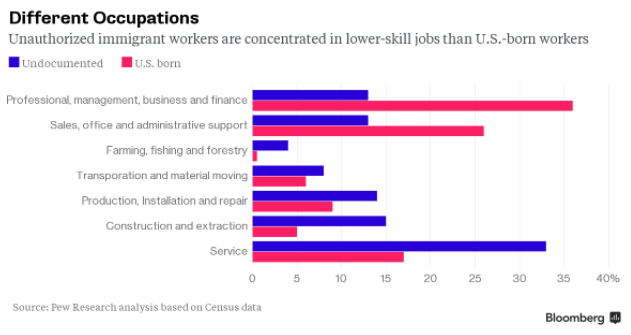
The Washington Post illustrates a specific example of this labor shortage that would occur in California, Nevada, Texas, and New Jersey. The article states, “[E]ven if every unemployed American in those states took an undocumented worker’s job — wildly unlikely, given that most Americans are unwilling to do the dirty jobs filled by many immigrants — it would still leave hundreds of thousands jobs unfilled.” In California, undocumented workers range anywhere from a third to half of the agricultural workforce. Deporting these immigrants would affect about half of the fruits and vegetables consumed in America and cripple California’s farming industry.
Deporting 11 million immigrants would provoke massive international displacement. Dictators and extremists cause humanitarian exoduses, not those with democratic principles.
Regardless, all of this fear mongering over immigrants is in vain. On top of the evidence already presented, plenty of other studies have shown the benefits of immigration for host countries. I sifted through examples from Miami to Great Britain, but I settled on a scenario from South Africa published in Foreign Policy magazine to illustrate my point.
Before the end of apartheid in the early 1990s, black South Africans had their citizenship revoked and were exiled to quasi-nation states called Bantustans, cut off from white South African society. Before apartheid fell, white South Africans were afraid, as many in America are today, of what would happen when the barriers fell and the black South African population (9 times that of the white population) flooded the labor market. To put this into perspective, this would be the same proportion as the entire population of Brazil, China, and India simultaneously immigrating to the United States. The result was unlike anything anyone expected. Household incomes for both black and white South Africans doubled between 1993 and 1994. This type of economic situation has repeated itself as well. When the EU lowered labor migration restrictions between European countries Portuguese immigrants rushed to Denmark for work. This left both Denmark and Portugal with a more than 2% GDP increase rather than economic collapse.
The above examples illustrate that immigrants are complementary workers to native populations. They get more work done faster, and they do not simply come and take jobs. They create more. More jobs and more wealth. This is a statistic that Donald Trump should look into. Instead of building a wall to block out immigrants and silence their cries for help, we should be building bridges to help those in need and allow them to contribute to our economy. Instead of deporting 11 million immigrants, we should be granting them a path to citizenship so they can continue to contribute to our economy and be allowed to pay taxes.
Conclusion
The Mexican border wall and broad deportation plan are the extreme end of President Trump’s policy statements on immigration. His administration has backpedaled from some of these claims, but the possibility of a partial implementation, or reversal of policy remains. My hope is that the aforementioned policy proposals have been placed in sufficiently clear light regarding their actual effects on the U.S. population and economy.
A Reflection on the Peaceful Transition of Power: Why Inauguration Day Was More Important Than Most Realized
Staff Writer Matthew Chakov analyzes the importance of transitions of power in democracies.
“I do solemnly swear that I will faithfully execute the Office of President of the United States, and will to the best of my Ability, preserve, protect and defend the Constitution of the United States.”
The oath of office. Thirty-five words that draw millions (well… sometimes millions) of people to Washington D.C. every four years. January 20th, 2017 was a very emotional day, and certainly one that will go down in United States history for many reasons — especially because nobody, not even the president himself, imagined or could have imagined that day would ever come. Some Americans were elated; others, terrified. Despite the mixed reactions, all Americans on that day were bequeathed a new commander-in-chief.
However, it was not the inauguration of a billionaire real estate developer turned reality TV star that was the most thought provoking aspect of the day, nor was it the fact that he was a precedent breaking individual defying a myriad of democratic norms during the transition. But it was that the next of the long line of peaceful transitions of power in United States history was officially a success. Americans seem to forget about the record setting 200 plus years of administrations taking a bow and stepping off the stage, sometimes even to let the new blood reverse everything they had accomplished in their time in office. Pundits and politicians alike mention it on occasion, but nobody takes the time to ponder how big of an accomplishment it really is. It’s taken for granted.
A major reason that such a pivotal achievement is glossed over in political discourse is because of its normalcy. Humorously, a quote from the animated show Futurama best explains this phenomenon: “When you do things right, people won’t be sure you’ve done anything at all.”
Every four or eight years, the metaphorical keys to the White House are handed off to the next administration without a drop of blood. We do not think about the truly beautiful or complicated processes that drives our world until they break down in front of our very eyes, and that is exactly what happened in early December 2016 in a country far away from America, yet relevant to this discussion.
Not Your Typical Juxtaposition
While the eyes of the world were focused on the upcoming Trump Administration and the tumultuous transition, The Islamic Republic of The Gambia (the Gambia) had a presidential election on December 1st, 2016.
The African country gained its independence from the United Kingdom in 1965, but it formed a “loose confederation” with Senegal, an adjacent country, in the early 1980s that broke down just a couple years later. Sir Dauda Jawara, the Gambia’s leader from the country’s inception, was ousted in a military coup d’état in 1994 by 29-year-old Lieutenant Yahya Jammeh who has since been the president. The over two-decade rule by President Jammeh was very characteristic of a military man who came to power in a coup; everything that one would expect from more publicized dictators on the international stage. Freedom House, an organization that ranks countries according to their relatively objective version of “freedom,” ranks the Gambia among the least free countries in the world. The Gambia is sandwiched between Yemen and Swaziland in their “Freedom in the World 2016” rankings, hardly an accomplishment. Even though Jammeh had virtually complete control over his country, he still had elections, and to nobody’s surprise he continued winning using tactics like jailing political opposition and making it prohibitively difficult to oppose him with burdensome regulations and exorbitant registration fees.
December 1st came, and the people of the Gambia went out to cast their ballots like usual. But the results when the votes were tallied up left the country and the world flabbergasted. Gambian businessman Adama Barrow upset President Jammeh by tens of thousands of votes in a stunning rebuke of a dictator who had aggressively suppressed his opposition.
The transition period in the Gambia began, but it was so hectic that it made the Trump transition look seamless. At first there was reason for optimism. Jammeh announced on national television that he would concede the election and assist Barrow in the transition, but ultimately take a “backseat.” This concession by an African dictator so used to winning stunned observers, even the Gambia’s head of the electoral commission, Alieu Momarr Njai, who said, “The president is magnanimous enough to accept that he had lost the election… It’s very rare that this present situation now, in Africa, that this happens.” However, this concessionary sentiment in Jammeh did not last long because the president made another statement just over a week later calling for a new election because of “abnormalities” that could only be fixed with a new vote. This resulted in a month of fear and uncertainty in the country of almost two million.
Jammeh was condemned by the international community, and Barrow eventually fled to Senegal for his own safety. The dictator continued refusing to cede power, even declaring a state of emergency in his country that banned “acts of disobedience and acts intended to disturb public order.” Foreign troops with the permission of Economic Community of West African States (ECOWAS) decided to invade the Gambia in support of Barrow who is the legitimate president in their eyes. While this was happening, Adama Barrow was inaugurated at the Gambian Embassy in Senegal, and the troops soon stopped advancing to give time for Jammeh to decide to end the dispute diplomatically, which eventually happened. On January 21st, Yahya Jammeh left the Gambia for Equatorial Guinea with millions of dollars and some luxury cars, handing the country over to the President Adama Barrow to rule.
Reflection is an important aspect of improvement, and it’s an activity that everybody should participate in following such a divisive election. It would help the discourse in this country if everybody took a step back and admired the things that went right instead of just complaining about the things that went wrong. Even after over a year of the most bitter campaigning the country has seen in the modern era, there was a peaceful transition of power that did not get nearly enough appreciation. Looking at the situation in the Gambia made me thankful for living in a country where I do not have to worry about the conflict following the first Tuesday after the first Monday of November. The United Nations reports that over 45,000 people have fled the Gambia for Senegal in the interregnum period because of the uncertainty surrounding Jammeh and the possibility of violence. There was and still is a lot of anxiety on the left regarding the actions of President Trump, but nobody needs to be worried about a war on United States soil or any kind of violent domestic strife on or even close to the level witnessed in the small African country. An unquantifiable number of things can be said when it pertains to flaws in the American system, but watching the Gambia go through this period of chaos has granted me a new appreciation for this democracy, and I hope one day the Gambia will be able to achieve what we have.
The Death of the Blue Wall and the Return of the Southern Strategy
Staff Writer Alyssa Savo analyzes how campaign strategies change over time.
Where on earth do the Democrats go from here? That’s the big question currently confounding left-wing political strategists, pundits, and elected officials following the Democratic Party’s absolute routing in the 2016 election. The left was defeated not only in the presidency, but also at the Congressional and state levels to such a degree that the Republican Party is estimated to be in its strongest position since at least 1928. Democrats seem unable to reliably win elections anywhere outside of the safest blue states, locking them out of control of every branch of government and the vast majority of state legislatures and governorships.
In the wake of such a dramatic party collapse, it seems remarkable that the same concerns were spreading about the Republican Party eight years ago following the election of President Barack Obama. The GOP, pundits and strategists argued, was becoming increasingly reliant on a narrow faction of older and socially-conservative white voters, a demographic that could only reliably win a smattering of states in the South and rural West. The Democrats, by contrast, would be able to ascend to new heights of power by building a new coalition from America’s changing demographics, most famously described as the “emerging Democratic majority” by Ruy Teixeira and John Judis in their 2002 book of the same name. Growing populations of ethnic minorities, working women, and college-educated professionals, Teixeira and Judis argued, would join the Democratic Party’s existing base to create a nearly-impenetrable electoral alliance. The resounding success of the so-called “Obama coalition” in 2008 and 2012 only reinforced beliefs in an inevitable march towards a permanent progressive majority.
Vital to this theory was the theoretical “blue wall,” a cohort of states from the Northeast, West Coast, and Midwest that had gone Democratic in every election from 1992 to 2012. These states added up to 242 electoral votes, meaning that Democrats would only have to capture a few swing states to win the presidency; Republicans, meanwhile, held only 102 electoral votes in the equivalent “red wall,” far short of the 270 needed to win the White House. The Republican Party would have to run the field, as they managed in 2000 and 2004, in order to win the presidential election – a task made that much harder by growing populations of minorities and college-educated voters throughout the South and Southwest.
The Republican Party was quick to take action after 2008, kicking off strategies to insulate the party against the threat of death-by-demographics. In early 2010, conservative strategist Chris Jankowski launched the Redistricting Majority Project, or REDMAP, as a Republican plan to capture state legislatures and give the party an edge in congressional redistricting after the upcoming 2010 census. Jankowski’s REDMAP plan was wildly successful, enabling Republicans to seize a 234-201 majority in the House of Representatives in the 2012 election despite Democrats winning the popular House vote by 1.4 million votes. Well-funded and well-run Republican campaigns also captured a growing number of governorships and Senate seats after 2008 in spite of the forecasted national Republican collapse, positioning staunch conservatives like Wisconsin Governor Scott Walker and Michigan Governor Rick Snyder not only in swing states but within the blue wall itself. One by one, local Democratic parties in several states began to fall behind the GOP in terms of fundraising and organizing, especially in industrial Midwestern states that used to be reliably blue.
The Republican National Committee also began efforts to develop a new, modern style of conservative politics following Mitt Romney’s loss in the 2012 presidential election. Under the leadership of Reince Preibus, the RNC released the Growth & Opportunity Project in early 2013, a so-called election “autopsy report” which echoed concerns about the viability of the party’s dwindling core demographic. The autopsy report singled out Hispanics in particular as prime potential Republican voters provided the GOP move beyond the staunchly conservative party line on immigration. The Republican Party’s strategy after 2012, Preibus has said, would have to include newfound emphasis on “tone, inclusiveness, and engaging in [minority] communities” to expand its base and stay competitive with the left. Young, forward-thinking moderates who could win over Democratic-leaning voters were the best hope of the Republican Party at the national level, the conventional wisdom went.
Even after these efforts, fears lingered on the right that the Republican Party was still unprepared to combat the Democratic demographic advantage moving forward. One of the biggest proponents of the might of the blue wall heading into 2016 was Chris Ladd, a Republican columnist for the Houston Times who predicted dire odds for the GOP in the upcoming presidential election despite their success in the 2014 midterms. Ladd anticipated that the blue wall could soon encompass 257 or even 270 electoral votes by expanding to include New Mexico and Virginia, meaning that presidential elections from 2016 onward would, “until a future party alignment, be decided in the Democratic primary.” The Republican Party, meanwhile, had become too deeply entrenched in party fundamentalism and social conservatism to compete against Democrats outside of low-turnout midterm elections. The GOP would have to become a more inclusive party, and quickly, if it wanted any hope of winning the White House again.
So when Donald Trump barged into the Republican presidential primary in June of 2015, he stood in stark opposition to a party mainstream that had spent years trying to move beyond its reputation as racist, exclusive, and out-of-touch. Bipartisan ridicule of Mitt Romney’s advocacy of “self-deportation” during the 2012 election seems quaint in contrast with a candidate whose kick-off speech vocally denounced Mexican immigrants as drug dealers and rapists. Trump also went far beyond the usual Republican party line of being “tough on crime” and national security, ringing the alarm on a nonexistent crime waveseizing America’s inner cities and promising Muslim bans and war crimes as part of his plan to wipe out ISIS. And in spite of his obvious disregard for Republican leaders’ vision of a more inclusive and diverse Grand Old Party, Trump quickly barreled to the front of the Republican primaries. His message – economically populist on its face but underscored by a tone of racial animosity – was particularly resonant among white voters in the rural Rust Belt, who eventually proved enough to hand Trump the Presidency via the Electoral College. Donald Trump’s victory clearly didn’t rely on bringing members of the “emerging Democratic majority” into the conservative fold; exit polls showed Hillary Clinton winning women by the biggest margin of any candidate since Bill Clinton in 1996 along with little evidence for Republican gains among minorities and college graduates. Instead, Trump won by destroying the Democratic Party’s advantage in supposed “blue wall” states including Michigan, Wisconsin, and Pennsylvania.
Donald Trump’s strategy in the Midwest in 2016 was in many ways strikingly similar to the Republican Party’s “Southern Strategy” from 50 years ago. Starting in the 1960s, white Southerners who once made up the loyally-Democratic “Solid South” became increasingly resentful of integration and civil rights legislation being forced upon them by liberal Democrats in the federal government. Republican candidates began to campaign in the South on platforms carefully crafted to avoid embracing blatant racism while still speaking to racial fears felt by many white voters. By tackling issues like busing and welfare with arguments based on “states’ rights” and economics, Republicans allowed themselves plausible deniability while still distinctly feeding into their voters’ deeply-felt racial animosities. In a 1981 interview, Republican strategist Lee Atwater succinctly described the Strategy:
“You start out in 1954 by saying, “N*****r, n*****r, n*****r.” By 1968 you can’t say “n*****r”—that hurts you. Backfires. So you say stuff like forced busing, states’ rights and all that stuff. You’re getting so abstract now you’re talking about cutting taxes, and all these things you’re talking about are totally economic things and a byproduct of them is blacks get hurt worse than whites. …obviously sitting around saying, “We want to cut this,” is much more abstract than even the busing thing, and a hell of a lot more abstract than “N*****r, n*****r.””
Parallels can easily be drawn between the Southern Strategy attacks on social welfare policies and Trump’s aggressive “America first” rhetoric of today. His pledged Mexican border wall and crack down on immigration into the United States have often been justified as consequences of “economic anxiety,” a reaction to a hollowing out of inner America chronically ignored by the political establishment. At its core, this argument isn’t wrong: the parts of the country that swung the most towards Trump and away from the Democrats are mainly areas in the rural Midwest with the greatest number of blue collar jobs vulnerable to outsourcing or automation. But at the same time, 2016 exit polls showed Hillary Clinton winning voters who named the economy as their top concern by significant margins in states like Michigan and Wisconsin, implying that support for Donald Trump has to do with more than pure economic interests.
Donald Trump’s militant anti-crime and anti-terrorism rhetoric, too, seem more seated in stoking racial anxiety than addressing actual issues. Despite Trump’s repeated claims to the contrary, crime is at a 20 year low in America, and his botched “refugee freeze” on certain majority-Muslim countries largely targets countries with no history of terrorism in America while giving a pass to others with significant terrorist pasts such as Saudi Arabia and the UAE. Further, a University of Massachusetts study found a strong relationship between white voters’ likelihood of voting for Trump and how strongly they deny the effects of racism, a pattern that didn’t occur with John McCain in 2008 or Mitt Romney in 2012. It appears evident that Trump, intentionally or not, employed a sort of “Midwestern Strategy” to win over working-class white voters in the Midwest who once were loyal Democrats and voted for Barack Obama four years ago, much as the Republican Party captured the Solid South half a century ago.
It’s unlikely that either Republican leadership or Donald Trump could have done such intensive damage to the blue wall on their own in 2016. Years of effort by the RNC served to undermine the Democratic Party at the state level in the Midwest, sticking them with a mediocre selection of candidates and massive deficits in funding and staff despite the national party’s continuing confidence in the region. In turn, Donald Trump’s incendiary racial rhetoric and laser-precise populist appeal on economic issues gave him the needed edge to rip into Democratic margins among working-class whites in the rural Rust Belt. The alliance between Republican Party officials and their popular nominee was at best unsteady and at several points outright hostile, but ultimately proved to be the political “odd couple” necessary to deliver 2016 for the Republican Party at every level of office.
The Future of the Parties
The result of the 2016 election pose major challenges for both parties moving forward, most critically the Democratic Party which just a few months ago was growing worried that a GOP collapse could leave them without robust opposition. Democrats have to quickly come up with an alternative to the “blue wall” in time for 2018 and 2020, as they can no longer count on historical loyalty in the Midwest and also lag behind in supposed emerging Democratic Sun Belt states like North Carolina and Arizona.
The Democratic Party could make an effort to recapture the Rust Belt states that turned against them over the course of the last eight years, a tactic that would likely require the party to recalibrate its national platform to appeal more to white working-class voters. Democrats may have pulled off a victory in the Electoral College if, as some Bernie Sanders loyalists have argued, they had spent more time promoting their own populist economic polices and less time on divisive social issues like reproductive rights and immigration. However, this theory doesn’t explain why, for the first time in history, every single state voted for the same party for President and Senate in 2016, resulting in decisive defeats of Midwestern progressives like Russ Feingold in Wisconsin and Ted Strickland in Ohio. In addition, even if the left had scraped together a victory in 2016 by holding on to the Midwest, it’s possible they would just be delaying the inevitable. As Sean Trende and Derek Byler have documented in their RealClearPolitics series “How Trump Won,” the Democratic Party pulled even in rural and urban areas in 1988, but since then has become increasingly concentrated in metropolitan areas while falling out in rural areas and small towns. Odds were going downhill for Democrats in the rural Midwest long before Donald Trump threw his hat in the ring.
Democrats could also try to attempt a reverse of the Southern Strategy of 50 years ago by targeting diversifying, vote-rich states throughout the South and Southwest including North Carolina, Arizona, Georgia, and Texas. While these states are all Republican leaning to some degree now, growing populations of Hispanic, African-American, and college educated voters in coming years could make them vulnerable to pick-ups by Democrats in the future. Even in 2016, Hillary Clinton performed considerably better than previous Democratic nominees in many of these states, giving the left something to hope for in future elections. A “Sun Belt Strategy” would impose its own problems for the Democratic Party, however. The fact that Donald Trump was still able to win these states in spite of his inflammatory racial and sexist rhetoric indicates that capturing the Sun Belt will be a harder battle than Democrats anticipated. In addition, rhetoric that appeals to minorities and well educated voters in the Sun Belt could further alienate white working-class voters in the Rust Belt and vice versa, putting Democrats in the tricky position of either trying to balance two very different demographics or choosing just one region to concentrate their efforts in.
Republicans, though having an obvious advantage over the Democrats right now, will also have to grapple with major rifts within their own party soon. If the Trump administration fails to deliver on its economic promises and ends in political disaster, as many anticipate, voters in the Midwest and elsewhere could turn against the Republican Party as quickly as they came to support it. But if Donald Trump starts to show returns for American workers and remains popular among the Republican base, the GOP will have to deal with a de facto leader whose policies and ideology are in sharp contrast with their own.
Traditional conservative values like interventionist foreign policy and free-trade economics remain priorities for most Republican members of Congress, even though such policies are at odds with the beliefs of both President Trump and a growing number of Republican voters across the country. Donald Trump’s warm relationship with Russia and Vladimir Putin puts the GOP in a sticky spot, for instance, considering that just four years ago their presidential nominee vocally denounced Russia as America’s “number one geopolitical foe.” Similarly, recent polls show self-described Republicans as the most distrustful of free trade’s effects on American workers, while Democrats are the most trusting, potentially threatening congressional Republicans’ current economic goals. In order to work with President Trump and maintain support from voters, conservative politicians will likely have to bend on at least some parts of their platform – a move which, in turn, could push certain demographics including educated whites and humanitarian Christians towards the Democratic party.
At any rate, the next four years and beyond are bound to see dramatic upheavals in the voter coalitions on both sides of the aisle. The theory of the “blue wall” has clearly been blown open, and the “emerging Democratic majority” also seems far more dubious than it did a few months ago. At the same time, we shouldn’t underestimate how quickly the Republican Party’s current national coalition could fall out; after all, if you’d told pundits in 1984 that solidly-Republican California and Vermont would soon be among the bluest states in the country, they’d have laughed you out of the room. Depending on the successes and failures of the Trump administration, we could be looking at a very different electorate by the next presidential election – it remains to be seen what theory we’ll be using to predict how Americans vote in 2020.
Immigration Policy Under President Trump: Toughening Up or More of the Same?
Staff Writer Erin Campbell predicts migration policy under the incoming Trump administration.
Since the day he announced his candidacy for President of the United States, Trump has called for comprehensive immigration reform, usually spouting, “We’re gonna build a wall, and Mexico’s gonna pay for it!” Through telling his supporters that immigrants have taken jobs away from hard-working Americans and given only higher crime rates in return, Trump’s anti-immigrant rhetoric has energized xenophobic movements in the United States. Consequently, a palpable national tension between white nationalists and minority groups surges, leaving undocumented individuals fearing for their future and safety. As Trump’s political style lends itself to vague (yet “tremendous”) promises, it is difficult to forecast how exactly the President-elect will choose to reform immigration policy come January. Throughout the duration of his campaign, Trump has presented various – and at times contradictory – promises regarding how he will approach immigration issues while in office. Oscillating between hardline, mass-deportation strategies and the idea that skilled undocumented immigrants should be able to pursue legal status in the United States, Trump’s concrete plans for immigration reform remain somewhat of a mystery.
During a campaign rally in Phoenix, Arizona, Trump claimed, “Anyone who has entered the United States illegally is subject to deportation – that is what it means to have laws and to have a country.” Yet, at the same time, he has expressed that the United States economy stands to benefit from immigrants seeking further education. In an interview with Chuck Todd on NBC’s Meet the Press last fall, Trump explained, “We’re going to try and bring them back rapidly, the good ones…We have to bring [immigrants] that are university, you know, go to universities, that are doctors. We need a lot of people in this country.” Nonetheless, Trump’s immigration platform contends that the United States’ primary security interest lies in ensuring every inhabitant resides in the country legally, suggesting the ultimate goal of deporting the 11 million unauthorized immigrants currently in the U.S.
In order to ensure all undocumented immigrants are removed from the country, Trump has vowed to strike down every executive order Obama enacted during his time in the Oval Office, and as the next President of the United States, Trump has the power to do so. Such an act would terminate the Deferred Action for Childhood Arrivals (DACA), a policy that has granted protection and work permits to young immigrants brought into the country as children. Should Trump choose to enforce removal proceedings against those that DACA has benefited, more than 700,000 people face the risk of deportation. When pressed to detail his plans to pay for his more robust deportation efforts, Trump has hinted at reallocating funding from federal bureaus such as the Department of Education and the Environmental Protection agency.
Serving as an influential voice throughout the campaign, Trump’s long-time supporter and recent pick for U.S. Attorney General, Alabama Senator Jeff Sessions, has built his political career on anti-immigration rhetoric and calls for mass deportations. As head of the Department of Justice, Sessions would have the ability to direct national resources toward the currently backloggedimmigration courts. By encouraging federal prosecutors to increase the number of criminal cases brought against undocumented immigrants and by hiring more right-leaning judges for federal immigration courts, Sessions would have the power to speed up the removal proceedings for hundreds of thousands of undocumented immigrants. Additionally, with Sessions as Attorney General, Trump could withhold federal funding from more than 200 self-proclaimed sanctuary cities, including New York, Chicago, and Los Angeles, which offer refuge to undocumented immigrants in order to force local governments to share information and more fully cooperate with the U.S. Immigration and Customs Enforcement (ICE).
On a contrasting note, House Speaker Paul Ryan assured many fearful Americans that the President-elect’s administration would not direct efforts toward Trump’s “deportation task force,” stating on CNN’s State of the Union, “We believe an enforcement bill, a border security enforcement bill is really the first priority and that’s what we’re focused on.” Indeed, Trump’s border wall became a major talking point throughout his campaign. Though he often spoke of his wall as a modern feat of architecture during election season, he has since admitted that stretches of the border wall may be guarded by a fence, or left to natural barriers. To help secure the border, Trump states he will hire several thousand new Border Patrol agents and end Obama’s “catch-and-release” policy, instead forcing unauthorized aliens out of the country upon point of entry.
Following his win in the election, however, Trump has seemingly taken a step back on some of his more polarizing campaign promises on immigration. To contrast the hate-inciting rhetoric he employed earlier in his campaign, Trump has offered that, upon completion of the fortified border wall/fence, he may soften his policies on deportation. During his 60 Minutes interview with Leslie Stahl, he stated, “After the border is secure and after everything gets normalized, we’re going to make a determination on the people that they’re talking about who are terrific people, they’re terrific people, but we are going make a determination,” though the implications of this position remain unclear. Moreover, while Trump has in the past portrayed undocumented immigrants in a broadly negative light (“They’re bringing drugs. They’re bringing crime. They’re rapists,” though, “some of them,” he assumes, “are nice people”) his tone appeared more nuanced in his 60 Minutes interview. He stated:
“What we are going to do is get the people that are criminal and have criminal records, gang members, drug dealers, we have a lot of these people, probably 2 million, it could be even 3 million, we are getting them out of our country or we’re going to incarcerate. But we’re getting them out of our country, they’re here illegally.”
Though the figures he presented in the interview have been disputed by immigration experts for being exaggerated (Pew Research Center estimates the total number of undocumented immigrants at 11 million – of that number, about 800,000 are criminals), Trump’s decision to focus deportation efforts on undocumented immigrants with criminal records may alleviate the concerns felt in his initial anti-immigration rhetoric. What’s more, his plan to focus deportation efforts on so-called “bad hombres” is not so unfamiliar to Washington – Obama has similarly directed efforts toward removing criminal immigrants from the U.S.
Speaking on immigration in his final presidential debate with Hillary Clinton, Trump praised Obama’s deportation numbers. “President Obama has moved millions of people out,” he stated, “Nobody knows about it. Nobody talks about it, but under Obama, millions of people have been moved out of this country. They’ve been deported.” Over the past decade, federal enforcement rates on deportation have steadily increased. With the removal of nearly 2.7 million undocumented immigrants during his two presidential terms, Obama stands to become the U.S. President with the greatest number of deportations enforced in history. In regards to Trump’s comments on 60 Minutes, Migration Policy Institute director Muzafar Chishti expressed, “What he’s saying is sort of consistent with present policy,” given that he achieves his goal of 2 to 3 million deportations over the duration of his presidency.
Looking toward 2017, the forecast for the future of U.S. immigration policy remains uncertain. Unlike any of his predecessors, Trump embodies an unpredictable storm of pandering and promises, ever-shifting with the winds of public opinion. Though policy experts may construct an idea of what Trump’s presidency will look like through his public statements, interviews, and contributions from his advisors and allies, millions of undocumented immigrants must play the waiting game to see what their future truly holds.
A Shift in Abortion: from Surgical to Medicinal
Staff Writer Jeremy Clement explains shifts in the reproductive rights landscape.
Since the Supreme Court’s decision in 1973 to legalize abortion in all 50 states in the case of Roe v. Wade (410 U.S. 113), millions of abortions have been performed, most through surgical methods. Recent studiesshow that medication abortions are starting to rival surgical abortions in the United States, a phenomenon that has been occurring in Europe for some time. The FDA has developed a new evidence-based regime for the drugs used in medication abortion, but regulations in some states keep the rate of medication abortions around 43%, while states like Iowa and Michigan with no restrictions have higher rates, around 55-65%. Before discussing these state restrictions, it is important to know what exactly medication abortion is, as well as any issues surrounding it.
Mifepristone and Misoprostol
The two drugs used to perform medically induced abortions are Mifepristone and Misoprostol. Mifepristone (approved in 2000 by the FDA) is given at the clinic where the patient choses to have their abortion. The drug, according to Planned Parenthood, “works by blocking the hormone progesterone. Without progesterone, the lining of the uterus breaks down, and pregnancy cannot continue.” Next, the patient takes Misoprostol at home, where they may be alone or with a loved one. Misoprostol causes the uterus to empty and complete the abortion.
Anti-abortion groups have labeled the medicinal abortion option as dangerous. They especially disagree with the new FDA regulations that make the drug easier to acquire. The President of “Operation Rescue,” an anti-abortion group in Kansas, said that “pharmaceutical companies will use the FDA’s decision to persuade more ‘vulnerable pregnant women’ to use the ‘unpredictable’ drug.”
The facts disagree with this “unpredictable” label. A study by the University of Illinois at Chicago regarding the effects of medication abortion on university students showed that the medication is safe and reliable. The researchers found very few difficulties with the procedure and concluded, “Medication abortion services in a student health care clinic are safe and feasible. However, additional treatment may be required with some patients.”
Side by side with the surgical abortion option, medical abortion is just as safe as surgery with some minor tradeoffs. With the medication option, there is less chance for cervical or uterine injury due to the lack of medical instruments in proximity to the reproductive area. There are some minor downsides including more office visits, more bleeding for the patient (although the surgical option will cause bleeding as well), and 1-3% more women will have to redo the procedure as compared to surgical abortion. However, a major advantage of the medication is that the procedure can be done in the privacy of the woman’s own home with a loved one if she so chooses.
The State of the States
As previously stated, the prevalence of medication abortions as a method varies across the states due to differing regulations. The new FDA regulations have helped surpass some of these regulations. Specifically, the regulations allow the medication to be taken for 70 days after the start of the woman’s most recent menstrual period, up from 49 days under previous regulations. The prescription process was also simplified. So, following these new regulations, what is the current condition of the states’ laws surrounding the medication abortion process?
There are three broad categories of regulations, and some states overlap containing more than one type. Three states (Texas, Ohio, and North Dakota) reject the new FDA regulations and follow the old, outdated, and more rigid regulations. Nineteen states require the clinician to be present when the medication is taken, taking away the home privacy aspect of the procedure. Lastly, 37 states require clinicians who “perform medication abortion procedures to be licensed physicians.” This last category severely restricts the supply of medication abortions. These regulations are a primary reason why the U.S. is not on par with Europe on the overall percentage of abortions completed with medication as opposed to surgery.
Implications and Future Trends
The public opinion on abortion has remained relatively the same (within 1-9 percentage points) since 1998. The majority has fluctuated between pro-life and pro-choice about 5 times since that date, with the pro-choice camp at roughly 47% and the pro-life camp at roughly 46% in 2016. This is a unique case for a social issue, given that many other social issues such as gun control, healthcare, same-sex marriage, and the death penalty have shifted left since the 1990’s.
I offer a suggestion as to why medication abortions may possibly shift public opinion towards the pro-choice camp. The main factor for my reasoning is the private aspect of the medication route. Allowing women to perform the abortion at home takes the procedure out of the public view. This means that the concerns over graphic images of late term abortions and unsafe procedures are minimized. If this more private form of abortion does not shift public opinion, it may still allow women to avoid the scrutinizing eyes of the pro-life camp just enough to mitigate further regulations and restrictions.
“A New Nationalism”: 1992 and the Birth of President Trump
Staff Writer Alyssa Savo explains the historical precedent for Donald Trump’s 2016 electoral victory.
“I understand good times and I understand bad times. I mean, why is a politician going to do a better job than I am?” – Donald J. Trump on NBC’s Meet The Press, October 1999
You could be forgiven for thinking that 2016 was the first time Donald Trump ran for President of the United States. Much was made about the Republican nominee’s lack of political experience, and his campaign certainly looked the part. The candidate regularly ignored the consensus and orders of Republican leadership, staffers were kicked out seemingly at random, and the campaign’s ground game consisted of little more than eye-catching rallies. Of course, Trump’s unorthodox campaign was ultimately enough to win him the presidency in violation of all political wisdom. But his campaign wasn’t quite as unprecedented as it’s made out to be, either.
During this election, surprisingly little attention was given to the first presidential campaign of Donald Trump–no, not this year’s, but his campaign for the Reform Party nomination in 2000. Granted, Trump’s first run for President wasn’t much to write home about, as his campaign lasted just four months and the Reform Party was little more than a footnote in the election. The eventual Reform Party nominee, Pat Buchanan, captured less than 1% of the national popular vote on Election Day. In the mythos built up around the 2000 presidential election, pundits and historians have been much more interested in debates over the Electoral College, Bush v. Gore, and Ralph Nader than the meager implications of the Reform Party.
But Pat Buchanan’s Reform campaign in 2000 was a remnant of a powerful wave of populism that swept the nation eight years earlier. Populist movements already had a proud tradition in American history, periodically resurging in national politics every couple of decades. The mid-nineteenth century witnessed the rise of the nativist Know-Nothing Party; the turn of the century saw the radical anti-bank campaigns of William Jennings Bryan; and in the 1960s, Alabama Governor George Wallace militantly defended Southern “states’ rights” and segregation. In the 1992 presidential election, another populist wave motivated by economic nationalism, cultural conservatism, and rabid anti-elitism propelled two fringe candidates to the front of the race and threatened to upend American political orthodoxy. Donald Trump’s 2016 campaign, though far more successful than the movements which came before it, simply picked up where the last wave of populism left off a quarter-century before.
1992: Pat Buchanan Takes On Washington
President George H. W. Bush was in poor shape entering the 1992 presidential election. Just a year earlier, President Bush had become a national hero due to his decisive leadership in the Operation Desert Storm campaign to drive Saddam Hussein out of Kuwait. But the President had seen his approval ratings plummet since their high of 89% in early 1991. Bush infamously recanted on his 1988 campaign promise–“Read my lips: no new taxes”–by signing on tax increases to address the climbing federal deficit, costing him dearly among voters who once admired his integrity and commitment to the middle-class. The nation was struggling to recover from a recession, leaving many in doubt of the President’s ability to lead the country through economic crisis. Bush was also developing a reputation as an out-of-touch elitist, egged on by incidents including a clip that appeared to show the President marveling at a mundane supermarket scanner. Incumbent presidents rarely face serious challenges for their party’s nomination, but in 1992 one candidate saw an opportunity to take on George Bush: Pat Buchanan, a right-wing commentator and former advisor and speechwriter to Presidents Richard Nixon and Ronald Reagan.
Pat Buchanan’s campaign against President Bush rings awfully familiar to modern ears. Buchanan described his campaign as “America first,” claiming a need for “a new nationalism” that would defend the American worker first and foremost heading into the 21st century. Buchanan attacked free trade deals that the United States signed with other nations and decried manufacturing jobs being outsourced to Japan. He called for a shutdown of immigration to the United States to prevent American jobs from being stolen by foreign labor. He rejected George Bush’s conception of an American-lead “New World Order” after the fall of the Soviet Union, asserting that the United States should stay out of unnecessary foreign conflicts and focus on domestic issues. Buchanan also railed against Washington elites, admonishing President Bush’s lack of energy and “vision.” He called for a “law and order” response to the crime wave seizing the nation, drawing criticism for racially suggestive comments he’d made in the past. And he undertook what he later coined as the “culture war,” attacking multiculturalism and liberal sensibilities–an obvious precursor to Trump’s assault on political correctness, albeit based more in conservative Christianity than deliberate vulgarity.
Buchanan’s message hit home in New Hampshire, a state roiling from the recession and the first stop in the Republican primaries. Voters in the state, fraught with economic worries, were drawn to Pat Buchanan’s promise to restore American jobs and economic power. New Hampshire was also flooded with ads attacking President Bush’s dishonesty for caving on his “no new taxes” pledge, sinking his reputation in the state. Buchanan won 37% of the vote in the New Hampshire primaries, including over half of independents and most of the 30% of voters who said they wanted to “send a message to the White House.” Buchanan’s showing in New Hampshire was also his best; after giving President Bush a severe rattling in the first primary, Pat Buchanan’s campaign began to lose steam for the rest of the race. Buchanan won 22% of the total Republican primary vote to Bush’s 72.5%. The President emerged victorious in the Republican primary, but not without some serious fatigue. Later on at the Republican National Convention, Buchanan gave a concession speech touching on several familiar refrains. He assailed the “radical feminism” of future First Lady Hillary Clinton, criticized the Democratic Party for elitist pro-free trade policies, and called for Americans to “take back our country” in the wake of the Los Angeles riots, describing the city like a war zone.
Pat Buchanan was not the only challenger to the political establishment in 1992. Though many in the nation were looking for a change from President Bush, the Democratic nominee wasn’t proving to be a very appealing alternative. Emerging from a hard-fought and bitter primary, Arkansas Governor Bill Clinton was already battling an unsavory reputation due to his involvement in the Whitewater housing scheme and accusations of sexual impropriety from multiple women. Many Americans, dissatisfied with both major parties, found themselves supporting Ross Perot, an eccentric Texas billionaire and independent candidate who announced he would run for President on CNN’s Larry King Live in February. Much like Buchanan before him, Perot campaigned on a protectionist economic plan to restore American jobs and a strong response to the crime wave, all the while railing against Washington elites and government corruption.
Ross Perot began his national campaign with a huge wave of support, leading in several polls taken in early summer of 1992. But just as his lead was surging in July, Perot unexpectedly suspended his campaign due to a bizarre alleged blackmail plot involving his daughter’s upcoming wedding, only re-entering the race a few weeks before the general election. Despite his months-long absence from the race, Perot still won 19% of the popular vote, the best of any third-party candidate since Theodore Roosevelt’s Bull Moose run in 1912. Meanwhile, Bill Clinton was elected President with 43% of the popular vote, the smallest share by a winning president since Woodrow Wilson.
The Aftermath of 1992
Pat Buchanan wasn’t ready to rest after his 1992 defeat. He ran in the Republican primaries again in 1996, this time facing off against Senate Majority Leader Bob Dole. Though Buchanan had a better-organized campaign in his second run, he still couldn’t keep up with Senator Dole, capturing just 21% of the total primary vote in a distant second to Dole’s 59%. However, Buchanan’s second campaign found a stronger audience in the industrial Midwest, where he pulled 34% of the primary vote in both Michigan and Wisconsin. Blue-collar voters, concerned about their economic future, were drawn again to Buchanan’s rhetoric about an “America first” economy that would protect the working-class and sympathized with his distrust of immigration and multiculturalism. Though Buchanan was defeated for a second time, his campaign laid a blueprint for a populist candidate to court working-class voters in regions like the Rust Belt by appealing to economic nationalism and anti-elitism.
Ross Perot also ran again in 1996, this time on the Reform Party ticket after establishing the party himself a year earlier. But the less conservative and more reform-minded crowd that Perot captured four years ago had largely come around to President Clinton, who was by then quite popular nation-wide and easily leading the race. Perot was able to win 8% of the popular vote–not a bad performance for a third-party candidate in the greater scheme of history, but a marked drop from his much more successful 1992 campaign.
The populist wave began to seriously wane after 1996. President Bill Clinton’s popularity was only continuing to increase, and a period of immense economic growth left a satisfied country less skeptical of globalism and multiculturalism. The Reform Party would face a serious crisis of character in 2000; without Ross Perot’s magnetism to unify it, many feared the primary could become a free-for-all of fringe candidates in search of a party. Pat Buchanan eventually won the Reform Party nomination, but not without enduring a bizarre and dramatic primary which at points involved Donald Trump calling Buchanan a “Hitler lover”and a counter-convention organized by John Hagelin supporters following his primary loss. Buchanan attracted just a fraction of the voters he won over in the Republican primaries, ultimately winning 0.43% of the popular vote.
The radical populist movement appeared to die off after the Reform Party’s dismal performance in 2000. After Pat Buchanan’s challenges to the Republican Party in 1992 and 1996, following primaries would be largely dominated by mainstream conservatives like George W. Bush and John McCain. Ron Paul was probably the closest successor to Pat Buchanan, a staunch libertarian with a devoted cult following who entered the Republican primaries in 2008 and 2012, but he never posed much more than a headache to party leaders. The Tea Party movement, a hard-right grassroots movement motivated by economic conservatism and anti-establishment rhetoric, briefly threatened to challenge Republican orthodoxy during Barack Obama’s presidency. However, so-called “tea-party whisperers” like Paul Ryan and Marco Rubio were effective at bridging the gap between Republican leadership and the newest popular conservative movement, helping to preserve party order.
At least, until this year. After lying dormant for nearly a quarter-century, the radical populist movement once led by Pat Buchanan returned with a vengeance to elect Donald Trump President of the United States. Trump’s presidential campaign focused on many of the same issues that Buchanan did in 1992: economic protectionism, backlash against multiculturalism or “political correctness,” resentment of the Washington establishment. But what was different about Donald Trump in 2016 that allowed him to win the presidency where Buchanan failed twenty-four years before?
Why Trump Struck Lightning
Part of the answer can probably be chalked up to pure party structure. In 1992 and 1996, Pat Buchanan was facing off against the most powerful Republicans in the country, leaving him little path to challenge party leadership and win the nomination. In contrast, Trump entered a Republican primary where attention was split between over a dozen candidates, none of which held the blessing of party leaders. Trump could take advantage of sheer personality to bulldoze past his competitors, gaining enough momentum to be unstoppable once the primary field was worn down to something more manageable. And unlike Ross Perot, once Trump won the primary he had the force of the Republican Party behind him; he didn’t have to worry about winning over conservative partisans or convincing pragmatically minded voters to throw their vote to him.
But there’s more to Donald Trump’s victory over Hillary Clinton than just being in the right place at the right time. Public opinion has shifted dramatically against globalization and the economic elite in the twenty years since the heyday of NAFTA and free trade. Many Americans believe that the economy now caters to elite interests and has ceased serving the working-class, increasing the appeal of economic populists like Trump. This sense of economic alienation only grew after the 2008 financial crisis, where to many it appeared that the federal government went out of its way to protect Wall Street and wealthy corporations while ignoring the workers those institutions left behind. For all of her progressive rhetoric, Hillary Clinton couldn’t shake her reputation as a Washington insider unsympathetic to American workers. Donald Trump, in contrast, fed into the feelings of abandonment and resentment held by many working-class voters, especially in the industrial Midwest.
Immigration is also a more salient issue now than it was in the 1990s–the number of illegal immigrants in the United States now numbers at about 11 million, compared to just 4 million in 1992. Declining faith in government and backlash against Congress also make anti-elitism and promises to “drain the swamp,” in Trump’s words, much more appealing to the public. In a 1992 interview with Face the Nation’s Bob Scheiffer, Pat Buchanan claimed Americans wanted a decisive leader who would take on Washington in response to Scheiffer’s description of the 102nd Congress as “the most partisan session that [he] could remember.” Buchanan was right, but a few decades too early.
Pat Buchanan has not been silent on the similarities between his past campaigns and the modern-day campaign of Donald Trump. In a pre-election interview with New York Magazine, Buchanan said he was “delighted we were proven right,” celebrating the similarities between Trump’s message and his own vision from 1992. In another interview with the Washington Post’s Chris Cillizza, Buchanan claimed the Republican Party will eventually realign around the values of nationalism and protectionism which Trump brought to the forefront, regardless of the will of the party establishment. He also correctly predicted Trump’s winning strategy for the presidential race, calling for Trump to “go for victory in Pennsylvania, Ohio, Michigan and Wisconsin … campaigning against the Clinton trade policies that de-industrialized Middle America.” Now that Trump is president-elect, Buchanan has expressed hopes that his ideological successor will engage in battle with Congress and refuse to back down on his radical campaign promises.
We don’t know yet if Buchanan’s prediction that Donald Trump will transform the Republican Party are true. The president-elect’s lack of political experience could make him vulnerable to manipulation from seasoned politicos, crippling his attempts to reshape the political culture of Washington. Attempts to predict Trump’s path during the election have a mixed record at best, however, casting doubt on any predictions of what a Trump Administration might look like. At any rate, the movement that propelled Donald Trump into the White House is far from new, building heavily on Pat Buchanan’s campaign from a quarter-century ago. The main difference between Trump and populists of the past is that the former was able to win a presidential election, overcoming efforts by political leaders from both sides to stem the tide of populism. Trump’s economic nationalism, backlash against political correctness, and militantly anti-elite rhetoric fed into feelings which had been fomenting among a significant portion of Americans for decades at the least. The political establishment will have to formulate a response to the Trump movement if they want to quash the populist uprising that seized the nation in 2016, or else pray that this bout of populism is just overstaying its welcome.
Trump, National Myths, and the Rise of Populism
Executive Editor Emily Dalgo provides new insight on the factors contributing to Donald Trump’s 2016 electoral victory.
It happened.
What was to me incredibly obvious a few months ago, that Donald Trump would be elected the 45th President of the United States, was a complete shock to most of the country and the world. Polls got it wrong. Experts got it wrong. GOP insiders got it wrong. American University’s Allan Lichtman got it right, but he seems to be about the only one.
Why were we so sure that Trump would lose?
How, in the wake of so many populist movements across the world, so many uprisings from the disenfranchised, so many new and growing platforms for the people who have felt their identities slipping away — whose pain and anger with the systems in place swelled until it was the only newsworthy story — could we dare to pretend for one moment that the United States would be immune to the power of a populist revolt? Our “exceptionalism” is not invulnerable to those who put truth to power, even when their truth is one we think we can cast aside as uninformed or irrational.
Frustration with the economy and leadership in a post-economic crisis world has manifested itself in various ways across the world. The so-called Arab Spring, which engulfed the Middle East and North Africa in 2010, resulted in revolutions of various types. Populist parties have won elections in Hungary, France, Greece, the Czech Republic, and Poland, among others. Jeremy Corbyn, a fringe radical in the UK Labour Party, rode a wave of voter discontent to take his party’s leadership. In Russia, Vladimir Putin’s government has turned to a nationalist foreign policy to distract a restive Russian middle class that has seen its quality of life decline. Britain voted to leave the European Union, arguing that the EU was restricting fair trade policies, strangling the UK’s choices on immigration, and threatening the British way of life.
The international uprisings founded on discontent, the increasingly momentous populist movements, and the newly-empowered, vocal, and active American right-wing community should have made us stop and seriously question the polls that told us we were safe from a Trump Presidency.
The ascent of Donald Trump in the 2016 US presidential election, anticipated by no one just a year earlier, is driven by a deep dissatisfaction with the “Washington establishment.” All of the recent developments across the world have a common thread—their supporters seek to revise the status quo at the expense of established political, economic, and cultural institutions. Trump’s appeal is no exception.
What makes a Trump supporter?
First, we must ask what makes an anti-establishment voter, since before people support Trump’s specific policies (or lack thereof, frankly) on immigration, healthcare, etc., they support the idea of Trump. The ideology driving an anti-establishment, populist voter is that a new leader who represents the people can dismantle the systems and institutions currently in place, which the voter believes have made their quality of life worse. Those who support anti-establishmentarianism want an honest candidate, unchained from the corrupt circle of elites.
Trump’s populism is a form of voter backlash against long-term social changes that threaten to dismantle the country, culture, and society that they know. In other words, many Trump supporters live in fear that the America that they know is slipping through their fingers, and that the cultural values that they define as “American” are shifting, causing them to feel apprehensive of the future and overwhelmed with uncertainty of their place and role in the country. The fear of being marginalized and left behind causes what Jennifer Mitzen calls ontological insecurity. This refers to a person’s sense of “being” in the world; an ontologically insecure person does not have a stable sense of self and place. This threat against one’s identity creates a difficulty to act and maintain a steady self-conception. In contrast, the ontologically secure person has an unquestioned sense of self and is confident of his or her place in the world in relation to other people.
While all anti-establishment movements are based on grievances and all seek to revise traditional political and social institutions, they disagree on what those grievances and institutions are, causing a split in anti-establishment movements. Bernie Sanders was an anti-establishment candidate, but could not be more unlike Trump in his political beliefs. Sanders supporters absolutely fit the mold of disenfranchised, angry voter that I just outlined in regard to Trump supporters: they wanted to dismantle the institutions (i.e. Wall Street, NAFTA) and systems (i.e. structural racism, sexism, patriarchy) in place that make the quality of life worse, and wanted an honest candidate who was “above” the politics of the political world. We can see, then, that Sanders and Trump supporters initially agree ideologically, yet they place blame on extremely different institutions and systems. Why would people who, fundamentally, share so many of the same complaints about the status quo back leaders with two very different versions of a better future?
I contend that the answer lies in one’s national Origin Story.
If we accept Role Theory, which states that people’s perceptions of their place in society shape their actions and their expectations for the actions of others, then we can start to move toward an understanding of the Sanders/Trump split in modern American populist movements. The national role is one subset of Role Theory. Individuals use their interpretations of national role to set expectations for their in-group and out-groups. In other words, people rely on their answer to the questions “who are we?” and “what is our mission?” to develop preferences over political outcomes. In this sense, national role can co-constitute a set of very specific policy preferences for a voter.
If one’s view of the national role shapes one’s policy preferences, we should be able to see distinct correlations between certain policy preferences and certain perceptions of the national role. It’s easy to put an empirical measure on policy preferences; support for a particular political party or candidate is perhaps the most obvious. But the idea of national identity is very nebulous, so measuring a person’s perceptions of the national role is difficult. Besides just asking, “what do we do?” there are alternate ways to observe an individual’s view of national role. This is where the national origin story comes in.
The origin story of America essentially answers when and why America became the America it is today. The story will change from person to person, and is dependent on a person’s view of the country, of himself, and how he constructs his own identity. Thus, the origin story fits the national role. Where you come from defines who you are and what you do. So, if people have different ideas about what we do, it should trace back to different Origin Stories. I posit that the national origin story is a salient marker of identity that can be used to distinguish between varying conceptions of nation and national role.
Divergent interpretations of the national role (measured through one’s origin story of America) are responsible for the split between anti-establishment movements based on pocketbook grievances and those focused on nationalistic and xenophobic grievances. If I have constructed my identity based on a nation that begins to undergo radical social change, my identity will be shaken. If I believe America to be a white, Christian, English-speaking, conservative country, an influx of immigrants, the enactment of liberal social policies, or the advancement of women, LGBTQ, or non-Christian peoples will shake my perception of my country. For people who base their own sense of self on their interpretation of the country, changes like these can cause ontological insecurity.
In August, I put these theories to the test. After running statistical (regression and comparative) analyses on 500 survey responses, with 240 of these coming from Trump and Sanders supporters, I have come to the conclusion that origin story is a better predictor of political tendencies than previously understood. This means that how a person views America’s origin (when did America become America?) can shed light on whom he or she will vote for. Thus, the origin story can be seen as a predictor of voter behavior.
The survey collected respondents’ demographics, their first choice for President in 2016, xenophobic indicator questions, and gave three origin stories and asked them to rate how warmly they felt toward the stories on a scale from 0-100. The stories, as they appeared on the survey, are written below.
“America came into its true character after defeating the Germans and the Japanese in the second Great War. During this time, each U.S. state and territory unified to contribute to the war effort, leading to American agricultural and industrial supremacy. Our victory after WWII established international respect and honor for American citizens, our government, and our military, proved our unity as a nation, and showcased the power and importance of the United States of America.”
“America came into its true character during the Civil Rights Movement. In 1965, African-Americans and their allies worked through multiple channels to compel the American government to recognize that all Americans, regardless of the color of their skin, deserve equal protection under the law.”
“America came into its true character when the pilgrims landed on Plymouth Rock. The pilgrims and other early American settlers were people who were fleeing the horrors of the old world, where individuals could not be free. In the New World, these young Americans created a nation based on liberty and freedom.”
Each of the three stories presented a distinct character of American identity and told a brief story of when America came into its “true character.” The story themes are based on David Bell Mislan’s previous work on identity formation, which recognized them as significant categories. The first story reflected an American origin based on power, unity, military might, international prestige, and importance. I call this story the Exceptional Story. The second story, the Legal Story, emphasized equality, opportunity, hard work, and equal protection under the law. The third story, the Enlightened Story, underscored an America that was founded on liberty, freedom, and progress away from the European “old world.”
While I originally thought that Trump supporters would overwhelmingly choose the Exceptional Story, the table below reveals the results that, upon reflection, make a lot of sense.

Trump supporters did not have a clear winner when asked to choose from three American Origin Stories; all three were almost equally chosen, and twice as many Trump supporters ranked a combination of stories equally as compared to Sanders supporters, as can be seen in the graph below.

This tells us that there is not one conception of American origin that Trump supporters follow. There is no guiding story that enlightens the average Trump supporter about who we are, what we do, and what our mission is, as Americans. This tells us a few things about Trump’s win: first, that his vague and vacillating policies were probably more of a strong suit than we thought. By refusing to take firm stances and stick with them, and instead opting to allude to ideas or simply promise to “Make America Great Again,” Trump took advantage of the ontologically insecure voter and allowed him to employ whatever conception of the national role he liked.
Sanders, in contrast, very clearly symbolized one particular national role ideology, causing him to gain a cult-like following from those who shared his same view of the country’s national role. The second take-away from this data is that Trump’s supporters possess a wide-range of origin stories and are often unsure of their own opinion of the national role. This means that for a Trump supporter, one conception of national identity might be more or less salient depending national or global current events, or how he or she is feeling about their own personal life during any given time. Sanders supporters proved confident in their Legal Origin Story of America, while Trump supporters did not all align in their beliefs and often chose more than one origin story. This could mean that Trump supporters are more easily convinced of new national roles or are more easily manipulated through messaging or false news, since they do not have a sturdy and steadfast perception of identity through which to view the world.
Trump tapped into the wave of international unrest of the establishment and of the “other,” a combination that fed perfectly into a disenfranchised, ontologically insecure voter. There is a correlation between one’s conceptions of the national role and the ability to be swayed by xenophobic ideologies. If a voter possesses ontological security, he is less likely to be convinced that groups, individuals, or ways of life outside of his own social network are an existential threat to his own safety, wellbeing, or way of life. Sanders supporters are nestled in this camp, since the Legal Story of American Origin emphasizes equality and community under the law. They feel that America did not really become America until all of its citizens were equal under the law. Thus, a Trumpian view of immigration does not fit their national narrative, because immigrants are fundamental to the understanding of America under the Legal Story framework. If a voter does not posses ontological security, he is more easily convinced that others are to blame for his own discontent.
So, it happened. In January, Donald Trump will be inaugurated. Shock, fear, anger – many Americans have felt it all since November 8th. What we need to remember, though, is that Trump supporters should not be cast aside as idiotic, uneducated, or almost anything else that prominent media outlets have called them. Yes, their political preferences might be racist, xenophobic, sexist, etc., and this should not be dismissed. But these preferences are based on deep seeded conceptions of national and personal identity, national role, and American origin. This, unfortunately, means that until we can teach “who we are” and “what we do” in a way that allows all Americans to feel ontologically secure in a globalizing world, we’re likely to see Trump-like nationalism live on well into the future.
This article presents a new angle from a full research paper completed September 2016 on xenophobia and anti-establishmentarianism, which was co-authored by Emily Dalgo and Dr. David Bell Mislan and funded by the AU Summer Scholars Research Fellowship.
And who’s gonna pay for it? The Costs of Trump’s Anti-Mexican Platform
Guest Writer Erin Campbell argues the pitfalls of Trump’s anti-Mexican policy positions.
Among large swaths of Republican voters, it is a truth universally acknowledged that the next President of the United States must enhance border security between the US and Mexico to keep illegal immigrants from entering the country and to protect American jobs. Perhaps the most pervasive of these policy proposals is Donald Trump’s monolithic response to immigration control: we’re gonna build a wall, and Mexico’s gonna pay for it. While crowds of supporters enthusiastically echo Trump’s wall demands at his rallies, the spread of their anti-Mexican rhetoric threatens US foreign relations with its neighbor, and consequently, threatens the future of the US economy and national security.
Though the specifics of his plan remain unclear, Trump asserts that his $10 million wall, measuring around 35 feet tall (and ‘it just got ten feet higher’) would impede the flow of alleged criminal activity from Mexico to the United States. With the Patriot Act serving as his legal framework, Trump claims he has the ‘moral high ground’ to impose stricter border regulation at Mexico’s expense; not only does Mexico’s ‘unfair subsidy behavior’ threaten US jobs, Mexico has an obligation to offset the “extraordinary daily cost of this criminal activity, including the cost of trials and incarcerations.”
Citing the US’s powerful economy and political dominance as coercive tools, Trump assures that Mexico will pay for the cost of a border wall “in one form or another,” through economic sanctions, trade tariffs, and/or greater trade regulation. According to the platform on Trump’s campaign website, “Mexico needs access to our markets much more than the reverse, so we have all the leverage and will win the negotiation.” As Trump pushes his characterization of Mexico as a country of “cunning” criminals who take advantage of the US’s economy, he builds an isolationist discourse that ignores the value of our international relations and paints the US as a self-sufficient hegemon that can bully its neighbors into any position that suits it.
In response, however, past and present Mexican leaders have reassured their constituents that Mexico will not bend so easily to Trump’s will. In an interview with Excelsior, current Mexican President, Peña Nieto, likened Trump’s anti-immigrant rhetoric to the fascist mechanisms of Mussolini and Hitler, warning that his unrealistic political strategy presents “simple solutions to problems that, of course, are not so easily solved.” Acknowledging that trade relations with the US are vital to the Mexican economy, Peña Nieto expressed hope to continue cooperation with the future president, whoever he or she may be. Nonetheless, the Mexican government firmly maintains that Trump’s border wall will not be constructed with any support, financial or otherwise, from Mexico.
Regardless of the feasibility of Trump’s prospective wall, his anti-Mexico platform gravely threatens the US’s relationship with an important regional ally. The North American Free Trade Agreement, NAFTA, has been instrumental in promoting economic growth and development throughout Mexico, Canada, and the US. Since its beginnings in 1994, NAFTA has strengthened interactions between the US and its neighbors; through the arrangement’s framework, the three nations have instituted mechanisms to facilitate intergovernmental relations and forums for dispute resolution. Though the tripartisan trade agreement is entrenched with asymmetrical power divisions between the three partners – as studies demonstrate the US influencing policy decisions in Canada and Mexico without the reverse occurring – the United States economy has enjoyed significant benefits from NAFTA, and a fair amount of its success is pinned to the agreement’s success.
Currently, Mexico is the US’s third largest goods trading partner, the second largest export market, and third largest supplier of goods imports – in 2015, total goods traded between the two nations amounted to $531 billion. Moreover, the Department of Commerce estimates US goods and services to Mexico supported 1.1 million American jobs in 2014. Since creating stronger economic ties with the United States, Mexico’s economy has transformed into a new level of competitiveness. While the Mexican economy felt some pressure from lowered oil prices and reduced production, its expansion of exports to the United States encouraged economic growth in 2015. Projections of Mexico’s financial future also appear positive; if Mexico continues to develop close economic relations with the US, the World Bank forecasts a gradual acceleration of growth in coming years.
Furthermore, communities along the US-Mexico border comprise the fourth largest economy in the world, and in order to encourage greater development in this region both governments must coordinate their local and national economic policies. To build upon the region’s strengths, US perceptions of the border area must transform to recognize its potential as an asset rather than a problem. Successful interaction on either side demands a more developed cross border infrastructure – not to divide and separate, but to create more windows for international exchange. By continuing to support Mexico’s growth and development, the US helps make North America more competitive on a global scale, which in turn benefits its own economic situation. Despite Trump’s populist rhetoric, investments from the US to Mexico are more than one-sided aid packages – the US stands to benefit from stronger relations with its southern neighbor.
Additionally, the existing economic ties between the two countries have helped reinforce their diplomatic relationship, especially in addressing similar security concerns like drug related violence and illegal immigration. Through programs like the Merida project, the US has assisted the Mexican government scrutinize law enforcement and institutionalize rule of law south of the border. While this program enjoyed limited successes, it serves as a starting point for further cooperation in the fight against drug related violence. In her article, US and Mexican Cooperation: The Merida Initiative and Drug Trafficking, Yasemin Tenkin argues the US could more effectively eradicate root causes of the illicit drug trade and drug related violence by investing further in Mexico’s economy, targeting poverty and unemployment. To address these security concerns, the US’s conceptualization of Mexico must shift to recognize it as a permanent, strategic partnership. Contrarily, Trump’s isolationist discourse suggests the US renounce its links to Mexico, questioning the benefits the US receives from the asymmetrical relationship.
The increasingly populist tone of bilateral relations between the US and Mexico has led to tension in the past decade, occasionally putting a strain on diplomatic decision-making; as such, a Donald Trump presidency would place bilateral relations between the two nations at risk of severe deterioration. From Trump’s perspective, the US enjoys a hegemonic status in the sphere of foreign affairs, and may wield its political power for leverage in its international relations. What Trump’s rhetoric fails to recognize, though, is that his brand of isolationism is ineffective in today’s globalized reality. In order to achieve progress in shared policy areas such as immigration reform or weakening the drug trade system, the US must maintain a working partnership with Mexico. If Trump were to stifle the Mexican economy’s growth and cut off remittances, as he proposes, the consequential loss of income for Mexico’s vulnerable population would provide prospective immigrants an increased incentive to seek better opportunities in the US; by ignoring the role of American consumers in perpetuating the influx of illicit drugs, and failing to coordinate policy with Mexico, the US can do little to address long term solutions to cross border dealings.
By promoting a characterization of Mexico as a dependent, underdeveloped, and violent country, Trump and his supporters disregard the value of Mexico’s growing economy, and hence fail to recognize the benefits of the US’s partnership with Mexico. Without cooperation and coordination between the two countries, the US would suffer the loss of a significant trade partner and destroy myriad opportunities for economic growth and employment, weakening North American competitiveness in the global market. In regards to national security, Trump’s failure to recognize Mexico’s potential as a cooperative, problem solving partner rather than the source of conflict weakens the US’s ability to create far-reaching policy solutions to stabilize the border. So who’s gonna pay for that wall, Mr. Trump? Looking at the likely economic and political future of a US without strong bilateral relations with Mexico, it looks like the United States stand to bear more costs than the presidential hopeful may have foreseen.
To Salute or to Burn: The Battle Over Flag Desecration did not End with Texas v. Johnson
Staff Writer Jeremy Clement discusses the legal history of flag burning as free speech in America.
“You are a fucking scumbag traitor piece of fucking trash.” In Missouri Donald Trump supporters shout at flag stomping Anti-Trump protesters. Violence erupts as more than 200 people take part in a standoff at the very same Trump rally. Another rally in Wisconsin includes members of the “Fuck Your Flag Tour” protesting against racial discrimination while stomping on an American flag.
Flag desecration and in particular flag burning is not a new controversy. While the act o flag desecration has been declared legal and a legitimate form of free speech by the United States Supreme Court; controversy and emotions are building over the issue again. The views of our potential candidates on this sensitive issue may be worthy of more discussion given the huge impact on our society another era division over this issue would cause.
History
In 1984 a man named Gregory Lee Johnson protested the policies of Ronald Reagan by burning an American flag outside of the Republican National Convention in Dallas. His conviction for the act was brought to the Supreme Court. Here in Texas v. Johnson (491 U.S. 397), the Court decided that “flag burning constitutes a form of ‘symbolic speech’ that is protected by the First Amendment.” The ruling was the first to protect flag desecration based on the freedom of speech. Writing for the dissent Justice Stevens argued that the government had a state interest in limiting the right to desecrate the flag due to the flag’s unique status in the United States.
When congress tried to circumvent the Johnson ruling with the passage of the Flag Protection Act the decision was upheld in United States v. Eichman (496 U.S. 310). After this ruling there were various attempted to work around the ruling by congressional statute and state laws, there were also attempts to overrule the ruling through a constitutional amendment.
Current Presidential Candidates
The most recent political battle over this issue was in 2005 and 2006 with a flag desecration bill (in 2005) and constitutional amendment (in 2006) introduced in Congress. The Flag Protection Act of 2005 was cosponsored by Hilary Clinton. This piece of legislation was different from past bills in that it sought to punish flag desecration if it were to incite violence. The New York Times equates the bill with, “attempt[ing] to equate flag-burning with cross-burning, which the Supreme Court, in a sensible and carefully considered 2003 decision, said could be prosecuted under certain circumstances as a violation of civil rights law. A middle ground between those who want to keep flag desecration legalized and those who wish to completely forbid it under all circumstances regardless of consequences or content. Both Democratic candidates, Sanders and Clinton voted no on the 2006 Amendment due to its lack of clarity and broad nature. However, Clinton did endorse a counter measure similar to her 2005 bill to replace the 2006 Amendment.
Relevance
With flag desecration issues and events popping up more frequently in this present election the votes of the past could become more relevant than the candidates would believe. Donald Trump has stated that he believes that flag desecration should be illegal and events at his rallies have shown that violence can result when people on opposite ends of this spectrum confront each other. The candidates may need to confront this issue head on at some point in the future.
The most dangerous part of this issue aside from the violence is the near 50/50 divide among the public. A Gallup poll asked for the public’s opinion on the issue in 2006 while the Flag Desecration Amendment was being discussed. The poll asked two questions, one that gave some information about the issue and the other that was more specific, the polls fluctuated the majority on each side of the issue but still hovered around 50/50. With the public so sharply divided on the issue any conflict resulting from it would be hard to resolve. Even more difficult would be to amend the constitution in favor of those rallying against flag desecration.
This particular election has seen an unusual degree of polarization. American’s have seen what they perceive to be their own American values questioned. The foundation of the system of our democracy and electoral system has been questioned by Trump through criticisms of the nomination process. Sanders has brought an economic ideology to the table that many Americans are uncomfortable with in the form of Democratic Socialism. Donald Trump has also touched nerves with his comments on race, women, and immigration. These clashes of values are extremely volatile. The question of flag desecration is even more toxic in this environment as America is redefining its image. The American flag does not stand for the same principles for everyone anymore and these polarizing points of view of America make this a nasty time for such a dangerous discussion.
Why U.S. Foreign Policy Isn’t Ready for Hillary
Contributing Editor Emily Dalgo digs into Hilary Clinton’s foreign policy record.
Hillary Clinton is now the presumptive Democratic nominee for the 2016 presidential election. While Clinton is, without question, a better fit for the job than the GOP’s inevitable nominee, Donald Trump, she might have some explaining to do before she can rally the entire party behind her. Any pro-Hillary voters who prioritize moral plans for American foreign policy should probably look into the candidate’s past in Haiti. Last summer, the Pulitzer Center hosted journalist Jonathan M. Katz for a discussion about the Clintons’ influence and rather infamous legacy in Haiti. It’s surprising how little the failures and destruction of Bill and Hillary Clinton’s presence in Haiti have been brought up so far. Hopefully by November, Clinton will have been pushed toward necessary change.
First, some background on the topic: on January 12, 2010, the deadliest natural disaster ever recorded in the hemisphere, a magnitude-7.0 earthquake, devastated Haiti’s southern peninsula and killed 100,000 to 316,000 people. Former President Bill Clinton and Secretary of State Hillary Clinton led the Haitian reconstruction effort and vowed to help the country “build back better,” so that if another disaster struck, Haiti would be able to respond more quickly and with more efficiency. Hillary described their efforts as a “road test” that would reveal “new approaches to development that could be applied more broadly around the world.”
The Clinton Foundation alone has directed $36 million to Haiti since 2010. Another $55 million has been spent through the Clinton-Bush Haiti Fund, and an additional $500 million has been made in commitments through the Clinton Global Initiative’s Haiti Action Network. But what does Haiti have to show for all of these investments? Not much, according to Katz. “Haiti and its people are not in a better position now from when the earthquake struck,” he said. The hundreds of millions of dollars and the years of reconstruction efforts have yielded negligible results. For a project so expansive, Hillary has kept relatively quiet about Haiti thus far in her campaign. Her spokesman declined to comment on how Haiti has shaped her foreign policy, saying Hillary would address that “when the time comes to do so.”
Hillary’s big plan for how she would “rebuild” Haiti in the wake of desolation was characteristically American: through business. With big corporate plans on the horizon, Bill and Hillary became exceedingly familiar faces in Haiti leading up to the 2011 presidential elections. It’s not surprising that the candidate who vowed to make Haiti “open for business” was ultimately the victor. Former Haitian pop star Michel Martelly eventually won the race, after Hillary salvaged his candidacy when he was eliminated as the number 3 candidate by convincing the parties to accept him back into the race. Katz said that this vote was fraudulent. Martelly, a businessman and strong proponent of foreign investment in Haiti, was “attractive” to the State Department, Katz noted. He very much had a “Clinton view of Haiti and a Clinton view of the world.”
That’s how Caracol Industrial Park, a 600-acre garment factory geared toward making clothes for export to the U.S., was born in 2012. Bill lobbied the U.S. Congress to eliminate tariffs on textiles sewn in Haiti, and the couple pledged that through Caracol Park, Haitian-based producers would have comparative advantages that would balance the country’s low productivity, provide the U.S. with cheap textiles, and put money in Haitians’ pockets. The State Department promised that the park would create 60,000 jobs within five years of its opening, and Bill declared that 100,000 jobs would be created “in short order.” But Caracol currently employs just 5,479 people full time. “The entire concept of building the Haitian economy through these low-wage jobs is kind of faulty,” Katz stated on Monday. Furthermore, working conditions in the park are decent, but far from what should be considered acceptable.
Not only did Caracol miss the mark on job creation, but it also took jobs away from indigenous farmers. Caracol was built on fertile farmland, which Haiti doesn’t have much of to begin with. According to Katz, Haitian farmers feel that they have been taken advantage of, their land taken away from them, and that they have not been compensated fairly. Hundreds of families have been forced off the land to make room for Caracol. The Clintons led the aggressive push to make garment factories to better Haiti’s economy, but what it really created was wealth for foreign companies. This trend was echoed when the Clintons helped launch a Marriott hotel in the capital, which has really only benefited wealthy foreigners and the Haitian elite.
Mark D’Sa, Senior Advisor for Industrial Development in Haiti at the U.S. Department of State, said that many of the Clintons’ promises remain unfulfilled and many more projects are “half-baked.” Haiti remains the most economically depressed country on the continent. If Hillary wins in 2016, U.S. policy geared toward Haiti will undoubtedly expand, meaning even more money will be funneled to the Caribbean nation to fund the Clintons’ projects, for better or for worse. According to Katz, the truth is that we don’t actually know how much money has been thrown into the Caribbean country to “rebuild” it, and that with economic growth stalling and the country’s politics heading for a shutdown, internal strife seems imminent.
The introduction of accountability for the foreign aid industry is the most important change that can be made, according to Katz. Humanitarian aid does nothing positive or productive if there are not institutions in place, managed by individuals who actually live in these countries, to oversee that aid is serving rather than hurting the people it is supposed to “help.” Hillary Clinton’s efforts in Haiti have fueled political corruption, destroyed arable farmland, and have forced hundreds of families to leave their homes and their jobs to make room for a factory that has not given even a fraction of the amount to Haiti as it has taken. If the introduction of accountability is the way to go, then we first need to start talking. So Hillary, what do you have to say about Haiti?
Can Donald Trump the WTO?
Associate Reviewer Paul Jeffries discuses the international legal implications that undergird Donald Trump’s trade policy.
Yes—it’s another piece covering Donald Trump’s policies—but don’t leave quite yet; I promise to not fall into the enticing leitmotifs typical of the current status quo for journalistic coverage of Trump. Allow me to explain.
Be it on the left or the right, there seem to be two major fissures into which commentators fall whenever Trump’s name is mentioned—sardonic, arrogant insouciance, and melodramatic fear-mongering. Those in the former camp will attempt to write the entire Trump phenomenon off as a manifestation of angry whites too ignorant to see that his proposals are all nonsense and that he is leading them to an inevitable slaughter in a general election; they don’t deem his policies worthy of analysis because they believe the probability of his winning is zero. Those in the latter camp will attempt to spin every Trump statement as an apocalyptic forecast, harking a potential Trump presidency as the harbinger of immediate international Armageddon. Both seem, to me, ridiculous. The first comes with the assumption that Trump’s campaign has exposed nothing useful whatsoever; whereas, I concur with scholars like Dani Rodrik and Paul Krugman who believe that the populist wave of support behind a candidate like Trump has highlighted a failure of the US system to share adequately the fruit of globalization and international trade equally amongst the US population. The second sacrifices the reality of the US constitutional system of checks and balances in favor of exaggeration for the sake of ratings and clicks; after all, what would attract more viewers—a piece that recognizes the relative impotence of the US presidency given the division of power between the three branches of government, or one that harks Trump as a Hitleresque totalitarian who will destroy the world?
As with most political polemics, clinging to one ideological line doesn’t lead to much in the way of constructive discussion. Thus, I will not caricaturize Trump using a broad, ideological brush. Nor will I go soundbite-hunting (which honestly requires little creativity during this campaign cycle) in order to cherry-pick quotations that could then be falsely described as Trump’s trade policy. Instead, wary of the aforementioned chasms that flank me on both sides, I will attempt to go straight to horse’s mouth to analyze Trump’s trade policy reform proposals, basing myself only on his one and only official campaign position paper that pertains to trade—“U.S. – China Trade Reform.”
A few final disclaimers before proceeding to the targeted analysis are apposite. First, the paper the policy paper under scrutiny here only directly apostrophizes China; however, the policies proposed implicate much more than the bilateral US-China trade relationship. As a result of this, even though this is the only trade-related policy paper of Trump’s, we can deduce a great deal from the suggestions therein when it comes to understanding Trump’s broader approach to trade. Trump’s trade policy paper does contain a variety of economic figures used to justify the proposals therein. I will not be fact-checking any of these myself; there are plenty of better-suited sources that do precisely this type of work. My intention is to examine Trump’s major reform proposals, explicating both the international legal mechanisms they target, as well as the potential effects they would have if carried out in their entirety.
Distilling the signal from the noise
Some have called the Trump campaign “substanceless,” arguing that he is all talk with no concrete policy proposals. While hyperbolically effective, that is not true when it comes to trade; there are certainly enactable proposals contained within Trump’s policy paper. That said, there is also a great deal that is simply talking point fodder disguised as policy. There are many examples of this type of non-policy proposal peppered throughout the paper—too many for each to be explained in this article—hence, I want instead to begin by offering a framework for sifting through these purely rhetorical proposals, identifying a few glaring examples of strong words, without any legal authority behind them.
When looking for practical trade proposals that could actually be enacted, it is important to remember that the executive branch in the US has relatively little power in determining trade policy. The U.S. Constitution is perfectly clear in its delegation of trade authority to the Congress, not the Executive. Article I, Section 8 gives Congress the sole authority “to regulate Commerce with foreign Nations.” This power is no longer absolute, however. In the 20th century, it was quickly discovered that logrolling in the Congress was a political tendency that would make crafting trade deals in the Congress alone untenable. As such, the so-called “fast track presidential authority” to broker trade agreements was created by the Trade Act of 1974. While this act did delegate the authority to negotiate trade agreements to the President, it is an impermanent power that must be persistently re-authorized by the Congress. Even today—an age that many would commonly believe is dominated by trade agreements in-the-works such as TTIP and TPP, the president’s authority is very limited. The only TPA authority currently active is the Trade Preferences Extension Act of 2015, which grants the Obama administration limited “power to negotiate major trade agreements with Asia and Europe.” In short, the next president of the United States will have to seek renewed TPA from Congress, and even if it is allotted, any deals made or tariffs proposed are entirely at the mercy of congressional approval. With all this in mind, we can craft a strategy for identifying concrete proposals—finding the signal amidst the noise. We should interrogate every proposal by inquiring: what mechanism is being used to accomplish the policy aim (tariffs, duties, etc.), and what legal entities ultimately control said mechanisms.
As an example of a proposal that is backed by no concrete policy, let’s examine one of Trump’s suggestions regarding a harmonization of environmental and labor standards:
China’s woeful lack of reasonable environmental and labor standards represent yet another form of unacceptable export subsidy. How can American manufacturers, who must meet very high standards, possibly compete with Chinese companies that care nothing about their workers or the environment? We will challenge China to join the 21st Century when it comes to such standards.
As can be seen, this proposal offers the perfect opportunity to test the framework laid out previously. We see very clearly that there is a policy aim—ensuring that the US and China are both held to similar environmental and labor standards—but there is no mention of the mechanism that would be used to accomplish this policy aim. This is surprising, because resorting to tariffs as a default policy tool is a well-documented favorite of Trump’s. Even though the paper mentions no mechanisms and thus cannot be analyzed as policy, we can still answer the second question of our framework, because there is a legal entity that does in large part oversee the standards that Trump would like to see more equally followed: the World Trade Organization (WTO). In fact, this is not an outlier; in most of the instances in Trump’s trade policy paper where a policy aim is announced without a specified mechanism or legal entity being referenced, the issue likely falls under the umbrella of disputes for which the WTO already serves as a forum. This incongruence hints at what I find to be the most confusing and, in my estimation, untenable characteristic of Trump’s trade policy. It seems to argue on various fronts for vigorous US reengagement at the WTO, pressuring other countries—namely China—via the WTO dispute settlement mechanisms more than ever before, while concomitantly arguing for the brandishing of tariffs and other protectionist measures the likes of which the US has not seen since Herbert Hoover held the presidency.
A trumped-up WTO strategy? – Enforce some rules ardently, while breaking others unabashedly
The internally contradictory nature of Trump’s policy proposal as concerns the United States’ role at the WTO is difficult to untangle, but perhaps no better microcosmic representation of the strategy exists than this paragraph concerning how Trump plans to combat “China’s illegal export subsidies and other unfair advantages.”
The U.S. Trade Representative recently filed yet another complaint with the WTO accusing China of cheating on our trade agreements by subsidizing its exports. The Trump administration will not wait for an international body to tell us what we already know. To gain negotiating leverage, we will pursue the WTO case and aggressively highlight and expose these subsidies.
As we can see, the second sentence intimates that a Trump presidency would not wait for the WTO dispute-settlement process to run its course. While an alternative legal mechanism is not proposed, we can insinuate from the rest of the policy paper that what is implied is that the US would pressure China with countervailing duties and tariffs. That said, the following sentence is a complete reversal; without even skipping a sentence the proposal pivoted from “not wait[ing] for [the WTO] to tell us what we already know,” to “pursu[ing] the WTO case” aggressively.
For the sake of a thought experiment to explore the implications of this internal contraction if actually put in practice, let us assume that Trump carries through on all such promises—both of more aggressive WTO dispute settlement action against China, and of simultaneous tariff use. What would come from this? Those who paint Trump’s policies as perfectly pursuant to John Bolton’s view of international law would be exposed as wrong, because even Bolton, who believes that international law has no moral character and instead is only what states will it to be, acknowledges that certain systems exist—such as the WTO—that can be used by states to secure beneficial outcomes if adhered to. If the two previously mentioned Trump policy proposals were both enacted, the result would be devastating for the United States because of the current structure of the WTO dispute resolution mechanisms.
WTO dispute resolutions over subsidies are governed by the “Agreement on Subsidies and Countervailing Measures,” and given the diverse ways that subsidies can be disguised (which Trump rightly identifies in the policy paper), successfully winning a dispute before the WTO takes time and a great deal of fastidious effort. On the other hand, the levying of a tariff such as those for whose implementation Trump argues all throughout the policy paper, beginning with the very first paragraph of the “Details of Donald J. Trump’s US China Trade Plan,” is in blatant violation of a host of more universal obligations, and Trump’s proposals would bring the US into immediate breach of GATT Article I—the most favored nation principle that WTO members should treat all imports equally—as well as GATT Article II—the restriction of tariffs to a maximum of the “bound rate” established in the tariff schedule.
Why then, would this be so detrimental? Again, it is a matter of the legal mechanisms that undergird these two separate processes. While the WTO dispute settlement for subsidies is a long, complex process, tariffs are the most overt form of protectionism, and, as Scott Lincicome of The Federalist appropriate states, “such an obvious violation of WTO rules would make for the easiest WTO dispute in the organization 20-year history.” Hint, the US would lose.
Thus, the hypocrisy of Trump’s proposals as concern the US’ role in the WTO is damaging not just because they are difficult to understand and ideologically self-contradictory (are we for or against the WTO?); they are prejudicial because if they were actually to be enacted, they represent a fundamental misunderstanding of how the WTO dispute-settlement processes operate, and would lead to disproportionate harm for the United States, while China—the target of all of these policies—would actually be able to impose countervailing duties, and the rest of the WTO member states would be justifiably on China’s side, as they have the strength of numerous international legally binding accords behind them.
But what about efficient breach? International legal scholars agree that’s a thing, so…
No. Allow me to stop you there. Efficient breach definitely is a thing, but to apply it in light of Trump’s policy recommendations here would be a gross misunderstanding of that legal school of thought. Eric A. Posner—the intellectual father of efficient breach—agreed with Bolton, in that both espoused the belief that international law had no moralistic underpinning, and was thus a tool for states to use to maximize their well-being. This is a line that sounds like it would fit very well with Trump’s “America First,” doctrine, but to take the next logical leap and say that Trump’s plan is thus one that might be espoused by the likes of Posner and Bolton, would be to convolute sound legal theory with obfuscous rhetoric.
The principle undergirding efficient breach is that of economic efficiency of trade-offs; i.e., international norms (such as adherence to WTO rules) can be broken if the relative economic efficiency of breach outweighs that of continued compliance. Trump’s international trade policy proposals highlight a variety of key problems that are sadly oftentimes left undiscussed because of the polemical—and thus media-attracting—nature of other claims therein. He addresses many issues that should be addressed by the next president—be it the disproportionate distribution of benefits from international trade amongst Americans, to the need to pursue greater harmonization of compliance with international commercial standards so that some nations are not disadvantaged while others are able to dodge safety and labor regulations. That said, all of these issues are overshadowed by the self-defeating nature of Trump’s policy proposals vis-à-vis the WTO. Without even broaching the cultural, sociological, and political implications of overtly breaching the GATT—a subject which would merit an entire article of its own—Trump’s trade policy is currently plagued by a coherence problem identified by our previously established analytical framework. Even if one agrees with every beginning presumption and aim expressed in Trump’s policy paper, the legal mechanisms in place that govern international trade would result in a terribly inefficient breach. WTO law is not all trumpery, and Trump would do well to remember that that which is rhetorically powerful matters much less than that which is legally efficient.
More of the Same: Bernie’s Foreign Policy, Just War Theory, and International Humanitarian Law
Executive Editor Bill Kakenmaster analyzes the feasibility of Presidential Candidate Bernie Sanders’ foreign policy proposal.
The 2016 presidential race has, without a doubt, become one of the most significant electoral phenomena in recent American history. Moreover, the Islamic State (IS) poses a historic problem for candidates, and although foreign policy has not taken center stage, a quiet but vociferous debate goes on about whether the Democrats’ left hand—Bernie Sanders—is more of a hawk or a dove. Sanders basically has no chance of winning the Democratic nomination, but has affected the presumptive Democratic nominee’s position in significant ways. We know enough about Clinton’s foreign policy history given her tenure as Secretary of State, but we know little about Sanders’ positions and how they would possibly influence Clinton. Is Sanders’ policy towards IS theoretically legal? If it reaches the threshold of legality, does that necessarily mean it fulfills the requirements of jus ad bellum and jus in bello? Two useful yet tragically under-utilized lenses for analyzing candidates’ proposed military aggression are those of just war theory and international humanitarian law.
Just War Theory and International Humanitarian Law
International humanitarian law, sometimes called the laws of war, is a set of international legal obligations that applies to states during times of conflict and proscribes them or their agents from certain actions in order to mitigate the harmful consequences of armed conflict. Just war theory provides the legal justification for international humanitarian law, and: jus ad bellum and jus in bello. Jus ad bellum relates to states’ preparatory actions for engaging in conflict before actually doing so. Jus in bello states that, whatever states’ motivations, their wars must be conducted justly. Without going into too much detail, the international humanitarian legal regime takes jus ad bellum and jus in bello as given requirements of warfare—these are like constitutional principles that cannot be violated. The rights granted to states by jus ad bellum and jus in bello are the rights to (1) declare war with just cause and (2) respond to force proportionally. Jus ad bellum derives legal support from Articles 2 and 51 of the UN Charter. Jus in bello’s derives legal support from the Geneva and Hague Conventions, and from customary international law. States have five minimum requirements according to just war theory. First, any just war must be waged by an internationally recognized actor, such as a state or a coalition of states, and must be announced publicly ahead of time. Second, wars must be waged with just intentions, such as the maintenance or restoration of peace. Third, states waging war must only do so if there is sufficient evidence to suggest that the war’s objectives are achievable—the laws of war prohibit mass violence if nothing will likely come of it. Fourth, wars must be waged via proportional means. In other words, if one state invades and conquers another’s territory, then the latter only has the right to take back what is due, not conquer more than its fair share of the former’s territory. Finally, war must only be a last resort after exhausting all other, non-violent means of conflict resolution. As long as states meet these five requirements, their foreign policies are theoretically legal under a just war framework.
It is not useful to list every illegal offense in this essay, which is only concerned with Sanders’ response to IS. Matters of international humanitarian law are almost never as clear-cut as deeming something legal or illegal; they depend on innumerable factors and can be justified in myriad ways by a competent lawyer. However, international humanitarian law relates to jus in bello and derives its authority from two principle legal sources. First, international humanitarian law derives support from hard sources of law in treaties like the Geneva and Hague Conventions, and other legal documents. Second, although not every state is signatory to the relevant treaties, and less have ratified the legal statutes in question, but customary law criminalizes the most severe violations of international humanitarian law. For example, drones are not explicitly banned by any international legal statute, nor are they considered inherently indiscriminate according to the International Committee of the Red Cross (ICRC). But all states going to war must satisfy the principle of distinction, meaning that they must distinguish between civilians and combatants. Drone strikes against terrorist groups like al Qaeda have a higher threshold for distinction because it is not always clear whether the target is a combatant or not. This means that tactics like signature strikes, for example, are “clearly unlawful,” at least according to the UN Special Rapporteur on Extrajudicial, Summary, or Arbitrary Executions Christof Heyns.
Sanders’ Foreign Policy
During the first Democratic debate, Sanders said, “I am not a pacifist […] I support airstrikes in Syria and what the president is trying to do.” Sanders has also shown himself wary of deploying boots on the ground. And he has even called the situation in Syria “a quagmire in a quagmire,” claiming to “make sure that the United States does not get involved […] like we did in Iraq, the worst foreign policy blunder in the history of this country.” So, if he sticks to his campaign promises, we can expect that Sanders likely will not support boots on the ground, opting instead for airstrikes and a coalition of Middle Eastern nations to combat IS—a policy the Senator first supported in 2014.
So, would Sanders’ proposed airstrike-coalition plan comply with the laws of war, and would they adhere to just war theory? On the first question, maybe. On the second, no.
Few would dispute that fighting IS sufficiently constitutes a just cause, especially if the belligerent nations include those most proximate (e.g., the hypothetical members of Sanders’ proposed coalition) and those whose citizens were killed by IS members, not just those who would be indirectly threatened (e.g., the U.S., France, and other victims of IS attacks). Barring more cynical theories that the IS was created by the West in order to justify intervention, going to war because your people have been beheaded or blown up in terrorist attacks does not represent a war of aggression, even if they may do harm to the region. Moreover, Obama’s announcement that his administration will “degrade and ultimately destroy” IS could reasonably count as a public declaration of war by an internationally recognized actor: the United States. What remains is to provide sufficient evidence that military operations are (1) the last resort and (2) likely to achieve the war’s objective. As long as Sanders sticks to his belief that “unilateral military action should be a last resort” and proffers a solution that will likely “degrade and destroy” IS, he has satisfied jus ad bellum.
Sanders’ plan does not fulfill jus in bello, however. Considering that drones are not inherently illegal, but must satisfy the principle of distinction, airstrikes comply with the law only to the unlikely extent that military leaders refrain from signature strikes and other, similar indiscriminate tactics. If, however, the military did not refrain from indiscriminate attacks à la Obama administration, the types of attacks Sanders only says are “counter-effective,” then the drone policy would violate the principle of distinction. The U.S. has not ratified Protocol I of the Geneva Conventions—the protocol officially codifying distinction—but the ICRC considers distinction distinguishing between civilians and combatants part of customary law, or “general practice accepted as law” and independent of treaties. Furthermore, assembling a coalition of Middle Eastern states might relieve the U.S. of any legal responsibility for wars of aggression—whether or not the coalition’s actions would violate the laws of war is beyond this essay. However, if the U.S. knowingly provides funding, weapons, or training to the hypothetical coalition and the latter subsequently violates any international humanitarian law, a case could be made for the U.S.’s complicity. Lastly, if the Senator’s plans include indefinitely and illegally detaining prisoners at Guantánamo Bay—or any other military prison for that matter—and employing enhanced interrogation methods with the purpose of discovering information about IS, then the plan’s detention strategy would violate international humanitarian law. In the abstract, Sanders’ vagueness puts his IS plan in the clear. But as a strategic campaign maneuver, it leaves open the possibility of violating the law when the situation supposedly calls for it. As Sanders described himself, “I am not a pacifist.”
Significant evidence suggests that drone strikes—arguably the centerpiece of Obama’s and Sanders’ plans—engender anti-American sentiment and support for IS. According to a public letter written by four Air Force service members with more than 20 years of experience between then, mistakes that result from the drone program, such as the killing of civilians and U.S. citizens “fueled the feelings of hatred that ignited terrorism and groups like [IS], while also serving as a fundamental recruitment tool similar to Guantánamo Bay.” The number of drone strikes sharply increased under Obama, which Sanders considers “constitutional and legal.” Therefore, Sanders faces an uphill battle to prove that continuing airstrikes will likely achieve the war’s objectives, and that his IS policy will comply with international humanitarian law’s jus in bello requirements.
Conclusion
As with any election, foreign policy has taken a back seat to important questions such as what to do with the economy, and this is no more evident than in Sanders’ campaign. However, all candidates’ policies towards IS represent no less important questions. Sanders can easily justify waging war against IS, thus fulfilling jus ad bellum, however his plan’s strong support for drone strikes sends it into questionable legal territory under the best circumstances, and frankly illegal territory under the worst circumstances. Insofar as it might comply with the law and established principles of justice in international relations, we might accept it as a legitimate plan, but the vagueness with which it has thus far been proffered do more for leaving open the possibility of omission of the U.S.’s legal obligations than to assuage any concerns over its illegality.
Recent Articles