
Boots On The Ground: Accountability and Responsibility for Private Military Contractors Abroad
Marketing Editor Annmarie Conboy-DePasquale forwards methods of holding Private Military Contractors accountable.
Private military contractors (PMCs) are a fixture on battlefields across the globe dating back thousands of years. Their form continues to evolve as state governments become increasingly reliant on them. Today, military contractors are divided into three groups which perform distinct tasks within the broader PMC grouping; military provider firms (MPFs) focus on tactical elements and engage in direct fighting; military consulting firms (MCFs) provide training and advice for the restructuring and operating of a client’s military; and military support firms (MSFs) that provide military services categorized as supplementary including intelligence, technical support and logistics.
As the United States’ use of contractors continues to grow, with contractual obligations rising from $187 billion in 2000 to $283 billion in 2011, the amount of control the US government has over these contractors declines. This lack of oversight and accountability gives rise to situations where the actions and/or ethics of members of the private firms who, while operating on American dollars, are bound by neither the same rules nor protections as American troops operating in the same regions; producing situations such as the Blackwater killings, and raising concerns about their ability to act outside the confines of U.S. laws while under the umbrella of government funding. Allegations of PMC involvement in human rights violations also fuel upset.
PMCs cannot be labeled as purely good or bad, they exist in a complex market wherein they are private firms with leading roles in the theatre of public warfare. They enjoy a level of autonomy which has become increasingly problematic; the incidents of PMC misconduct or mishandling rose as their degree of use in the Iraq and Afghanistan conflicts did the same. There has long been a debate over the loyalties and motives of PMCs. Leaders of the contracting groups claim their employees are subject to contractual accountability, and that it is just as binding as the oaths of enlistment taken by government armies.
Conversely, advocates of PMC policy reform state that controversy occurs when public interests diverge from those of the company. PMCs are businesses first and their ultimate goal is profit, which will always serve as a roadblock to the contractors effectiveness as military forces. By this line of reasoning, finding a way to more closely align the two sets of interests - those of the US military and PMCs - would bring about a more harmonious and successful relationship. In the case of the PMCs this may be done by writing contracts more carefully with stricter regulations or enforcing changes stipulated by the Commission on Wartime Contracting.
The aforementioned issues are largely boardroom fights; the most difficult scenarios to provide answers for take place in the field, where tensions run high and the most important component of maintaining order is a clear, respected chain of command. In the military, soldiers are subject to their immediate supervisors, but also to court-martials and ultimately to the President of the United States, as well as the nation herself. Alternatively, PMCs have little to no disciplinary structure aside from their shareholders. International law currently addresses only traditional mercenaries; there is little to no legal recourse for misconduct. PMC employees currently fall into the grey area also inhabited by detainees of Guantanamo Bay; they are neither civilian nor soldiers. This can be dangerous for the contractors, who are not protected under the Geneva Conventions.
Shrouded in secrecy, PMCs “diffuse” responsibility across actors, and in doing so, the answer to who should be held accountable becomes more and more elusive. Speaking on the subject, U. S. Army Colonel Peter Mansoor said the Army needed to take:
“a real hard look at security contractors on future battlefields and figure out a way to get a handle on them so that they can be better integrated - if we’re going to allow them to be used in the first place...if they push traffic off the roads or if they shoot up a car that looks suspicious, whatever it may be, they may be operating within their contract –to the detriment of the mission, which is to bring the people over to your side. I would much rather see basically all armed entities in a counterinsurgency operation fall under a military chain of command.”
Even before stepping onto foreign soil, PMCs represent a problematic threat from within their ranks; member recruitment is private. While many recruits are well-qualified ex-servicemen, a sizeable percentage lack proper experience or have unsavory records which include possible human rights violations. PMCs like to keep violations hidden from the media and may release employees who are then hired by other firms, unaware of their past misconduct. In the Balkans, a group of DynCorp employees was found to be involved in sex crimes, slavery, illegal arms trade, and prostitution rackets. There was even a tape of the Bosnia supervisor raping two women; DynCorp whisked the men out of the country and they never faced prosecution. Instead, they fired the “whistleblowers.” Another similar situation occurred in the Abu Ghraib prisons.
The lack of oversight present in the operations of PMC is alarming in another facet; it often allows governments to complete public goals through private means. While governments favor this option, it is a slippery slope wherein they can partake in endeavors which may not otherwise be approved, either by the public or by legislative branches. Although PMCs receive government money, their activities are not state-sponsored. Activities are happening away from public view which may have lasting impacts on foreign policy. One example of this is how President George W. Bush used PMCs to interfere in the Colombian Civil War to a greater extent than approved by Congress for U.S. military forces.
This was a source of serious discussion and debate during the Iraq war, where an average of 21,000 PMC troops in the region from 2003-2009, spiking from 10,000 to 40,000 between 2003 and 2008. PMC troops carried out countless military operations which are not accessible under the Freedom of Information Act, and which will remain secret as private contractors are not answerable to Congress. This is another grey area inhabited by PMCs; some engage in tactics not sanctioned, or even not legal, in the countries they are working in and/or under contract with. This issue again has roots in the lack of structure for assigning responsibility and accountability to employees of PMCs as they operate, and the absence of legal repercussions for misconduct.
The foundation for reforms will be the PMCs legally binding contracts. In writing and negotiating them, the DOD has the opportunity to include strict outlines for a chain of command; akin to a hierarchy for responsibility one might find in the U.S. armed forces. The establishment of a clear and necessary power structure will be instrumental in controlling the behavior of PMC employees abroad. While it is unrealistic to expect an immediate willingness from the PMCs to cooperate, the US government funnels billions of dollars to these companies every fiscal year and taking a hard line with them over contractually based responsibilities will be beneficial as the DOD continues to do business with them in the future.
Perhaps even more important than the presence of a mandated accountability apparatus is the need for it to be enforced once agreed upon. As mentioned before, there are currently some documents which place limitations on PMC conduct but they remain unenforced, enabling the accountability vacuum presently seen in the PMC theatre. Enforcement and oversight procedures must be put in place at the same time as the new chain of command.
As there are currently no international statutes under which PMC can stand trial for misconduct, the DOD must require their contractors to submit to U.S. jurisdiction or jurisdiction of the region in which they are operating under in each specific contract. This will likely be the hardest point to reach agreement on with the PMCs, but it is arguably the most important. Creating and enforcing a chain of command aimed at requiring accountability for one’s actions are crucial steps forward, but if at the end of the day PMC employees still cannot face legal consequences for misconduct, some instances being horrific acts of violence, then contractors are able to remain in their loop of unchecked power. The capacity to follow through with disciplinary actions is critical.
These are not all encompassing solutions, there are other issues which will need to be addressed. Presently, the issues of accountability and responsibility for PMC actions abroad are the most pressing in this realm and the basis for reforming these areas lies in the power of contracts.
The Mirroring of the Two 9/11s
Design Editor Camila Weinstock elucidates the ramifications of the 9/11 terrorist attacks in the United States and those of the earlier 9/11 authoritarian coup in Chile.
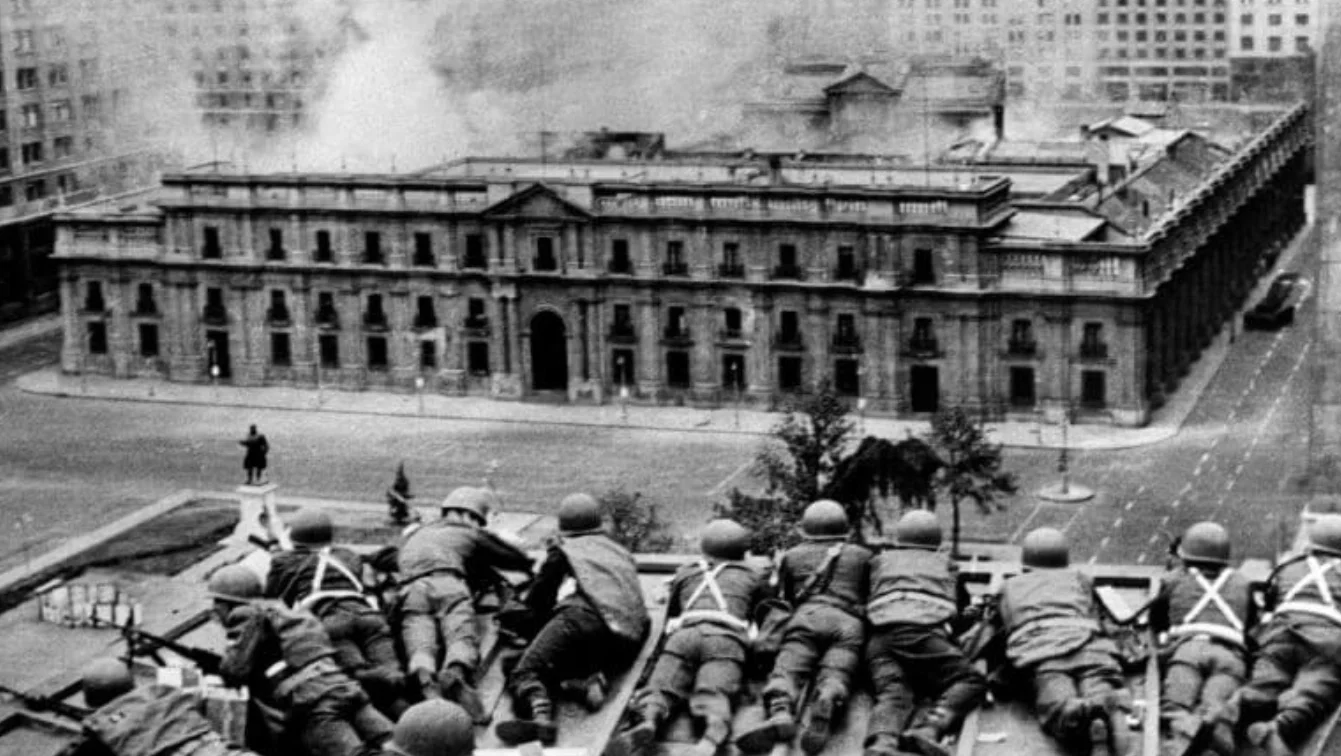
The infamous images of hijacked airplanes hitting the World Trade Center’s twin towers are etched into the minds of every American old enough to remember the morning of September 11th, 2001. The terrorist attacks of that day spurred a decades-long war in the middle east and heightened tensions surrounding what it really meant to be an American. 9/11 is a date known all around the world, but rarely does the world talk about the first violent 9/11 that occured in Chile. Whereas the United States’ 9/11 was the doing of jihadist groups, Chile’s 9/11 was a government military coup. The morning of September 11th, 1973, the military began to bomb La Moneda, the presidential palace. By the end of the day, the president, Salvador Allende, was dead, and Chile’s government transformed from a burgeoning socialist democracy into a bloody military dictatorship that would last seventeen years. Both 9/11s have eerie similarities beyond their dates; the two events can trace their origins to the Cold War, and the United States’ desire to prevent the spread of communism.
The Cold War and the Creation of the Taliban
With the creation of the Truman Doctrine, stopping the spread of communism became one of the United States’ biggest foreign policy focuses. During the Cold War era, the United States’ geopolitical strategies throughout the world were aimed at curbing the slowly spreading reach of the Soviet Union. Beginning in the late 1970s, the Soviet Union attempted to gain control over Afghanistan, first invading the country in 1979, and later establishing a puppet regime in Kabul. Afghanistan’s complex history and ethnic diversity made it difficult for a country-wide takeover, and as a result, the Soviets’ invasion carved out pockets of the country where power was divided between the control of communist forces and Afghani rebels. The Soviets’ attempt to take over the country was met with significant resistant from locals, especially from Muslims who felt that the communists atheist beliefs threatened the practice of their religion. These resistant groups later developed into mujahideen groups, consisting of Muslim rebels. One of the largest forces supporting the mujahideen groups was the CIA.
After failing to prevent Iran’s Islamic revolution, the United States viewed Afghanistan as a key player in the middle east region, and was intent on not letting it fall into red hands. Thus, the CIA created rebel training camps in Pakistan where they trained Afghani muslim rebels, including Osama bin Laden. The United States, along with other anti-communist allies, allocated funds to help arm Afghani rebel groups in their fight against communist forces. The Reagan administration armed the mujahideen with anti-aircraft missiles, breaking previous policies against supplying rebels with American-made weapons. From the underbelly of the CIA training camps, the beginnings of what would later become the Taliban emerged . Michael Rubin of the Washington Institute for Near East Policy, explained that following the collapse of the Soviet Union, the United States left Afghanistan, creating “a policy void in which radical elements” would flourish. The Taliban quickly conquered areas of southern Afghanistan, gaining power and support, viewed as an alternative to the conflict created by territorial control by rival mujahidin forces. The Taliban took control of the Afghan government, under a platform promising peace, disarmament, and a return to Islamic values. Later on, Osama bin Laden came to the aid of the Taliban, providing a few thousand highly trained soldiers, and creating the foundation for the alliance between al-Qaeda and the Taliban.
Neoliberalism and the rise of socialism in Chile
While much of the spread of the Cold War was occuring on the eastern continents, the United States quickly became aware of a communist wave gaining momentum in South America. Prior to the rise of the Unidad Popular, Chile’s left wing party composed of socialist and communist groups, Chile had been one of the first nations to wholeheartedly embrace the neoliberal policies laid out by the Bretton Woods System and the Washington Consensus. Historically, Chile had always suffered from great classism and vast inequality gaps between socioeconomic classes. Once neoliberal policies were implemented, these inequality gap only grew larger, also widening social tensions between the wealthy American-educated upper class, and the lower class dwelling in campamentos on the outskirts of the city. Free market reform was heavily supported by the political-economic elites in Chile, whose wealth would only further increase from foreign trade, but in the long run, neoliberal policies led to high unemployment and the banking collapse of 1982.
Social and economic tensions played out across Chile’s three main political parties, the Unidad Popular, la Democracia Cristiana, and the Partido Nacional. These societal tensions took center stage during the 1970 elections, and as a result, Salvador Allende, running as the Unidad Popular’s candidate” won the presidency with 45% of the popular vote, establishing the first democratically elected socialist government. Allende promised the nationalization of Chilean resources, income distribution, and agricultural reform, all changes that appealed heavily to the lower class who suffered under neoliberal economic policies. While Allende was popular with the lower class, the Unidad Popular lacked a majority in congress, creating a major obstacle in accomplishing his administration’s policy goals. One of Allende’s first steps towards transitioning Chile from a democratic state to socialism was to nationalize the copper mines, Chile’s largest export. One year into his administration, the worldwide price of copper fell, causing the deterioration of the economy. While Allende did not come to power through a revolution, the United States saw him as a threat, due to his close friendships with Fidel Castro and Che Guevara, as well as his staunch defense of the Cuban Revolution.
The morning of September 11th, 1973, Santiago woke up to the sounds of machine guns, and soldiers marching towards La Moneda, as part of an American-backed military coup. By the end of the day, General Augusto Pinochet had poised himself as the head of the new military dictatorship, and Allende had taken his own life rather than surrender himself to the military. Backed by the United States, Pinochet sought to eradicate any and all traces of socialism in the country. Under his leadership, Operation Condor was created. This alliance of right-wing dictatorships included Argentina, Bolivia, Paraguay, Uruguay, and Brazil. With the aid of the United States, Operation Condor launched a campaign of political repression, targeting socialist and communist leaders and sympathizers throughout the continent. Additionally, US interests in the region were represented by the Chicago Boys, a group of economists trained at the University of Chicago. While working with Pinochet’s regime, the Chicago Boys helped to once again revert the Chilean economy to its previous neoliberal practices. Throughout Pinochet’s seventeen year long military dictatorship, an estimated 1,198 people were disappeared, with hundreds more being subject to torture, and political executions.
The United States’ indifference in the face of the human rights violations committed under Pinochet’s regime is a topic rarely discussed. The United States’ involvement in the military coup reached far beyond simply supporting Pinochet in the name of preventing the spread of communism. In one of the more infamous cases, it came to light that the CIA trained the head of the DINA, Pinochet’s secret police force. Manuel Contreras oversaw the DINA, whose operations were responsible for the torture and disappearances of thousands of political enemies. Contreras also claimed that at Pinochet’s request, eight CIA agents came to Santiago with the intention of helping to organize the structure of the secret police. The United States humored the brutality of Pinochet’s dictatorship, a small price to pay for one less communist state. After evidence arose that Pinochet’s DINA was responsible for the assassination, in the middle of DC, of a former Chilean diplomat, public outcry around the world largely condemned the actions of the military dictatorship, but the United States took no concrete steps to sever its ties with the regime During the mid 80s of the Reagan administration, foreign policy advisors and analysts began to feel frustrated at Pinochet’s refusal to return Chile to its former democratic state. Pinochet had served his purpose in eradicating communism, and in 1988 US officials pressured him to hold a plebiscite, where he was succeeded by a member of the democratic christian party.
In Chile, the implications of the military coup still resonate to this day. Under Pinochet’s regime, basic human rights were violated, and the entire country lived under a reign of terror for seventeen years. During the dictatorship, many right wing supporters praised Pinochet for his quick improvement of the economy, while the poor suffered. Pinochet’s regime focused on destroying the informal campamentos that surrounded Santiago, instead forcing the poor to move into conventillos, where multiple families were crammed into small homes. Not only did this forced migration destroy the social fabric of the campamentos, but it also decreased sanitation and nutrition standards for many of Santiago’s urban poor.
9/11’s Impact and Legacy in the United States and its Foreign Policy
Exactly 28 years after Chile’s military coup, American Airlines Flight 11 crashed into the North Tower of the World Trade Center at 8:46am. By the end of the day, the terrorists’ actions killed 2996 people. Shortly thereafter, Osama bin Laden, founder of al-Qaeda, stepped forward to claim responsibility for the attacks, claiming that “it was confirmed to [him] that oppression and the intentional killing of innocent women and children [were] a deliberate American policy. Destruction is freedom and democracy, while resistance is terrorism and intolerance.” Thus, the American “war on terror” was launched with the Bush administration vowing not to end until every terrorist group was defeated. Under the guise of battling terrorism, the United States invaded Afghanistan and Iraq, from 2001-2006. Now, almost two decades since the 2001 terrorist attacks, US troops still remain in both countries.
The terrorist attacks of 9/11 impacted the United States in more ways than just in simple casualties and injuries. After decades of enjoying its position as the hegemonic world leader, the United States felt vulnerable for the first time, shedding the illusion that its power was untouchable. In response, strong pro-American, nationalistic sentiments flooded the country, appearing in everything from renaming french fries to freedom fries to the increasing popularity of the American war hero movie genre. The aggression with which the United States launched its counterattack in Afghanistan was met with widespread hostility towards the west. Since 9/11, the U.S. government has spent more than $7.6 trillion on defense and homeland security, in addition to implementing policies like the Patriot Act, aiming to make America safer against the threat of terrorism.
The Two 9/11s and the Construction of Memory
In both Chile and the United States, the legacies of their respective 9/11s persist to this day. In Chile, there still exists much social division in regards to public opinion of the dictatorship. Outside of the classroom setting, the dictatorship is a taboo subject, with most reluctant to admit their past support of Pinochet. Many Chileans still support Pinochet, emphasizing the good he did for the economy, while glossing over the atrocities committed under his regime. Other former supporters claim that they had no idea that the tortures and disappearances were anything more than rumors. In the many years since the end of the military dictatorship, relatives of the disappeared and tortured have led the human rights movement in the country. Many NGOs dedicate their time to helping to secure evidence of torture and killings, in hopes to bring forth charges against the responsible parties. While many continue fighting to know what happened to their loved ones, others have fought to repress this knowledge. The Bachelet administration fought to lift the 50 year “veil of secrecy” over the testimony heard by the National Commission on Political Prison and torture. Bachelet’s bill was hotly contested, with supporters urging the disclosing of detention sites, and the identities of over 30,000 torture victims. For family, the failure to lift the veil was devastating. Because the identities of many of those who participated in the torturings and killings are still unknown, these individuals continue to enjoy military benefits and pensions. It is undeniable that the dictatorship forever changed the landscape of Chilean society, instilling a chilling sense of terror over the entire country, that to this day still leaves its trace.
Just seventeen years after the United States’ own 9/11, the marks of the terrorist attacks still appear on everything from pop culture to the attitudes of Americans towards foreigners, and vice versa. The surge in American nationalism unified many Americans, while at the same time gave rise to a growing sense of islamophobia throughout the western world. In 2001, 93 anti-Muslim related hate crimes were reported to the FBI. Strong nationalism gave way to strong anti-Muslim, anti-terrorist sentiments. Additionally, research showed that post-9/11, Americans’ preferences for media changed, with most movie-goes now being more likely to prefer films that do not require much cultural engagement. While xenophobic beliefs seemed to have had reduced gradually over the years, they have seen a resurgence in recent years due to anti-Muslim remarks made by then-candidate Trump throughout the duration of the 2016 election cycle. Recent studies have shown that in 2016, anti-Muslim hate crimes actually surpassed those reported in 2001.
Conclusion
With both the Chilean and American 9/11 events, their origins can be dated back to the Cold War and the United States’ anti-communist doctrine. While the two events may seem unrelated at first glance, their roots and aftereffects mirror each other. In both countries, many suffered human rights violations as a result of events that took place in 9/11. In the present day, both Chile and the United States have undergone political shifts towards the right, with the respective administrations of Piñera and Trump. In both countries, the younger generations have shown strong leftist tendencies, fighting to question the beliefs of the right-leaning administrations. While Chile’s 9/11 can oftentimes be mistaken as a long-ago part of the nation’s history, today people still remember that it has many consequences. Recently, the Chilean minister of culture was forced to resign after old Facebook posts of his resurfaces, where he had called the National Museum of Memory and Human Rights leftist propaganda that failed to accurately represent the dictatorship. Even now, many people within Piñera’s administration have faced criticism for their past support of Pinochet. Defenders of human rights urge the importance of preserving national memory in both countries, sparking many conversations surrounding how exactly the respective 9/11s should be remembered and represented for generations to come.

Birth Control: Uses, History, and Policies
Contributing Editor Claire Spangler provides policy recommendations on expanding birth control access in the United States.
Across the country and the globe, some women are fortunate enough to take personal control over their health, economic opportunities, and lives. They are granted an unprecedented freedom with the help of various contraceptive. However, it is only the fortunate that control their fate for various state and federal laws within the United States make this freedom all the more onerous to attain. To understand how we came to these restrictions it is first necessary to explore the purpose of the medicine and then the history of restrictions and allowances in the United States. Finally, alternative methods of access as seen in in certain states will illuminate potential future policy aspirations.
Uses and Affects
All women have personal reasons to take birth control, in any of the many forms available. One such reason is preventing unwanted pregnancy. Of sexually active women of a reproductive age (15-44) in the United States, roughly 70% are at risk of an unwanted pregnancy. Within this group 68% of women who use contraceptives only account for 5% of unwanted pregnancies. The combination of risk and preventability profess the incredible need for accessible birth control. Statistics show the demand; in 1960 the pill became available and within five years 6.5 million American women used it. Today, 80% of sexually experienced women have used the pill. Also, alternative methods are increasing in popularity including sterilization, hormonal methods, IUDs and male condoms.

While many women choose to take birth control to avoid becoming pregnant, there are multiple uses for the drug. An estimated 72% of women take oral contraceptives for non-contraceptive reasons alone, or for non-contraceptive reasons in tandem with contraception reasons. The pill has the ability to reduce cramps, menstrual pain, regulation, and acne treatments. It also has farther reaching effects like controlling endometriosis and polycystic ovary syndrome. Endometriosis is a condition affecting millions of American women that causes such severe pain as to drastically affect women’s ability to go about their daily lives. Polycystic ovary syndrome, on the other hand, can increase the risk of endometrial cancer and death if not properly regulated. This condition affect one in ten women and hormonal birth control is the most common treatment. In addition to health concerns, birth control has the ability to affect many aspects of a women’s lives.
Birth control and reproductive control are essential to women’s legal and economic status. Indeed during her Senate confirmation hearing, Ruth Bader Ginsburg famously said:
“The decision whether or not to bear a child is central to a woman's life, to her well-being and dignity. It is a decision she must make for herself. When Government controls that decision for her, she is being treated as less than a fully adult human responsible for her own choices.”
Restricting women’s access to birth control methods is discrimination on the basis of sex. Sex discrimination is treating someone unfavorably because of their sex; it is cited both in terms of sexual harassment and economic opportunities. To understand access to birth control as a discriminatory issue it is essential to recognize the legal and economic repercussions. First, in regards to legality, women are only treated as independent persons under the law when they have the freedom to choose. Restricting women from this right is paramount to treating then as a lesser person under the law, unable or unqualified to make decisions for themselves. Second, birth control access is essential for protecting women’s economic opportunities. When women are able to regulate pregnancy on their own terms, the results are swift and definite. Birth control advances women’s economic status and educational opportunities. In the job market, young women have previously been relegated to low level jobs and deprived of promotions because companies assumed that they would leave within a few years to start families. Birth control has helped cull this trend and has allowed women the freedoms to choose when and if to start families. Indeed, more women are choosing to put off having children, many in favor of their job opportunities; today, a third of wage gains to women are a result of birth control access. Additionally, women’s educational opportunities are affected. Birth control is the most influential factor in women choosing to stay in college and is a large component of many women’s choice to attend in the first place: even with a bachelor’s degree, an estimated 30% increase of women in skilled jobs (medicine, law, dentistry) can be attributed to birth control access. The effects don’t merely stop with opportunities; oral contraceptives are associated with lessened risk of ovarian and endometrial cancers. However, it is important to mention that there are potential costs to taking oral contraceptives as well; namely, the associated increased risks in cervical (5% increased risk) and breast cancer (7% increased risks). Yet, both risks decline or disappear when use of oral contraceptives end. Considering the evident benefits both to women and the economy it is important to investigate the political history of birth control to understand today’s regulations.
History
The history of birth control is riddled with inaccuracies. Since the beginning of humankind people have avoided unwanted pregnancy. However, many historic methods were very unsafe, if effective. In more modern times researchers have focused on safe and effective methods to prevent unwanted pregnancies. In the early 19th century many methods of birth control were available and easily accessible including condoms, diaphragms and douches. However, the American Medical Association began attacking these options in the 1850s. Anthony Comstock, in particular, crusaded against contraceptives and orchestrated the 1873 ban on sending contraceptives or distributing information through the mail. It was not until the 20th century that birth control increased in popularity, largely in part to the efforts of Margaret Sanger. She is attributed with coining the term “birth control” and started the American Birth Control League, later known as Planned Parenthood Federation of America. Sanger also lobbied biologist Gregory Pincus to develop a birth control pill. Pincus partnered with physician John Rock, a catholic doctor who educated people on sex and treated and tested infertility. Rock’s research on infertility paved the way for birth control pills that were later approved by the FDA in 1957. Regardless of the serious side effects of the first available version of the pill, by 1965 6.5 million American women were taking the pill. Only five years later, President Nixon signed Title X into law providing federal funding for family planning services. Other methods of birth control began taking off following this funding, most notably the IUD.
Other notable victories for birth control include the 2000 Equal Employment Opportunity Commission (EEOC) decision on contraceptives. The EEOC ruled that employers must cover contraceptives costs if their health insurance plans also pay for a number of other products that enhance well-being. Various legislations of this nature were already in effect in 28 states by the mid-1990s. The right to contraceptives through health plans were solidified at a federal level in 2010 when President Obama signed the Patient Protection and Affordable Care Act (ACA). The ACA added contraceptives to the list of preventative services covered without patient co-payments. Ultimately, protections of this manner have been lessened by President Trump. Religious and moral opt-outs by companies are now affecting thousands of women’s access to birth control. The religious exemptions have a basis in Burwell v. Hobby Lobby in 2014. The case allowed Hobby Lobby to opt out of providing contraception under the Religious Freedoms Act. Justice Ginsburg wrote the dissenting opinion, stating that “the exemption sought by Hobby Lobby and Conestoga would…deny legions of women who do not hold their employers’ beliefs access to contraceptive coverage.” A similar case has recently come under scrutiny with the nomination of Judge Brett Kavanaugh to the Supreme Court by Trump. During the senate confirmation hearing Judge Kavanaugh was asked about his decision in Priests for Life v. the U.S. Department of Human and Health Services. Judge Kavanaugh sided with the religious organization that argued against health plans covering birth control because IUDs and emergency contraception are “abortion inducing drugs.” This term, used by Judge Kavanaugh is alarming to those who use and promote access to birth control. This turn of events and increasing restrictions for birth control are making access increasingly difficult, especially considering the price of attaining birth control.
Policies
Birth control varies in cost by type of contraceptive. The average cost of the pill is anywhere in between $0-$50 before insurance that covers birth control. To be able to get the pill, many states require a yearly doctor visit costing from $0-$350, again dependent on insurance. Many have rallied against the provision of having a doctor’s visit, especially considering that many women who take the pill have done so for years, and that women have been proven to be just as accurate at self-screening as a doctor. Additionally, there is a shortage of OB/GYNs in the United states, making it difficult for women to get a prescription in the first place. Indeed, many parts of the world have easier access to oral contraception than America.

Photo from: http://ocsotc.org/world-map/
In response, seven states have made it possible to get the pill without a prescription. California, Oregon, Colorado, New Mexico, Hawaii, Maryland and Colorado all allow pharmacists to sell birth control over the counter. States considering legislation of this manner include Illinois, Minnesota, Missouri, and New Hampshire. The District of Columbia and Utah also recently authorized similar legislation, although they have yet to implement it. This ease of access will not only lower the cost of entry, but this free-market solution also has the potential to drive down costs. Also, birth control via mail is more readily accessible. Companies like Nurx let women get a prescription and order birth control online. The prescription part of the service is mere health questionnaire that is later reviewed and submitted to a partner pharmacy. Nurx offers over 40 types of contraception and emergency contraception. This service is already available in 18 states and is particularly popular in “contraception deserts” where women lack access to health services. Other services offer different types of birth control and have their own methods of prescribing.
Apps are also going up in popularity. There are both apps for ordering birth control via mail or to a pharmacy, and apps that provide birth control advice. Natural Cycles is an app based on the temperature method. The temperature method is the tracking of a woman’s temperature to estimate her fertility on any given day. Natural Cycles tracks the temperature and alerts women to days when pregnancy is likely or unlikely to occur after unprotected sex. The method, if used properly, is 91% effective— the same as the pill. In August of 2018 the app was approved by the FDA.
Policy Recommendations
Birth control is a necessary medicine to the equal opportunity of women under the law and in regard to economic and educational opportunities. Birth control also provides women with needed protections from various ailments and conditions. Given the obvious need for access as seen in statistics mentioned earlier as well as contraception deserts and economic restrictions to obtaining birth control, as well as religious infringes, the United States needs to pass comprehensive legislation protecting and expanding women’s access to birth control. The approval by the FDA of Natural Cycles is an excellent start that will affect many women, yet women who chose other methods or need other methods to curtail personal conditions are not protected. Federal legislation should be pursued to include the following:
Allow pharmacies to write prescriptions
Allowing pharmacies to write birth control prescriptions ensures that women have an ease of access to vital medicine while still receiving a consultation. If a woman has any questions on birth control types or situations, she has a trained professional to ask who won’t cost her. This method is also necessary for contraception deserts where alternative medical professionals are not available.
Allow prescriptions to be sent via mail
Contraception deserts tend to be in rural areas, away from many medical professionals and urban areas. Women in these areas must be allotted the same rights to birth control as women elsewhere, and thus should be able to revenue medication through the mail. Mail prescriptions have already been proven to be highly affected in these areas, and the opportunity should be afforded to all American women.
Restore protections to birth control under all health care plans irrespective of the provider
Companies that refuse to provide their employees with access to birth control are not only overstepping their bounds as a capitalist business but are also imposing their beliefs on their employees. All Americans are free to pursue their own belief system and to not be coerced into a certain religion. The federal government should protect this right by imposing a level rule over health care: companies should not be able to opt out and disproportionately affect their employees. Furthermore, this precedent opens door to refusing such services as antidepressants and anesthesia, to name two medications opposed by various religions.
Conclusion
Birth control is a divisive topic in America, yet it helps both individual women and the enhancement of the American society and economy. Certain companies and states are making headway via online access with enormous success, and should be considered an ideal for the future, yet the government needs to act to apply these benefits across all 50 states. To best serve American citizens and to yield the highest possible results for the country, birth control should be made more accessible through health care protection and ease of access.
The Need For Scholarly Education and Efficient Promotion Within Police Departments
Guest Writer Alyssa Boeh urges scholarly education for American police departments.
The current police officer promotion system is based on rank, seniority, and test scores. These factors determine where an officer is ultimately placed to serve. Most police departments do not consider an officer’s previous experiences within their new location when making assignment decisions. The system also does not provide sufficient officer training and education on the vital background knowledge needed about the precincts they will patrol. Officers are often placed wherever there is an opening, even if they lack interest, experience, or insight within the area. This problem in the promotion and police training system is an impactful one. Police officers are responsible for protecting members of the distinct communities that they are assigned. To effectively do so, they must have a comprehensive understanding of the community’s culture and the particular challenges that they may face. Officers need to be better equipped to work in the environments that they patrol; improved training and education based on scholarly research will allow officers to protect and support community members in a more sensitive, capable manner. In turn, this will likely lead to stronger relationships with the community, and improved perceptions of police officers, and the law in general. Additionally, crime rates will likely drop due to better policing tactics, case closures will increase, and community trust in police will rise.
The book Ghettoside, A True Story of Murder in America by Jill Leovy, is a commentary on how police officers and specialized units, like gang and homicide units, do not understand the communities they serve. It shows how, within our current systems, there exists a lack of knowledge about the unique needs of the diverse citizens that officers are enlisted to protect. Left without proper training and understanding, promoted officers simply bring their previous experiences in other placements to their new assignments. This makes it difficult for police to effectively do their jobs, as officers treat a new situation with the same approach they used in their last community. Not understanding the specifics of each placement can also exacerbate police-community relationships in areas with high minority populations and strong police presence. When this occurs, it is important to look at the ways new officers, detectives, specialized unit officers, and other command staff get their information about the communities they serve.
This is why more effective promotion and training programs should be implemented in departments, specifically those in major cities like the Metropolitan Police Department (MPD) in Washington D.C. The current system of promotion in MPD consists of a test, an oral board, and a hypothetical scenario. Officers do not get a choice in where they go and often do not have prior experience in that specialty or precinct. As it currently stands, MPD officers receive twenty-four weeks of academic and physical training. The focus of the academy is to learn the basics of police work and prepare cadets for patrol duties. This includes two weeks of intensive firearms training, a week of civil disturbance training, vehicle skills, and survival skills. At this time, the academy does not cover training on the diverse communities found in Washington D.C.’s seven police districts. If the academy does not educate its officers on the variety of residents and cultures that exist within the city, they cannot be expected to consider these nuances when they are involved in specialized units. These aspects are critical to effective policing in the current climate of increased police violence and shootings, decreased trust from the public, and the creation of the Black Lives Matter Movement. Therefore, great effort should be put into reforming the manner in which officers are prepared for new job placements.
Beginning in the early 1900’s, the notion that police officers should be better educated became an important topic in police reform. This focus coincided with the early start of the reform era of policing in America. The goal of the reform effort was to reduce misconduct, corruption and inefficiency through training, standards, technology and education. Since that time, scholarly, on-going education has become one of the central elements in more effective and comprehensive policing. This belief, that scholarly, complex education is universally accepted as the benchmark of success, began to take hold in the expectations for reforming American policing.
Even with this newfound interest in scholarly reform, research shows that police academy training has not changed much in the last twenty years. Training needs to move away from traditional policing and incorporate more community-based skills. New training methods should emphasize problem solving, decision making, and interpersonal skills. A study conducted in 2001 found that the police training academy has a positive impact on new officers’ attitudes towards community policing. However, the positive attitude was found to dissipate over time as the officers moved to their assigned locations and were exposed to the new work settings and organizational culture. It is important to reassess officer knowledge not only to ensure they know all skills and information necessary, but also to update them on new insights within their area of work. Finally, research shows that it is important for the officers’ supervisors to reflect the same values and skills needed for community policing. The superiors in each department must also engage in the training and review sessions in order to set an example for their officers. Most importantly, in order to truly improve officer performance where it is needed, these programs must strive to achieve a successful application of knowledge from the classroom to the field.
Unfortunately, research shows that the programs currently implemented in police departments do not rely on evidence-based practices and research as a guide to success. Instead, these programs reinforce police status quo and do not challenge officers to gain a more intelligent, holistic understanding of the citizens and areas they serve. In Washington D.C. there are a myriad of communities and diverse groups that expand across the District, each having their own unique characteristics. MPD must integrate information specific to these communities into new education practices so that officers can learn to address crime while staying sensitive to the culture and challenges of the people they are tasked with protecting. Not taking a broader approach to education creates a disconnect between classroom training and the kind of practical implementation that actually makes a difference. When police training is grounded in scholarly education and research, it gives departments the skills necessary to create strong relationships with community members so that they can work together to reduce crime.
A well-rounded police training program should be taught by scholarly faculty, with the focus on making police education more intellectually demanding, broad, and complex. Needless to say, policing has not seen this type of education implemented and instead research has shown that police education is not taught by scholarly faculty and is anything but intellectually challenging. Across the board, scholars, police commissioners, activists, and policymakers agree that better education and training for officers is a necessity that must be implemented immediately to address the current issues that plague modern policing.
To improve officer performance, this policy proposal is based around the promotion system and more effective training for candidates after their placement is decided. There is a need for specific training for officers as they are promoted to specialized areas. Officers will be required to complete a certain amount of training hours before starting work in the community, as well as yearly reviews with updated information. Before this policy can be started, a training curriculum must be created, and funds need to be gathered and distributed amongst trainers and curriculum developers. Once resources are accumulated, this policy can, and should, be implemented immediately.
When it comes time for an officer to promote within a police department there is an almost uniform system in which individuals move up the ranks. Across the country, police departments promote based on an officer’s time on the job and performance on the tests required for the new placement. Usually this consists of a different test for becoming a Sergeant, Detective, Lieutenant and Captain. This process may also include an oral board, hypothetical situation, or peer review. Once an individual has completed the test, they are placed on a list that ranks each candidate available for promotion from highest combined score to the lowest. When a position opens in any unit, the first name on the list is assigned to the new position and so on.
When individuals have been assigned to their new placements they will likely move to a different location, as most promoted positions are not in the same district or office where they previously worked. Usually this means officers also get new shift times and may work hours they never have before. When these changes are made and finalized they have no say in the matter; it is strictly up to administrators. Police officers are often thrown into these new situations with little training or preparation. Most of their education is achieved on the job, through practice in their new role, and from those who held positions before them. This approach has left officers without adequate training and the tools they need to best serve the communities they are assigned.
In this proposed policy, the new system for promotion would enable candidates to pick their top three placements when filling out their written test. Candidates could have their names placed, only on, the list for each of their three desired placements. Here they would be ranked in the same manner they were in the previous system, but this time they would have a better chance of being promoted into one of their chosen specialties or units. Making this change would provide a sense of performance accountability to officers in these placements because they ultimately selected where they would like to go. This ownership would reduce the mentality of simply punching into their jobs and leaving as soon as their shift is over. Instead, individuals would work where they want and, in theory, will be more passionate about the assignments and people they are serving. This would also mean that officers that may want to work in areas that do not require a lot of effort, or feel they can’t handle serious and disturbing cases, could therefore choose assignments aligned with their abilities and desires. This would be a critical step in making specialized units more efficient.
After new candidates have been placed on their three chosen promotion lists, and have been selected to serve in an open position in one of their desired specialties, the next step is to educate them on their new units. Since many officers, detectives, and other higher ranking officials get sent to new positions that they have never worked in before, they should have a basic understanding of the communities and cultures within their new service area. This type of training does not currently exist on a wide scale and is something that is vital to effective policing and positive community relations. This proposal would introduce new training, achieved through the introduction of a thirty-hour classroom curriculum that all new candidates would take before making a full transition to their new promotions. This new training would consist of in depth lectures and presentations covering information on how to better serve the specific communities they will work in and the types of crimes associated with those communities.
These classes would be taught by outside scholars, either from the community or local universities, and would discuss the circumstances unique to specific neighborhoods. At the same time, attention will be brought to the issues caused by policing these areas and address ways in which legitimacy and respect could be improved. This classroom curriculum would also cover the particular specialties these individuals will be working in, such as gangs, homicide, or sexual violence. Topics could cover anything from ways to sensitively deal with victims or witnesses, or how to properly and effectively work a case to completion. Candidates should also be tested, in written and oral form, and required to get passing grades, to prove they have learned the information and can successfully implement it in the field. This is a timely process and it seems unlikely that these individual would be able to complete all thirty hours, so a minimum of twelve hours, or two six hour courses, must be required before they can begin working in their new assignment. The remainder must be completed within six months of taking their new position.
A cost benefit analysis of this proposal highlights many different aspects that should be considered when implementing the policy. First, the most impactful cost of this proposal comes down to money. Funds will be needed to pay for the creation of the curriculum and training guidelines for the program. Police departments will need to spend time finding someone who is qualified and willing to create a training course. This person will need to be paid to develop the new curriculum, as well as the basic cost of materials. Additionally, capable instructors must be paid for the time spent training officers during the initial thirty hours, as well as for the yearly review sessions. When it comes down to it, the most substantial financial cost of this program is that money will be spent on education rather than somewhere else within the police department. Another cost of this program is the time officers spend during training instead of policing. Trainees will need to be paid to sit in a classroom for thirty hours initially and six hours yearly. This means that additional officers will need to be paid to police the streets, in place of the ones going through training.
Despite the financial costs of this program, there are many benefits. First, police officers will be more qualified and have a better understanding of the issues facing their specific assignment location. The component of the policy which allows officers to list their top three assignment areas will result in officers being more invested in the area they are assigned to because they have a say in the matter. This will also weed out the officers who do not really care about helping the community. Officers who are not concerned with learning about the environment they are assigned to aren’t likely to be willing to sit through thirty hours of training. This will decrease the number of officers who move up in rank but do not have a stake in the community they are supposed to serve.
Another benefit of this program is that it could potentially increase police legitimacy. If officers have a better understanding of the culture of their community, they will be better equipped to foster meaningful relationships with community members. Police officer safety while on the job will also increase because they will be more prepared for the environment they work in. When residents see officers solving problems that they see as issues, they will be more likely to respect the officers and the local police in general. One benefit of this could be higher rates of case closure due to improved community relationships. Community members will be more willing to speak with and help officers regarding cases in their neighborhood. As a result of this increased legitimacy and better community relations, the crime rate of the specific areas may also decrease. Officers will be able to solve crimes more efficiently with the assistance of local residents.
The current police training system is outdated and focuses on traditional police tactics. There is a growing need for knowledgeable officers who understand the areas they are assigned to police. The present system places officers based on rank, seniority, and test scores. Officers are given little to no training specific to their location after they are given their assignments. This policy focuses on implementing a training course designed to teach newly promoted officers about their specific locations and community contexts. The thirty-hour course will help the officers to develop skills to more efficiently solve issues facing their community. The officers will have a better understanding of the community’s culture and be capable of forming lasting relationships with the residents. Yearly reviews will refresh the officer’s knowledge and provide insight to new information related to their location. Scholarly education and training improves the officers’ safety and ability to do their jobs with a better understanding of the environment they work in. Police are tasked with protecting and serving the public; they are given rights by the public that are not afforded to any other community agency and for that reason they are held to higher standards. When an institution holds that much power an investment should be made in the training required to achieve its highest potential.Through stronger communication and appreciation of the community, crime rates could potentially decrease while case closures increase.
The Willing and Able: Combatting Homophobia and Stigma in American Blood Donation
Guest Writer Jackson Yoder explores the shortcomings of homophobic blood donation policies.
In April 2016, my ex-boyfriend and I went to an on-campus blood drive at our high school a few days after we had each had sex with each other. I had been able to donate blood in spite of my personal sexual activity several times before, so I did not believe that this time would be different. I was wrong. Both of us were deferred for a year on the basis that we were a sexually active, monogamous, protection-using gay couple.
For my ex-boyfriends and myself, along with countless other gay and bisexual men across the United States, this anecdote is not unique. In 1983 and 1992, the Food and Drug Administration issued standard-setting recommendations to blood centers to defer sexually active gay men indefinitely from donating, even if the sex was protected and monogamous. In 2015, the FDA revised these recommendations by shortening the deferral period to one year. While some activists and health organizations heralded the revision as a victory, many individuals still believe that the revision does not go far enough. The Food and Drug Administration’s 2015 revision of its earlier recommendations for blood donation is deeply flawed because the recommendations utilize weak scientific and medical reasoning, they codify homophobia, and they continue to fail to save the lives of potential blood recipients. In order to resolve the issues with the Food and Drug Administration’s blood donation recommendations, the United States should acknowledge its potential role in promoting human rights, follow the example of other countries such as Argentina and Russia as possible models for activism and policy change, and facilitate norm realization in other countries.
Before dissecting the problems within the Food and Drug Administration’s 2015 revised version of the 1992 blood memorandum, it is necessary to first analyze the original 1983 recommendations in order to evaluate the flawed foundation of the current recommendations. In 1983 the FDA published their report, “Recommendations to Decrease the Risk of Transmitting Acquired Immune Deficiency Syndrome (AIDS) from Blood Donors,” that recommended the indefinite deferral of several specific groups of individuals. Among these groups, two groups of “persons at increased risk of AIDS” are defined as “persons with symptoms and signs suggestive of AIDS” and “homosexual or bisexual men with multiple partners.” The first definition is problematic because, as outlined throughout the report “HIV and the Blood Supply: An Analysis of Crisis Decisionmaking,” several leading American health organizations, including the FDA, utilize an illusory correlation when referencing the prominence of AIDS among gay men. Essentially, multiple organizations argue that because there is a high rate of AIDS among gay men, gay men must be at an increased risk or predisposed to transmitting AIDS to others. Following this logic, the FDA outlines the standard operating procedures. In this way, major health organizations such as the FDA cemented the idea that same-sex sexual activity was “suggestive of AIDS,” thus laying the groundwork for the codification of homophobia and stigma through blood donation rhetoric and bureaucracy.
Defining persons “at increased risk of AIDS” as “sexually active homosexual or bisexual men with multiple partners” highlights one of the major disparities between the original 1983 recommendations and the 2015 revised recommendations. Here, the FDA provides an important specification that would not be sustained in future blood donation recommendations; in order for someone to be considered at increased risk, they had to be both homosexual or bisexual and sexually active with multiple partners. Under this definition, a gay man in a monogamous, sexual relationship, regardless of whether or not the sex was protected, would still be eligible to donate blood. Although these provisions in no way represent a perfect understanding of the nature of Human Immunodeficiency Virus (HIV), they do demonstrate a primitive understanding that sexual contact with multiple people may play a key factor in the catalyzing the rapid transmission of AIDS, and that same-sex sexual activity alone may not explain rapid rates of transmission or increased risk among individuals.
What scientists now know is that the transmission of AIDS is much more nuanced than sourcing from scapegoated and disenfranchised groups such as queer men, intravenous drug users, sex workers, immigrants, and hemophiliacs. As the United States Department of Health and Human Services highlights in a fact sheet addressing myths surrounding AIDS, “only certain body fluids – blood, semen, pre-seminal fluid, rectal fluids, vaginal fluids, and breast milk – from a person who has HIV can transmit HIV”. Findings such as these help to explain the prevalence of AIDS among each of the aforementioned groups. Rather than each of these groups being predisposed to contracting or transmitting AIDS due to their lifestyles or behaviors, the likelihood of contraction or transmission is determined as a deviation from an otherwise safe practice. For example, intravenous drug users are not predisposed to contract or transmit AIDS because they use drugs, but rather because they may use unsterile needles with traces of other people's’ bodily fluids still on them. Similarly, as the Centers for Disease Control and Prevention points out in a 2017 fact sheet titled “HIV Among Gay and Bisexual Men,” “most gay and bisexual men get HIV through having anal sex without condoms or medicines to prevent or treat HIV.” The high rate of transmission, then, is not due to same-sex sexual activity itself, but rather unprotected sex. With this nuanced and scientifically validated understanding of the causes of AIDS transmission, it should seem that the FDA would revise its recommendations accordingly to allow for sexually active gay men that have exclusively protected sex to donate blood.
In fact, this assumption is only partially true. In its 2015 “Revised Recommendations for Reducing the Risk of Human Immunodeficiency Virus Transmission by Blood and Blood Products,” the FDA recommended to all blood donation facilities, among other things, that the indefinite deferral of sexually active gay people be reduced to one year. Claiming to have revised their previous recommendations on the basis of responding to new scientific evidence and accusations of discrimination and homophobia, the FDA adjusted its position back to its core 1983 recommendation regarding donors engaging in same-sex sexual activity. The 1983 recommendation reads, “until the AIDS problem is resolved or definitive tests become available, [sexually active homosexual or bisexual men with multiple partners] should refrain from blood donation because of the potential risk of recipients of their blood.” Despite discoveries in the ensuing decades that AIDS was transmitted through bodily fluid exchange rather than lifestyle or identity, the FDA failed to alter its tone in its 2015 revised recommendations: “Defer for 12 months from the most recent sexual contact, a man who has had sex with another man during the past 12 months.” In contrast with the original 1983 recommendations, the concept of frequent sexual activity with multiple partners has seemingly become irrelevant. Additionally, even in light of the groundbreaking scientific discoveries detailing AIDS as transmissible only through the exchange of bodily fluids, the FDA claims that the use of protection is not a factor in its report: “Throughout this guidance the term ‘sex’ refers to having anal, oral, or vaginal sex, regardless of whether or not a condom or other protection is used.” This is the only mention in the 29-page report of the use of protection, one of the biggest factors, as stated earlier, in limiting the transmission and contraction of AIDS. If one utilizes the early and frequent use of protection, honestly answers blood donor questionnaires, has their blood subjected to screening, and takes responsibility to be tested regularly for sexually transmitted infections (STI), the risk of a blood recipient receiving an infected unit of blood is limited to less than a one in 500,000 chance (“HIV Transmission Through Transfusion – Missouri and Colorado, 2008”). With the chance of receiving an infected blood unit proven to be so miniscule, and the subsequent continuation of the deferral of gay men adding to climate of homophobia and stigmatization, it is irrational to continue the twelve-month deferral of gay men from donating blood in the United States.
While many activists and grassroots organizations have already successfully argued against the continuation of the arbitrary deferral recommendations, little traction has been gained since 2015 because of the lack of a clear path to alternative legislation. Grassroots organizations such as the Gay Men’s Health Crisis, Blood is Blood, and Banned4Life have each worked tirelessly to progress the agenda of allowing gay men to donate blood, uninhibited and without fear of discrimination, by organizing community blood drives, providing resources for HIV testing, and lobbying for policy change. These organizations help to catalyze public sentiment in the United States in favor of revising the 2015 recommendations, but they still fail to offer concrete alternative solutions.
Taking a cue from other countries that have allowed gay men to donate blood without a sexuality-based deferral, United States health organizations such as the FDA, can borrow scientific models for sustainable policy change. Of over a dozen countries that have eliminated the deferral of gay men based on their sexuality, two primary alternatives exist. The first, as used by countries such as Spain, Italy, and Russia, assesses individuals based on their sexual behavior, namely, whether or not they have been using protection during sex, and whether they are having sex with multiple partners, rather than their sexual orientation. Thus far, not one of these countries has experienced an increase in the number of AIDS infections via blood transfusions, indicating that this policy is a successful alternative. The second alternative, as utilized by countries like Argentina and Peru, uses the same strategy as the first alternative, but additionally connects the policy change to the progression of queer rights in those countries. For countries with more conservative views towards their queer population, such as the United States under the Trump administration, the first alternative may prove more suitable, while countries with more outspoken support for their queer communities may opt for the second alternative.
Through the work of grassroots organizations and pressure from the international community, the United States Food and Drug Administration will hopefully revise its recommendations and allow for queer people to freely donate blood to save lives. Perhaps then, the United States can begin to reclaim some of its former reputation as a champion of human rights by setting a precedent for blood donation rights around the world.
Strategic Political Inaction: The New Norm for the Republican Party
Managing Editor Kevin Weil discusses conservative candidates tendency to stay silent on important issues to avoid controversy approaching the 2018 Midterms.
As the 2018 Congressional midterms approach, election observers will once again fixate on survey research and public polling figures. Of course, these factors are the easiest variables to measure within electoral politics, ironically becoming the one constant aspect of an unpredictable political climate. The 2018 midterms are overshadowed by President Trump’s publicly unpopular and controversial policies. Ultimately, the upcoming midterms are primed as a rebuke of the Trump administration. Though the Republican Party retains a majority in both congressional chambers, many lawmakers remain silent or refuse to publicly condemn the Trump administration’s controversial policies. This behavior reveals an interesting dynamic in today’s highly polarized electoral politics: it is more advantageous for lawmakers to default to political inaction in unpredictable situations than to challenge party leaders - especially President Trump. This is the new norm within Republican Party politics.
The Trump administration ushered in an era hostile to establishment party politics. Among Republicans, many rank-and-file party members fall in line with the President, while those with substantial political capital, like Senator John McCain and former Massachusetts Governor Mitt Romney, vocalize their dissent towards the party’s emerging anti-establishment and anti-elitist platform. As the Trump administration prioritizes issues like trade and immigration, policies championed by the establishment wing of the Republican Party, like health care and tax reform, are pursued haphazardly. This sudden political shift isolated Republican incumbents, ranging from moderate budget-balancers to mainstream conservatives, forcing many into retirement. The majority of Republican incumbents intent on running for reelection opt to remain silent and avoid taking controversial stances that would show opposition to President Trump.
Survey research and public polling indicate an up-and-coming rebuke of the Trump administration’s policies in the 2018 midterms. For Republicans, there has been widespread scrutiny regarding the accuracy of survey research and public polling as a result of the 2016 election. The risk and uncertainty in gauging President Trump’s grassroots support creates a difficult political situation for Republican lawmakers running for reelection. Even with generally high approval ratings, the President’s party typically loses seats in midterm House elections. President Trump’s historically low approval rating, with an average of 39% over his entire term, should incentivize Republican incumbents to distance themselves from the Trump administration, in order to expand majorities within their districts. Instead, Republican incumbents are strategically choosing to remain silent, refusing to publicly condemn the Trump administration. The perceived threat of public shaming through President Trump’s frequent attacks on members of his own party retains a hollow loyalty and political complacency.
Indeed, the Trump administration fosters a certain unpredictable political climate by pigeonholing Congressional Republicans into reluctant obedience. This revives ideas of risk and uncertainty associated with game theory politics in international relations. For instance, the “madman theory,” coined in the 1960s by military strategist Herman Kahn, describes the act of making a threat credible by convincing an opponent of one’s own instability. Realist international theory often notes examples of this concept, specifically with world leaders like former President Richard Nixon and Soviet Premier Nikita Khrushchev. The Trump administration has seemingly adopted this risk-based tactic both in international diplomacy and domestic politics, especially as it pertains to his campaign-style governance. For instance, Trump has created an atmosphere of uncertainty for those who publicly oppose his administration’s agenda by targeting lawmakers and journalists through Twitter, campaign rallies, and press briefings. The effectiveness of this tactic has yet to be measured, it effectively subdues dissidents within the Republican Party.
Under the Trump administration, game theory and risk factors largely dictate behavior in Washington. President Trump’s abrasive behavior amplifies Washington’s uniquely polarized and partisan climate, creating an ambiguous pressure for key players to fall in line with Trump’s agenda. Given Trump’s background as a real estate tycoon and a reality TV star, it was expected that his administration would operate like a business or even a reality-television show. As it turns out, the Trump White House is essentially an unraveling prisoner’s dilemma, with factionalism perpetuating a standoff between self-interest and the goals of the administration. Empty administrative positions, sudden resignations, and the frequent leaks characterize the administration’s dog-eat-dog culture. Such a chaotic administration is unprecedented, which further complicates the policymaking process in a tense political climate.
As the 2018 midterms approach, the Trump administration’s influences on an already unique political climate cannot be dismissed. It is foreseeable that President Trump’s footstep in Washington will be one of acute partisan division. Fear of becoming a target of the administration and the unpredictability of President Trump’s core base is forcing Republican political actors into complacency. Democratic opponents are becoming more ideologically radical in seeking polarizing candidates rather than moderate ones. Though partisan interests are growing increasingly distinct, the Trump administration creates obstacles for those with intentions of returning to a predictable process of legislation and executive action. That said, Trump may have fulfilled his campaign promise of bringing an end to establishment politics, as risk and uncertainty hold Washington in a stall.
On the Second Amendment: A Divided Understanding of Liberty
Contributing Editor Kevin Weil analyzes the domestic gun debate in the U.S., in response to the Parkland Florida school shooting.
The most recent mass school shooting in Parkland, Florida has reignited the national debate on gun ownership. The tragedy at Stoneman Douglas High School adds to the long list of the country’s peculiar epidemic and, with it, a divided United States returns to an almost cyclical partisan wedge issue of between the balance of gun rights and gun control. Despite the emotionally-driven campaign to incite a response from Washington, D.C., the federal government appears to be noncompliant with the statistically popular sentiment . Interestingly enough the national conversation is dominated by a conflicting understanding of liberty, specifically in one’s right to life and agency to protect it. In order to make practical and substantive progress and this increasingly pertinent issue, it is necessary to examine our foundational principles of life and liberty and reconcile it with the trend of modernity.
Acknowledging the tension between America’s constitutional rights and the trend of modernity, specifically with the country’s fluid cultural norms, is not a new approach to public policy or politics as a whole. Indeed, Thomas Jefferson is perhaps the most notable Founding Father to express reservations about the Constitution’s amendability, writing to James Madison about instituting a 19-year recurrent expiration date. His letter to Madison echoes the sentiment surrounding the activism being carried out by the Stoneman Douglas survivors, especially in penning the words “ The earth belongs always to the living generation.” To the extent that Jefferson’s ideas give reason to the divide between the millennial/post-millennials and the preceding generations, the issue of gun rights and mass shootings is a persistent issue within American society today.
A major aspect of - and even the primary reason for - society is security. It is no question that the Founding Fathers derived many of our core principles from John Locke, imbuing concepts of “Life, Liberty, and Property” into our founding documents. Defending oneself from harm is ultimately a universal aspect of human nature. Ideally, the Second Amendment enshrines this right to self-preservation, as any individual reserves the right to defend oneself when his life, liberty, or property are threatened. The abuse of the Second Amendment, however, has spurred the topical conversation of limiting, controlling, and regulating the indirect influences on the Second Amendment, namely weapon modifications, models, and mental disorders . This has, in large part, been the despotic response of mass shootings. Yet, this tendency unfortunately neglects the “despotic” nature of limiting these rights, for it presupposes that the state would be delegated these responsibilities.
Delegating the right of security and protection to the state carries culturally divisive sentiment, and it gives reason to Washington’s acute inaction. There is an undeniable divide between more culturally diverse, coastal regions and the demographically homogeneous,
landlocked regions of the United States. The antagonistic sociopolitical relationship between these two regions has recently intensified, as the recent surge of populist sentiment has exposed the stark contrasts between the “forgotten” man and the “coastal elite.” Those who live in removed regions of the country tend to revere their enumerated rights of individual protection. Idaho and Montana are prime examples of this, as their population disbursement is in tandem with their lax gun laws . Neither of these states require universal background checks, prohibit possession to those deemed “high risk,” or have outlawed high capacity magazines and assault-style weapons. Rural areas of the United States preserve the Framers intent to reserve preservation of oneself and property to the individual as opposed to the state.
Alternatively, there is demonstrative assent to gun control measures within coastal regions like the Atlantic Northeast and the West Coast. Connecticut and California, for instance, have the strictest gun laws in the United States. Each state’s respective populations densities , as well as the history with mass shootings, have prompted their governments to take action to restrict the Second Amendment, thereby increasing the agency of state and local law enforcement to protect its citizens. Though “liberty” has been understood by the Framers to be of individual right, it has been redefined under the changing cultural forces on the coasts. Liberty has become understood by coastal and urban/suburban regions of the country to mean the freedom of harm in public. More prevalent and frequent social interactions such as attending schools, concerts, and sporting events, in these populated areas have an increased risk of maximizing tragedy, which has prompted the people to limit their individual rights of self-protection for the individual and collective well-being in public.
This division, though more subtle than partisan rhetoric, poses as an incredibly difficult hazard for those pursuing gun control policy change. There is a cultural grounding to this dual understanding of “liberty,” which has led to an increased use rhetoric, laden with shame and blame against those reluctant to act. This has resulted in more far-fetched solutions being proposed, such as the repeal of the Second Amendment offered by former Supreme Court associate justice John Paul Stevens. Such a forum for discussion isolates specific regions of the country, isolates their political culture, and detracts from any substantive progress being made on the state level.
In reconciling the tension between gun rights and gun control, the cultural foundation in which the respective regions of the United States approach the issue should be acknowledged and accommodated. As it stands, gun control is an incredibly contentious issue and is typically used to consolidate popular support on a partisan basis. To resist the Second Amendment by restricting an individual's right to self-preservation is to forgo Lockean principles that the United States was founded upon. Yet, to say that this sentiment cannot change with America’s fluid culture assumes the inefficiency of its democratic institutions.
Embracing federalism and enacting state-level legislation is an approach that accounts for sociopolitical and geographic national divide. In this way, amassing local support, whether it promotes or subdues the free exercise of the Second Amendment, is the most respectful and efficient manner to approach such a domestic agenda in the face of America’s mass shooting epidemics. If there is to be any progress on this issue, elected officials must adopt the approach of popular leadership rather than partisan entrenchment. Emphasizing similarities of intent rather than differences of opinion--a pursuit which is typically easier to accomplish within smaller majorities--is the best possible approach to convince the American people of the Second Amendment’s value to the individual or of its potential threat to public well-being. Until this notion is understood, nothing can be legitimately accomplished with the backing of popular support.
Steel and Votes: How the Steel tariffs will destroy American jobs and create Trump supporters
Contributing Editor Michael Donaher explores how the steel industry and declared tariffs will impact the realm of international trade.
Introduction
On March 8th, President Trump signed a 25% tariff on steel imported into the United States. The announcement came in the aftermath of a Section 232 Investigation by the Department of Commerce which investigated the impact of imports on national security. The findings of the report suggest that the President institute tariffs on both steel and aluminum to protect American industry. The signing took place at a small ceremony in the White House, featuring workers from steel production plants -- those who the President, and the tariff’s supporters, claim will benefit from this policy. Conspicuously absent from the ceremony were workers from steel intensive industries - a group that comprises hundreds of thousands of jobs more than that of the US economy than steel producers.
US allies and trading partners responded strongly to the tariff announcement. Director of the International Monetary Fund (IMF) Christine Lagarde said she feared escalation to a trade war and French President Emmanuel Macron called the tariff policy “economic nationalism” . Yet lost in the whirlwind of a disrupted and disturbed geopolitical stage is the impact these tariffs will have on American workers. They are very much a follow-through on Trump’s part -- a reflection of his long-held disdain for China and other countries who he believes engage in unfair trading that hurts US industry. In a 2016 rally in Fort Bend, Indiana, then-candidate for President Trump said the Chinese were “raping our country,”ostensibly a response to their unfair trade practices which he claims threaten American business.
A Brief History of Trade Regulations
Unfavorable trade practices by foreign actors have long been the subject of controversy in the US. According to the Economic Strategy Institute (ESI), a firm specializing in globalization and trade analysis, many US trading partners engage in a tactic referred to as “dumping” where they intentionally undercut domestic market rates to receive a more favorable advantage from domestic buyers. Since 1980, ESI notes that there have been over 40 cases of dumping from many countries, including: Russia, Brazil, South Korea, and Japan. The ESI report alleges that firms based in these countries are typically beneficiaries of subsidies and other support from their government. In a model that simulated steel price dumping during the 1990s, weighing the benefits steel consumers receive with the losses the producers endure, ESI found that if there had been no anti-dumping duties imposed, the economic losses would have outweighed the gains.
This report is proof that price dumping and unfavorable trade policies a real threat to US economic interests. However, there are a few key details that distinguish anti-dumping as a tactic from the practices the Trump Administration alleges to be common. Currently, companies can accuse foreign competition of price dumping to the International Trade Commission (ITC), which then directs the matter to the Department of Commerce for an investigation. If the Commerce Department finds dumping to have occured, than U.S. Customs and Border patrol establishes Countervailing duties (CVD) - a tax on a specific good from a specific firm or country. For example, there are CVDs on clad steel plates from Japan, or Frozen Warmwater Shrimp from India. There are countless others from roughly 30 different countries. This process is appropriate given the scope of the problem as ESI defines it: “Based upon historical experience, injurious dumping is modeled as an intermittent or periodic practice that is employed by foreign companies in only some years.”
The Trump tariffs on steel and aluminum are clearly an aggressive strategy. Lawmakers on both sides of the aisle have responded quite clearly, including Republican policymakers. Many responded to the tariff’s announcement with their own take on how this may help or hurt American workers. Greg Gianforte, the lone Representative in the House for the state of Montana and notable Trump ally in Congress, expressed dismay in the aftermath of the announcement: “These tariffs are a bad idea, because they could lead to Montana agricultural products being shut out of foreign markets. They also will drive up costs for America’s manufacturers and serve as a tax that increases prices for Montanans.” Likewise, House Speaker Paul Ryan stated: “I disagree with this action and fear its unintended consequences.” Although a political outsider in more ways than one, it is rare to see this President break from the consensus of his party on such a specific policy stance.
The Politics of Steel
There are a few theories that can explain why the President broke from his party and instituted this policy. According to the Bureau of Labor Statistics (BLS) data and a figure in the Economist magazine, five states in particular hold the most jobs in steel production; Michigan, Indiana, Illinois, Ohio, and Pennsylvania. Of these, Michigan, Ohio, and Pennsylvania are known to be battleground swing states during President elections - keys to winning the electoral college and being elected President. It is no secret that these states were key to President Trump beating Secretary Clinton. The numbers don’t lie; the President won 65 of the 85 total electoral votes across these states. Knowing that many working-class manufacturing workers reside here, this policy may be an attempt to improve the lives of these workers, therefore galvanizing the base that was so crucial to the Trump victory in 2016, this time for 2020.
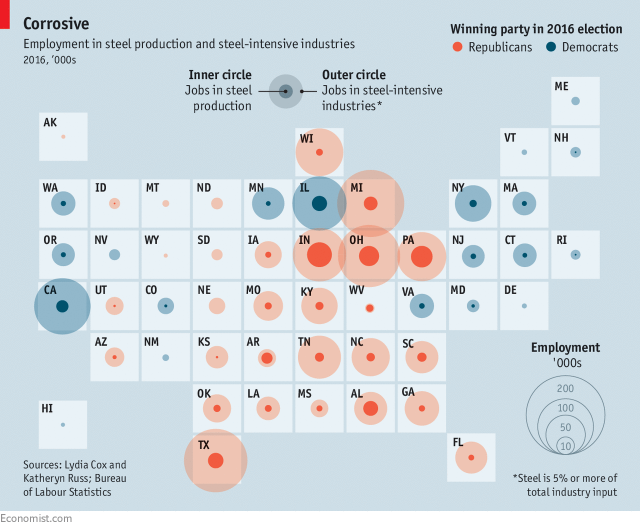
Figure from the Economist depicts steel intensive and steel production by US State.
There is one key oversight to adopting this point of view: according to the aforementioned date from the BLS, the number of Americans working in steel-intensive industries, which consists of firms that use steel as an input to production, far outweigh those working in steel production alone. In each of the five previously mentioned states, the number of Americans working in steel-intensive industries is more than 50% greater than those working in steel production. The likely impact the tariff will have on these workers is far from good - in fact, most experts contend the outlook is grim.
Tori Whiting, a trade Economist for Conservative think-tank the Heritage Foundation, finds the fact that 17 million Americans working in automotive manufacturing and construction, industries that rely on steel as an input, to be incredibly problematic as they will be punished from the tariffs. She stated: “These potential tariffs may put small groups of manufacturers on life support, but they will jeopardize the jobs of millions. The president has a responsibility to protect all American workers rather than a select few…”. Annie Lowrey of the popular liberal Atlantic Magazine found similar issues, concluding that the President’s characterization of the tariffs to be smart economic and national security policy to be far from the truth.Lowrey echoes the fears of IMF Director Lagarde, contending that US allies will read the tariffs as “flimsy policy” and will engage in a “tit-for-tat” trade strategy that will harm American business.
Conclusion
Experts, thought leaders, policy wonks, and demagogues alike seem to have rallied behind the notion that the steel and aluminum tariffs are bad policy. They are almost guaranteed to bolster one industry at the cost of hindering a much larger swath of others. Despite this, there remains a very palpable fear amongst working class Americans -- a reflection of a painful reality that the post-industrial era will continue to rob Americans of their manufacturing jobs, their way of life, and thus their livelihood. President Trump appears to be making an attempt to bring this sentiment into the mainstream, and as a result, carry his unexpected and unprecedented Presidency into a second term.
Rising and Falling Powers: Will the United States Peacefully Exit the Global Stage?
Staff Writer Kevin Weil explores the theoretical and philosophical foundations of a world order absent of U.S leadership.
“A man may die, nations may rise and fall, but an idea lives on.”
– John F. Kennedy, 1963
Since the close of World War II, the United States maintained a strong international presence, strengthened the international order, and took the lead on global free trade, the pursuit of human rights, and the spreading of democratic ideals. As the champion of liberty and democracy, the U.S. upheld this liberal world order over 70 years. Recently, however, the rise of nationalism and protectionist policies in the United States call the viability of the global order into question. Indeed, it is hard to wrap our minds around a world in which the United States is not a global superpower. Taking a step back and removing the American-centric veil reveals the stark reality of international politics – a political reality in which the United States’ global influence is contested by rising nations, specifically China. In this scenario, international conflict has the potential to be a likelihood or an inevitability, especially as the United States and China pursue their respective interests.
The United States’ status of preeminence and stability within international politics is beginning to wane. Following the dissolution of the Soviet Bloc in the early 1990s, the United States gradually lost interest in maintaining its global influence. The lack of a power balance leaves little incentive to proactively engage in global affairs and, consequently, no overarching need to reconcile a state’s interests with the global common good. To this extent, the sentiment driving the election of President Trump and his “America First” platform was predictable. A substantial aspect of Trump’s 2016 presidential campaign sought to capture the American peoples’ disinterest in pursuing global initiatives as a leading superpower. Both during his campaign, and during his current administration, Trump denounces the continued engagement and reliance on international pacts like NAFTA and the Paris Climate Accords and instead calls for fairer and more reciprocal global exchanges that benefit the United States. Concerns about whether a liberal world order will endure the United States’ exit from the national stage are valid. U.S. leadership spearheaded the past 70 years of international achievements. Yet, the resurgence of nationalism, protectionism, and an overall retraction of U.S. involvement in global affairs opens the potential for new global leadership.
Dr. Graham Allison, Director of Harvard’s Belfer Center for Science and International Affairs, recently published a book that addresses the current competition between the United States and China and more broadly the universal conflict between rising and ruling international powers. The work, entitled Destined For War, refers to this concept as the “Thucydides’s Trap.” According to Allison, it was the Athenian historian Thucydides who was the first to articulate the likelihood of conflict between a rising power and a ruling one in his work The History of the Peloponnesian War. In discussing a regional conflict between the city-states of Athens and Sparta, Thucydides writes that “It was the rise of Athens and the fear that this instilled in Sparta that made war inevitable.” Allison identifies sixteen of these Thucydidean conflicts throughout history that reflect the underlying issue of the Peloponnesian War: a rising power challenging a ruling one. Out of those sixteen conflicts, Allison notes, twelve erupted in war – and predicts the next to be between the United States and China.
Throughout his book, Dr. Allison adopts an idea called “applied history” to support his argument as to why the rise of China is a threat to the United States. Applied history, Allison claims, allows key political actors to make rational decisions with reverence to historical precedents and parallels. Indeed, Allison does well to illuminate the potential conflict he foresees between the United States and China through historical analogues. Allison provides several historical examples of nations facing Thucydides’s Trap, ranging from political influence, land and sea power, and global economic dominance. Interestingly enough, the only example that Allison characterizes with a domain of “global power” is between the United States and the Soviet Union following the Second World War, a scenario that did not result in war. Allison’s analysis ultimately seeks to answer the question: how can the key political actors in the United States and China avoid Thucydides’s idea of “inevitable war” that the United States and the Soviet Union avoided during the second half of the Twentieth Century?
In answering this question, Allison diverges from the Thucydidean perspective that war is inevitable. He understands war as an increased likelihood between the United States and China, especially as both President Trump’s and Xi Jinping’s policy initiatives ignore issues of international importance in favor of their own respective national interests. Destined for War, as Allison frames it, attempts to uncover the root of the impending problem. He introduces his book with the humble and reflective words of Theobald von Bethmann Hollweg, Germany’s chancellor during the First World War: “Ah, if we only knew.” Although war may not be inevitable to Allison, the likelihood of potential conflict is a compelling reason to reflect on the past. In this regard, an international conflict will constitute the transition of global influence from the preeminent power to the rising power. Whether this transition will be voluntary and peaceful is questionable, given that the United States and China are pursuing their respective interests with firm determination. Both states are certainly determined to bolster and extend their spheres of influence, as President Trump proposes a military parade and Xi Jinping continues to expand economic influence into the South China Sea. Certainly, diplomatic sentiment and the potential for peaceful transition becomes an afterthought as both nations appear committed to their respective visions.
Analyzing the relationship between the United States and China with international schools of thought helps to clarify the circumstances surrounding the two nations. Thucydides writing is actually understood as a prominent example as a realist school of thought. Dr. Allison applies these realist ideas to historical events. Thucydidean realism demonstrates how key international actors, like world leaders and states, see “politics as power” as a means to create opportunities and increase influence – typically by force. This idea would explain global affairs like Vladimir Putin’s military intervention in Ukraine, as well as Xi Jinping’s naval response to the territorial dispute in the South China Sea. Realists see the ultimate objective of states as the rational maximization of power. Those with a more liberal-minded perspective of global affairs are concerned with the viability of the liberal world order that the United States forged following World War II. Thomas Wright, Senior Foreign Policy Fellow at the Brookings Institute, understands the liberal order as incredibly fragile and malleable to the behavior of President Trump, Vladimir Putin, and Xi Jinping, writing in a recent Brookings Institute blog that “It is the combination of Trump, Xi, and Putin that makes the present situation so dangerous.” From this school of thought, the world order is threatened by key individual actors all following ambitious visions for their states.
The concept of “politics as power” is often dismissed as base and amoral, while engaging in diplomacy and embracing a common humanity are often hailed as great international achievements. Both of these schools of international theory are too often seen as distinct and mutually exclusive. In actuality, aspects of each theory build off of one another. This implies that realists see value in alliances and international treaties, but will not rely on these pacts if it conflicts with a state’s interests. Likewise, liberals understand that fear is a compulsory factor in human behavior but try to reconcile this drawback by encouraging trust building. Certain political realities, however, make a faithful implementation of either of these theories difficult within international relations. The existence of a world order and its demands on the state are restraining and unattractive to many, like President Trump. Trump’s election signaled a shift in the United States’ interests, but the liberal order will not cease to exist. Accepting the reality of a world order guided by China’s political, cultural, and economic norms is equally unattractive to states that have grown accustomed to U.S. leadership. In such a likely case, the U.S. will need to become accommodated to its new global role of limited influence.
As the United States continues to decrease its global influence, which President Trump seems intent on doing to achieve his “America First” initiative, the issue remains whether there will be a peaceful transition of political, cultural, and economic influence. The Cold War offers an interesting example of a situation in which peace was desired, but the political reality of the situation impeded its achievement. With the Soviet Union challenging the United States’ superpower status, the world watched as each power deterred the other with weapons of mass destruction. Fear of mutually assured destruction (MAD) checked the other power from acting irrationally. Yet, even at the most critical period of the Cold War, the Cuban Missile Crisis, President Kennedy made explicit choicesthat increased the risk of war: publicly confronting Soviet Premier Khrushchev, threatening airstrikes, and offering an ultimatum that, if denied, would require the U.S. to respond with force. Kennedy certainly desired a solution to the bitter tensions between the United States and the Soviet Union, but also understood the devastation that violent international conflict would bring. He used the tense backdrop of the Cold War as a basis to advance global cooperation and embrace “the most important topic on earth: world peace.”
President Kennedy presented his concept for a new world order to the American University Class of 1963, speaking of a renewed political order:
“genuine peace, the kind of peace that makes life on earth worth living, the kind that enables men and nations to grow and to hope and to build a better life for their children–not merely peace for Americans but peace for all men and women–not merely peace in our time but peace for all time.”
Even on the brink of war, Kennedy balanced his realist approach to the Soviet Union’s encroachment on Cuba with an optimistic vision for a self-sustainable world order free from the United States’ guidance. As peace and order were sought in the face of global violence, Kennedy understood the importance of balancing respective interests with a common good. However, this occurred under a balance of power. Today, the United States’ authority continues to wane and countries will continue to seize opportunities to gain the regional influence that the U.S. is relinquishing.
Whether this observable tension between the United States’ self-interests and China’s interests of power will come to physical war has still unknown. Both countries can make efforts to avoid such conflicts, but the actions of President Trump and Xi Jinping indicate that there will be an eventual collision of interests. If anything, it is important to hold historical events in reverence and to recognize their value. In a rapidly changing world, history provides a sound basis for reason and gives meaning to Thucydides’s History “as a possession for all time.”
How the U.S. Senate Committee on Foreign Relations Influences American Foreign Policy: A Case Study
Guest Writer Reagan Williams explores the mechanisms the U.S. Senate Committee on Foreign Relations dichotomies domestic sources for conducting international relations.
When discussing the history, effectiveness, or future of United States foreign policy it is essential to consider the organization and motivations of the actors who shape it. These actors primarily include (but are not limited to) the President of the United States, the U.S. Department of Defense, the U.S. Department of State, the U.S. Intelligence Community, and the U.S. Congress. While the foreign policy positions and actions of the President and these federal agencies are widely discussed in the media, the actions of Congress get less attention. Congress’ ability to impact U.S. foreign policy is seen as lesser than that of the President or these agencies. Congress is primarily perceived and criticized by the media and the public as a domestic actor. However, given that Congress is the sole entity capable of declaring war and that the President needs two-thirds of the Senate’s approval to ratify any treaty, Congress can actually play a critical role in the development of U.S. foreign policy. This article provides a brief overview of the United States’ position on and actions in Iran in regards to their nuclear program in order to analyze the process by which the U.S. Senate, and in particular the Senate Committee on Foreign Relations (SFRC), influences U.S. foreign policy. The article begins by offering a brief history of Iran’s nuclear program and a description of the SFRC structure. The second half of the article outlines the foreign policy tools of the Senate, examining the use of resolutions, bills, confirmation hearings, additional hearings and official statements, treaty ratification, and budgetary powers, respectively, to affect U.S. foreign policy on Iran.
For more than a decade, the focus of U.S. foreign policy toward Iran has centered on Iran’s nuclear program. In 2002, the National Council of Resistance of Iran revealed that Iran was developing undeclared nuclear facilities. Iran denied this allegation. Still, according to The Nuclear Threat Initiative, Iran entered into talks with France, Germany, and the UK to avoid referral to the UN Security Council (UNSC). As a result of these talks, Iran signed the Additional Protocol Resolution created by the International Atomic Energy Agency (IAEA), interrupting their enrichment activities. In 2005, Iran rejected a long-term agreement proposed by France, Germany, and the UK, declaring its intention to resume uranium conversion activities. The following year, the UNSC passed Resolution 1696, “which demanded that Iran suspend enrichment activities, banned the international transfer of nuclear and missile technologies to Iran, and froze the foreign assets of twelve individuals and ten organizations involved with the Iranian nuclear program.” In 2008, The UNSC reiterated this positionwith Resolution 1835, after Iran continued enrichment activities, refused to fully cooperate with the IAEA, and turned down an economic incentives package offered by the P5+1. In September 2009, Iran notified the IAEA of its intention to construct a second enrichment facility. At talks with the P5+1 the following month, Iran agreed to IAEA inspections; however, negotiations broke down after Iran reneged on a fuel exchange deal with France and Russia. After Iranian President Mahmoud Ahmadinejad announced a deal to build ten additional enrichment facilities in 2009, the U.S. House of Representatives passed a billpermitting President Obama to impose sanctions on companies supplying gasoline to Iran. As The Nuclear Threat Initiative outlines, actors continued to take these kinds of multilateral and unilateral actions on Iran in the following years as various attempts at negotiations continued to break down. In 2010, for example, the UN Security Council imposed another set of sanctions on Iran’s nuclear investment. In November 2011, the IAEA published a report outlining “possible military dimensions” to Iran’s nuclear program. Also in 2011, the U.S. Congress added the Menendez-Kirk amendment to the National Defense Authorization Act, requiring President Obama to sanction the Central Bank of Iran in an effort to economically pressure Tehran into compliance over its nuclear program. In 2012, President Obama expanded sanctions with the Iran Threat Reduction and Syria Human Rights Act.
A few years ago, there was a turning point in U.S.-Iran relations. In June 2013, Hassan Rouhani was elected as the new President of Iran. According to the BBC, in September 2013, Rouhani and President Obama had the first phone conversation between the two positions in three decades. After the call, President Rouhani tweeted “In phone convo, President #Rouhani and President @BarackObama expressed their mutual political #will to rapidly solve the #nuclear issue.” This exchange indicated a willingness on each side to begin negotiations. In July of 2015, the P5+1, the E.U., and Iran agreed on a Joint Comprehensive Plan of Action (JCPOA) to guarantee that Iran’s nuclear program remains peaceful. On January 1, 2016, the JCPOA was implemented and the IAEA and Secretary of State John Kerry verified Iran’s compliance with the Action Plan. The U.S., in turn, lifted the nuclear related sanctions previously imposed on Iran.
What was the role of the Senate in the last few years? While President Obama was negotiating the deal and Secretary Kerry verifying Iran’s compliance with it, what was the SFRC doing? To understand the work of the SFRC, it is important to first understand the Committee’s structure and role within the Senate. The SFRC is comprised of members of both the majority and minority parties of Congress. In the current 115th Congress, the SFRC is chaired by Republican Senator Bob Corker. Including Senator Corker, there are eleven Republican members of the SFRC. Led by ranking member Senator Bob Menendez, there are currently a total of 10 democrats on the SFRC. The Committee contains several subcommittees, organized into regional and thematic groups (e.g. the subcommittee on Near East, South Asia, Central Asia, and Counterterrorism subcommittee, or the subcommittee on Western Hemisphere, Transnational Crime, Civilian Security, Democracy, Human Rights and Global Women’s Issues). The SFRC considers, debates, and reports treaties and legislation and has jurisdiction over diplomatic nominations. Their debates influence how the Senate executes its Article I powers over U.S. foreign policy. Article I enables the Senate to provide countervailing research and new insight through committee hearings or studies, ask questions and advocate alternative ideas, conduct investigations, confirm (or refuse to confirm) ambassadors and secretaries, ratify (or refuse to ratify) treaties, review, alter or reject executive branch policies, and control the budgetary allocations for various policies and programs.
Over the past several years, the Senate has implemented these powers in the case of Iran in several ways. First, the Senate has passed over two dozen resolutions regarding Iran since 2013. These resolutions cover topics ranging from Iran’s nuclear program to its human rights abuses. While this alone may imply that the Senate has been highly involved in the development of U.S. policy on Iran, Congressional resolutions do not actually wield any legal power. Rather, such resolutions are a way for Congress to express its opinions on an issue and in doing so, hope to influence the actions of the executive branch. The first of the Senate’s resolutions on Iran’s nuclear capabilities was submitted with bipartisan support and referred to the SFRC in the 113th Congress in February 2013. This resolution, S.Res. 65, supports “the full implementation of United States and international sanctions on Iran and [urges] the President to continue to strengthen enforcement of sanctions legislation.” S.Res. 65 points out that “Iran has engaged in a sustained and well-documented pattern of illicit and deceptive activities to acquire a nuclear weapons capability,” that 74 senators called on President Obama in 2012 to be prepared “to take military action against Iran if it continues its efforts to acquire a nuclear weapon,” and that Iran’s acquisition of nuclear weapons poses a “tremendous threat” to the United States. While S.Res. 65 was the first Senate resolution passed solely to address Iran’s nuclearization, they had begun to make mention of the threat even in 2012. S.Res. 574, sponsored by Senator Kirsten Gillibrand, called on the U.N. to “implement existing United Nations Security Council (UNSC) resolutions sanctioning Iran and to take additional stronger unilateral diplomatic and economic measures to prevent the Government of Iran from obtaining nuclear weapons.” Also in 2012, Senator Lindsey Graham sponsored S.Res. 380, a resolution that again references UNSC resolutions on the matter as well as expresses Senate support for U.S. foreign policy aimed at preventing Iran from acquiring nuclear weapons.
Since 2012 and 2013, Senate Resolutions on Iran have grown firmer in their language and more blatant in their calls to action on the part of the President. In January 2015, S.Res.40 of the 114th Congress affirmed the Senate’s support of the efforts of U.S. and the P5+1 to reach an agreement to prevent Iran’s acquisition of a nuclear weapon as well as the re-imposition of sanctions should Iran violate a reached agreement. In September 2015, Senator Ted Cruz sponsored S.Res.238 to express the Senate’s disagreement with the start date of their 60-calendar day period to review the JCPOA due to receiving insufficient materials at the specified start date. In December of 2015, the Senate passed a joint resolution (S.Con.Res.26) expressing the right of states and local governments to uphold economic sanctions against Iran. However, the joint resolution specifies that such regulations may “in no way interfere with the conduct of United States foreign policy.” In 2016, S.Res.414 was written to offer the Senate’s advice on U.S. action in the case that Iran violates the JCPOA. In this resolution, the Senate proposes that if Iran violates the JCPOA, then the U.S. ought to seek the reinstitution of several UNSC resolutions and Council of the European Union regulations concerning “restrictive measures” against Iran as well as re-impose nuclear-related sanctions and additional punitive sanctions. As these examples demonstrate, the SFRC utilized their power to issue resolutions to continuously make their opinions (both along and across party lines) and policy recommendations regarding Iran known over the last several years.
In terms of hard legislative power (i.e. bills or joint resolutions) Congress can “regulate commerce with foreign nations,” “declare war,” “raise and support armies,” “provide and maintain a navy,” and “make rules for the government and regulation of the land and naval forces” as dictated by Article I of the Constitution. With regard to Iran’s nuclear programs, the Senate has passed dozens of bills since 2013. In 2014, Senator Corker sponsored S.2650, a bill which legislates that the President must submit to Congress any agreement with Iran regarding its nuclear program within three days of entering into it. It also provides for “a 15-day review period by the SFRC and the House Committee on Foreign Affairs and a subsequent 15-day period in which a joint resolution of disapproval may be introduced in the House and in the Senate for expedited consideration.” The day after the introduction of S.2650, S.2667 was introduced. S.2667, the Iranian Sanctions Relief Certification Act of 2014, ensures that the President certifies to Congress before (and every 60 days thereafter) any waiver of sanctions is executed and that such a waiver will not facilitate Iran’s ability to promote terrorism, build nuclear weapons, or violate human rights. In March of 2015, Senator Barbara Boxer sponsored S.669, the Iran Congressional Oversight Act. This bill requires the President to report to Congress “at least once every 90 days” in regards to Iran’s compliance with the JCPOA. Also in 2015, Senator Corker sponsored another bill, S.615, the Iran Nuclear Agreement Review Act (INARA) of 2015, allowing Congress to review any agreement made by the P5+1 with Iran to prevent Iran’s acquisition of nuclear weapons. In 2016, the Senate passed S.3339, the JCPOA Enforcement Transparency Act, requiring the President to notify certain congressional committees within 20 days of “all past decisions made by the Joint Commission or the Technical Working Group under the JCPOA… and of each subsequent decision made by such commission, such working group, or any subsequent working group established under the JCPOA within 30 days after such decision is made.” Unlike the various resolutions passed over the last several years, these bills do more than voice the Senate’s position or offer additional research on the issue–the bills legally require that the executive branch take specific actions in order to keep Congress informed and involved in U.S. foreign policy on Iran.
The Senate has the unique authority to confirm Presidential nominees for positions within the executive branch that can impact foreign policy. The SFRC has utilized this authority in order to vet appointees’ positions on Iran. More generally, the SFRC often uses this role to facilitate a discussion on the most pressing matters of U.S. foreign policy (recently emphasizing the growing animosity between the U.S. and Russia as well as the threat of a nuclearized North Korea or Iran) in the presence of various government officials, scholars, and the media. For example, in Secretary Tillerson’s hearing, the importance of maintaining sanctions and preventing Iran’s nuclearization was discussed at length. Senator Chris Coons asked Secretary Tillerson how he believed the U.S. could strengthen its hand against Iran as well as how the U.S. would sustain “the current level of visibility we have into Iran’s nuclear program and how would that make us safer or stronger” if the U.S. were to withdraw from the agreement under the new administration. Senator Coons again referenced Iran by discussing a section of the JCPOA later in the hearing. While Secretary Tillerson confirmed his desire to do a “full review” of the JCPOA, he agreed with the SFRC about the end goal of ensuring that any use of nuclear weapons in Iran is strictly peaceful. Likewise, in the confirmation hearing of UN Ambassador Nikki Haley, Senator Corker took the opportunity to express his view that Iran is violating the JCPOA. In the hearing, Senator Marco Rubio pointed out that the Obama administration “attempted to use the United Nations … to go around Congress on the Joint Comprehensive Plan of Action and attempt, as they claim, to create a binding, legal obligation under what they claim to be international law related to a flawed Iran nuclear deal.” Senator Rubio followed this by asking Ambassador Haley her view on this “use of the Security Council… to go around the Senate’s constitutional role to provide advice and consent on treaties.” Haley’s response assured Senator Rubio of her dedication to including Congress, and the Senate in particular, in any joint action with the UN. Senator Tim Kaine asked whether the Ambassador supported backing out of the JCPOA to which she, like Secretary Tillerson, said she supported a review of the details of and Iran’s compliance with the agreement. Senator James Risch later used the hearing to voice his opposition to Senator Kaine’s support of the JCPOA, arguing it is not tough enough on Iran. Through these comments and questions, the SFRC was able to turn the hearing itself to a place of debate on U.S. foreign policy toward Iran.
The SFRC has also used other hearings, official statements, and the press as platforms for addressing the JCPOA. In hearings, members of the SFRC have questioned both the Obama and Trump administrations with regard to the JCPOA. At a full committee hearing in December of 2014, the SFRC listened to the testimonies of the president of the Institute for Science and International Security, a Harvard Research Director, and a Hudson Institute Senior Fellow. Senator Humphrey also pointed out in his Foreign Affairs piece that “the body of fact and insight developed by a committee hearing or study can be drawn upon for informed criticism or for advocating new policies.” This particular hearing examined the Joint Plan of Action (JPOA) and various options and limitations for a final comprehensive deal between the P5+1 and Iran. The hearing was also used to discuss the regional impact and concerns. The testimony of Michael Doran, the Senior Fellow from the Hudson Institute, was particularly critical of the Obama Administration’s bias toward and overly optimistic (in his opinion) presentation of its relationship with Iran. Currently, the Trump administration continues to stall action on the JCPOA, agreeing in January to again waive key sanctions lifted by the U.S. as part of the JCPOA. In September 2015, SFRC Ranking member Senator Ben Cardin penned an op-ed for the Washington Postcriticizing the JCPOA and ultimately concluding with his decision to vote against it. However, having eventually come to support the final version of the deal, in October 2017, Senator Cardin released a statement stressing the importance of the JCPOA and urging President Trump to uphold the deal. Conversely, but similar to the positions of Secretary Tillerson and Ambassador Haley, many Republican members of the SFRC continues to support a review of the deal. A week after Senator Cardin’s statement, Senator Corker released a statementexplaining the efforts of the SFRC, in conjunction with the State Department and the National Security Council, to “develop a legislative strategy to address bipartisan concerns about the JCPOA without violating U.S. commitments.” As these examples illustrate, Senators can utilize both their official platforms as well as the public platform created by their celebrity in order to express an opinion, provide information, or sway opposition. Conversely, behind closed doors, the staff of the SFRC can use their positions to express Senate opinions, exchange information, or sway opinions in individual meetings with foreign officials, other government agencies, international organizations, or private companies.
The Senate is the sole actor capable of ratifying treaties. However, in the case of the JCPOA, dissent within the Senate about the deal’s terms turned a two-thirds ratification of the agreement into an insurmountable hurdle. As such, the JCPOA is not a treaty, but was actually negotiated as a political agreement by President Obama. The Article II Constitutional limitations on the President to pass a treaty do not completely hold at the international level. As Iulia Padeanu argues in the Yale Journal of International Law, the JCPOA operates the same as a treaty would as per the rules of the Vienna Convention on Diplomatic Relations. Moreover, as explained by NYU professor David Golove, the Senate’s passage of the Iran Nuclear Agreement Review Act of 2015 (INARA) framed President Obama’s decision to pass the JCPOA as an exercise of joint legislative and executive power. While their passage of INARA limited the Senate’s ability to criticize Obama’s exercise of executive power, it allowed them to have some influence in the matter. Still, this case offers an example of the limits of the Senate’s foreign policy influence.
Finally, the Senate can impose its budgetary power to influence U.S. foreign policy. Congress’ budgetary power is at times perhaps its greatest foreign policy tool. Former Secretary of State Dean Acheson once correctly noted that in “one aspect of foreign affairs Congress is all-powerful. This is in the establishing and maintaining of those fundamental policies, with their supporting programs of action, which require legal authority, men and money.” In the case of the JCPOA, however, Congress’ budgetary power has not come into play. According to the New York Times, $1.7 billion was given to Iran by the U.S. following the deal, but the money was only indirectly linked to the JCPOA. The payment was for “a decades-long dispute” over Iranian payments to the U.S. for military goods that were never delivered following the 1979 Iranian revolution. Consequently, the SFRC has had to fully enact its other legislative powers to compensate for its inability to exercise budgetary influence. The SFRC has used its legislative power to push for a greater influence on the waiving of sanctions on Iran. The President has the power to lift sanctions he himself imposed and can suspend congressionally imposed sanctions. However, Congress must approve any permanent waiver of congressionally enacted sanctions. The lengthy timeline of such an approval process is another reason Congress decided to pass INARA. Again, as reported by the New York Times, there was enough bipartisan support for INARA in 2015 that Senator Corker was able to champion it, feeling hopeful that he could muster a congressional override of Obama’s likely veto of the bill. Moving forward, should President Trump decide that the JCPOA is not in the best interest of the U.S., the 60 day review period legislated by INARA will be triggered. Georgetown professor Colin Kahl speculated in a Foreign Policy Executive Roundtable podcast that the administration’s rationale behind decertifying the deal is that it will create leverage to renegotiate the terms of the deal. However, as Kahl points out, the administration has not demonstrated a real ability to control Congress and once the power is given over to Congress, the easiest move is to re-impose sanctions. A reimposition of sanctions only requires 50 votes while any other action on Iran would require 60. Again, Congress’ budgetary power has not afforded them hard power in the case of Iran, but they have been able to exercise some influence legislatively with regard to sanctions.
Congress is principally regarded as an entity that impacts the domestic landscape. While the Senate’s ability to deal directly with international issues is limited, it can use the powers it is allocated by the Constitution in creative ways to influence some parts of U.S. foreign policy. As is evident in the case of U.S. policy on Iran, the Senate, and the SFRC in particular, has used each of its different powers as well as its unofficial platforms to impact the shaping of the JCPOA. While such actions can leave the executive and legislative branches in gridlock, as was nearly the case in 2015 when President Obama struggled to gain support for the JCPOA, it can also provide a check on plenary executive power abroad. In an increasingly globalized and intertwined world, its important that the SFRC, and the Senate more broadly, continue to exercise its powers to shape U.S. foreign policy. Global challenges–climate change, migration and refugee flows, terrorism, and new nuclear powers–affect Americans regardless of whether the U.S. prefers to be involved with these challenges or their accompanying actors. As representatives of those Americans, Senators have to wield every source of their foreign policy powers to address these challenges accordingly.
Trump’s Tax Cuts are Overly-Optimistic, Likely to Inhibit Long-Term Growth
Contributing Editor Michael Donaher examines the Trump administration's tax cut plan and ramifications in both Congress and international markets.
In December of 2017, President Trump signed the “Tax Cuts and Jobs Act”. Aimed at lowering taxes and spurring economic growth, this legislation contains many components that are highly controversial. Those most notable are the cuts in the corporate tax break and a shift in the tax collection scheme for multinational companies. Although aimed at simplifying the U.S. tax code and attracting more companies to America, the prospect of these aims coming to fruition are at the very best optimistic. The consequences of this bill have the potential to suspend economic progress and burden the United States economy with debt for generations.
Currently, any company that is headquartered in the United States is subject to the corporate tax rate of 35% on all of its earnings, including those made overseas. However, while all American-made earnings are taxed the year they are made, overseas income is only taxed if and when it makes its way into the United States. Critics of this system and proponents of the tax bill have long argued that this practice has discouraged investment in America. Recently, The Tax Foundation compared the American tax structure to Organization for Economic Cooperation and Development (OECD) member countries, and found that this model can partially explain why American-based companies flock to countries with a territorial based model. The result is the exclusion of America from the work of these businesses, a phenomenon referred to as the “lock-out” effect.
While the Trump tax bill could address this problem, many critics of the plan have been quick to point-out that instituting a territorial-based model could actually exacerbate the practice of companies offshoring their assets. The Center for American Progress published a September 2017 article on their website warning that the effect of such a change would result in the loss of American jobs and decreased wages. A serious claim, the article cites a figure from the U.S. Bureau of Economic Analysis (BEA) that indicates over half of previously reported foreign income resides in just seven countries with extremely low corporate tax rates. This data suggests that instituting a territorial-based system would only reinforce movement of income to countries with more business-friendly tax systems and have serious consequences on the American economy.
Economists and policymakers don’t have to search very hard for an example of how companies might actually respond to such a change. A 2011 reportpublished by The Tax Policy Center found that when the U.S. government instituted an income repatriation tax holiday in 2004, multinational corporations based in the U.S. were not as generous as proponents of the holiday predicted. Whereas policymakers who supported the holiday anticipated investment in American capital stock and job creation, instead, the report found that most companies bought more shares of company ownership or paid dividends to their shareholders.
Aware of the impact this change may have, Republican lawmakers who crafted the Tax Cuts and Job Acts legislation made last-minute changes to the bill before it was passed to impose a one-time 15% repatriation tax on foreign income moving back into the US. As a result, any of the estimated $2 trillion that is held overseas–if repatriated to the U.S, would be taxed at this rate once the law is instituted. This change came towards the end of the negotiations for the tax bill, after concerns were voiced as to how the bill would impact the deficit. Instituting this tax rate was a natural compromise; lawmakers cut the foreign tax rate in the hopes that it would spur investment the territorial-based model offered, while raising revenue that would have been sunk without it.
While reducing the tax rate companies pay on their income as it moves back into the United States does not resolve the many concerns that a territorial-based model presents, it does address a larger issue: how the tax cuts will create debt. Concerns with the cost of making these tax cuts have underscored the entirety of the tax reform debate. In general, two theories have prevailed: the first comes from the bill’s proponents, who argue that the anticipated growth the cuts will spur will create jobs, broaden the tax base, and therefore raise any revenue lost from lowering the initial rate. Critics on the other hand are far less optimistic; they argue that a lower rate will in lead to decreases in the national revenue, leading to future government budget constraints, inevitable cuts, and possibly even economic downturn in the future.
It is important to note that the fiscal conservatives who support the tax cuts rest their credibility on an optimistic prediction of growth offsetting future debt. Shortly after The Congressional Budget Office (CBO) estimated that the tax bill would result in $1.5 trillion in additional debt over a 10 year span, Secretary of the Treasury Steven Mnuchin claimed that if GDP grows at 2.9% over this same period of time, that growth will offset any revenue shortfalls. While supporters of the bill have rallied around this narrative, what this statement fails to capture is how rare this kind of growth is. According to the BEA, in only one year since 2010 has the U.S. had a growth rate of 2.9% or higher, and after President Bush signed similar albeit less extensive tax cuts during his Administration, 2005 and 2006 alone measured growth above 3 %. This, of course, was followed by a startling declining in growth and the Great Recession.
The CBO estimates that from 2009 to 2019, the Bush Tax cuts will amount to $3 Trillion in additional national debt. Just as these cuts have materialized into a greater burden of debt, the CBO projections show that Trump’s will only add to this. While the United States has a stable credit history, this does not shield it form the drawbacks of slipping further into debt. Foreign Policy magazine reported that before the bill was passed, adding the projected debt would hinder the creditworthiness of the US government and raise interest rates, thus increasing the cost of borrowing. This makes the cost of funding the government grow, thus only worsening the present situation by adding more debt with interest.
Additional costs to borrowing will likely impact the day-to-day government function, particularly in areas of the budget that see the most funding, like national defense. The Brookings Institute found in a 2012 report that adding debt of comparable size to that which already exists would hinder the the creditworthiness of the US government, leading to higher interest rates and a higher cost to lending. Former Chairman of the Joint Chiefs of Staff Mike Mullen called the national debt the single greatest national security risk, echoing concerns cited in the Brookings report that the increased cost of defense spending could jeopardize US leadership abroad. What’s clear from these analyses is that Republican lawmakers and other proponents of the bill have put their blind trust into an overly optimistic projection and corporate altruism. What is not so clear is how strongly these changes will impact future budgetary constraints, economic growth, and US leadership on a global scale.
It is helpful to contextualize this legislation to better understand how this may shake world economic power dynamics. While the US economy is strong, automation continues to sweep the nation, threatening the jobs and therefore the livelihood of millions of working class people. This makes the offshoring of multinational companies, and any bill that might incentivize this behavior, of particular concern. Further, as our population ages, we are reminded of the future financial burden that comes with increasing costs to health care and entitlements. Finally, our young people who will govern over the aftermath of these irresponsible spending measures have their own mountain to climb in the form of student loan debt, which was most recently reported at about $1.5 Trillion in total.
The United States has a debt problem that doesn’t look like it will be solved anytime in the near future. This tax bill, through increasing the national debt and shifting from the global taxation scheme has the ability to rewrite the global economic order. Whereas the current administration touts its first and only major legislative victory as a major step towards economic renewal in the United States, almost every other sign indicates otherwise.
Revising Campus Sexual Assault Policy: President Obama’s Rollout Versus Secretary Devos’ Rollback
Staff Writer Annmarie Conboy-DePasquale explains the problems with the Trump administration’s policy towards campus sexual assault.
Sexual assault is an uncomfortable topic. After decades of being shamed into silence, victims have begun to find their voices in the new century. Though the number of survivors reporting continues to grow, they face countless roadblocks in pursuit of awareness and justice. In 2011 President Barack Obama, on the same day he announced his re-election bid, sent the Department of Education a surprise “Dear Colleague” letter which reinterpreted Title IX to give the federal government far more control over procedures colleges and universities use to handle allegations of campus sexual assault. While celebrated by advocates, it soon became clear to legal scholars that the policy was, perhaps fatally, flawed. In 2017, President Donald Trump’s Secretary of Education, Betsy DeVos, announced an expected rollback of the Obama administration’s campus sexual assault regulations. This move was met with fierce public opposition and quiet support from several major news outlets. President Obama’s and Secretary DeVos’ campus assault policies each had good and bad components, but other factors also had major impacts on how their strategies were perceived by the public.
The Obama Policies
Though President Obama left office with a 60% job approval rating, in 2011 he was hovering in the high forties. The Democratic party had suffered punishing defeats in the 2010 midterms, losing control of the House of Representatives and loosening their grip on the Senate. Embarrassed, the administration re-centered its attention on identity politics to solidify the party base. Vice President Joe Biden had long been a staunch advocate of sexual assault awareness and prevention, famously drafting the Violence Against Women Act in 1994, and the Obama-Biden ticket capitalized on this in the 2008 campaign. But the “Dear Colleague” letter issued by the Office for Civil Rights was delivered long before the two became seen as crusaders against campus sexual assault. With no warning and little to no explanation, even six years later, the letter was largely an attempt to re-energize a disheartened base. Undoubtedly the administration also sought to reform the way colleges and universities respond to allegations of sexual assault, but in its rush to save face, did they tilt the scales of justice in favor of accusers?
Upon releasing the letter, the Obama administration’s education department called for all of the seven-thousand plus colleges which receive federal money to overhaul their procedures for adjudicating sexual assault allegations. By painting campus sexual violence as an issue of discrimination and civil rights and sexual violence as a form of harassment, the letter forced schools to use both a different adjudication system than would be used if the incidents were reported to law enforcement, and required the schools to act. The most controversial instruction enclosed was the requirement to hold students accused of sexual assault to the lowest possible standard of proof, “a preponderance of the evidence.” In using this standard, colleges could discipline, and even expel students if 51% of the evidence indicates guilt, whereas at many universities, occurrences of cheating and noise violations still use higher standards. Other questionable standards include requiring universities to give accusers the ability to appeal not-guilty judgments – essentially allowing double jeopardy – and all but outlawing cross-examination of accusers. The debate over whether these guidelines had gone too far developed into one of the hottest battles in education today. Accordingly, when the Secretary signaled her intent to eventually pull back these reforms, the public response was intensely divided.
New Guidelines
On September 7, 2017, Secretary DeVos announced rollbacks of the Obama-era policy and instituted new temporary guidelines which remain in-place today, saying the system “is wholly un-American, and is anathema to the system of self-governance to which the Founders pledged their lives over 240 years ago.” Interim guidelines published by the Education Department the same day lifted the demand for colleges to use the “preponderance of the evidence” standard, allowing them to raise it to “clear and convincing.” Schools are also no longer required to hand down a decision in the first 60 days after a report is filed, and mediation may be introduced (it had been banned under Obama’s guidelines for fear it accusers would feel pressured to participate). Additionally, schools are now required to provide the same information to both parties and give equal access to procedures: both sides have the right to cross-examine or have a lawyer present. DeVos is using the window between this rollback and final implementation as a public comment period – a window the Obama administration neglected to offer before sending the “Dear Colleague” letter or finalizing the regulations in 2014. Amid attacks from activist groups and public figures alike – including former Vice President Biden – the Secretary drew “cautious applause” from the editorial boards of USA Today, the Boston Globe, and the Washington Post.
The applause is “cautious” largely because of the staggering unpopularity of the Secretary’s boss, President Donald Trump, whose approval rating at the time the new guidelines were announced sat an abysmal 36%. DeVos’ confirmation hearing was infamously hostile, and she quickly became a lightning rod for Democrats critical of the Trump campaign-turned-Presidency. Damaging mistakes were made when rolling out her proposed guidelines. Over the summer, top Education Department official Candace E. Jackson tasked with enforcing campus sexual assault had this to say, “[Campus rape] accusations — 90 percent of them — fall into the category of ‘we were both drunk,’ ‘we broke up, and six months later I found myself under a Title IX investigation because [the victim] just decided that our last sleeping together was not quite right.” Although she later walked back the quote, some wounds are not so easily healed. DeVos herself also drew heavy criticism for meeting with a so-called “men’s rights” group, and possibly hinting at mandatory referral to law enforcement by suggesting schools ‘go back to doing what they do best, education.’ Both of these occurred while her Department was considering reforms of Obama’s policies.
With DeVos as one of the most visible symbols of the Trump administration in action everything she does is under a microscope, and Campus sexual assault has developed into a “hyper-partisan issue.” Factions have emerged, “with Democrats indiscriminately defending the rights of victims—often ignoring the reliability of evidence—and Republicans indiscriminately defending the rights of the accused—at times questioning the existence of the epidemic of sexual violence on college campuses.”[11] While both sides retain elements of rational concern, at some point they each became, to a degree, radicalized, “the response to the new rules reflects the tribalism of campus sexual-assault politics—an issue that ought to be free from partisan bomb-throwing. Some conservatives caricature advocates for victims as snowflakes; activists too often tar critics of Title IX as chauvinists.” Feminist Harvard Law Professor Janet Halley has long been a critic of the Obama policies and co-authored a letter to the Department of Education in August which advocated several of the guidelines adopted by DeVos’ interim plan. Speaking to NPR Halley said,
“I think that people come into this debate on a side. They come in on the side of survivors. They come in on the side of the accused. I’m saying, let’s try to be on the side of all the students and from that point of view think about what we would want these programs to look like. And I think if we thought that way, we would be doing very different things than we are doing today.”
Questions involved in campus assault do not lend themselves to multiple answers, making this an even more treacherous issue to split by party line.
Legal Challenges
Many of the changes to the guidelines already put forth are based on legal precedent. Since colleges began adhering to the Obama guidelines in 2011, over 170 lawsuits have been brought against universities by males accused of sexual assault who say they were wrongly punished and or their right to due process was violated. They have been on the winning side of 69 judicial decision, and fewer than 50 have lost. An important note here is that there is no universal definition of sexual assault on campus. Investigations which take place on campus are not criminal proceedings they are civil, and as such what one campus considers sexual assault or misconduct may be very different from what a college 5 miles away does. The matter of who gets to decide on a definition is another issue entirely. However, due process is a (relatively) agreed upon concept, and violations of this are what form the basis for these court cases. In a country where the accused stand innocent until proven guilty, a disturbing trend has emerged.
On many campuses, a new attitude about due process has taken hold. Rooted in fear of losing their federal funding, colleges have leaned hard into the accuser-protecting Obama guidelines at the expense of students who stand accused. The “preponderance of the evidence” rule required college adjudicators to make high stakes decisions when they were only 50.01% certain of their answer. Students accused were not required to have access to lawyers- indeed many were discouraged from seeking legal counsel under threat of being cut off from the investigation – or the same information as their accusers. Often, students accused of sexual misconduct were not even informed of the nature of the complaint against them until punishments were imposed. In a 2015 article for the Harvard Law Review, Janet Halley, a Harvard Law Professor, describes a case at an Oregon college in which a male student was investigated for an assault that happened hundreds of miles away (he bore a passing resemblance to the young woman’s attacker), and told to stay away from a female student, resulting in the loss of his campus job and a move from his dorm. He was later conclusively found to be innocent. Like so many aspects of this issue, how to decide what restrictions should be imposed on students under suspicion is murky at best.
One of the few near unarguable tilts in the scale is seen when considering the shifts in the language used by the federal government to discuss cases of sexual assault. Where the original 2011 “Dear Colleague” letter referred to the accuser as the complainant or alleged victim and the accused as the alleged perpetrator, following federal documents in 2014 referred to the former as the survivor or victim, and the latter as the perpetrator.[19] This diction is a slippery slope the Obama administration continuously lost their footing on. By forfeiting the alleged part of the terminology, the Obama guidelines critically endangered one of the most tangible representations of the nation’s standard of “innocent until proven guilty.”
Conclusion
There is no simple solution to this dilemma, no way to neatly sum up something which impacts so many people – changes the course of so many lives. The two policies discussed here are both flawed, but so are the politicians who spearheaded them; so are the parties they represent. Finding a fair way to adjudicate cases of campus sexual assault will take years and no small amount of bipartisan efforts. A solution will never be reached if party lines become rigid barriers.
Docket #16-1161; The Case that Could Change How America Votes
Staff Writer Annmarie Conboy-DePasquale explains the negative effects of gerrymandering.
In 1812, Massachusetts Governor Elbridge Gerry enacted a law that redrew the state’s senatorial districts. Under the new lines Federalists were grouped together in fewer districts, constituting a successful effort by the Democratic-Republicans to minimize the Federalists’ voting power and to increase their own. In response the Boston Gazette published a cartoon satirizing one of the new districts which was thought to resemble a salamander. Many have likely never heard of Governor Gerry, who signed the Declaration of Independence and would later become the fifth Vice President of the United States. However, a growing percentage of the population has heard his name many times without knowing it.

Gazette cartoonist Elkanah Tisdale unwittingly and inextricably linked the politician to one of the most controversial policy debates in modern U.S. politics when he named the animal: “the Gerry-mander.” © North Wind Picture Archives
What actually is Gerrymandering?
Gerrymandering is when electoral or district lines are redrawn in a manner which gives one political party a majority while minimizing the voting power of opposition parties. This practice has continued for the two centuries since gaining its name. Each state is guaranteed two senators by the Constitution, but the number of representatives is decided every ten years by a Census population count. Pennsylvania is currently designated 18 representatives: 18 Congressmen and/or Congresswomen are elected by 18 districts to the House of Representatives. Following every census, district lines are redrawn to reflect shifts in population prior to votes taking place. Most states, including Pennsylvania, assign this responsibility to their state legislatures who send their district maps to the governor for approval. A nationwide breakdown of who is responsible for redistricting can be seen in the image on the right, created by Professor Justin Levitt from Loyola Law School. Overall, 37 state legislatures have primary control of their own district lines, and 42 legislatures have primary control over the congressional lines in their states – including five states with just one congressional district. Of these states, Iowa, Maine, New York, Rhode Island, and Vermont appoint commissions to advise the legislature about where legislative lines should be drawn, but state legislatures are not required to adopt the maps proposed by the commissions. Connecticut, Illinois, Maryland, Mississippi, Oklahoma, Oregon, and Texas have backup commissions that draw state district lines if the legislature does not pass another plan.

© The Washington Post
In some other states where state legislatures do not control district lines – Arkansas, Colorado, Hawaii, Missouri, New Jersey, Ohio, and Pennsylvania – political commissions undertake this responsibility. These are composed of elected officials who draw the district lines. The remaining states – Alaska, Arizona, California, Idaho, Montana, and Washington – use independent commissions to draw both state and congressional district lines.

In the states where the legislature alone draws and approves new district lines, a single party majority provides a dangerous opportunity. The party in power is able to redistrict in a manner which all but ensures they remain in control of the legislature; two methods they frequently employ are “packing” and “cracking.” New lines either “pack” unfriendly voters into the fewest districts possible, therefore loading other districts with their supporters, or “crack” blocks of the same unfavorable voters into multiple districts, thus diluting their voting power enough to prevent them from electing a member of an opposing party. These two methods tend to produce mystifying district maps, making the state heavily gerrymandered.

© The Washington Post
The Implications of Gerrymandering
The image on the right has been picked up by several major media outlets and used to explain the practical application of Gerrymandering.
The premise: an individual is tasked with creating five districts from the 30 Blue citizens and the 20 Red ones.
Scenario 1: The person draws five long districts which produce three blue districts and two red, a “perfect representation.”
Scenario 2: The Blues have won control of the legislature and want to ensure they remain there. They draw the districts horizontally instead of vertically; this results in Blues winning 5/5 seats despite only holding 3/5 of the vote. Enter, “compact, but unfair” representation.
Scenario 3: The Reds have gained control of the state government. There is no way for them to mathematically secure a majority the way the Blues can, so they have to get creative with their redistricting lines. The Reds manipulate the grid so the Blues can only secure a majority in two districts (remember the Blues have 60% of the vote), successfully packing and cracking their way to an all but secured reelection, albeit “neither compact, nor fair” representation.

The third scenario is mimicked in reality by the map of Pennsylvania’s Congressional districts. In the 2012 elections, the Democratic Party won 5 of the 18 seats allotted to the state. This itself is not suspicious, until the popular vote is taken into account: Democrats won 51% of the total votes cast in Pennsylvania. The disproportionate Republican landslide was a result of heavy gerrymandering by the same party while in control of the state legislature. Districts number six and seven in the bottom right corner of the state are two of the most bizarrely-drawn districts in the country. Others, some drawn by Republicans and some by Democrats, include Maryland 3rd, North Carolina 12th, Florida 5th and Texas 36th.
Opposition to Gerrymandering
Some states have handed off the redistricting process to independent commissions. The tech community introduced the idea of computer generated district maps, but this has run into legal roadblocks – including the Voting Rights Act which ensures states consider race when drawing district lines so minorities are represented in Congress.
The most substantial challenge to gerrymandering is presently sitting in the Supreme Court’s docket. The case, Gill v. Whitford , originated in 2010 and stemmed from outrage over newly- drawn district maps in Wisconsin.
In November 2016, a three-judge Federal District Court struck down the 2010 legislative map for the Wisconsin State Assembly, drawn by Republicans; the party had just taken complete control of the state’s legislature, ending a 40 year Democratic reign. The ruling mandates Wisconsin to redraw the 2010 district lines, and was the first ruling from a federal court in over 30 years to declare a voting map as unconstitutional partisan gerrymandering. Gill v. Whitford is an appeal to the Supreme Court of that decision. Judge Kenneth F. Ripple wrote for the majority that the map, “was designed to make it more difficult for Democrats, compared to Republicans, to translate their votes into seats.” Arguments in the case are set to be heard on October 3rd, 2017. When it was announced the Court would hear the case The New York Times ran a front page, above the fold article with the subheading, “A Wisconsin Case Could Upend a Disputed Election Tactic”- a version of the article appeared on the paper’s website the previous night.
When the Bench hears arguments in October, the outcome of the case will likely depend on the vote of Justice Anthony M. Kennedy. In a concurring opinion on a 2004 gerrymandering case, Justice Kennedy wrote that if challenge presented “a workable standard” he may consider it. The defendants in Gill v. Whitford claim to have created exactly that. Shawn Johnson of Wisconsin Public Radio offered this explanation of the new standard:
“The metric that they came up with they called the efficiency gap, and it measures what they call wasted votes. Let’s say you have a strongly Democratic district. And if a Democrat got a lot of votes there, but they only get one seat, they’re saying that they wasted a lot of votes to get those seats. If Democrats come up just short in a lot of other districts, they’re saying they wasted those votes as well…..So they compare that district-by-district to the statewide total, and that gives them this efficiency gap measure. And by that metric, plaintiffs looked back at redistricting plans throughout the U.S., going back to 1972, and Wisconsin’s redistricting plan was one of the most strongly political gerrymandered in history.”
As arguments draw closer, the Republican party has splintered over the case. This is because the Republican party benefits heavily from gerrymandered districts. For example; the GOP currently has a 24 seat margin over Democrats in the House, and at least ⅔ of these districts are locked in by gerrymandering. Despite this, prominent Republicans including Senator John McCain of Arizona, former Republican Senate leader from Kansas Bob Dole, and 1996 presidential nominee and former Governor of California Arnold Schwarzenegger, and Governor John R. Kasich of Ohio have all signed and filed amicus curiae, or “friend of the court,” briefs imploring the Supreme Court to rule that the “extreme” gerrymandering exhibited by the Wisconsin case violates the Constitution. Meanwhile, the Republican National Committee, the National Republican Congressional Committee, and the Republican State Leadership Committee have led the charge in the opposite direction, all filing briefs which implore the court to uphold the maps in question.
Former Wyoming Senator Alan K. Simpson, who filed one of the aforementioned briefs with fellow Republicans, believes this case was a long time coming. “This case is long overdue,” he said, “Quite literally, gerrymandering is killing our system. Most Americans think politicians are corrupt, and when they’re rigging maps to pick their own constituents, they’re giving them reason to believe it.” Leaders on both sides of the aisle have attributed the increasing polarization in politics, as well as the growing public disapproval of Congress, to manipulative tactics like gerrymandering. Governor Schwarzenegger said, “You see a direct correlation…in California, for instance, we did the redistricting reform and the legislators have over 50 percent approval rating, and in Washington they have a 16 percent approval rating.” The former Governor went on to say, “it’s a rigged system…You have situations where you get 50 percent of the vote but only 35 percent of the seats. That is corrupt. That is incorrect. It’s unfair to the people.”
However the Court rules, the impact will be far-reaching in the regions attempting to fight gerrymandering. A decision to reject the lower court ruling and uphold the 2010 Wisconsin Assembly lines would not end the road for those attempting to rid the nation of gerrymandering. Similarly, a decision to uphold the lower ruling and name the tactic as unconstitutional would not automatically bring an end to the practice. Thousands of districts, both Congressional and local, would need to be redrawn.
After the Supreme Court hears arguments on Gill v. Whitford it could release a decision as early as November, or as late as June.
Washington, Tehran, Pyongyang, and…Munich? —Trump’s Dangerous Iteration of the Warped Legacy of ‘Appeasement’ in U.S. Foreign Policy
Guest Writer Danielle Seigel critiques the Trump administration’s appeasement policies.
It will be 80 years next year since the Munich Agreement was signed by the leaders of France, Great Britain, Italy, and Germany. When the agreement’s stipulation of allowing Nazi annexation of the Sudetenland proved to be ineffective in achieving its intended purpose of acquiescing to one of Hitler’s demands in the short-term in the name of curtailing Nazi expansionism and preventing war, British Prime Minister Neville Chamberlain was accused by the world of appeasement. In 2017, the term appeasement is still being leveraged in foreign policy debates in the United States. From arguments on the right against the Obama administration’s Joint Comprehensive Plan of Action (JCPOA) with Iran, to Republican Senators critiquing the Obama administration’s food aid to North Korea, to President Trump criticizing South Korea’s attempt to organize military talks with Pyongyang, invoking appeasement has become a widely popular strategy for critiquing any kind of engagement with historically unfriendly regimes.
However ubiquitous, the accusation of appeasement carries serious weight. To make sense of these modern allegations of appeasement, it is necessary to unpack what the term actually meant in the context of Munich and how its distorted legacy came to shape U.S. foreign policy toward belligerent regimes. Situating current uses of appeasement in this historical context will demonstrate that President Trump’s conception of appeasement—particularly in the Iranian and North Korean contexts—constitutes a dangerous iteration of the infamous lessons of Munich.
What did appeasement mean in 1938?
It is important to recognize that the terms of the Munich Agreement were a consequence of the specific goals and circumstances of Great Britain in 1938. Chamberlain knew that Great Britain was facing the possibility of single-handedly fighting a war with an increasingly expansionist Nazi regime in its own backyard. Chamberlain was also unconvinced that in the event of such a war, though Great Britain’s allies were rhetorically committed to preserving peace, he would receive enough military assistance to successfully resist Nazi expansion. As Thomas E. Ricks writes in Foreign Policy, “Appeasement is a position of negotiating with a strong state from a position of weakness.” While Great Britain was certainly not weak in the sense of lacking military or economic resources, its proximity to an aggressive Germany and uncertainty about the level of military commitment it would have from its allies put the country in a uniquely vulnerable geostrategic position in 1938.
Furthermore, Chamberlain’s bottom-line was avoiding the outbreak of war; he famously claimed that the Munich Agreement meant that there would be “peace for our time.” He weighed the risks of allowing German occupation of the Sudetenland against the daunting possibility of total war and determined that acquiescence was more likely to lead to peace. In this context, appeasement meant sacrificing some principles in the name of preserving a more fundamental objective; it was abandoning a short-term interest for a long-term goal. Ultimately, appeasement at Munich was embedded in these unique circumstances of 1938 and the validity of the Munich Pact was assessed based on a specific set of geostrategic and structural considerations.
The Legacy of Munich in U.S. Foreign Policy
While appeasement in the Munich context ultimately meant that a vulnerable Britain decided to make concessions to Hitler in the name of preserving its goal of peace, when war broke out a few years later, the consequences of the Munich Agreement took on a new meaning. The Allies learned that Chamberlain miscalculated the extent of Hitler’s territorial ambitions. As Germany continued to invade countries across the European continent, they realized that the assumption that Hitler would be satisfied with controlling the Sudetenland was wrong. The Allies consequently feared that acquiescing to Hitler’s territorial concessions is what led to war, and regretted not responding to German expansion with a strong show of force. Winston Churchill, for example, retroactively critiqued Chamberlain’s policy by likening it to “one who feeds a crocodile, hoping it will eat him last.” As Lipson and Levy write in International Security, as the war progressed, appeasement “…came to symbolize naïveté, failed diplomacy, and the politics of cowardice.” The lessons of Munich, then, were twofold: never negotiate with a belligerent regime, and always respond to aggression with a stronger show of force.
These lessons are at the core of how the United States treated totalitarian regimes in the decades following World War II. In 1950, NSC-68, the document that shaped American Cold War foreign policy, painted the Soviet Union as regime with a “hostile design” and concluded that Stalin must be met by a show of overwhelming force by the West. Underscoring this assessment is the assumption that a hostile and aggressive regime will only respond to hostile and aggressive opposition tactics. And as Douglas McCollam writes in Foreign Policy, this assumption and the fear of “another Munich” has influenced U.S. foreign policy toward unfriendly regimes in nearly every presidential administration since the end of World War II and the start of the Cold War. From Eisenhower’s decision to get involved with the French fight against Communism in Indochina, to Johnson sending troops to Vietnam (and then consistently escalating the scope of U.S. operations there), to George H.W. Bush’s war in the Gulf, the fear of repeating the mistakes of 1938 made it bad policy to negotiate with totalitarian regimes and perpetuated U.S. involvement in a series of deadly protracted conflicts across the globe.
Obama’s Shifting Approach
The Obama administration’s foreign policy constituted a significant departure from this tradition. From the first day of his tenure he signaled a willingness to compromise with historically unfriendly regimes, as demonstrated by the oft-quoted statement in his inaugural address that “we will extend a hand if you are willing to unclench your fist.” Since then, he has repeatedly engaged in negotiations with the United States’ alleged worst enemies everywhere from Pyongyang to Tehran to Havana. In 2012, Obama negotiated a deal with Pyongyang to send food aid to North Korea in exchange for International Atomic Energy Agency (IAEA) access to its facilities. White House Asia adviser Victor Cha claimed that despite criticism that Pyongyang may not be trusted to properly utilize the aid, the deal is worthwhile because “it means getting a handle on what has been a runaway nuclear program that’s continued unabated for more than three years.” Perhaps most notably, President Obama worked with Tehran to implement the Joint Comprehensive Plan of Action in 2015. The JCPOA outlines a framework to curtail Iran’s nuclear capabilities for non-peaceful purposes and increases IAEA access to inspect facilities in exchange for lifting international sanctions.
These policies suggest that the Obama administration understood negotiations with these regimes to be a useful tool for promoting U.S. interests. In the face of nuclear threats from regimes who have been historically unfriendly toward the United States, he did not follow the tradition of threatening the use of force or entering the country into a protracted conflict. Instead, President Obama made the assessment that negotiations presented a better opportunity to achieve his national security goals. In other words, he defied the long-standing notion in U.S. foreign policy that engagement with an aggressor is inherently dangerous.
The Danger of Regression Under Trump
In his first year of office, President Trump has repeatedly suggested that he does not plan to continue Obama’s strategy of negotiating with Pyongyang and Tehran. In September of this year, Trump accused Seoul of appeasing the North. Glenn Thrush and Mark Landler write in The New York Times: “In invoking South Korean “appeasement,” he criticized Seoul’s proposal to hold military talks with the North, saying of Pyongyang, “they only understand one thing” — meaning the “threat of military force.” Similarly, a number of Trump’s supporters on the right, including Florida Senator Marco Rubio, have argued that the President’s promise to eventually dismantle the Joint Comprehensive Plan of Action signals the end of a U.S. policy of “appeasement” toward Iran. Rubio even directly invokes 1938, writing in a tweet that “As currently structured, the deal is 21st century equivalent of the Munich Agreement.”
There are a few logical issues with equating negotiating with Pyongyang and Tehran to appeasement in the Munich context. First, again, the Munich Agreement was a consequence of the geostrategic vulnerability of Great Britain in 1938 and Chamberlain’s uncertainty about levels of international support in the event of a full-scale war. The United States in 2017 is not in this position. There is absolutely no threat of Pyongyang and Tehran pursuing territorial expansion in the United States’ backyard. While there are concerns about Iran funding terrorist organizations like Hezbollah that threaten the stability of areas of geostrategic importance to the United States in the Middle East, it is simply not the same kind of direct and immediate threat to national security that Great Britain faced from Nazi Germany. Additionally, when the United States negotiates with Iran and North Korea, it is doing so from a position of strength.The military capacity, economic strength, and international political influennce of the United States vis-a-vis both of these countries is astronomical, and cannot be compared to the position of Great Britain in relation to Hitler’s Germany in 1938.
Ultimately, these modern allegations of appeasement signal that the United States is reverting back to the pre-Obama conceptions of appeasement. Underlying Trump and Rubio’s comments are both of the assumptions that have defined U.S. interpretations of the lessons of Munich since World War II—that any engagement is dangerous and that hostile regimes will only respond to strong force. This regression is extremely dangerous. By equating any kind of engagement with appeasement, Trump is abandoning the Obama-era strategy of engaging in negotiations with historically unfriendly regimes as a tool for achieving U.S. interests. Finally, by adapting this conception of appeasement, President Trump is framing the North Korean and Iranian nuclear programs as problems that can only be solved through the use of escalating threats and eventually force. As Senator Bob Corker warned in October, these kinds of threats—coupled with a President with a propensity for recklessness—could put the United States “on the path to World War III.”
Donald Trump Could Drive a Wedge Between Mormon Voters and the GOP
Staff Writer Alyssa Savo explores the correlation between Mormon leaders and the Trump movement.
In most presidential elections, predicting the winner of the heavily-Mormon state of Utah is a non-exercise. Democrats have won the state exactly once since 1952, in Lyndon Johnson’s 1964 landslide re-election; Republicans, meanwhile, have averaged 61 per cent of the popular voteand a 29-point margin of victory over the Democratic candidate. The 2016 election, however, seemed to be a departure from usual order. The Republican candidate, Donald Trump, faced historically steep disapproval ratings in Utah and polled so poorly that the state briefly appeared to be a toss-up on the eve of the election. Some commentators warily proposed that Utah, one of the most reliably Republican states in the union, could throw its vote to the Democratic Hillary Clinton or even to the last minute independent candidate and Utah native Evan McMullin. These predictions were ultimately dashed on election day, as Trump won Utah by a comfortable though historically small 17-point margin. Trump’s poor performance in Utah relative to past Republicans nevertheless demands greater attention to the political beliefs of Mormon Americans. The disapproval many Mormons express towards President Trump over issues of character and immigration policy could bring these voters to drift away from the Republican Party in favor of alternatives that are more consistent with their own faith.
Why Mormons Resisted Trump
Mormons, or adherents of the Church of Jesus Christ of Latter-Day Saints (LDS), generally receive little attention from researchers of elections and public opinion. Mormons are currently estimated to be slightly less than two per cent of the American population, with the vast majority being concentrated in rural Western states such as Utah (51%), Idaho (20%), and Wyoming (10%). Mormons consistently rank as one of the most reliably Republican religious groups in the United States next to white evangelical Christians, with 70 per cent of Mormons considering themselves Republican or Republican-leaning according to Pew Research Center. Analysis of the religious right often focuses primarily on evangelical and fundamentalist Christians that have historically dominated the movement, resulting in the nuances of Mormon politics and culture to be overlooked due to their position as a minority among even conservative voters.
In spite of their reliable and staunch conservatism, Mormons were also one of the resistant segments of the Republican base to Donald Trump’s primary campaign in 2016. Many of Trump’s worst primary states were in the rural West, pulling just 14 per cent of the vote in the Utah caucuses and performing similarly poorly in Wyoming and Idaho. Later in the campaign, polls showed a dire 61 per cent of Utahns disapproving of the Republican candidate. Many notable Mormon politicians also delayed endorsing Trump for President until late in his campaign or outright refused. Most notably, former Republican presidential nominee and Utah political icon Mitt Romney refused to endorse Donald Trump for President, publicly feuding with the 2016 nominee and stating that he was “dismayed” with the state of the party. The LDS-owned Deseret News, one of the biggest newspapers in the state of Utah, publicly called for Trump to resign his candidacy in October of 2016.
A significant portion of Mormon voters, clearly, were not happy with the Republican Party’s nominee in 2016. There are several reasons that could explain why Donald Trump has been so unpopular among Mormon voters, one of which being his personal character (or perceived lack thereof). Mormons are one of the most religiously devout and involved denominations in the United States, Pew Research Center, measuring importance of religion, frequency of prayer, and frequency of church attendance, found that 69 per cent of Mormons ranked high in religious commitment in contrast with just 30 per cent of the American public. As a result, Mormons’ religious faith is disproportionately influential on their political stances and their view towards integrity in public figures relative to other faiths. Donald Trump, well known for multiple divorces, infidelity, and vulgarity, stood in stark contrast to Mormon voters’ ideal vision of character and Christianity. The Access Hollywood tape, which depicted Donald Trump gloating about sexual assaulting female contestants on his various reality television shows, was particularly problematic among Mormons and prompted several high-profile Mormon politicians to call for Trump to step down as nominee. Utah governor Gary Herbert described Donald Trump’s comments as “beyond offensive [and] despicable” and announced that he would not vote for either Trump or Clinton for President shortly after the taped was released.
The history of persecution faced by the Church of Latter-Day Saints also appears deeply influential on its adherents’ views towards religious minorities, particularly Muslim-Americans. David Campbell, political scientist and author of Seeking the Promised Land: Mormons and American Politics, says that“Mormons as a group has [sic] deeply ingrained within their psyche that they are a religious minority that has experienced persecution in the not-distant past,” most notably the mass violence and attempted extermination the church faced in Missouri in the 1830s. A Public Religion Research Institute (PRRI) study found that 37 per cent of Mormons believe that Islam is at odds with American values, in contrast with 67 per cent of white evangelicals. Mormons were also 21 per cent less likely than white evangelicals to agree that the American way of life needs to be “protected from foreign influence.” Following Donald Trump’s call for a ban on Muslim travel into the US during his 2016 campaign and again after his State Department’s announcement of its travel ban list in January of 2017, the Church of Latter-Day Saints issued pointed statements advocating religious freedom and calling for compassion towards all those “fleeing physical violence, war and religious persecution.” Trump’s antagonism towards Muslim-Americans during his campaign likely resonated with Mormons’ own history of religious persecution, leaving them discouraged about the Republican nominee’s apparent embrace of religious intolerance.
The Church of Latter-Day Saints’ moderate line on immigration is also a probable factor in explaining Mormon voters’ antipathy towards Donald Trump. David Campbell, Christopher Karpowitz, and J. Quin Monson, authors of the upcoming book Mormonism and American Politics, have found that Mormons are one of the most welcoming religious groups in the nation towards immigrants, second only to Jewish-Americans. The authors theorize that Mormons are especially sympathetic towards illegal immigrants because of the number of Mormons that participate in mission trips to other countries, particularly the developing Latin American nations that many illegal immigrants come from in the United States. Mormons’ experience with overseas missions as well as their deeply-held religious faith, which emphasizes compassion towards the poor and suffering, makes them more sympathetic to the plight of many Hispanic immigrants in America. The western states where most Mormons live are also home to large Hispanic populations, and a PRRI study found that Mormons were more likely than other white Christians to say they live in a community with many new immigrants or that they had a close friend who was born outside of the United States. It appears that because of their experiences and compassion towards Hispanic immigrants in America, Mormons were much more likely to be resistant to Donald Trump’s anti-immigration and anti-Mexican rhetoric compared to the rest of the Republican base.
The Future of Mormon Politics
It’s unclear how the Mormon community’s disapproval of President Trump will influence Mormon politics in the long-term. A migration of Mormon voters to the Democratic Party, as some predicted during the 2016 campaign, appears unlikely. Hillary Clinton only modestly improved her share of the popular vote in Utah over Barack Obama’s 2012 performance. Her 27 per cent share of the vote is still far from enough for a Democratic presidential candidate to have a serious shot at winning the state in future election, and only 11 per cent of Utahns are registered Democrats as of 2017. The collapse in the Republican margin between 2012 and 2016 seems instead to owe mainly to former Romney supporters opting to vote Evan McMullin, the former Republican, independent Mormon, and Utah native who made a name for himself by running as a third party against Donald Trump in various, mostly rural western states. If Mormons do start to drift away from the Republican Party due to opposition to Donald Trump, they are unlikely to make peace with Democrats over divisive social issues like abortion and gay rights. Indeed, despite there being multiple open and contentious post-2016 elections in Utah, including the Senate seat currently held by Orrin Hatch and the special election to replace Congressman Jason Chaffetz, little attention has been given to potential Democratic challengers. If anything, Democrats are more likely to benefit from Mormon voters staying home on election day in states like Arizona and Idaho due to disillusionment with Donald Trump and the Republican Party.
Third parties and independent candidates, on the other hand, may have greater prospects for growth in states with considerable Mormon populations, particularly Utah. There is already precedent for third parties to be taken seriously in the state at the presidential level. Evan McMullin managed to pull in 21 per cent of the popular vote despite declaring his campaign in August of 2016 and having little in the way of campaign infrastructure, and billionaire independent Ross Perot managed to place second in Utah in 1992, beating out the Democratic Bill Clinton. The Libertarian Party has been floated as a possible alternative in Utah, but Mormon voters are unlikely to embrace the party as a whole due to its liberal positions on social issues such as gay marriage and marijuana. Instead, a third party in Utah may look more like the United Utah Party, which launched in 2017 as a centrist alternative to the major two parties by Brigham Young University political science professor Richard Davis. The party’s platform emphasizes government ethics reform in addition to combining a moderate stance on immigration with traditionally conservative positions on issues including abortion, the Second Amendment, and government regulations. Such a party could appeal to former Republican Mormons put off by the president’s personal indiscretions and hostility to immigrants as well as to more moderate voters in the state. Further, a UtahPolicy.com poll found that 63 per cent of Utahns consider themselves “not very loyal” to either party and would be open to voting for a third party like the United Utah Party. Though voters often describe themselves as being less partisan than they really are in public opinion polls, there is clearly some room for an alternative to both the Democratic Party and Donald Trump’s Republican Party.
Nonetheless, the best way to see if Mormon voters are actually willing to leave the Republican Party is to watch upcoming elections in Utah and other heavily-Mormon states. Recent polls have found lackluster approval ratings for Utah Senator Orrin Hatch, who is up for re-election in 2018, prompting speculation over whether he could be beaten by an independent Mitt Romney or by his likely Democratic challenger, Jenny Wilson. Similarly, Salt Lake County mayor and Democrat Ben McAdams has announced that he will challenge Congresswoman Mia Love in Utah’s 4th congressional district next year, where he may have a better-than-usual shot at victory as Salt Lake County makes up 85 per cent of the district. These races, and others in the region, could be a portent of things to come if non-Republicans are able to emerge victorious among Utah voters. In addition, Evan McMullin may run again as an independent in 2020 should Trump seek re-election, and would have considerably more preparation and infrastructure in a second campaign. Analysts of public opinion and elections would do well to keep an eye on these and related races in upcoming years to see whether there is serious movement away from the Republican Party among Mormon Americans. If other candidates – whether they be Democrats, United Utah, independent, or something else entirely – see electoral success with Mormon voters, the U.S. could witness the development of an even more distinct Mormon political identity unique from the rest of the religious right. This would be a historic political development and yet another splinter in the Republican Party’s polarized and conflicted base.
Self-Interest Well-Understood: A Doctrine in Need of Revival
Staff Writer Kevin Weil unpacks American political polarization.
“The freedom which we enjoy in our government extends also to our ordinary life. There, far from exercising a jealous surveillance of each other, we do not feel called upon to be angry with our neighbor for doing what he likes …” – Thucydides, Pericles’ funeral oration, 431 BCE
If one were to take a step back and observe the progression of American culture from its beginnings to modern day, a consistent trend of materialism, or more particularly individualism, would be evident. Certainly, there has always been a compulsion for Americans to become secluded into one’s own, focusing on their own interests, whether it be their careers, family, or wealth. Indeed, this phenomenon is not absent from American culture today. However, the recent rise of polarization across economic, political, and social spectrums in the United States, in tandem with this habitual individualism, is cause for alarm; turning inward and pursuing one’s own interests is now accompanied with perceptions of growing maliciousness towards those who remain outside of an immediate inner circle, like family or close friends. These outgroups could be distant and faceless individuals or even neighbors within a given community. With this growing tension between the private individual and their respective communities, it is essential to reexamine the value of individual and communal self-interests in order to find what is truly facilitating America’s divisive climate.
Before assessing American individualism with the contemporary trend of polarization, the social atmosphere of the United States at its founding should be examined; the population’s ancestral diversity and lack of roots formed communities that were particularly telling of the society’s unique sociological behavior. Through this behavior, Americans were an interesting breed to the rest of the world at the turn of the Nineteenth century. American citizens at this time wholly rejected the status quo of centralized rule and established their own colonies, social orders, and man-made institutions with the assistance of geographic isolation. Social assimilation was a spontaneous and organic process which was fueled by the diverse social climate. This contributed to the creation of a democracy that not only emphatically empowered the individual as the Framers envisioned but, also, attributed outstanding importance to communal associations. Moreover, there was a reluctance to willingly cede responsibility beyond these associations to governing authorities, due to the oppressive shadow that the British empire had left on the colonies as well as other driving factors like religious work ethic. These factors, among other influences such as the equal access to socioeconomic mobility, primed materialism to become imbued into the mores of American culture. It is here that materialism reveals itself as a motivating influence within American society; however, the sentiment of individualism has the potential to quickly follow and remains a looming threat to shared communal responsibilities.
There is perhaps no other thinker that has elaborated more on this topic than social and political thinker Alexis de Tocqueville. It was Tocqueville – a Frenchman – who came to the United States in 1831 and marveled at America’s unique culture. His work, Democracy in America, although parsing many aspects of American democracy, observed the average township’s rejection of centralized authority as well as the culture’s emphasis on the individual, his interests, and the ability to accord it well with others. Tocqueville’s ideas are especially critical of the potential ill-effects of individualism, namely that of utter neglect for those outside of one’s immediate associations. He, more importantly, observed how Americans combatted these ill-effects with the idea of “la doctrine de l’intérêt bien entendu,” or the doctrine of self-interest well understood. This doctrine held that virtue – one of happiness and usefulness – need not be found entirely in one’s pursuit of their own interests, but rather finding where it overlaps with their neighbors in their own pursuits. It awakens elements of discipline and moderation while still pursuing one’s own personal interests.
Although Tocqueville remains rather abstract in describing this phenomenon, the doctrine of self-interest well understood has very practical applications. For instance, imagine a suburban neighborhood during a snowy winter. As snow begins to fall one morning, the members of a neighborhood put their shovels to good use. At first they prioritize their porches and driveways and gradually work toward the public sidewalks and streets. Each neighbor understands, and is obliged to uphold, their responsibility to the community, despite the sidewalks and streets being public domain. In turn, they commit their share of shoveling accordingly along with their fellow neighbors. Alternatively, each neighbor could shovel their own respective property, as one consumed with individualism would be inclined to do, and relinquish the shared responsibility of shoveling public sidewalks and streets to a governing authority – a dangerous potentiality that Tocqueville’s refers to as “soft despotism.” Although this example is exaggerated and in some sense romanticized, it captures the essence of what Tocqueville articulates in his writing. The shared responsibilities of neighbors, despite implying sacrifice, are useful to the individual and the community when faced with certain everyday obstacles, like unplowed rows. The result, in this case, is cleared sidewalks and streets for every community member to use. Yet, the threat of individualism continuously compels neighbors to delegate these shared responsibilities to government authorities, which has the potential to expand and even exploit these communal responsibilities – which is where one can understand American culture today.
The notion that contemporary American culture has succumbed to soft despotism is unsurprising, as Tocqueville understood this trend as characteristically organic to democracies. As time passed, Americans began to prefer having increasingly less public responsibilities, and consequently began to focus their efforts inward. Today, American society accepts that the government retains a sizable amount of responsibilities, such as public welfare and infrastructure. Despite this, the attributes of American society that Tocqueville notes in his travels are still relevant and impactful. His observations describe his understanding of American “social theory” extensively, isolating the qualities that establish America as “a society possessing no roots, no memories, no prejudices, no routine, no common ideas, no national character, yet with a happiness a hundred times greater than ours [France’s] … How are they welded into one people? By a community of interests.” It is not outlandish to think this of America’s current culture, for it continues to embody a diversity of race, ethnicity, language, and opinion. The divergence from this social theory, however, is revealed as soft despotism overtakes communities. What Tocqueville failed to speculate was the potential influence that negative externalities can have within a modern democracy, most notably mass media and social media, each having the ability to penetrate the individual’s inner circle and warp their perception of his or her surroundings. These externalities typically enforce hollow stereotypes and heuristics that emphasize economic, political, and social differences for ratings, social agency, or even electoral backing.
In 2017 the reality of both mass media and social media’s influence cannot be dismissed, especially because it has the capability of altering individual’s social and political dispositions. This influence is more potent as the American sociopolitical climate continues to become polarized. According to the Pew Research Center’s polling, there is a growing division between left and right-leaning ideologies and their trust of specific media outlets. Outlets like The New York Times and The Washington Post have come to be more trusted by individuals who self-identify as left-leaning, while outlets like Fox News and The Sean Hannity Show have come to be trusted by individuals who self-identify as right-leaning. As the majority of individuals continue to receive their news via television and cable, ideological and partisan skews in positions reinforce platforms that emphasize the differences of out-groups. As a result, individuals are less inclined to see the similarities of their neighbors in order to find common interests, as they are portrayed as irredeemably different on account of their perceived affiliations. On social media platforms, the autonomy of associating with others of like ideologies and dispositions eliminates the effort to find common interests with other community members. In a way, individuals form their own digital communities based on an understanding of common interests, like senses of humor, recreational activities, careers, and political ideas. Sorting associations by like political ideas, in particular, is especially noticeable on social media platforms like Twitter and Facebook, as Pew Research notes that many conservative individuals friend only those with similar dispositions, while more liberal individuals unfriend those with differing political opinions. Social media, in this sense, can be understood as an incredibly powerful tool when utilized by political organizations and social causes, such as national and state parties and social causes. Subjugation to mass media and social media outlets implies that individuals are able to form perceptions of communities, demographics, and factions without ever physically interacting with them, which proves to be costly, as it only feeds the growing trend of polarization and divisive sentiment.
It is important to note that Tocqueville does acknowledge that it is within American mores to recognize the differences of our neighbors, a behavior he attributes to the “equality of conditions,” or the facility of socioeconomic mobility in early American society. Indeed, it was once an integral aspect of American culture for individuals recognize the differences of others, particularly in relation to wealth and affluence, as it was relatively easy to work towards this type of success. However, this is purely in an economic capacity; today, warped dispositions of individuals are primarily based on emphasizing political, ideological, or social differences. Unfortunately, as the responsibilities of governing institutions become consolidated and expanded upon as a result of the despotic nature of democracy, so too is the relevance of the elected officials, which creates an incentive for campaigns to use divisive rhetoric to garner a following. A recent example of this was during the 2016 election cycle, as Democratic candidate Hillary Clinton sought to isolate her opponents’ following as “deplorable,” while Republican candidate Donald Trump contrasted elite Americans from “forgotten” Americans. As each candidates’ respective followings received this news through their preferred mass media or social media outlets, their perceptions of opposing were reinforced with malicious overtones, creating starker in-groups and out-groups.
Ideally, community members would understand each others’ fundamental differences and would focus on similarities and common interests – like being snowed in. Further, they would do this without forming preconceptions and make efforts to find some common ground even with knowledge of held differences. Although this simply is not the case today, Tocqueville’s proposed doctrine of self-interest well understood, while being a useful method of repudiating soft despotism, is also useful in nullifying the negative externalities that emphasize hollow and trivial differences. Tocqueville attributes great value to this doctrine in its modest achievability and its accommodation “to the weaknesses of man … [for] it personal interest against itself, and to direct the passions, it makes use of the spur that excites them.” In this context, the “weaknesses of man ” can be understood as the human impulse that drives individuals inward; the doctrine, however, makes use of motivation surrounding self-interests and projects it towards to community. Overcoming the negative influences of mass media and social media, which many mindlessly depend on as aspects of modern society, is essential to rediscover the unique aspects of early American society.
To clarify, Tocqueville’s message is not politically charged. He continuously mulls over the relationship between equality and liberty, believing that the former should not be pursued at the expense of the latter. Throughout Democracy in America, he warns of the possible sleepless complacency to soft despotism, tyranny of the majority, and communitarianism. He proposes ideas that, instead, are not “lofty,” but taken up with a certain willingness and gumption. As American society continues to stray further from Tocqueville’s observations of early American culture, his illustration of American society falling victim to individualism should be considered:
like a stranger to the destiny of all others: his children and his particular friends form the whole human species for him; as for dwelling with his fellow citizens, he is beside them, but he does not see them; he touches them and does not feel them; he exists only in himself and for himself alone.
This dark picture describes what is occurring in today’s social climate in an imperfect fashion, for it does not acknowledge the negative dispositions that individuals hold today over others with differences. Individuals may essentially be strangers to all others, but they also hold contempt for those who are believed to hold differences in ideas, opinions, and in some cases language and race. The common neighbor, in this sense, does not only lack value to an individual’s self-interested pursuits, but now embodies everything that challenges those pursuits if a particularly skewed outlet isolates their differences as such.
If American society wishes to do away with its entrenching, divisive sentiment, Tocqueville’s doctrine of self-interest well understood is a critical starting point. It is not an incredibly high-minded feat to pursue and achieve, but it is rather one of humility that boasts the potential for a “regulated, temperate, moderate, [and] farsighted” society. Certainly, it is open for debate as to whether centralized governments should return much of the responsibilities that it has stripped, but the doctrine can indisputably bring the polar ends of the spectrum closer together, so as to realize their common similarities before their differences. Moving forward, Americans should be conscious of how media outlets portray those within perceived out-groups, and make a reasonable effort to understand not only their fellow neighbor’s common interests but how neglecting their position in the community on the basis of their differences serves only to divide further.
Infrastructure is Donald Trump’s Most Popular Policy, But The President Can’t Strike a Deal
Contributing Editor, Alyssa Savo, discusses Trump's trade policies and juxtaposes campaign rhetoric with political reality...
“The oath of office I take today is an oath of allegiance to all Americans. For many decades, we’ve enriched foreign industry at the expense of American industry; Subsidized the armies of other countries while allowing for the very sad depletion of our military; We’ve defended other nation’s borders while refusing to defend our own; And spent trillions of dollars overseas while America’s infrastructure has fallen into disrepair and decay.”
Nearly 31 million Americans were listening in to the new president’s inaugural address on a chilly January morning. The speech they heard was unlike any other given by a U.S. president in living memory, calling out a dying nation whose most basic industry and infrastructure were in ruin. “American carnage,” he called it, pointing to the country’s once-famous highways, airports, and bridges that had fallen into disarray. The president went on to assure the audience that under his leadership, the nation would soon embark on the great mission of rebuilding its crumbling infrastructure “with American hands and American labor.”
This was not the usual promise of newly-elected Republican presidents, but it was a familiar refrain from Donald Trump, who had spent over a year on the campaign trail vowing to invest in American infrastructure. In October of 2016, the Trump campaign unveiled a groundbreaking new infrastructure plan: a spending package that would combine private and public investment, clocking in at over $1 trillion dollars, easily eclipsing Hillary Clinton’s $500 billion plan. Donald Trump’s campaign site on infrastructure included a length list of promises, including a “visionary” new transportation system in the tradition of President Dwight Eisenhower, the establishment of new pipelines and coal export facilities, and the creation of thousands of jobs in construction and manufacturing. Such a massive government spending project was major departure from Republican orthodoxy, which had long been averse to any such public spending increases. Just eight years prior, Republicans had staunchly resisted President Barack Obama’s post-recession stimulus proposal that included, among other things, broad investments in infrastructure and transportation. Donald Trump had never been a typical Republican, however, campaigning on a platform based more in populist nationalism that left little room for the fiscal conservatism that had come to characterize the Republican party. Americans recognized this, with polls showing that voters thought of Trump as less conservative than any other Republican presidential nominee in modern history.
From an electoral perspective, Donald Trump had plenty of reason to embrace the infrastructure investment plan. Increased infrastructure spending is popular among Republicans and Democrats alike, and was one of Trump’s most well-received budget proposals earlier this March with a 79 percent approval rating. At the time of his inauguration, 69 percent of Americans believed that President Trump’s pledge to increase infrastructure spending was “very important,” exceeding every other promise that Trump made on the campaign trail. Infrastructure also handily weds the liberal objective of public investment with the conservative goal of job creation and attracted support spanning the political spectrum from liberal economist Paul Krugman to former White House chief strategist Steve Bannon. The proposal also deliberately evoked memories of Dwight Eisenhower’s leadership of the Interstate Highway System, which remains widely celebrated by liberals and conservatives alike decades later (a rare feat). Infrastructure spending would theoretically be an easy sell to both the public and D.C. insiders, with significant amounts of support on the left and the right.
Donald Trump’s advocacy of an infrastructure investment plan also highlighted one of his strongest qualities as a presidential candidate, namely his reputation for deal-making and pragmaticism. Infrastructure has long been a major goal of the Democratic party, pushed repeatedly by President Obama and shot down time and again by congressional Republicans. Trump is no stranger to this fact, and has spoken openly about his goal of cutting an infrastructure deal with Democrats in Congress. Democratic senators representing states that Trump won could be particularly open to the promise of an infrastructure package, aiming to reach out to Trump’s base and bring needed investment to struggling states like Ohio and North Dakota. One New York Times interview showed President Trump beaming at the possibility of an deal, hoping for “tremendous” support from Democrats “desperate” for a win on infrastructure.
Eight months out from his inauguration, however, President Trump has taken little action to begin negotiating an infrastructure investment deal. In May, Trump announced that the White House’s plan was “largely completed” and would be released within two to three weeks if not sooner, but the story was quickly overshadowed as the president moved on to traditional Republican policy goals such as repealing the Affordable Care Act. Trump’s initial appointment of Elaine Chao as Secretary of Transportation was well-received, but other key positions in the department such as the administrators of the Federal Highway Administration and the Federal Railroad Administration have been left empty since Trump took office. Now the president seems more concerned with promoting the Republican party’s tax cut plan, even in the wake of destruction unleashed by Hurricanes Harvey and Irma that necessitates large-scale infrastructure rebuilding.
But even if Donald Trump did have his sights set on an infrastructure negotiations, he would likely face several obstacles on the path to a deal. Even though Trump should have an advantage with Republicans controlling both houses of Congress, his spending plan would likely be a hard sell with conservatives. Congressional Republicans have already spent the last eight years challenging President Obama’s proposals to increase transportation and infrastructure spending, including Obama’s post-recession stimulus package in 2009. Though Trump’s proposed plan focuses far more on private spending and investment than Obama’s, Republican leaders have still been lukewarm at best about the prospects of an infrastructure deal. Speaker of the House Paul Ryan and Senate Majority Leader Mitch McConnell have been largely silent on the issue, while House Majority Leader Kevin McCarthy has emphasized that he would only a consider an infrastructure plan that did not come with any increases in spending. Congressional Republicans, currently preoccupied with the conservative goal of large-scale tax cuts, are unlikely to provide much help to President Trump on a massive infrastructure spending package.
Trump’s recent negotiations with Democratic leaders on the debt ceiling and DACA point to the possibility that the president could push through infrastructure reform by working on a deal with Democratic leadership. However, this path poses its own difficulties. The president’s current deals could quickly unravel, owing to his impulsiveness and tendency to go back on his word, which raises doubts about the fate of any future negotiations. In addition, Trump’s current infrastructure proposal emphasizes private investment, which would likely face resistance from Democrats who favor a plan based in direct government spending. Though Trump could negotiate a new plan featuring greater public investment, he risks alienating many of the Republicans he would need to cross over and vote with Democrats to pass a bill. Congressional Democrats who were initially optimistic about the possibility of working with the president have also grown more wary in recent months. Ohio Senator Sherrod Brown, once open to negotiating with President Trump in areas they agree on, has expressed fears that the president’s infrastructure plan would empower Wall Street while sacrificing protections for workers and the environment. Trump would have to win over reluctant Democrats by proving that an infrastructure deal will be to the benefit of their own states and not just the current administration’s allies.
The prospects for Donald Trump’s massive infrastructure rebuilding plan seem great, and would likely be met with broad support from both the American public and the chattering class. However, the path to passing such a massive spending plan is far more rocky than the president’s rhetoric seems to indicate. Though Trump prides himself on his deal-making talent, he has yet to to demonstrate the commitment to careful and difficult policy negotiations that a bipartisan infrastructure spending deal would mandate. Striking an agreement between Republicans and Democrats in Congress would require President Trump to walk a fine line between private and public spending, and party priorities are currently focused more on tax cuts and DACA than on infrastructure. As it stands, Trump’s lack of interest in advancing his most popular policy proposal prevents these negotiations from even getting off the ground.
The Relationship Between the Deferred Action for Childhood Arrivals Program and Immigrant’s Mental Health
Staff Writer Jeremy Clement explains the importance of the Dream Act.
“After the election, I thought I was lower than everyone in society, that I had no voice or role or place here — an alien, like people say . . . But then I got to a point where I didn’t care because I knew I was going to commit suicide and nothing would bother me after death,” — William, a 16 year old immigrant from the Dominican Republic
The Deferred Action for Childhood Arrivals (DACA) Program
Following President Donald Trump’s recent movement towards an end to the Deferred Action for Childhood Arrivals (DACA) program, the news media and journalistic literature has been scrambling to publish information describing the program to the general public. An extensive amount of this literature has been dedicated to analysing the economic benefits that DACA recipients bring to the United States economy. Some studies have estimated that summarily deporting all of the immigrants previously covered under DACA would cost the U.S. economy upwards of $280 billion. This type of commentary describes what DACA should mean to U.S. citizens, but not enough attention is given to what DACA means to the immigrants themselves.
The following sections will touch upon the effects that DACA has on a little explored aspect of immigrant’s lives, their mental health. There have been some impressive studies done on this topic, and now it is important to have a conversation about it.
First, take a quick look at the basics of the DACA program.

DACA 101
The program was introduced by Barack Obama in 2012 through an act of
prosecutorial discretion. It is designed to protect from deportation undocumented immigrants who arrived in the U.S. as children. The protected immigrants receive work authorization and a two year renewable deferred action status. Most of them are employed, most are educated, and none of them have committed a felony. The following is the U.S. Citizenship and Immigration Services (USCIS) criteria for DACA eligibility:
Were under the age of 31 as of June 15, 2012;
Came to the United States before reaching your 16th birthday;
Have continuously resided in the United States since June 15, 2007, up to the present time;
Were physically present in the United States on June 15, 2012, and at the time of making your request for consideration of deferred action with USCIS;
Had no lawful status on June 15, 2012;
Are currently in school, have graduated or obtained a certificate of completion from high school, have obtained a general education development (GED) certificate, or are an honorably discharged veteran of the Coast Guard or Armed Forces of the United States; and
Have not been convicted of a felony, a significant misdemeanor, or three or more other misdemeanors, and do not otherwise pose a threat to national security or public safety.
Approximately 800,000 people are registered under DACA. In 2012, around 200,000 children had parents who were eligible for DACA.. The program has been beneficial to the welfare of immigrants and their children.
DACA and Immigrant’s Mental Health
There are hundreds of sources illustrating how higher wealth and socioeconomic status are associated with positive mental health. An article from Dartmouth University shows higher rates of stress hormones in those living in poverty, another article from the World Health Organization ties poverty to poor mental health, and another from The Atlantic discusses possible remedies. Significant mental health benefits for immigrant families stem from the DACA program’s history of poverty alleviation. Additionally, immigrants and their children are more likely to seek out mental health care services when they experience less fear about Immigration and Customs Enforcement raids and deportation.
Without the protection of DACA for their parents, children can suffer from many anxieties, including “parental anxiety, fear of separation, and acculturative stress.” In the following excerpt from the New York Times, an assistant professor at Harvard University, describes the effects of immigration enforcement related anxieties on children:
Experts on immigrant mental health say they have already seen a spike in symptoms since President Trump’s inauguration. Roberto Gonzalez, an assistant professor of education at Harvard who studies undocumented youth, says he has seen parents pull their children from school out of fear.
“This kind of elevated fear and anxiety can have detrimental physical and mental health effects in the long term,” he told me. “Many of the young people I’ve been studying have shown physical and emotional manifestations of stress: chronic headaches, toothaches, ulcers, sleep problems, trouble getting out of bed in the morning, eating issues.” It will get only worse, he said, with Mr. Trump’s DACA announcement.
A study in Social Science and Medicine elaborates on these mental health effects. It states that the stigma immigrants feel due to strict immigration enforcement practices can lead to depression, anxiety, and feelings of isolation. The children of deported parents often assume new responsibilities and face economic challenges on their own, exacerbating mental health issues. Deportation related fears also have a chilling effect on integration efforts and access to healthcare for immigrant families; reports in Massachusetts show evidence of immigrants missing health care appointments due to fears of Immigration and Customs Enforcement and local police. The following infographic from the same Social Science and Medicine study illustrates many of the effects of aggressive immigration enforcement on immigrants health.

Clearly, there are detrimental and unanticipated effects that stem from aggressive immigration enforcement. The protected status that DACA recipients receive helps both parents and children get the help they need, and it decreases mental health related stressors. These next sections will provide a look into specific studies regarding mental health and DACA.
The Scientific Literature
A recent article published in Science is aptly titled “Protecting Unauthorized Immigrant Mothers Improves their Children’s Mental Health.” The study took a sample of immigrant mothers, some with birthdays before the DACA cutoff and some after, and looked at their children’s mental wellbeing. The results indicated a relationship between DACA eligibility and childhood mental health. The children of parents with unauthorized status were significantly more likely to suffer from various developmental issues and health problems than children whose parents were authorized. The study showed that children whose mothers were eligible for DACA were about 50 percent less likely to suffer from an adjustment or anxiety disorder. The specific drop was 7.8 percent to 3.3 percent. It was concluded that the immigration status of the mothers had a dramatic effect on the mental health of their children.
Another study published in The Lancet Public Health journal titled “Health consequences of the US Deferred Action for Childhood Arrivals (DACA) immigration programme: a quasi-experimental study,” exhibited similar findings. A decrease of moderate to severe psychological stress was observed in DACA eligible study participants, while non-DACA eligible participants remained relatively the same in terms of mental health.
This last study was conducted by UC Davis’ Center for Poverty Research. The following information was published in The Journal of Nervous and Mental Disease. This study looked at developmental issues alongside mental health issues. The researchers found that in California, children of unauthorized Mexican parents are 53 percent more likely than children of US-born Mexican American and white parents to be at risk of developmental problems. In adolescence, children of unauthorized parents have higher rates of depression and anxiety than children of authorized parents.
Conclusion
By compiling all of the previous literature into one overarching narrative it is clear that any attempt to do away with the DACA program will most likely have negative effects on the mental health of immigrants and their children. This report strongly recommends keeping in place, and even expanding the DACA program. The economic benefits are enormous, the humanitarian benefits are noble, and the mental health benefits are well documented.
One final note is the acknowledgement that conducting proper research regarding undocumented immigrant communities is difficult. There are issues of perceived researcher credibility and trust of confidentiality regarding immigration status that make it hard to paint an accurate picture; the previously cited Science article touches on these issues. While the findings of the previous studies are by no means conclusive, the general trend does show positive mental health benefits stemming from the DACA program, and negative mental health effects of aggressive immigration enforcement. If you take anything away from this report it should be the realization that on top of the benefits to the United States, the DACA program does so much more for immigrant families
Infrastructure is Donald Trump’s Most Popular Policy, But The President Can’t Strike a Deal
Staff Writer Alyssa Savo explores the president’s difficulty achieving effective policy on infrastructure.
“The oath of office I take today is an oath of allegiance to all Americans. For many decades, we’ve enriched foreign industry at the expense of American industry; Subsidized the armies of other countries while allowing for the very sad depletion of our military; We’ve defended other nation’s borders while refusing to defend our own; And spent trillions of dollars overseas while America’s infrastructure has fallen into disrepair and decay.”
Nearly 31 million Americans were listening in to the new president’s inaugural address on a chilly January morning. The speech they heard was unlike any other given by a U.S. president in living memory, calling out a dying nation whose most basic industry and infrastructure were in ruin. “American carnage,” he called it, pointing to the country’s once-famous highways, airports, and bridges that had fallen into disarray. The president went on to assure the audience that under his leadership, the nation would soon embark on the great mission of rebuilding its crumbling infrastructure “with American hands and American labor.”
This was not the usual promise of newly-elected Republican presidents, but it was a familiar refrain from Donald Trump, who had spent over a year on the campaign trail vowing to invest in American infrastructure. In October of 2016, the Trump campaign unveiled a groundbreaking new infrastructure plan: a spending package that would combine private and public investment, clocking in at over $1 trillion dollars, easily eclipsing Hillary Clinton’s $500 billion plan. Donald Trump’s campaign site on infrastructure included a length list of promises, including a “visionary” new transportation system in the tradition of President Dwight Eisenhower, the establishment of new pipelines and coal export facilities, and the creation of thousands of jobs in construction and manufacturing. Such a massive government spending project was major departure from Republican orthodoxy, which had long been averse to any such public spending increases. Just eight years prior, Republicans had staunchly resisted President Barack Obama’s post-recession stimulus proposal that included, among other things, broad investments in infrastructure and transportation. Donald Trump had never been a typical Republican, however, campaigning on a platform based more in populist nationalism that left little room for the fiscal conservatism that had come to characterize the Republican party. Americans recognized this, with polls showing that voters thought of Trump as less conservative than any other Republican presidential nominee in modern history.
From an electoral perspective, Donald Trump had plenty of reason to embrace the infrastructure investment plan. Increased infrastructure spending is popular among Republicans and Democrats alike, and was one of Trump’s most well-received budget proposals earlier this March with a 79 percent approval rating. At the time of his inauguration, 69 percent of Americans believed that President Trump’s pledge to increase infrastructure spending was “very important,” exceeding every other promise that Trump made on the campaign trail. Infrastructure also handily weds the liberal objective of public investment with the conservative goal of job creation and attracted support spanning the political spectrum from liberal economist Paul Krugman to former White House chief strategist Steve Bannon. The proposal also deliberately evoked memories of Dwight Eisenhower’s leadership of the Interstate Highway System, which remains widely celebrated by liberals and conservatives alike decades later (a rare feat). Infrastructure spending would theoretically be an easy sell to both the public and D.C. insiders, with significant amounts of support on the left and the right.
Donald Trump’s advocacy of an infrastructure investment plan also highlighted one of his strongest qualities as a presidential candidate, namely his reputation for deal-making and pragmaticism. Infrastructure has long been a major goal of the Democratic party, pushed repeatedly by President Obama and shot down time and again by congressional Republicans. Trump is no stranger to this fact, and has spoken openly about his goal of cutting an infrastructure deal with Democrats in Congress. Democratic senators representing states that Trump won could be particularly open to the promise of an infrastructure package, aiming to reach out to Trump’s base and bring needed investment to struggling states like Ohio and North Dakota. One New York Times interview showed President Trump beaming at the possibility of an deal, hoping for “tremendous” support from Democrats “desperate” for a win on infrastructure.
Eight months out from his inauguration, however, President Trump has taken little action to begin negotiating an infrastructure investment deal. In May, Trump announced that the White House’s plan was “largely completed” and would be released within two to three weeks if not sooner, but the story was quickly overshadowed as the president moved on to traditional Republican policy goals such as repealing the Affordable Care Act. Trump’s initial appointment of Elaine Chao as Secretary of Transportation was well-received, but other key positions in the department such as the administrators of the Federal Highway Administration and the Federal Railroad Administration have been left empty since Trump took office. Now the president seems more concerned with promoting the Republican party’s tax cut plan, even in the wake of destruction unleashed by Hurricanes Harvey and Irma that necessitates large-scale infrastructure rebuilding.
But even if Donald Trump did have his sights set on an infrastructure negotiations, he would likely face several obstacles on the path to a deal. Even though Trump should have an advantage with Republicans controlling both houses of Congress, his spending plan would likely be a hard sell with conservatives. Congressional Republicans have already spent the last eight years challenging President Obama’s proposals to increase transportation and infrastructure spending, including Obama’s post-recession stimulus package in 2009. Though Trump’s proposed plan focuses far more on private spending and investment than Obama’s, Republican leaders have still been lukewarm at best about the prospects of an infrastructure deal. Speaker of the House Paul Ryan and Senate Majority Leader Mitch McConnell have been largely silent on the issue, while House Majority Leader Kevin McCarthy has emphasized that he would only a consider an infrastructure plan that did not come with any increases in spending. Congressional Republicans, currently preoccupied with the conservative goal of large-scale tax cuts, are unlikely to provide much help to President Trump on a massive infrastructure spending package.
Trump’s recent negotiations with Democratic leaders on the debt ceiling and DACA point to the possibility that the president could push through infrastructure reform by working on a deal with Democratic leadership. However, this path poses its own difficulties. The president’s current deals could quickly unravel, owing to his impulsiveness and tendency to go back on his word, which raises doubts about the fate of any future negotiations. In addition, Trump’s current infrastructure proposal emphasizes private investment, which would likely face resistance from Democrats who favor a plan based in direct government spending. Though Trump could negotiate a new plan featuring greater public investment, he risks alienating many of the Republicans he would need to cross over and vote with Democrats to pass a bill. Congressional Democrats who were initially optimistic about the possibility of working with the president have also grown more wary in recent months. Ohio Senator Sherrod Brown, once open to negotiating with President Trump in areas they agree on, has expressed fears that the president’s infrastructure plan would empower Wall Street while sacrificing protections for workers and the environment. Trump would have to win over reluctant Democrats by proving that an infrastructure deal will be to the benefit of their own states and not just the current administration’s allies.
The prospects for Donald Trump’s massive infrastructure rebuilding plan seem great, and would likely be met with broad support from both the American public and the chattering class. However, the path to passing such a massive spending plan is far more rocky than the president’s rhetoric seems to indicate. Though Trump prides himself on his deal-making talent, he has yet to to demonstrate the commitment to careful and difficult policy negotiations that a bipartisan infrastructure spending deal would mandate. Striking an agreement between Republicans and Democrats in Congress would require President Trump to walk a fine line between private and public spending, and party priorities are currently focused more on tax cuts and DACA than on infrastructure. As it stands, Trump’s lack of interest in advancing his most popular policy proposal prevents these negotiations from even getting off the ground.
A Post-Truth Era: America’s Agora
Staff Writer Kevin Weil explores President Trump’s tenuous relationship with the truth.
“What people believe prevails over the truth” – Sophocles, The Sons of Aleus
Among the societal preoccupations and political wedge issues that have pervaded American culture, none is perhaps free from the entanglement and securing of the right to openly speak one’s opinion. The right to free speech is one of America’s most cherished and revered principles. It maintains the open marketplace of opinions and ideas that drive our social and political discourse; its role in American society is unrivaled, for it protects the public’s accessibility to the fundamental principles of liberty and equality. And yet, it would appear that this right has recently proven to have drawbacks, namely in facilitating the very divisive social climate that the American people find themselves within in 2017: one preoccupied with racial tension, political polarity and recalcitrant sentiment, misguided accusations of immorality; and the endurance of a social atmosphere void of mutual respect – an actualized culture war that is evolving from a “post-truth” era.
The concept of a “post-truth” era is relatively new in name, but its hallmarks can be identified throughout history. A post-truth era is entirely catalyzed by demagoguery, rhetoric, and an appeal to innate and primal tendencies of human behavior. Certain personalities are predisposed to this behavior; those who establish a Machiavellian public image, whether consciously or unconsciously, utilize traits of egotism and duplicity to garner a popular following based in persuasiveness and potency. Further, a post-truth era’s social and political climate heavily neglect objective fact in order to shape popular opinion. American culture has progressed to a point in that political leaders now have the option to take advantage of the fallibility of man. Espousing lies and false Cassandras to shape public opinion is now a reality. The truth has become blurred and the conflation of a dyadic relationship has integrated itself into political dialogue: the truth becoming a lie, a lie becoming the truth.
A dyadic relationship between truth and falsehoods is not exclusive to these virtues: love and hate, good and evil, light and dark, animus and anima all find universal meaning from their respective dyadic relationships. These ideas would come to be supported by the psychological research of Carl Jung, who observed and recorded these relationships across historical, literary, and artistic mediums. The ancient Greeks, as a matter of fact, were particularly fascinated in assessing the value of dyads, especially wisdom and ignorance throughout human nature. These relationships pervade human nature and exist in various forms. In today’s political landscape though, the concept of “truth” has been taken for granted and handled irresponsibly, ultimately being used to sway public opinion and to consolidate popularity.
The idea of “truth” and the virtue of wisdom has been held in question throughout history, especially during the Classical Greek period. Plato, for instance, describes Socrates’ encounter with a post-truth phenomenon in The Apology. Socrates argues with a politician who claims to be wise and, when Socrates begins challenge his claim, both the politician and several engaged bystanders become angry and hateful of Socrates’ prying. Of course, this is not to say Socrates’ inquisitions was not valid; the ancient Greeks were fond of argument and debate within the agora as a part of their culture. But Plato’s description of this encounter goes beyond a simple disagreement between two individuals; rather, he describes a confliction of virtue – of wisdom and ignorance – that generates greater hostility when compared to a simple difference of opinion.
This is seen throughout American history. The freedom to speak and to organize around those with like ideas and opinions has driven political discourse since the drafting of the Constitution. Yet once a faction seizes on a falsehood that people can perceive as truth, positions are entrenched more vehemently and our culture begins to sway and waiver. Factions that have historically advocated for these falsehoods as platforms carry many similarities to America’s current sentiment. The nativist sentiment pushed by the American Party, or the “Know Nothings,” purported ethnically charged lies about Irish and German immigrants; the domination of American culture by wartime propaganda throughout the World Wars that was particularly aimed at the Germans and the Japanese, displayed the government’s ability to take hold of and manipulate popular opinion; and even the fear-mongering sentiment of McCarthyism showed the extent at which government can pursue accusations without proper evidence. How can one say that our current situation is so unique when American culture thrives off of biases and skewed positions?

Interestingly enough, our current situation is unique; though historians can reflect on the past travesties of America’s culture, they are currently disavowing our present circumstances, essentially history repeating itself. And although the past and current sentiments may have been justified through ideas like patriotism and national security, a consensus has been drawn that at present this sentiment is proving a danger to America’s institutions, namely the abuse of the right to free speech. A clear example of this is an interview between then-candidate Donald Trump and conservative talk show host Hugh Hewitt; in this interview, Trump openly lies in asserting that then-President Obama had created the terror organization ISIL, affirming his no-nonsense, “tells-it-like-it-is” branding. Trump has manipulated America’s past sentiment and morphed it into a post-truth phenomenon, modifying it in a way that is impervious to any form of argumentative dialogue or debate, for it only fuels the haste and passions his followers.
To his credit, it would appear Trump’s campaign style depended upon the successful manipulation of mass media outlets like CNN, Fox News, and the New York Times. Whether his un-statesmanlike behavior was a strategic campaigning style or that his blunt statements carried his voting base, the mass media outlets’ coverage of the Trump campaign provided with about $2 billion worth in extended news cycles by February of 2016, despite the Trump campaign only spending about $10 million in advertising. Trump himself, as a prelude to his eventual Presidential run, remarked in the late 1980s that being “a little different, or a little outrageous” attracted the press. He would come to capitalize on this idea of political differentiation from a field of establishment candidates and built his platform that legitimized outrageousness and falsities, eventually manipulating the media to project the message.
And where do we go from here? American political culture is faced with a breach of precedent, accompanied by hyper-partisanship, ideological differences, and divisive rhetoric. Unfortunately, this has engendered an environment in which many organizations and institutions have resorted to restricting free speech as an instinctive measure. In a recent Pew Research Center poll, 40% of Millennials who responded claimed that they were in favor of restricting free speech through government censorship if the speech was considered offensive to minority groups. It’s a natural inclination to silence divisive opinions and ideas through government intervention as well as, more informally, social dismissal. Yet, this is not conducive to American culture for it limits the freedom, equitability, and accessibility to the right to freely speak. If an opinion has proven to be wrong, the open-market of ideas will deem it as so, without need of censorship.
Upon reflection, it is necessary to ask: what does the truth provide us? Plato, for instance, insinuates within his Allegory of the Cave that it is an ideal “form” to strive to achieve. This may hold some validity, but this proposition does not take into account the value of argument and debate, despite this process being integral to ancient Greek culture. John Stuart Mill, however, does write extensively about open dialogue as well as the benefit of free and open discourse in his essay On Liberty. He contends that the advantages of open dialogue is far more beneficial to an individual’s given potential compared to a society of restricted speech or false opinion. Mill writes:
“Men are not more zealous for truth than they often are for error … it [truth] may be extinguished once, twice, or many times, but in the course of ages there will generally be found persons to rediscover it, until some one of its reappearances falls on a time when from favorable circumstances it escapes persecution until it has made such head as to withstand all subsequent attempts to suppress it.”
Mill perceives the looming threat of falsehoods in a society of free and open dialogue, and purports that only time and engaged dialogue can reveal the advantages of free speech. Although this post-truth phenomenon is seemingly void of any logical dialogue, the presence of dissent and opposition is a healthy reaction when effected through a comprehensive dialogue.
In reality, it seems American culture has diverted from Mill’s quintessential society. Racial and ethnic tension, political divisiveness, and an acute lack of empathy pervades our culture, enabled by our social media platforms. Bret Stephens, a New York Times columnist and a recent recipient of the Lowy Institute Media Award, described the social climate in the United States in a recent lecture. He describes that American dialogue and, more particularly, dissenting dialogue is readily toxic in that:
“we fight each other from the safe distance of our separate islands of ideology and identity and listen intently to echoes of ourselves. We take exaggerated and histrionic offense to whatever is said about us. We banish entire lines of thought and attempt to excommunicate all manner of people … without giving them so much as a cursory hearing.”
This is what is allowing America’s post-truth era to flourish. Individuals form and hold opinions and do not challenge people openly and publicly – they limit their dialogue to the social consolidation and anonymity of the internet. The freedom of speech coupled with mass and social media has generated a culture of intense ideological siloing of individuals that do not truly engage and quash false ideas. Consequently, a sizable amount of individuals are left accepting lies and ignorance as truth.
In this present time, the freedom to openly argue and debate is an influential weapon to wield. Its comprehensive, logical, and if used effectively infallible. It is no surprise that it has been utilized in all aspects of public life, for it is the arrow to society’s target. And as new obstacles present themselves, such as the rise of fringe factions like the neo-Nazi party, anti-semitism, racist and bigoted factions, or any faction that is not representative America’s inalienable principles, understanding the value of unrestricted public discourse is monumental.
For leaders that perpetuate a phenomenon in which objective falsehoods, their time in power is — to Mill – ostensibly numbered. These leaders peddle demagogic rhetoric only to have it fall out of the graces of popular opinion soon after. But only the freedom to openly, respectively, and empathetically express dissent to others is how individuals can combat a post-truth phenomenon. Consider former President Kennedy’s inaugural words in the face of today’s post-truth era: “those who foolishly sought power by riding the back of the tiger ended up inside.” President Trump may have modified the political playbook, but it may be accompanied by drawbacks. Trump has interestingly played off of the emotions of Americans rather than objective fact. Emotions are dynamic and volatile; only time will determine Trump’s perception by the public, considering his support, in its entirety, is established off of emotions.
As American culture develops it is invaluable to understand these moments in time. Not only is it crucial to acknowledge that a post-truth society was enabled, and that truth and falsehoods were easily manipulated and conflated, but also how it was facilitated and what were the priming variables. Partisan polarization, ideological consolidation, association based in uniformity rather than diversity, have become symptoms of a post-truth era and should be considered in the future. Freedom of speech, though it appears to have been a major influence in this problem, has also shown to be a powerful way to overcome the natural tendency to trust in human emotion and impulse rather than objective fact. But until American society understand this value, only time will tell if American culture will understand the dangers of a post-truth era.
Recent Articles