The Astana Peace Talks: A Looking Glass into the New Levantine Experiment
Staff Writer Caroline Rose analyzes the impact of recent peace talks held in Kazakhstan.
Astana, Kazakhstan buzzed with diplomatic ambition on the morning of March 15th. Delegations arrived, with legal advisors and security teams in tow, with the hopes of concluding arguably the most intractable conflict of our generation: the Syrian war. It was the fourth time a conference convened to address Syria’s tragedy; Geneva, Switzerland hosted talks in 2012, 2014, and 2016, all of which yielded little concrete action. Yet, Astana seemed different. The conference was the first to involve a diplomatic coalition wholly comprised of rebel faction leaders, bringing crucial narratives of on-the-ground combat experience to mediation. The negotiating table had narrowed, as Astana proved selective to only the key players in Iraq and Syria: The Syrian Government, Iran, Russia, Turkey, Free Syrian Army, and the Army of Islam. But most importantly, as top diplomats stepped out of their black SUV’s and into the hallowed halls of conflict negotiation, the cameras could not follow. Astana was established to alleviate six years of Syria’s nightmare, delegates asserted, and was not as image-conscious as conferences of the past.
While the talks defied many established norms and bureaucratic conferences of the past six years, Astana proved to be no exception. The talks concluded March 17th with little resolved — a trilateral talk between Russia, Iran, and Turkey, scheduled in May. One of the most paramount militant factions on the ground, the Free Syrian Army, publicly retracted their invitation out of discouragement with Russian and Iranian ceasefire violations and the powers’ compliance with the Assad government in disrupting the Wadi Barada water supply. While Astana was envisioned as an exclusive launching pad towards peace in the Levant — striking the ‘right’ balance between integral actors, short-term objectives, and discussion of strategic ambitions — the inclusivity of the talks proved artificial. Militant leaders had a seat at the table, but their voices muted in the face of a trilateral monopoly; a stake in the game did not equate to political influence in the eyes of Russia, Iran, and Turkey. With the conclusion of Syria’s civil struggle will come a very new geopolitical landscape in the Levant — one domineered by a growing sense of Russian influence and a question of waning American regional presence.
In this piece, I envision the motives and strategic ambitions behind Russia’s prowess in Syria, and analyze the possible political consequences of a Russian-led solution to U.S. foreign policy. Two questions must first be asked regarding the trilateral dynamic, survival of the Assad regime, and role of a retracted United States. First, is the war in Syria a crucible of the relationship between Moscow, Tehran, and Ankara, and one that will define external transactions? It’s crucial for both scholarly and policy communities to assess the delicacy of the relationship, using Astana as a looking glass into future trilateral decisions. Secondly, the Trump administration declined their Astana invitation, refraining from sending any formal delegation. The U.S. Ambassador to Kazakhstan occupied a seat at the table, but a ceremonial one at best, leaving the primary decision-making to Russia, Iran, Turkey, Syrian government, and rebel factions. Is this decision a product of an isolationist administration, or the acknowledgment that the United States has prolonged large-scale involvement to where all stakes have been lost? A lack of American participation in the largest conflict of the 21st century marks a new era — a new regional order — that U.S. Foreign policy will have to navigate.
Trilateral Fragility
Ties held between Moscow, Tehran, and Astana age beyond the start of Syria’s violence in 2011, and all three powers share a history of foundational relations through extensive trade of oil, practice of joint-military exercises, and mutual geopolitical threats. However, such close collaboration in the Syrian conflict is somewhat of a phenomenon in the region; the trilateral relationship is an odd coupling of the international liberal order’s largest ‘wild cards.’ Their heavy presence in the region has yielded them seats at the negotiating table, but their vast resources and established statehood statuses have given them the capability to mold and regulate the conversation at Astana.
Ellie Geranmayeh and Kadri Liik argue in “The New Power Couple” that the relationship between Iran and Russia is not solely grounded in opportunity, but also in commonalities. Tehran not only provides an airbase out of which Russian aerial reconnaissance forces operate out of in Syria, but both powers share a distinctive outlook on the Levant — a perspective not shared by Turkey, Assad, or even pro-Shiite and regime rebels in the region. With Syria as a “crucible of cooperation,” Putin and Rouhani wish to prop the despot, avoiding the democracy-building escapades of the past. On the first day of the talks, the Russian delegation proposed that a constitutional tribune be established to begin governmental reforms, all while cushioning Assad and his regime. Russia first introduced this draft constitution in January, 2017 at the intra-Syrian Astana Talks, where they established a framework for governance to then be approved by the Syrian people. While this approach was denied by many at Astana, the proposition sheds light on a premature Russian objective to rebuild Syria in its image, far beyond any cessation of violence. This approach still, technically, delivers regional stabilization, but at the sacrifice of many of the values and principles the international liberal order has prided itself upon. The Astana Talks reflected this pivot; the prioritization of maintaining the status quo reflects an ethical experiment, with Russia, Iran, and Turkey at the helm.
This experiment has constructed a smaller diplomatic environment for the three powers to maneuver. While a war of words was exchanged between the rebel delegation and the Syrian government of Bashar al-Assad, the focus of the talks remained primarily on maintaining the December 29th ceasefire agreement as a first step towards temporary stabilization. Constructed by Turkey and Russia and exclusionary to many jihadist and rebel forces, such as the Kurdish YPG and former al-Nusra front Jabhat Fateh al-Sham, the ceasefire served as the foundation for January and March Astana peace talks, but on the condition that the truce would hold. The nature and conditions of the ceasefire explain the trilateral monopoly at Astana; Russia and Turkey were able to regulate the participants, conditions of peace negotiations, and framework of discussion by design. Just as in December, 2016, the trilateral dynamic has found it successful to operate in a more intimate environment, and will continue this strategy with a May 2017 meeting. While this was the only concrete solution produced by the Astana Talks, it demonstrates that the talks’ inclusionary aspect was a mirage; the fate of Syria has and will be determined by the trilateral powers.
U.S. Vulnerability
A week after Kazakhstan was abuzz with talks of ceasefire and proposed amnesty deals, the United States’ Secretary of State, Rex Tillerson, was familiarizing himself with the ropes of diplomacy at the first session of the ‘Anti-ISIS Coalition.’ Convened in Washington, Tillerson served as the face of a new, revamped effort to defeat the Islamic State of Iraq and Syria in all existing strongholds. The day was a reflection of the new Trump administration’s adamant vow to eradicate the terrorist faction, in the interest of national security, from the face of the Levant. While a week apart, the two conferences reflected a deep contrast the strategies towards the Levant — a side encompassed in restructuring Syria’s institutional makeup, and another side centered around new approaches to counterterrorism, protecting national borders instead of transcending them. While separate thematic issues, the war against extremism and the alleviation of Syria’s civil conflict should become an intertwined strategy for Astana’s powers and U.S. foreign policy.
The United States did not send a formal delegation to the Astana Talks, despite receiving an invitation. They cited the “demands of the transition” as to why a negotiating team was not assembled, sending the American ambassador to Kazakhstan, George A. Krol, to the conference. This decision marks an interesting pivot in the normative and institutional structure of Middle Eastern diplomacy; the United States has spoken softly, but has carried a large stick in the region over the last half-century — particularly since the 2003 Iraq intervention. It is important for scholars and policymakers to analyze exactly why the new administration withheld participation from Astana, as it was seen as an open door for American foreign policy to enter, after six years of tentative activism in the region through funding and supplying Sunni rebels against the Assad regime. However, the White House would have deemed Astana a failure for U.S. interests from the start, as they did not prioritize counterterrorism through their dialogue — in fact, they invited many of the individuals that the Trump administration deems ‘terrorist’ factions.’ Astana was a conference rooted in the survivability of a ceasefire the United States was not included in, and therefore there was no national interest in active participation.
A Looming Question
On the morning of April 4th, President Bashar al-Assad’s forces deployed chemical weapons on Khan Sheikhoun, a small town in the Idlib province, killing85 civilians. The chemical used appeared to be an active nerve agent, similar to Sarin gas. Men, women, and children were strewn across the streets, gasping for air and shaking uncontrollably. Hospitals were flooded with victims, utilizing the scarce resources they had. The day was immensely reminiscent of August 21, 2013, when nearly 1,400 were gassed in the Ghouta agricultural belt just outside of Damascus, and met with a ‘red line’ ultimatum by the Obama administration, that later proved incredulous. President Donald Trump’s White House reinforced this red line through authorizing the launch 59 Tomahawk cruise missiles from US warships, targeting a Syrian government air base. where the chemical agents were deployed. This decision has been widely accepted by the scholarly and policy community as one of the largest moments in his presidency — the first use of a hard power tool by an isolationist president that has repeatedly chanted ‘America first’ as his doctrine in foreign policy.
The decision is accompanied by a series of serious questions. The first question that policymakers and scholars should examine, is what preconditions led Assad to perceive the opportunity to use chemical weapons without consequence. Brookings Institution fellow, Dr. Thomas Wright, has stated that the new administration’s uncertain objective in the Levant and receding participation in the conflict signaled a green light to President Bashar al-Assad. It was, in many ways, a test to the credibility of the ‘red line’ Trump’s predecessor had drawn, as well as the new president’s prowess in his first crisis situation. While the missile strikes signal greater commitment to preserving the human rights of the Syrian people and exercising an anti-Assad agenda, the exact role of the United States in the conflict is still a looming uncertainty. The first use of hard power in Syria by the Trump administration is not equivalent to a new White House strategy in the Levant — ‘America first’ still reigns as the chief doctrine, ruling the chance of intervention and active military presence unlikely. While the cruise missiles have preserved the credibility of U.S. policies, they serve as merely a slap on the wrist; President Bashar al-Assad’s regime is still largely uncontested by American militarized action and its survivability cushioned by the Iran-Russia alliance.
Conclusion
In May of 2017, Russia, Iran, and Turkey will exclusively convene around the negotiating table, behind closed doors. While the continuation of December’s ceasefire is still in a delicate state, much evidence points to a keener focus on Syria’s future political order. The intimacy of these talks demonstrates the artificiality of the Astana Talks’ democratic inclusivity; rebel voices and non-state narratives are welcome, but muffled under the resources and capability of the trilateral powers in the region. The future of Syria is still unclear, and will continue to be. The state of Turkey still opposes the durability of an Assad presidency and opposes any inclusion of Kurdish participation at the table, such as the Kurdistan Workers Party (PKK) at Astana. Rebel factions and extremist forces still characterize much of the conflict, and their refusal in many proposed ceasefires and political propositions stand as a powerful bulwark against cooperation in the region’s political order. Most importantly, the exact role that the United States will play in Syria is not certain; ‘America first’ will continue to indoctrinate the level of engagement U.S. forces will have in Syria — but for the time being, the American seat at the table remains ceremonial.
On The Decentralized Nature of the Egyptian Revolution
Contributing Editor Adam Goldstein analyzes factors contributing to the success of the Egyptian revolution.
In 2011 the Egyptian protest movement rocked not just the Middle East, but the world as well. A population long deemed to be pacified and placated demolished the Mubarak Regime, challenging the preconceived notions about the region held by many. We still feel its repercussions today, as the Egyptian government doubles-down on its authoritarian modality. Despite its ostensible unpredictability, there was a clear tension and method of political agitation that contributed to the revolutions we understand to be a key part of the Arab Spring.
This essay asserts that first, neoliberalism is the world’s dominant economic system, and thus places certain pressures on governments wishing to participate. Second, authoritarianism is the mechanism to enforce and maintain the neoliberal structure, and in doing so, prevented neoliberalism’s traditionally coherent opposition, labor, from forming. Third, opposition took a decidedly decentralized and broad path toward agitation. To expand on the relationship between the three points, authoritarianism is utilized to maintain Egypt’s neoliberal structures, and in doing so, created the movement(s) that ultimately overthrew the government. We cannot pinpoint one specific cause to explain the Egyptian protests. Instead, it is the synthesis of systems of economics and government, the institutions that reinforce those systems, and the subversive responses to those paradigms that explains the events of 2011.
Neoliberalism, Authoritarianism, and Opposition
Before synthesizing how these points combined to produce the Egyptian Revolution, a great deal of operationalization is necessary. Forming an accurate comprehension of the Egyptian Revolution demands an understanding of the interplay between neoliberalism and authoritarianism and how they might generate a specific type of opposition. While these points are likely applicable to other situations, they manifest most clearly in Egypt and thus offer us the best opportunity to form an understanding of the Revolution.
To begin, neoliberalism as an economic theory refers to the freeing of markets and fiscal conservatism, and in essence, the expansion of capitalist policies. These principles generally manifest in deregulation, privatization, and commercialized social programs. For example, a baker receiving subsidies from the government to keep bread prices low would have them revoked, forcing them to sell their product at the market price, which may potentially be too high for the baker’s customers.
The result of neoliberal policies is the subordination of labor to capital, in which individuals in the subaltern, or urban underclass lose agency and power to those in the capitalist class. Neoliberal policies are often a quixotic endeavor, and are typically used to develop the global south. Rather than distributing development gains equitably, benefits of the new neoliberal system are distributed in a way that amplifies already geographically stratified wealth distributions. Essentially, neoliberalism’s evisceration of the social safety net obliterated the Fordism-Keynesianism compromise of capitalism plus social welfare and replaced it with a new trickle-down ideology in which pure economic production would purportedly increase the general welfare of everyone. What ultimately happened was the widening of wealth disparities and the severe marginalization of the subaltern, which prevented members of the underclass from exercising agency.
The main driving force behind the amplification of spatial disparities is the idea of the mega-project. Neoliberalism places specific pressures on governments and economies to remain attractive to industry. Cities are reimagined for the outsider (consumers, tourists, investors, etc.), while those who actually live there are forced to suffer the consequences of the urban space’s sanitization and gentrification. Amplified spatial disparities without an effective safety net concentrated Cario’s subaltern into certain areas without a guarantee of a certain quality of life, creating densely packed areas of disenfranchised and alienated individuals lacking access to resources and thus the means to exercise agency. Indeed, Egyptians likely joined protest movements en-masse to increase agency, highlighting the link between agitation and alienation.
Understandably, the subaltern did not respond positively to the neoliberal system. While the Egyptian urban bourgeoisie enjoyed their newfound access to international capital, Cairo’s subaltern were increasingly alienated from their access to resources they had long enjoyed. Yet, the state’s coercive apparatus subverted attempts at political agitation. The authoritarian state’s ability to suppress opposition depends on the “strength, coherence, and effectiveness” of its coercive institutions. Democratic opposition manifests when coercive apparatuses are weak, incoherent, and ineffective. Indeed, utilizing security apparatuses to violently repress the masses is a commonly considered strategy for authoritarian regimes. A strong security service will violently suppress organized opposition and in turn, fomenting disorganization.
Securitization of civil society in Egypt was the process in which the security organizations regulated and confined the assemblages of the general population. Security organizations utilized torture and forced disappearances to dissuade organized opposition. The targeting of specific groups prevented opposition consolidation and kept dissidents from coordinating too closely. This strategy undermined cohesive opposition and forced dissent into localized and individualized incidents. While this process is far from unique to Egypt, it played a key role in creating the type of agitation that manifested during the revolution.
Due to the Egyptian Revolution’s origins in the neoliberal transformation and its policies of structural adjustment (the reorientation of the economic system toward neoliberalism in exchange for outside funding), the grievances of the protesters’ opposition to the neoliberal system and its oppressive reinforcement mechanisms originally manifested in labor oriented agitation. Yet the state’s coercive apparatuses, the preponderance of which is a hallmark of the governments that the Arab Spring challenged, prevented large-scale labor mobilization against the neoliberal system. Opposition, thus, took a less cohesive approach, and instead, followed a decentralized and flexible path. It was more a rage against the systems oppressing the subaltern than a specific call to action.
While this section pinpoints the neoliberal source of the grievances, the mechanism to enforce the neoliberal system, and classifies the modes of opposition, the following utilizes the Egyptian case to demonstrate how the three factors synthesized to produce revolution in 2011.
Egypt
Beginning in the 1970s, Anwar Sadat’s Egypt underwent a neoliberal transformation (Infitah), in which the government remade urban centers, cut social spending, and privatized jobs and social services. As Egypt continued its neoliberal transition, urban development became one method to attract industry, facilitated by the mega project. A mega project should be understood as a massive reorganization of private and public space. In essence, these mega projects force the subaltern into informal residential quarters built on public or agricultural land. Urban redevelopment projects are a direct result of the pressures placed on the neoliberal state. When entering the capitalist space, competition becomes a driver of action. To attract business and skilled workers, the state needs to create an “attractive” place for them to live and work, as the plans for the development project Cairo 2050 showcase. So while these programs certainly generated wealth, the de facto exile of the subaltern from their traditional homes to informal or grossly inadequate public housing, combined with social security’s evisceration meant that the subaltern became increasingly alienated and marginalized, creating the main demographic behind the 2011 revolution.
To reinforce and secure the tenability of Egypt’s developmental authoritarian project, the state increasingly relied on security services such as the State Security Investigations Service (SSI). The SSI tortured dissidents, kidnapped troublemakers, and specifically targeted Islamists but continued to harass other groups, spreading fear and doubt and keeping opposition from consolidating. Egypt’s Emergency Law, a 1981 provision after Sadat’s assassination granting emergency powers to the state, has been in effect since its passage. The Emergency Law provides legality to the SSI’s actions. Under the law, the SSI could arrest anyone at anytime, without warrant. Especially germane to this essay’s aim is the SSI’s targeted harassment, kidnapping, detention, and torture. The fear that this strategy sows prevents neoliberalism’s traditional counterweight, labor, from mounting a cohesive, sustained, open and effective opposition to the state’s policies.
Two aspects created the opposition that drove the 2011 protests, the effects of neoliberalism, and the SSI’s abuse of state power. Kefeya, Egypt’s alternative to labor centric protests, was officially created in 2004, although its origins can be traced back decades before. The Egyptian Kefaya (Enough!) movement showcases the difficulties and alternative tactics necessary when protesting through institutions such as labor organizations is impossible. Kefaya’s lack of specificity is also demonstrative of the subaltern’s grievances. The subaltern was upset at a broad and complicated system and the coercive mechanisms used to reinforce it. Kefaya is more an expression of the general outrage at an inequitable system than a pointed critique of specific issues. It is open to all political trends and ideologies as well as all party members (only if they remove party insignia and other identifiers at meetings). While neoliberalism created the necessary demographic for opposition, the state’s ability to suppress specific countercurrents meant that the opposition became a decentralized, bottom up collage of multiple ideas, identities and strands.
Neoliberalism’s push to reimagine the city to attract foreign business resulted in the alienation of the subaltern. Forced into densely packed areas with inadequate or nonexistent public services, and without a safety net to fall back on, alienation swiftly spread. Labor, which was the traditional outlet for agitation on behalf of the poor, was unable to consolidate and thus opposition formed in the decentralized Kefaya movement, which became the major force behind the 2011 protests.
While well known political scientists such as Joel Beinin purport that labor was the main driving force behind the 2011 protests, they are only half right. Beinin and his peers understand that the main grievance of the protests, whether explicitly stated or not, is the subordination of the proletariat to capital, but his claim that labor took the central role in the Egyptian protests is incorrect. In actuality, it is the synthesis of the neoliberal system (creating the protestor demographic) and the securitized authoritarian enforcement of the neoliberal system (creating the method of agitation) that explains the 2011 Egyptian protests. Pinpointing a single explanation, as Beinin supposes, does not offer us the full picture. It is the pressures of neoliberalism and authoritarianism that made the mélange of individualized and localized beliefs that manifested in Kefaya and spurred change in 2011.
A Divining Rod for Conflict: The Dangers of Faltering Water Infrastructure in Asian Metropolises
Contributing Editor Andrew Fallone explains the link between rapidly growing cities and faltering water infrastructure in Asia.
As the world changes around us, we are soon to be thrust into a future in which the availability of a particular natural resource that has formed the foundations of every human civilization throughout history is being called into question: water. At the end of 2016, former UN Secretary General Ban Ki Moon spoke to diplomats gathered in Marrakech for the United Nations Climate Change Conference, gravely warning them that “no country, irrespective of its size or strength, is immune from the impacts of climate change, and no country can afford to tackle the climate challenge alone.” Indeed, the world is gradually becoming united in recognizing the importance of protecting our water resources, with 90% of countries referencing agricultural development as important to alleviating the stresses of climate change. Undoubtedly, the rural poor who conduct most of the agricultural work in these countries are among the most at risk and most egregiously affected by water scarcity because it constitutes not only a human necessity for them, but also a foundation of their livelihood. Yet, the ramifications of water scarcity are growing and encroaching on urban metropolises at a rate that will threaten significantly larger subsets of the population in the near future. While many leaders have focused on the impact of rural water scarcity, soon-to-be thirsting urban populaces will force their political representatives to address the equally vital topic of water scarcity in urban areas of Asia.
The urgency of addressing this growing threat to our planet cannot be denied when one listens to José Graziano da Silva, Director-General the Food and Agriculture Organisation of the United Nations, who espouses that “from California to China’s eastern provinces and from Jordan to the southern tip of Africa, an estimated four billion people – almost two-thirds of the global population – live with severe water shortages for at least some of the time.” This problem becomes specifically pronounced in Asia when one considers that more than half of all 29 megacities (defined by the United Nations as a city with a population of more than 10 million people) are located in Asia. As our global populace urbanizes and begins to self-stratify to cities, population centers accelerate in growth to placate the need for concentrated labor sources in developing Asian economies. Population division to cities does not always align with the natural distribution of water resources, resulting in 1/3 of the global population currently living with consistent and reliable access to clean drinking water. With the populations of cities around the world projected to continue to grow, so too grows the preeminent importance of planning secure urban water supplies to quench all of these new mouths so that states are not forced to resort to violence.
It is important to differentiate between the problems caused by demand, called “water stress,” and scarcity driven by overflowing population, called “water shortage.” While economies of scale create the potential for sweeping water resource sustainability projects, megacities have not always adapted to the rapidly approaching threat of water scarcity well. With our global aquifers depleting and ice caps melting, the clock is ticking to find a solution to water stress driven by the massive populations of metropolises which will soon have serious political and human security implications – especially in Asia where the majority of these megacities lie. The first step to combatting water stress is evaluating how urgent the problem has become. With many Asian cities operating with an incredibly low buffer for water scarcity in the future, the problem of water shortage has accelerated to the point that it will pose a serious threat to the lives of tens of millions of people in Asia’s megacities if not dealt with imminently.
With a low buffer for error, many Asia metropolises are forced to wrestle with water shortage earlier than they are prepared for, which elevates the importance of the issue in the eyes of local bureaucrats but also can result in short-term stopgap solutions. Water shortage is a problem of both preparedness and infrastructure, the shortcomings of both of which were highlighted by the recent incursion of El Niño’s scorching weather patterns throughout Southeast Asia. In July of 2015, city authorities in Bangkok warned that taps may be shut off, as dams supplying the megacity with water see their usual water level of 8 billion cubic meters of water being reduced to a scant 660 million cubic meters of water. Residents were instructed to keep a reserve store of 60 liters of water on hand in case the city was no longer able to provide running water. This water stress resulted, at least partially, from poor infrastructure, for Thailand’s water is collected from rivers which become unusable in times of drought when salt water levels rise leaving the city unequipped to treat. Kuala Lumpur experienced similar strife during a period of dry weather in 2014 that was brought on from the fact that the entirety of the nation’s water comes from surface sources. These examples highlight the tribulations incurred by inadequate preparation, giving us a spyglass to a not-so-distant future if the proper steps are not taken to fight water shortage.
More than half of the world’s urban population now lives in Asian cities. If water stress remains unaddressed in these population centers, it’s possibly violent effects may likely become more pronounced and more serious. As massive population centers struggle to match the pace of their solutions to rapidly approaching water scarcity, it can easily become a conflict resource. Roughly 260 rivers run across borders through two or more Asian countries, and few treaties dictate who owns the rights to use the water from the river basins many nations rely upon. This ambiguity is bound to result in conflict as we move forward into the new world of water scarcity. Furthermore, in situations where water is scarce problems with water quality often follow, so we may end up fighting wars for water we are even apprehensive to drink. Infrastructure in cities must be expanded and modernized to bulwark against shocks to the system wrought from human-influenced changes in weather patterns.
The majority of responses to water stress have been classified by recent research in the International Journal of Water Resources Development as “crisis management.” Yet, the problem with addressing a crisis is that the crisis is seen as an isolated problem to be resolved. When the crisis dissipates, any potential long term solutions to urban water scarcity evaporate with the passing crisis. City administrations are apt to deal with a problem when it is being thrust in their face by citizens who incur the immediate effects of a water shortage, but to truly handle the threat posed by water stress in megacities, urban governments must look farther than just the next conflict to bulwark against the centuries of water strife that will likely follow. In Marrakech the UN Secretary General called for the world to become more resilient, and that is exactly what countries must do. Even if droughts end, the ever-exacerbated problem of global climate change is here to stay and we must adapt our solutions to water stress as such. As our ground water depletes and rivers stop running, securing readily available water resources for population centers is key to preventing a future wrought with water-incited conflicts.
The potentially violent political ramifications of water stress in megacities can neither be downplayed nor ignored as they have the potential to become the largest drivers of conflict in the developing world. The history of China, where in the near future there will be nine cities qualifying as megacities, illustrates that “he who controls the water controls the people.” This holds true throughout the nation’s history, from the first emperor, who tamed the country’s rivers with canals, to Mao Zedong who constructed more than 80,000 dams. Marvyn Piesse, a Research Analyst at Future Directions International argues that “to maintain a hold on political power, maintain control over water.” If the grasp governments have on their water resources evaporate, so too will the governments unless they can ascertain ways to modernize and prevent shortages from turning into lasting conflicts. A world where water wars occur is often posited as a threat for the future, but few realize that it is a world we already live in. From Golan Heights to the Kashmir Glacier, the locations of water resources have contributed to conflicts for longer than is often recognized. The presence of water on land adds and additional layer of complexity to conflicts often viewed as purely territorial, for with control over aquafers comes control of the people who drink from them. Water is a resource that is inherently unevenly distributed, and when that fact is combined with inept and unstable political regimes, the propensity for conflict is high. The likelihood of larger and more widespread water-driven conflicts is more than the impetus we need to actively take a role in bulwarking against water insecurity in metropolises for the future.
To fight water stress in megacity population centers, strides must be made in three key sectors: water resources must be diversified, water infrastructure must be updated to accommodate ballooning populations, and efficiency and austerity must be introduced into water use itself. In China, efforts are being made to construct “sponge” cities, which diversify the water supply of cities to include stormwater. Many cities in China have experienced difficulties from the huge amount of concrete used in their construction, but through strategic placement, and careful urban planning and interspersing of water-collecting city parks, new cities in China are able to rely less on water from ground and surface sources and rely more on the water readily available falling from the skies for needs from toilet flushing to being purified for drinking water. The new cities hold such promise that the Chinese government has promised to fund the construction of 16 sponge cities in the near future. Singapore has similarly set an example for how to diversify water resources, implementing the “Four National Taps” policy to ensure that water comes from four different sources. While half of the country’s water comes from Malaysia, they also desalinate saltwater, collect rainwater through a system of canals and ponds, and have a sewage system with two water reclamation plants. In India, sewage reclamation has become a pillar of its water resource. Between 70-80% of domestically used water originates as wastewater before it is treated in one of 234 sewage water treatment plants. This system is crucial as India accounts for 4% of the world’s water resources but constitutes 16% of the world’s population. In the megacity of Bangalore, they fought back against 48% of their water being sent through their pipes being unaccounted for by installing approximately 4,000 sensors in their pipes and pumping helium through their pipes to find leakages to be able to address them as soon as they are identified. Phnom Penh in Cambodia is a prime example of the benefits of implementing water austerity all the way up from the infrastructure. In 1993, only 20% of the city had access to running water, and that was only available for 10 hours a day, but by cutting down on the 70% leakage they were experiencing in their pipes and cracking down on corruption to eliminate illegal connections they were able to extend reliable water access to include 90% of the city. By today, under careful leadership, the city has 24/7 access to clean water, five times the treatment capacity, and a water loss rate of only 6.63%. Some other cities are taking their infrastructure systems to the next level, such as Hoi An, Vietnam, which plans to install a smart water sensor system that can actively respond to the changing water needs of the population. Some scholars go further than to recommend modernizing infrastructure and instead recommend that we start constructing new infrastructure through dams and canals. Only be pursuing solutions such as those discussed above that transcend the parameters of passing dilemmas can we buttress against future water wars driven by human-influenced climate change.
The threats to our water supply can be dealt with in an urban environment, as demonstrated by the examples above, through a combination of diversifying water sources, updating water infrastructure, and eliminating waste. These changes are crucial to Asia megacities, who are a window into what our rapidly urbanizing future will look like. Without adequately accommodating for obstacles to come, water wars could become more than a possibility; they could become an inevitability.
The Puzzle of Scottish Independence and EU Membership
Guest Writer Claire Spangler explores the potential for Brexit to further the Scottish independence movement.
The possibility of an independent Scotland and its consequent European Union (EU) membership holds a plethora of issues and ambiguities left to be clarified. The issue at hand is that the Treaty of the European Union does not address how, or if, a region of a current member could obtain membership, if that region becomes independent. The impending ‘Brexit’further complicates this matter. This grey area of potential membership is increasing the demand for clarification regarding membership acquisition in light of the ‘Brexit’ and the growing instability of the European Union. The potential secession of Scotland from the United Kingdom (UK) and entrance into EU membership poses a multitude of issues: defining the type of relationship an independent Scotland would have with the EU, what the process would be to become a member and how the process would manifest, and how the ‘Brexit’ affects Scotland’s want for membership.
There are contentious debates surrounding the Scottish need for departure from the UK and its subsequent reapplication to the EU. Some experts assert that an independent Scotland would only need to ratify a number of treaties to be a full EU member, while others state that Scotland would become a “third country” (a non-EU member) and thus would be immediately expelled from the EU.
Each theory has its discrepancies, and no one method has been defined as the clear course with which an independent Scotland should proceed. Furthermore, Scotland’s role in the EU will also be reintroduced within the context of the ‘Brexit.’ The outcome of the 2014 Scottish independence referendum was largely affected by the Europhile sentiments of the region and its desire to retain its EU role; thus, the ‘Brexit’ could trigger another referendum on independence that could result in Scotland preferring the EU to the UK. The EU-Scotland relationship needs to be defined, with a process for enacting that relationship decided upon, in order to present a clear future including EU membership to the Scottish people. By defining and asserting a clear path for Scotland, the EU can preemptively avoid any future issues such as drawn out negotiations or shocks to the EU economy.
Scotland’s want for independence is politically and economically based. The country, which has been ruled by the UK parliament since 1707, came under UK rule during a time of economic need, when insufficient supplies and catastrophic illness crippled the country. However, Scotland has matured in the modern age and is no longer in need of an economic system rooted in regional co-dependence. One of the primary arguments for secession is that Scots would gain political sovereignty (a wish that was only partially met by the creation of the Scottish Parliament in 1998. This furthered sovereignty would also have economic benefits, with increased economic freedom from UK obligations. However, both Scotland’s current political and economic standings are dependent on its membership in the EU. Scotland wishes to be politically independent in order to represent itself both to the world and to the EU specifically. With individual membership, Scotland would gain its own vote in EU matters; currently, the United Kingdom has a vote in EU matter, which represents the whole of the UK. In becoming an individual member, Scotland would be able to vote along the lines of its own interests and not merely be represented by the UK. Furthermore, economic independence would retain Scotland’s current dealings, while opening the economy per the wishes of the Scottish people. Thus, the question at hand is whether or not an independent Scotland could be a EU member in order to gain politically and economically.
The grey area surrounding an independent Scotland’s EU membership originates in the Treaty of the European Union (TEU). When the treaty was written, it had not been anticipated that a region of a Member State would attempt to secede, and thus the treaty has not identified the process concerning regions that have seceded from Member States. This means that, while there is a process in place for a member state to leave the EU, there is not one that specifically addresses a region such as Scotland. Thus, there is no predetermined legal process for Scotland that addresses what it would mean to secede from an EU member state. One viewpoint is that Scotland, by seceding from the United Kingdom, is exiting the EU. This is the opinion of former presidents of the European Commission, Prodi and Barroso, who described Scotland’s secession as an immediate withdrawal from the EU. This, however, is not economically or legally feasible because Scotland is economically intertwined with the EU, and Scots are currently EU citizens. An overnight expulsion of Scotland from the EU would devastate its economy as it is reliant on EU free trade — three of Scotland’s top five export partners are EU members. Member States are also entangled with the Scottish market, as they too gain from Scottish imports such as petroleum and chemical products. An expulsion of Scotland would manifest in the form of duties on its exports and imports, as well as the potential creation of export quotas for goods going into the EU. These restrictions would stress Scotland’s economy and potentially create barriers for EU countries seeking Scottish goods. Furthermore, Scots are EU citizens and to strip them of their citizenship overnight would be a harsh act that would leave many abroad without the freedom to cross borders, or at schools they can no longer afford. In addition to these entanglements, an immediate expulsion of Scotland would disregard the EU principle of sincere cooperation, diminishing Scotland’s right to the democratic process and the principle of continuity of effect. At any length, it appears that if an independent Scotland were to be considered a third country (non-member state) to the EU, it would be necessary to invoke Article 50 of the Treaty. Even if the EU considers the British exit to be Scotland’s exit from the EU, the exit itself would have to be negotiated over a two-year period to finalize all aspects of former EU dealings. However, a radically different view of Scotland has also been proposed.
The Scottish government, prior to the election, stated that an independent Scotland would be able to “take its place as a full Member State within the European Union”. This wording assumes Scotland’s current role in the EU as partial membership; it acknowledges Scotland’s role in the EU while recognizing that it soon will not be a member state. The government has elaborated on this matter by stating that, following a vote for independence, Scotland would enter negotiations with both the UK and the EU to ensure a smooth transition into independent EU membership. This method of negotiation is corroborated by a number of experts that define Scotland as a non-member actor in the EU. However, this relation to the EU, and the process as previously defined by the Scottish government, is dependent on the UK’s role as a member state.
The situation in Scotland was made more complex by the ‘Brexit’ vote. Many people have incorrectly assumed that the ‘Brexit’ would simply incite another Scottish referendum because of Scotland’s Europhile tendencies; however, Scotland’s plan, as stated in a government white paper, Scotland’s Future, is dependent on the UK as a member state. In the proposal for an independent Scotland, potential EU membership is defined as full membership, but with certain opt outs such as abstaining from certain EU norms that the UK currently abstains from. Specifically, Scotland will not pursue an entrance to the Eurozone or the Schengen Area, opting instead to continue using the pound and to keep its current Common Travel Area with the UK, The Republic of Ireland, Channel Islands, and Isle of Man. These two opt outs are radically affect by the ‘Brexit.’ Scotland now faces more questions concerning its potential EU membership including whether or not Scotland can mimic the Republic of Ireland’s opt out of the Schengen Area, and keep an open border with the UK, regardless of the Schengen’s external border resolution. The other, and more complicated, issue of currency will also need to be resolved. While Scotland has stated that it intends on continuing its use of the pound, it is questionable that as non-member the UK would allow its currency to be used by a separate country that willingly removed itself from UK jurisdiction. This topic has no precedent and would need to be determined by the UK Parliament. In addition to these technical conflicts, Brussels has ruled out the possibility of Scotland remaining in the EU while Britain leaves. The European Commission came to this conclusion in late June, with the intention of relaying that an independent Scotland would need to reapply for membership regardless of the timing of independence, since it will be a post-Brexit vote. However, this declaration too has loopholes and leaves Scotland’s future with more questions. It has been speculated that Scotland could follow in Greenland’s footsteps from 1982 when Greenland itself broke away from the EU, but its residents (Danish residents) and Denmark itself remained in the EU. In this situation, Scotland (which has voted to remain in the EU and predominantly voted against the Brexit) could use this precedent loophole to retain EU benefits that it has desperately been pursuing.
Scotland’s future is facing many contradictions in terms of its participation in the EU. Scholars and politicians cannot agree on the terms of a Scottish claim to EU membership or the process by which an independent Scotland could attain membership. The Brexit has further complicated the matter by forcefully beginning Scotland’s unwanted exit from the EU and the single market in particular. Indeed there is no clear path for Scotland at this time. The only clear aspect of this grey area is that Scotland wants EU membership and has proved so time and time again. It is a key player in, and depends on, the EU single market, and is prepared to fully add to the system by commissioning a full vote. Should Scotland have the opportunity to be a full EU member, it would do so whole-heartedly.
Religious Ideology v. Feminism: How Poland’s Growing Feminist Movement is Challenging the Catholic Church
Staff Writer Claire Witherington-Perkins explains the relationship between the Catholic church in Poland and women’s empowerment.
For centuries, Poland was a patriarchal society defined by the Catholic Church, confining women to traditional roles, with the Church and foreign powers reinforcing women’s subordination to men through cultural traditions and customs. While foreign entities occupied Poland, the Polish Church, seen as the mother of Poland, became the only stability and source of resistance in the country, cementing the idea that to be Polish was to be Catholic. Communist attempts to discredit the Church’s authority increasedthe Church’s popularity, prompting citizens to proclaim their faith and follow the Church as a form of resistance to communist rule. Despite the communist government passing legislation encouraging women to work and to alleviate women’s domestic tasks, Poles’ assertion of Catholicism inhibited any real change in gender roles and relations, as the Catholic doctrine confined women to a motherly, domestic role.
Communism’s attempts to redefine women’s roles from traditional patriarchal roles left a legacy of distrust of feminism, and thus, the feminist movement has been slow to emerge since the fall of communism in the 1980s, when Poland received an influx of Western goods. These goods provided an opportunity to introduce contraceptives into society; however, Pope John Paul II allied with pro-life Poles and introduced Catholic family planning in Poland. The post-communist era reinstated the Church’s authority in society, mandating religion classes in schools and priests as teachers. These classes deteriorated women’s status, encouraging domesticity through their rhetoric. Thus, the Church is the dominant moral authority in Poland, formulating the norms of acceptable behavior in politics and society. The Church has been reasserting its presence in Poland at a time when Poles are becoming less religious, and the Church can still influence political debates, as many politicians try to avoid controversial topics like reproductive rights. Competition for political positions and politicians’ fears of losing power reinforces the Church’s influence in politics. Although the Polish Parliament has passed legislation regarding work and maternity, these laws mostly act as a formality and do not impact day-to-day lives. The vastly influential Church, the main hurdle for feminist and women’s rights movements and organizations, is the root of the lack of and opposition to gender equality and reproductive rights, spreading its ideology through its presence in schools and political debates.
European Union
In 2004, when Poland joined the European Union (EU), many Poles within the feminist community had the idea that EU accession would immediately create equality, quieting the feminist movement during the accession process (1997-2004). This process requires adherence to the acquis communautaire, a common set of rules ensuring values such as human rights, equality, or environmental issues embedded in EU legislation. However, this adherence has not assuaged gender discrimination in Poland, especially in the workforce. EU accession has actually reinvigorated religious rhetoric in politics, associating women with motherhood and the nuclear family. Instead of improving women’s reproductive rights, Poland’s EU accession legitimized Polish laws adhering to pro-life ideology. Additionally, EU governing bodies have limited influence on Polish political parties regarding reproductive rights because, legally, the EU cannot intervene on moral values, including abortion. Many feminists in Polandsay that they thought joining the EU would make a large impact on reproductive rights but that they are now uncertain about the future of reproductive rights because the EU has not drastically improved the situation in Poland.
Since Poland joined the EU, the Polish people’s approval of the EU is increasing, but attitudes toward gender equality have experienced limited change. Up to 87% of Poles, the highest percentage in the EU, do not believe that gender equality is a fundamental right, posing a problem for future feminist or women’s rights movements. Many women are unhappy with the state-sponsored provisions for gender equality, and some women have appealed to European legislative and judicial bodies to try to ensure their rights. The European Court of Human Rights ruled against the Polish State in a case where a Polish woman was unable to receive an abortion even though the law entitled her to do so. Furthermore, the Council of Europe stated that women should legally have access to abortion to ensure safety rather than forcing women to have unsafe illegal abortions; however, the EU is unable to take any legislative action regarding abortion. Women’s organizations use “Europeanization”, or becoming more like Western Europe, as an argument for the improvement of women’s rights and access to safe abortion. Furthermore, many Poles emigrate from Poland and move to other European countries with greater gender equality and more open ideas regarding reproductive rights. Currently Poland is at a crossroads: now that it is a member of the EU, it must legally ensure equal rights and oppose discrimination; however, Poland remains one of the most religiously parochial countries in Europe.
Abortion and Reproductive Rights
Abortion was made legal in Poland in 1956 under the Condition of Permissibility of Abortion Act, which overturned the abortion ban in place since 1932. Women from all over Europe traveled to Poland for abortions from 1956 through 1993, a time when the state subsidized abortion. Polish women saw abortion as a fundamental right; however, the Polish government severely restricted abortions in 1993 when it approved the 1993 Family Planning Act. Since then, abortion in Poland is only legal under three conditions: the pregnancy or prospective birth would endanger the mother’s health or life, the fetus has a high risk determined by using prenatal tests, or the pregnancy was the result of a criminal act. This law was seen as a compromise, merging proposed liberal and conservative bills, but it sparked few pro-abortion grassroots movements. The compromise in 1993 established the current tension surrounding every aspect of women’s reproductive rights, but especially those surrounding abortion in Poland today.
As a result of the abortion ban, Poland has a thriving underground abortion market, with an estimated 80,000 to 200,000 illegal abortions and only 200 legal abortions in Poland each year. An illegal abortion in Poland costs between 2,000 and 5,000 PLN ($493.53-$1,233.82), when the average gross salary in Poland is 2,000 PLN ($493.53). Thus, illegal abortions are restricted to wealthy individuals. Illegal abortions are a lucrative industry in Poland: individuals seeking illegal abortions have nowhere else to turn and therefore doctors performing these procedures can charge any price. Thus, pro-choice movements find it challenging to mobilize doctors to their cause, as they are making so much money in the underground abortion market. Even when a woman is legally allowed to receive an abortion, she faces harassment from pro-life groups, and doctors can enact the “conscience clause” that allows pro-life doctors to refuse abortions on moral grounds. To cement the problem, the Polish government does not enforce the legal right to abortion even though its laws state that women in certain situations have the legal right to an abortion. Poland currently has a de facto abortion ban, as many doctors are unwilling or scared to perform legal abortions because they want to avoid stigma and risk for their hospitals or practices. The Church states that this de facto abortion ban is the current social compromise. However, 74% of Poles would rather keep the current legislation than pass a bill proposing a complete ban on abortions, indicating that the majority of the Polish population is in favor of allowing abortions in certain conditions rather than a de facto or complete legal ban.
Many Polish youth are morally opposed to abortions, mainly due to the Church’s influence through the role of priests in education in public schools, calling the fetus or embryo “conceived life” or “conceived child” as rhetoric to discourage abortion. The Church uses these terms to focus on the fetus rather than the mother, which encourages pro-life supporters to think of abortion as the “civilization of death”. While many Poles view abortion as unacceptable, contraception might seem a rational precaution to take for many women; however, that is not the case in reality. Despite the fact that female contraceptives are legal in Poland, the Church exerts such influence that it can affect the availability of these methods. Additionally, many doctors will refuse to prescribe female contraceptives for moral or cultural reasons. Poles have limited literacy concerning contraceptives and different methods of contraception, and women must have awareness and money to find effective, accessible contraceptives. For example, a monthly pill costs six to ten percent of a monthly minimum wage. Thus, only the wealthy and those willing to put in an effort to find contraceptives will have a reliable method of contraception (other than condoms), making reproductive rights a class issue in addition to a gender issue.
Having previously rejected a pro-choice bill aiming to liberalize Poland’s abortion laws, on 8 October 2016, the Polish Parliament rejected a proposed bill that would have been a near-total ban on abortions. Although Poland has one of the most restrictive abortion laws in Europe, the proposed bill, backed by the ruling right wing party, PiS, and the Catholic Church, would have criminalized all abortions, punished women with up to five years in prison and assisting doctors liable for prosecution and prison. Polish women received press around the world for their protests, marches, and strikes. Only fifteen percent of Poles opposed the strike, despite Poland having the lowest acceptance of abortion in Europe. Opponents to the complete abortion ban argue that a complete ban would not only deprive women of the choice of what to do with their own bodies but also would allow an underground market to thrive, which would be dangerous and encourage abortion-seeking Poles to get abortions abroad. Additional criticisms include that women suffering miscarriages could be under criminal suspicion and that the bill would discourage doctors from conducting routine procedures on pregnant women for fear of being accused of facilitating abortion. Women opposing the proposed bill argued that the complete ban was against fundamental reproductive and human rights, threatening to women’s safety and dignity. Both supporters and critics of the bill are unhappy with the current situation of reproductive rights in Poland, leaving the debate at a stalemate.
Conclusion
Poland’s debate itself lacks many key aspects needed to grant women their reproductive rights. There are many aspects of reproductive rights, such as sexual education, access to contraceptives, and hospital conditions (especially maternity wards); however, Poland’s reproductive rights debate focuses on abortion, disregarding larger issues and multiple aspects of reproductive rights. Furthermore, Polish legal language limits social and political discourse for improving reproductive rights because there is no term for reproductive rightsthat is defined as ‘protection of reproductive health and self-determination in reproductive matters.’ In order to make progress on these issues, this crucial term must be defined in order to have meaningful discourse regarding women’s agency.
There are 150-200 women’s groups in Poland, most of which advocate for political and reproductive rights with some intervening in other areas like socio-economic rights. Many women want to have children, but limited access to the labor market inhibits their ability to care for any children they may have. Thus, a solution to this problem is to clear any restrictions women have to the labor market, such as the pay gap, employer gender discrimination, and ideas of domesticity for women, although this would take many years to achieve. Polish feminist movements are actively trying to alter laws, so changing labor restrictions for women is well within these organizations’ goals. To change laws, however, pro-choice women must gain representation in Poland’s political bodies. The main opponent to women’s rights is the Church: the Church claims to protect women’s rights, although many feminists define themselves as Catholic. Much of the debate about Polish feminism concerns how to define it rather than on advocating important women’s issues and grounding these issues in the Polish context. Growing feminist groups and organizations are slowly starting to engage women in projects or activities that increase participation, but this engagement needs to improve. Women need to advocate for themselves and convince other men to advocate for them; however, without a large movement promoting gender equality, Poland will achieve little progress in the area of women’s and reproductive rights.
However, the presence of the Church in Poland creates a difficult atmosphere to obtaining gender equality and reproductive rights in comparison to many secular countries also experiencing a push for equal rights and reproductive rights. To combat these religious ideas confining women to “traditional” or domestic roles will have a few steps. The first step consists of understanding the Church’s rhetoric and rationale concerning their positions on women’s rights and reproductive rights. The second step would be to use the Church’s own rhetoric to push back and argue for gender equality and reproductive rights, starting with less controversial issues and moving onto those issues once the movement has momentum and support. Although these steps are not perfect, they roughly outline the process feminist movements must take in order to combat the rhetoric of the Catholic Church.
The Fate of AGOA
Secretary Deborah Carey analyzes American development efforts in Sub-Saharan Africa.
On May 18th, the US and 39 sub-Saharan African countries will celebrate the 17th anniversary of the African Growth and Opportunity Act (AGOA), the “cornerstone of the trade and investment relationship between the United States and sub-Saharan Africa”. This act has been subject to debate over the years. Is it effective? Should the requirements for African nations be more stringent? Does it invite too much investment in oil exports? This year, a new question has surfaced: Will it be favorable to the Trump administration? President Trump’s recent rejection of the Trans-Pacific Partnership (TPP) and broader platform favoring bilateral agreements have created uncertainty for existing partnerships, including AGOA.
Overview of AGOA
AGOA was signed by President Clinton in 2000, with the objective of bolstering trade between the U.S. and sub-Saharan Africa. Since then it has been considered the “cornerstone of trade policy” between the U.S. and Africa. There are currently 38 beneficiaries of AGOA, which are able to import 6,500 different products into the U.S. duty-free. Each country benefits differently. Nigeria alone accounted for 32% of AGOA trade in 2013, but other smaller nations and industries are scaling up to tap into U.S. markets. Throughout its implementation, there have been multiple reviews of the program. A performance overview was completed by the US Trade Representative in 2014, before President Obama led the U.S.-Africa Business Summit. Overall, they report that both the U.S. and Africa (as an aggregation of all beneficiaries) have benefitted from the partnership. The highest years for trade were 2008 and 2009, before the global slowdown resulting from the 2008 recession. Over time, a trade deficit (for the U.S.) has resulted, as more African industries tap into the benefits of duty-free exports. This report, and subsequent statements by African leaders, also highlight the existing challenges in the agreement. Most prominent among these are the rules of origin and product list.
Existing Challenges of AGOA
The existing Rules of Origin for AGOA state that a country must add 35 percent value to a good in the benefitting country for that good to enter U.S. markets tariff-free. This is a very high standard for smaller countries that may be producing one item in a large, global supply chain. As a result, one of the major criticisms of AGOA is the indirect manner that it incentivizes petroleum exports. Petroleum products, unlike manufactures, easily qualify under the Rules of Origin. Policymakers in the U.S. and Africa have been developing methods to mitigate this issue. The African Union’s “AGOA Forum” began in 2002, for nations to share ideas and strategies to bolster their industries and benefit from more duty-free products. Some countries have developed individual-country strategies, and favor industries—like textiles—that could qualify for AGOA with the construction of factories.
The U.S. has been partnering on diversification projects to diminish the rules of origin barrier. USAID’s “Trade and Investment Hubs” were created to assist countries in Africa to organize themselves around AGOA. In certain countries, such as Kenya, AGOA has inspired the development of “Export Processing Zones” (EPZ) that build-up infant industries. Richard Kamajugo of TradeMark East Africa underlines the importance of these endeavors: “Repealing the Act would wipe out the EPZ sub-sector that employs about 40,000 Kenyans, and greatly reduce trade as textile and apparel products account for about 80 per cent of Kenya’s total exports to the US.” When renewal was being discussed, scholars suggested the rules of origin be adapted to encourage regional integration. For example, by stating that products could benefit from duty-free entry if a region—like East Africa—contributed 35 percent value to a good collectively, private companies and governments in the region would direct supply chains to include regional counterparts. This suggestion was never operationalized, but remains a leading idea for the 2025 renewal.
The product list has also been a point of contention, and alternative strategies are not as flexible. While AGOA offers 6,500 products, many agricultural products that are essential to countries such as Tanzania—whose agricultural sector accounts for 80 percent of GDP— do not qualify. Sugar and groundnuts are at the top of this list, and remained excluded even after the renewal of the act. U.S. agricultural subsidies are rumored to be the underlying cause for exclusion of “import sensitive products,” defined as U.S. products that are “susceptible to competition from imports from other country suppliers”. Trade ministers of many AGOA beneficiary countries have lamented the exclusion of these products, but the US has not conceded.
Politics of AGOA
U.S.-African economic policy has been uncharacteristically bipartisan. President Bush quadrupled aid to Africa during his administration, and Obama has introduced specific initiatives such as PEPFAR, Power Africa, and Trade Africa throughout his two terms. When the AGOA renewal act passed Congress, it was attached to a larger act– the Trade Preferences Extension Act of 2015–which included Trade Adjustment Assistance (TAA) to mitigate the costs to workers affected by trade policies. Democrats had initially disputed the TAA on a stand-alone act, but with AGOA included, the Trade Preferences Extension Act of 2015 passed in the House of Representatives, 387-32 and Senate, 97-1.
With its highly bipartisan nature and remaining 8-year lifespan before renewal, policy analysts had minimal apprehension that AGOA would be questioned by the new Administration. However The New York Times recently obtained a list of “Africa-related questions” that were sent to experts at the State Department. One of the many inquiries included AGOA. The Administration asked: “Most of AGOA imports are petroleum products, with the benefits going to national oil companies, why do we support that massive benefit to corrupt regimes?” Analysts, such as Witney Schneidman of Brookings Institute, are now apprehensive about AGOA’s future. Schneidman contends “AGOA could easily be the first [trade] casualty under Trump.” Analysts, investors, policy-makers, and trade ministers alike are conspiring—what would the U.S.-Africa trade partnership look like without AGOA?
Impact if Ended
The impact of AGOA has exceeded the statistics of trade balances. Many government programs, private initiatives, and factories have been constructed around AGOA’s existence, since it creates demand for African imports in the U.S. One of the largest socio-economic contributions has been the inclusion of women. Women have been employed in regions where they had minimal involvement in the formalized economy. The existence of AGOA also increased investor confidence in Africa, which has led to both public-private partnerships with government enterprises and greater amounts of foreign-direct investment (FDI).
If tariffs toward AGOA-qualifying products are re-instated, these smaller-scale industries like clothing factories will not be able to compete with large corporations. Some analysts believe that investors, who have observed the market potential in Africa through AGOA programming, will fill in the gap. Others contend that China or the European Union will offer trade promotion programs in the absence of AGOA. Regardless of this speculation, the objective evaluations of AGOA have demonstrated the positive effects of its implementation. Economies in Africa would survive in the absence of AGOA, but trust between the benefitting nations and the U.S. would undoubtedly deteriorate.
Conclusion
Policy-makers and representatives on both sides of the political aisle should vocalize their support for AGOA preemptively, before the fears of AGOA revocation materialize. Those benefiting from AGOA in Africa and supporting its implementation in the US should specify the unique qualities of this U.S-African partnership, so it will be evaluated alone. Lumping AGOA together with other seemingly ineffective trade policies would be a mistake. While AGOA may not be the long-term policy prescription that underlines all U.S.-African trade policy, its benefits have incited the creation of many industries across the continent. The U.S. has undoubtedly benefitted from this multilateral partnership, especially in terms of economic growth and strengthened relationships with African governments. As we look forward to a more fair, growing global economy, Africa must be included; AGOA has facilitated the beginning of what could be a mutually prosperous future for the U.S. and sub-Saharan Africa alike.
Building Influence: Chinese Infrastructure Investment in Latin America
Staff Writer Gretchen Cloutier explores China’s growing influence in Latin America through development projects.
As China’s economic power grows, the Asian giant is extending its reach around the globe. While the country has maintained strong economic ties with Africa since the early 2000s, it has also recently ramped up trade and investment in Latin America. Chinese president Xi Jinping has agreed to double bilateral trade with the region to $500 billion and increase investment to $250 billion over the next decade, according to various deals signed with Latin American countries in 2015. Currently, China is the largest trade partner of three of the leading economies in the region: Brazil, Chile, and Peru. These countries, along with the rest of Latin America, mostly export primary goods and natural resources; copper, iron, oil, and soybeans account for 75 percent of the region’s exports to China. In addition to trade and investment, Chinese loans to the region have also increased from $7 billion in 2012 to $29 billion in 2015.
This investment in Latin America often comes in the form of large infrastructure projects aimed at improving transportation and better connecting the region to lower costs for Chinese imports. As the U.S. is turning its back on relations and trade with Latin America, most prominently exemplified by protectionist calls to end NAFTA and thus free trade with Mexico, China has recognized an opportunity to supplant the U.S. as the extra-regional hegemon. However, this is not due to China’s goodwill and altruism towards the region, but rather an opportunity to control global trade flows through Chinese owned transportation links, and reduce costs of trade to Asia. This is an ambitious goal, and although China has made promises of increased investment and signed deals for large infrastructure projects, it is uncertain if the plans will actually come to fruition.
Considering China’s own domestic politics, it is no surprise that the country favors trade and investment with left-leaning Latin American nations. The former Kirchner administration in Argentina had several deals with China, including plans for a nuclear plant, a satellite tracking station, and a $1 billioncontract to buy Chinese fighter jets and maritime patrol vessels. When current center-right president Macri came into office, he said the deals made under Kirchner would be reviewed and may face rejection, however after five months of internal review, the Argentine government successfully ratified the contracts. China has also loaned $65 billion to Venezuela since 2007, more than any other country in the region. China has a growing need for energy, and Venezuela mainly pays back the loans with oil. However, the current economic crisis in Venezuela could mean that the country may not be able to supply enough oil to China or pay back the loans, and so China announced in late 2016 that it would no longer issue new loans to Venezuela.
Chinese loans and investment are particularly appealing to Latin American countries since they rarely come with political and economic conditions or other requirements, such as implementing austerity of structural adjustment programs. Unlike loans from Western international institutions such as the IMF, Chinese loans have no (apparent) strings attached. Following the Latin American debt crisis of the 1980s, countries that sought relief from the IMF were required to implement structural adjustment policies that imposed austerity measures as a condition of the loans. This resulted in a “lost decade”of economic growth for the region, during which living standards and growth both plummeted. Considering this history with lenders from Western-dominated international organizations, China has found the ideal opportunity to shape Latin America for itself by investing in infrastructure, and, in return, gaining cheap access to the primary and natural resources needed for its booming population and industry sector. Two examples of the largest infrastructure projects currently proposed in Latin America are the Nicaraguan Canal and the Twin Ocean Railway.
Nicaraguan Canal
The Nicaraguan Canal, approved by the government in 2014 with a goal date of completion in 2020, is China’s alternative to the historically U.S.-controlled Panama Canal. The proposed design would stretch 178 miles between the Atlantic to the Pacific Oceans, running across the southern portion of the country, through Lake Nicaragua. It is estimated to cost $50 billion, and Chinese businessman Wang Jing (who owns HKND, the company responsible for developing and building the Nicaraguan Canal) is the only known investor in the project.

Photo: The Guardian
It remains unclear whether or not the Chinese government is directly involved in the planning or implementation of the project. Further complicating matters is Nicaragua’s diplomatic recognition of Taiwanese independence. Every Central American country, excluding Costa Rica, is politically aligned with Taiwan. However, China refuses formal diplomatic ties with any country that recognizes the island as a separate nation. But Taiwan has little to offer Central America, and as China’s economic and political power grows, Nicaragua and its neighbors are likely to shift diplomatic ties to the mainland.
Regardless of the Chinese government’s involvement, the current project is facing setbacks due to Wang’s reported loss of 85 percent of his personal wealth in a stock market crash, which he was using to fund the canal. Additionally, the construction of the canal has faced scrutiny and backlash for its effects on the communities in the surrounding area. It is estimated that about 30,000 people will be displaced due to construction of the canal. HKND has a compensation budget of $300-$400 million, or up to $13,300 for each displaced person. This has not stopped opposition from affected communities, however, and the last two years have seen more than 80 protests against the Nicaraguan government and HKND. These demonstrations have occasionally turned violent, and there have also been reports of arbitrary detainment of protesters. Additionally, concerns have been raised over the environmental impact of the project, including the pollution of Lake Nicaragua, the largest source of fresh water in Central America, which currently supplies water to over 80,000 Nicaraguans.
The construction of a Nicaraguan Canal would give China access to a shipping route across the geopolitically strategic isthmus without having to pass through the Panama Canal. This would lower costs dramatically for Chinese imports, since tariffs and fees for trade through the Panama Canal have tripled over the past five years. It would also give China unprecedented access to the region, with control over how both their imports and exports are traded. Like the revenue the U.S. gained from the Panama Canal, China, or at least the overseeing company HKND, could also profit from other nations paying fees to ship goods through the canal. Nicaragua, too, would benefit economically from increased trade in the region and probable shared profits with China.
While the canal is likely to be economically advantageous for both countries, its environmental and social impact could prove insurmountable. The construction has already faced setbacks due to environmental concerns, and, amid questions about funding, the Nicaraguan canal seems increasingly unlikely, at least in the near future. There has not been much additional construction since ceremoniously breaking ground in 2014.
Twin Ocean Railway
Another ambitious project proposed by China is a transcontinental railway stretching from Brazil’s Atlantic coast to Peru’s Pacific coast. As with the Nicaraguan canal, this railway would facilitate movement of goods and greatly reduce trading costs for China. There are two possible routes for the railroad: one running directly from Brazil to Peru along a northern corridor, and one that passes through Bolivia further to the south. The latter, dubbed the Twin Ocean Railway, follows a more direct route and would cost about $13.5 billion to build, stretching over about 3,700km. The former is estimated at an untenable $60 billion, and would be over 1,000km longer, measuring 5,000km from start to finish. If the project moves forward, it is likely to be built along the more feasible Twin Ocean Railway corridor.
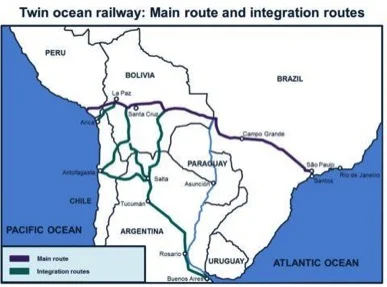
Photo from: Inter American Dialogue
This marks a win for Bolivia, who has been in discussions with China, Peru, and Brazil about being included along the route since 2014, following the signing of a Memorandum of Understanding creating a trilateral working group on the railway that did not include Bolivia. The landlocked country of Bolivia, which has the lowest GDP per capita in South America, has been looking for a way to access the sea since Chile annexed part of its territory on the Pacific coast in a war during the 1870s. The opportunity for Bolivia to once again be connected to seaports via a major trade-based railway could provide a much-needed boost to the economy.
Like the Nicaraguan Canal, the railway project has also been met with criticisms of possible environmental degradation and threats to local communities. Some of the route passes through delicate Amazon ecosystems, and it is projected to expose up to 600 remote indigenous communities that have never previously had contact with other societies. Current Peruvian president Pedro Pablo Kuzynski has also raised concerns that the railroad will be too environmentally harmful to build.
Looking Ahead
The Nicaraguan Canal and the Twin Ocean Railway are two impressive megaprojects, which, if completed, would underscore China’s economic influence abroad, and help to further cement its role as a global economic power. However, both projects are far from completion. In addition to their environmental and community impact concerns—which could halt the projects in and of themselves—many questions have been raised about their economic feasibility and long-term success, especially given China’s track record with similar endeavors in the region.
The Twin Ocean Railway’s aims are very similar to those of the InterOceanicatranscontinental highway, which also incorporated Brazil. The project began in 2006, however it was never fully completed, and the parts that were finished are not entirely structurally sound. Today, it remains a collection of unfinished, damaged, or impassable sections of highway, with no further construction or completion date in sight. Another Chinese company signed a contract with Brazil in 2011 to build a soy processing plant valued at $2 billion; however the proposed project site remains an empty field. Plans for a different railroad to be built by a Chinese company in Colombia in 2011 never materialized, along with another train project that failed in Venezuela. Given China’s history with these other infrastructure projects, it is entirely possible that the Nicaraguan Canal and the Twin Ocean Railway could end up in a similar situation – never completed or, at best, only partially built and then abandoned.
In addition to the projects that were never finished, other contracts have been pulled due to allegations of corruption between host governments and China. A rail project worth $3.7 billion slated for Mexico in 2014 was terminated after a public outcry due to evidence that the deal benefitted allies of Mexican President Enrique Peña Nieto. Additionally, a recent scandal in Bolivia revealed that the government awarded almost $500 million in no-bid contracts to a single Chinese company, raising concerns about unlawful special privileges. China’s record of not completing projects or engaging in shady contracts could sour relations with the region and foment public skepticism about foreign infrastructure investment, deterring future opportunities for China to grow its economic influence and for Latin America to develop valuable infrastructure and trade links.
Investment in large infrastructure projects in Latin America could be monumental for China’s economic influence and ever-expanding soft power, while at the same time offering sizeable benefits to many Latin American economies. However, Chinese firms must overcome their previous shortcomings and actually make progress on constructing these projects in a socially and environmentally responsible manner. Transcontinental trade and transportation links are largely missing from the region, and these proposed projects would provide much needed connections not only among neighbors, but also to Asia and the rest of the world.
Russian Aggression and the Annexation of Crimea
Guest Writer Daniel Lynam explores policy responses to Russian aggression in Ukraine.
Following the end of the Cold War and the subsequent collapse of the Soviet Union, power dynamics on the Eurasian continent were reshaped by expansions of Western institutions, such as the European Union (EU) and the North Atlantic Treaty Organization (NATO). These expansions have strongly contributed to the current state of tensions between the US (and the EU) and Russia. Russia, under the leadership of Vladimir Putin, is attempting to restructure the balance of power on the continent. A restructuring of power dynamics on the European continent is seen as necessary by the Kremlin to maintain their territorial sovereignty. This is on display in conflicts in Ukraine such as the annexation of Crimea in March 2014 and military buildups along Russia’s Western border. The current US policy towards Russian aggression includes raising the cost for Russia for its actions with the goal of regime change and supporting US allies in Eastern Europe.
Historical Background
The North Atlantic Treaty Organization (NATO) was forged in 1949 to ensure a US commitment to the security of the European continent post WWII and in response the rise of the Soviet Union. The Alliance was formed to ensure a sharing of burden would occur, and that the European nations would too be responsible for their defense in cooperation with the United States. The Soviet Union countered NATO with its own, similar arrangement, the Warsaw Pact between Russia and the communist states in Eastern Europe.
Andrew T. Wolff best describes the source of current Russian aggression as stemming from two historical contexts: a) Russia’s tradition of geopolitical emphasis and worldview and b) a strong disagreement over a 1990 “no expansion promise” made between Russian Prime Minister Mikhail Gorbachev and US Secretary of State James Baker.
Russia has long held a long-standing tradition of approaching the world through a geopolitical standpoint. Russia places an emphasis, above all else, on its own territorial sovereignty and maintaining a relative sphere of influence. This ideology can be seen throughout Russia’s centuries of history as an expansionist empire; some might even argue that this “empire mindset” has still not subsided under the new post-Westphalian state order. This territorial sovereignty is exerted by the ability of the Kremlin to influence politics of that area through political, economic, and social pressures.
The expansion of the EU and NATO, two organizations which deliberately elected to leave Russia out of their membership and operations for many years, pose, for Russia, a threat to its territorial sovereignty as well as its sphere of influence in Eastern Europe by promoting ideals and reform policies not in line with Putin’s administration. Due to the close ties of ethnic Russians across countries like Ukraine, economic and political success there may serve as a ‘spark’ leading to a call for reform in Russia itself—this poses a potential threat to Putin’s control over the country. While some might point to the strong favorability of the Russian leader in the polls, it is important to remember that Putin is looking towards his long-term placement. Should the Russian economy be struck again by recession or depression, that favorability will quickly turn into unfavorability as Russians who were simply content may no longer have a source of income nor food to put on their table.
On a similar note, the 1990 informal agreement between the US and Russia supposedly stated that in exchange for cooperation on a peacefully reunified Germany, NATO would not expand past East Germany. The breakdown comes in interpreting what this agreement actually meant. For the Kremlin, it meant NATO membership would not extend past East Germany, which it did. NATO’s first expansion was in 1999 with the addition of Poland, Hungary, and the Czech Republic into the alliance and has since grown to 28 members. According to a high ranking NATO official, the US and NATO understood this agreement to mean no NATO-deployed troops or bases would be stationed beyond East Germany, which there has not been until after the 2014 annexation of Crimea.
Ultimately, Russia’s interest does not actually lie in the Crimea, but rather the annexation can be seen as an attempt to destabilize the Ukrainian government which was seeking closer ties with the European Union. The government was on the eve of signing a EU-Ukrainian agreement, granting Ukraine access to the EU common market and a push forward on the needle towards accession. Keeping Ukraine from fully integrating with the ‘west’ is of utmost importance for the Kremlin to ensure its sphere of influence remains somewhat intact. This type of power move can also be seen in Georgia, where Russia invaded South Ossetia in 2008 following talks of Georgia looking to join NATO. While Georgia’s NATO aspiration was not the immediate trigger, it intensified relations which ultimately broke down with military build-ups following the downing of a Georgian unmanned drone.
Current US Policy
The current US policy in countering Russian aggression, namely the 2014 annexation of the Crimea and rebel activity in Eastern Ukraine is best described by Steven Pifer, a Senior Fellow at Brookings, in a testimony to the Senate Foreign Relations Committee. Pifer broke breaks down the current US response into three sections:
“I. Bolster the Ukrainian Government
II. Reassure NATO allies of the US commitment to defend against Russian aggression
III. Penalize Russia with the objective of promoting a change in Russian policy”
These three aspects of the US’s strategy, in practice, seek to try to increase the cost of aggression for Russia both through sanctions and increased military support of our allies.
US efforts to bolster the Ukrainian government have been accomplished through disbursements of foreign operations assistance with US$513,502,000 budgeted for 2016, up from US$334,198,000 in 2015. These funds overwhelmingly went to support ‘Economic Development’, with the second largest spending category being ‘Peace and Security,’ which includes providing material support and training to Ukrainian troops. These efforts are meant to help sustain the Ukrainian government against opposition forces and help it fund programs to continue to develop the country economically and socially.
In reassuring NATO allies of the US’s commitment against Russian aggression, the US has pledged both support and weapons. The 2015 European Reassurance Initiative saw the Baltic states each receiving over US$30 million each in equipment to bolster their defense efforts as well as dramatic increases of US Foreign Military Assistance being pledged to these nations as well. The US is currently constructing a second anti-ballistic missile station in Poland in order to complete a so-called “European ballistic missile shield.”
During NATO’s 2016 Summit in Warsaw, President Obama announced the stationing of 1000 US troops throughout Eastern Europe, namely Poland and the Baltic states. While 1000 troops offer Europe minimal, if any, tactical advantage, it is moves like these that NATO sees as key to maintaining the alliance. Should an invasion occur into any of these nations, not only will the invaded nation’s troops be attacked, but so will the US troops, directly forcing the US into the conflict. The theory goes that now the US will have no choice but to pursue full engagement after attacks on their own troops.
While these moves have reassured many US allies, they do pose a very real risk of being interpreted by Russia as encroachment and escalation on its border. Without proper channels of communication and a clear understanding between the two parties, these troop movements may be countered by similar build-ups by Russian troops. This can lead to a continuous cycle of build-up by both sides in response to one another.
A key part of the US response to Russian aggression has been so-called “smart sanctions” which target individuals the US has identified as playing a role in guiding and execution Russian aggression in Ukraine and the Crimea. These sanctions are intended to increase the personal, economic, and diplomatic cost of Russian aggression. Sanctions range from freezing of financial assets to restrictions on travel for these individuals. Additional sanctions imposed in partnership with the EU and NATO members a) restrict access of state-owned enterprises to western markets, b) embargo oil production and exploration equipment exports to Russia, and c) embargo military good exports to Russia. The ultimate goal of the sanctions is to force a regime change through external pressure on the regime itself as well as pressure the economically-affected population.
While the Russian economy has been in an economic downturn since 2014, credit may not be fully placed on the sanctions regime, but rather on a global downturn in oil prices. The Russian economy relies extensively on oil exports with minimal diversification. The global downturn in oil prices as directly impacted the economy and the value of the Russian ruble. The sanctions regime has further hampered the recession by limiting the country’s access to credit, meaning it has limited sources of finance. With the recent OPEC agreement to cut production, it will be a true test of the strength of the sanctions regime and how much it will prohibit the economy from recovering fully.
Concluding Remarks
The current conflict in Ukraine is a symptom of wider Russian aggression. These moves, unilaterally executed by Putin, can be viewed as a response to long-term ‘encroachment’ of western organizations like the EU and NATO. These organizations which explicitly do not include Russia (although attempts have been made for more bilateral cooperation) pose threats to what Russia perceives to be its territorial sovereignty and its sphere of influence. Russian moves can be seen to attempt to destabilize the international systems set up by Western powers.
Many politicians and pundits like to talk of a “Russian reset” in which the US (and other Western powers) would attempt to reharmonize relations with Russia and start with a blank slate, of sorts. I can appreciate the sentiment of this approach and for sure, so does Donald Trump. However, I think it’s a folly. A fundamental basis of international relations is the idea of the “long game,” states and actors are always aware of how their actions affect their long-term status, credibility, and survival. The same concept can be applied in a backwards looking manor; it is laughable to think a state will forget previous actions and threats. Rather, I would argue, Trump and other western leaders should look to rebuild relations with Russia fully embracing our past and current clashes. A relationship with Russia should be folded into institutions where the Kremlin can have an equal seat at the table and reassure itself that any moves executed by Western powers does not pose a threat to Russian sovereignty. This is key if any successful and productive relationship with Russia is to move forward.
On the same note, we need to reemphasize it is never okay to sit idly by or fail to respond to aggressive moves on behalf of Russia that threatens sovereignty of other nations. Maintaining sovereignty of all nations is paramount to US security. If we don’t defend others, who would defend us should the day come. That’s why Donald Trump should continue the US’s trifold policy, until otherwise warranted, of bolstering support militarily and economically of Ukraine and its Eastern European allies as well as attempting to usher a regime change through sanctions.
The Case for the Iraq War
Guest Writer Robert Rosamelia looks at past and present American attempts at nation building.
“Nation-building” is often considered a loaded term in our modern lexicon that sets political pundits and experts alike off on riffs and rants that coalesce around how it has been done incorrectly. Talk of the continuing instability in post-Cold War attempts to assist in the emergence of democratic states in Iraq, Afghanistan, Libya, and Syria dominates the conversation surrounding nation-building. This stigma suggests that nation-building is nearly always a recipe for disaster undertaken with foolish expectations in mind for the host nation. However, nation-building can be done with great success—exemplified no better than the postwar reconstruction of Germany and Japan—and carries with it lessons to be learned for future U.S. foreign policy initiatives. In this article, I will discuss three major points about U.S. nation-building efforts in Germany and Japan, the failure to emulate those efforts during the 2003 invasion of Iraq, and how the situation in Iraq can still be improved and serve as a point of improvement:
Planning for the occupations of Germany and Japan was meticulous, whereas the Iraqi plan was undercut by a lack of consensus. Advanced planning for the reconstruction of Germany and Japan began before World War II had even ended. This comprehensive approach allowed the U.S. to create hierarchical and sensible command structures, and American generals were cautious to revert power back to the postwar nations. Iraq’s management was far less detail-oriented. A failure to understand cultural and economic intricacies undoubtedly caused tensions between different religious and ethnic groups to spiral into intense struggles that threaten the stability of the country to this day.
A sense of national identity in Germany and Japan served as a benefit to the occupation. The relatively singular cultures of German and Japanese nationals benefitted American planners by only having to consider each culture on its own. Economic and governmental stability were the major focal points of the U.S. nation-building effort after WWII. In Iraq, the U.S. occupation turned chaotic rather quickly due to the neglect of internecine struggles between various ethnic and religious groups. Because there was no singular Iraqi identity, failure to acknowledge these social hierarchies ultimately fostered an environment where open hostility could not be prevented.
There is still a means of achieving Iraqi stability, but the window is closing. As Iraq is mired by internal conflict, a glimmer of hope remains from the examples of Germany and Japan. America’s role as an advisory power may still serve to mediate discussion between different swathes of Iraqi culture, and complete detachment from their political sphere should be weighed by their readiness to govern. Lessons in planning and execution from Germany and Japan should dictate future U.S. policy, and Iraq now serves as a benchmark for improvement for future nation-building efforts.
Nation-building, as a general term, is often interpreted as the occupation and reconstruction of one nation—the host nation—by another with the end goal of making the host country resemble the occupying nation. In the United States, this definition is often associated with the effort undertaken by the U.S. to democratize the dictatorship led by Saddam Hussein in the aftermath of the 2003 invasion. The lack of anticipation of cultural and economic challenges created a stigma that nation-building is nearly always a recipe for disaster undertaken with foolish expectations in mind. However, nation-building can be done with great success, exemplified no better than the postwar reconstruction of Germany and Japan. American generals overseeing the postwar reconstruction of Germany and Japan had a detailed command structure in place working in tandem with experts on the host countries; the absence of familiarity with Iraqi political culture would hobble American attempts at nation-building after the 2003 invasion just as the proficiency of German and Japanese political culture had benefitted the American proconsuls in the aftermath of World War II. In addition to the rigidly planned and long-spanning implementation of nation-building efforts in Germany and Japan, the homogenous cultural and societal trends in the host countries also served as a boon to U.S. efforts that was not present during the occupation of Iraq. These diverging strategies ultimately caused two nation-building efforts to chart different courses, but lessons learned in both post-WWII Germany and Japan and post-invasion Iraq now serve as benchmarks of improvement for future U.S. endeavors in nation-building.
Before World War II had officially ended, the United States government had already been hard at work on three stages of preparation that were identical for German and Japan. This period consisted of “the first stage, 1942-43, a time of research and preliminary position papers, the general framework for a new world order and basic principles for the treatment of defeated enemy countries,” “the second period of more advanced work,” and “the third stage of planning [when] political solutions of the Japan specialists had gained wide acceptance.” This punctilious approach was designed in order to create an environment where experts on both host nations would draw upon knowledge of their cultures meant to be incorporated into the framework set up by the postwar governments. In the specific case of Germany, the U.S.-led allied powers “pursued nation-building in Germany by demobilizing the German military, holding war crimes tribunals, helping construct democratic institutions, and providing substantial humanitarian and economic assistance,” and the democratization effort was made easier due to consideration by American experts that Germans of the Weimar Republic had a basic understanding of democratic systems of government. The effort by American planners to create democratic nations that would resemble American structures was expert-driven and required a commitment in time and resources by U.S. military governors in order to keep economic and civil operations stable. Iraq would begin with similar goals of democratization, with Andrew J. Bacevich summarizing the American invasion of Iraq “as the initial gambit of an effort to transform the entire region through the use of superior military power, [and] it not only made sense but also held out the prospect of finally resolving the incongruities bedeviling U.S. policy.” While Iraq had the same general end goals of the postwar occupations of Germany and Japan, the results could not have been more different in Iraq due to inadequate preparation on the part of the U.S. that had been so heavily relied upon in Germany and Japan.
Operation Iraqi Freedom started in 2003 with the primary goal of unseating Iraq’s dictator, Saddam Hussein, in an attempt to create a democratic Iraq that would serve as a benchmark for other countries in the region and encourage them to follow suit. American interests in Iraq were nearly indistinct from the interest in creating stable nations of Germany and Japan, yet Germany and Japan are currently stable democracies and two of the world’s foremost economic powers while Iraq remains mired in intense regional conflict with a weak central government. In the post-9/11 world, there was certainly a desire to see the unpredictability of Saddam Hussein and his threats of possessing WMDs neutralized as quickly as possible. As the arguments of “no blood for oil” also arose in the lead-up to Operation Iraqi Freedom, economist Gary S. Becker dismisses this claim with the fact that “the U.S. would be better off if it encouraged Iraq to export more, not less, oil because that would lower oil prices.” In short, if the U.S. wanted oil from Iraq, war would be incredibly destructive to this objective. However, the Bush administration’s handling of the subsequent occupation of Iraq, according to Michael E. O’Hanlon, “surely includes the administration’s desire to portray the Iraq war as a relatively easy undertaking in order to assure domestic and international support, the administration’s disdain for nation-building, and the Pentagon leadership’s unrealistic hope that Ahmed Chalabi and the rather small and weak Iraqi National Congress might somehow assume control of the country after Saddam fell.” Juxtaposed to the time and resource commitment and intense knowledge of host nations by the American military governments present in Germany and Japan, the effort to nation-build in Iraq was negatively impacted by a less precise and incredibly blunt military intervention that dissolved the current structure without a suitable replacement. The failure of the Bush administration to enact a fully developed strategy only exacerbated the potential for chaos in a host nation O’Hanlon concludes as “still plagued by the continued presence of thousands of Baathists from Saddam’s various elite security forces who had melted into the population rather than fight hard against the invading coalition.” Germany and Japan had robust military governments that sought to create stability before turning power over to the host nation, but their homogenous cultural makeup was another major benefit that the Bush administration did not possess and failed to explore during the occupation of Iraq.
Economic and governmental factors played a large role in the bifurcated end results of post-WWII Germany and Japan and Iraq. U.S. proconsuls’ awareness of the need for a stable governing structure in the former cases and the intelligence gap in the latter case was paramount in determining the differences in end result. In post-WWII Germany, “the occupying powers continued to allow the German central bank to operate, but they, rather than the Germans, exercised control over it,” and “in the U.S. sector, General Clay devoted substantial effort and resources to restarting German factories and mines.” The American nation-building effort had taken great care in ensuring an economically stable system would be in place once occupation of Germany came to an end. This was undoubtedly due in part to the fact that economic blight had crippled Germany in the aftermath of World War I and made the people of Germany susceptible to authoritarianism. American proconsuls were right to address this as a primary component of their nation-building efforts as a means of preventing another politically gifted figure from demagogically exploiting the postwar disarray to promote their own ends in the way Adolf Hitler did during the Weimar period. For this reason alone, economic stability was a driving force for American planners during the reconstruction of Germany. Governance in Germany was also tempered, and American generals were cautious to introduce immediate German rule because of concerns that “a civilian would be lost that quickly after the close of hostilities.” American military governors had a command structure in place, and turning control over to the host nation too soon had the potential of resulting in a breakdown of the fledgling democratic system the U.S. was trying to build if pressured too soon. The invasion of Iraq proved to be a nearly polar opposite approach to the one taken in postwar Germany.
After the toppling of Saddam Hussein and the presence of U.S. troops in Baghdad, the politics surrounding economic structures in Iraq immediately came to the fore. Unlike in Germany, socio-economic development was undermined due to a lack of American knowledge of the major economic resource of Iraq—oil—as Anthony H. Cordesman of CSIS points out:
Iraq’s oil wealth has not been used to create the economic conditions for unity, and is a critical underlying problem in trying to heal its sectarian and ethnic divisions. The [Iraqi Prime Minister] Maliki regime strongly favored itself and Arab Shi’ites over Arab Sunnis, and wavered between efforts to bribe the Kurds and force them to put all petroleum development under central government control.
The failure to understand cultural ties to economic resources in Iraq meant that the United States was already at a disadvantage. Unlike in Germany, American forces had no reliable source to turn over economic control to in Iraq, and the lack of cultural ties to Iraqi economic resources almost ensured sectarian conflict would arise in the absence of the American military. The governing system of Iraq did not fare much better due to the lack of democratic foundation in the country. The nation-building effort in Iraq had the potential to see the new Iraqi government accommodate the multiple sects of its society by “endowing those institutions with popular legitimacy and widespread participation, not merely shifting power and access from one group to another.” Compounded by the insufficient amount of time spent integrating the civilian population into a democratic framework after the military intervention, murky American understanding of the multiple identities of Iraqi society did little to help an increasingly unstable environment.
A clear example of such murky understanding of the Iraqi political structure came from the slash-and-burn approach coalition forces took in the form of de-Ba’athification, or the dismantling of the Ba’ath Party in Iraq that espoused the principles of socialism and Arab nationalism under Saddam Hussein’s authoritarian regime. Any restructuring of the Iraqi political environment would require some degree of de-Ba’athification, but the American approach saw an abrupt shift for a nation that was not united under one national identity in the way the Germans or Japanese were and had deep-seated sectarian struggles. The goal of de-Ba’athification was, according to the Coalition Provisional Authority Order 1, “eliminating the party’s structures and removing its leadership from positions of authority and responsibility in Iraqi society” in order to ensure “representative government in Iraq is not threatened by Ba`athist elements returning to power and that those in positions of authority in the future are acceptable to the people of Iraq.” In doing so, the U.S. comprehensively rebuilt the Iraqi government on a foundation rooted in—among other things—sectarian struggles that would boil over under the Premiership of Nouri al-Maliki, a Shiite Muslim. As Prime Minister of Iraq, al-Maliki set the stage for the current volatility in the region due to what Council on Foreign Relations fellow Max Boot deemed the “victimisation of Sunnis [and] made them receptive to Isis, which was being reborn in the chaos of Syria.” Swaths of Iraqi Sunnis who were suddenly found out of the job as a result of de-Ba’athification were targeted by mass arrests and suppression tactics under al-Maliki that made them feel isolated and under attack. In 2011, AEI scholar Frederick W. Kagan and Institute for the Study of War President Kimberly Kagan wrote that “Maliki is unwinding the multi-ethnic, cross-sectarian Iraqi political settlement” in part due to his exploitation of the effects of de-Ba’athification. Such a comprehensive reorganization of the host nation’s government with no apparent sensitivity to centuries-long sectarian struggles was a major contributor to the failure to achieve political stability in Iraq.
While Germany and Japan had fairly simple ethnic and cultural breakdowns largely due to a sense of national identity, Iraq was unique in this case due to the fact that “oil, ethnicity, religion, tribes, militias, the insurgency, the Sunni Arab boycott of January 2005 elections, and old-fashioned power struggles combined for volatile post-Saddam politics” that had not been accounted for in Iraq. These cultural intricacies led to complications that were less contentious in the examples of Germany and Japan, and the lack of anticipation on the part of the U.S. for these factors made for a messy reorganization of post-intervention Iraq. In his reflections on the Iraq War, Robert Kaplan surmises that “better generalship and logical command chains would likely have improved the security situation, leading to less financial cost, less loss of human life, less opportunity for Iranian meddling, and thus a better geopolitical outcome.” The U.S. benefitted from a stringent chain of command and more homogenous host country in the case of Germany and Japan, but the inadequate anticipation for the dynamics of Iraqi culture and elite structure threaten to put the entire undertaking in severe jeopardy. There was no clear evidence that Bush administration officials were prepared to grapple with the competing sectarian interests present in Iraq that were absent from the nation-building effort in postwar Germany and Japan, and herein lies the issue. The central key to success for any nation-building effort is that the host nation is capable of creating a unified government, and Professor James M. Quirk appropriately observes that “for Iraq, that included Shiites confident that Saddam Hussein and the Ba’ath Party would not return to repress them, minority Sunnis that they would not be repressed by the rise of Shiites to power, and Kurds that much of their autonomy (and oil assets) would be preserved.” Being attentive to this dynamic was crucial at the time of the invasion, and not having a strategy in place to deal with the intricacies of Iraqi culture ultimately led to intense sectarian violence.
The future of Iraq is one that now seems uncertain with the rise of ISIS and internecine conflict between different regions of the country that are at odds due to their competing identities. While it is uncertain what, if anything, the U.S. can do to turn the deteriorating situation in Iraq around, a suggestion by Sen. Marco Rubio (R-FL)—a member of the Senate Foreign Relations Committee and Senate Select Committee on Intelligence—takes sectarian relations into account in order to “negotiate a power-sharing deal that will give predominantly Sunni provinces, such as Anbar and Nineveh, assurances that their rights will be respected by Baghdad.” Though this is imperfect as a sole solution due to the fact that sectarian divides are not the singular cause of Iraq’s current political instability, Sen. Rubio offers a perspective that incorporates sectarian conflict in a way not seen in the planning for post-invasion Iraq. Future U.S. sensitivity to the cultural identities and awareness of the power dynamics at play are paramount to establishing governmental structures that will in turn function constructively with respect to Iraqi culture. As with Germany and Japan, the U.S. withdrawal of forces in 2011 does not mean an end to advising, but the Iraqis are now—whether they were ready to in 2005 or not—beginning to govern themselves. For the future of Iraq to regain stability despite the instability in the region, the current U.S. nation-building effort should be conscious of the fact that “early difficulties, and even early failures, will not indicate long-term disorder as long as the key representative interests remain committed to this kind of politicking instead of retreating to coups, secession or open advocacy of violence.” The best course of action for U.S. planners in Iraq is to be cognizant of competing sectarian interests while allowing these differences to be dealt with politically as opposed to violently and facilitate discussion where need be.
The post-WWII German and Japanese nation-building efforts succeeded because of a logical chain of command and significant time and resource investments that sought to steadily revert power back to the host countries; Iraq’s failures resulted from a loosely-defined command structure after regime change and a lack of understanding by U.S. planners of the rudiments of Iraqi cultural diversity in a way not seen in the German or Japanese examples. Though the results of poor foundational handling after regime change are seen in modern-day Iraq, there are still lessons that can be gleaned from previous nation-building successes in Germany and Japan. Future U.S. foreign policy—if it is to still be one of championing democratization abroad—would do well to observe the future of Iraq and remember the lack of foundational planning as a benchmark for improvement if future nation-building efforts are to be beneficial to U.S. foreign interests.
Overestimating Refugees’ Economic Impact: An Analysis of the Prevailing Economic Literature on Forced Migration
Contributing Editor William Kakenmaster disproves prevailing myths surrounding refugees’ economic impact.
The UNHCR reported in June 2016 that the number of number of refugees, asylum seekers, and internally displaced persons reached a record high of 65 million individuals worldwide. How will all these individuals impact the economies of the countries in which they find asylum? Do refugees, as some politicians claim, force domestic workers out of the labor market? Do refugees exert a substantially negatively net fiscal impact? This paper attempts to address these questions by analyzing the prevailing economic literature from 1990 until the present on refugees’ and immigration’s economic impact. I argue that, although the estimated economic effects of immigration and refugees vary, their overall impact is negligible. Refugees exert a slightly negative impact on domestic wages if domestic labor is immobile. At the same time, refugees’ net fiscal impact depends more on their tax contribution—which is a function of their labor market integration—than their consumption of publicly funded goods and services.
Overview
Refugee and forced migration issues have dominated recent political debates in Europe and other parts of the world. Those on the political Right claim that refugees threaten European national security, economic prosperity, and cultural traditions; those on the political Left claim that the influx of refugees represents a humanitarian crisis that demands accepting additional refugees. Perhaps the Economist’s attempt to reconcile these two opposing opinions puts it best: “Humanity dictates that the rich world admit refugees, irrespective of the economic impact. But the economics of the influx still matters.” Setting aside that international law does require states to provide refugees with asylum, this paper attempts to address the two most salient economic questions regarding refugees’ arrival in Europe.
First, do refugees displace domestic workers, leading to higher rates of unemployment and lower wages? Second, do refugees exert significant strains on public finances? While perfect data do not exist to answer either of these questions beyond the shadow of a doubt, evidence suggests that, in the short run, granting refugees asylum leads to a negligible overall effect on the labor market and public finance. In the long run, however, refugees positively contribute to the labor market and public finances, the extent of which depends mostly on the success of their integration into the economy.
Refugees and the Labor Market
Economists disagree about the precise nature and extent of immigration’s impact on the wages and unemployment rates in immigrant-receiving countries. On the one hand, some studies suggest that immigration has “essentially no effect on the wages or employment outcomes” of domestic workers. David Card’s famous analysis of the Mariel Boatlift found that refugee immigration had a positive, yet minimal impact on the Miami economy due to the city’s ability to absorb refugees into previously unexploited sectors. On the other hand, George Borjas argues that, because of labor mobility, the impact of immigration on unemployment and wages may be tenuous in regional labor markets, while simultaneously depressing labor market conditions at a national level. Borjas measured skilled and unskilled immigrant labor in terms of educational qualifications and found that a 10 percent increase in the labor force due to immigration resulted in a three to four point decrease in domestic workers’ wages.
However, other studies attempt to find some sort of middle ground, disputing both the argument that immigration has no effect on the labor market and the argument that immigration drastically depresses wages and employment. Gianmarco Ottaviano and Giovanni Peri, for instance, adopt the qualification bands from Borjas’ framework, but they assume that, even within those bands, immigrant and domestic workers are not perfect substitutes. In other words, immigrants with the exact same educational qualifications as domestic workers can function as “imperfect substitutes” because of labor market discrimination. Even if immigrants could do the same job as domestic workers, they don’t practically function as perfect substitutes because, in reality, they may not be hired by employers who consider them less capable because of their race, ethnicity, nationality, language, etc. As a result, Ottaviano and Peri find that immigration has “a small effect on the wages of native workers with no high school degree (between 0.6% and +1.7%) […and] a small positive effect on average native wages (+0.6%).” Moreover, Ottaviano and Peri also note that, given the standard error, this effect is not “significantly different from 0.” The largest impact on the labor market observed was on the wages of previous immigrants, which were found to have “a substantially negative effect (−6.7%).” Thus, even at the theoretical level, the effect of immigration on the labor market has been highly contested.
Later, even more tweaks were made to the traditional methodology used to study the economic effects of migration. Stephen Nickell of the University of Oxford and Jumana Saleheen of the Bank of England recently studiedmigration’s impact on average British wages in any given region of the country between 1992 and 2014. Crucially, Nickell and Saleheen measure skill distribution by occupation, a clever methodological tweak considering “that it is often very tricky to accurately compare education qualifications across countries.” In addition, treating skill distribution as a function of occupationhelps to translate the economics of migration directly into the jargon of public discourse, which treats immigrants principally by occupation rather than by educational attainment, such as with the “stereotype of the Polish plumber—used widely as a symbol of cheap labor.” Ultimately, Nickell and Saleheen findthat migration exerts “a statistically significant, small, negative impact on the average occupational wage rates of the regions” studied. The largest effect on wages observed related to semi-skilled and unskilled labor, where a 10% increase in migrant labor resulted in a 2% decline in the average wage. Nickell and Saleheen’s occupational measure of qualification might be said to be more accurate than educational measures such as Borjas’ considering that, oftentimes, educational credentials do not transfer between countries. Therefore, Nickell and Saleheen’s findings suggest that refugees immigrating to Europe may adversely affect the labor market, but not nearly to the extent that some politicians claim.
Moreover—and with specific regard to refugees—the Economist notes that the wage-dampening may “even have positive side-effects” for the domestic labor market. A recent paper by Mette Foged and Giovanni Peri finds that, in Denmark between 1991 and 2008, domestic workers pushed out of low-skilled industries by refugees changed jobs to other, “less manual and more cognitive” labor-intensive sectors. Such jobs included “legislators and senior [government] officials,” “corporate managers,” and even “skilled agricultural and fishery” sectors. By contrast, the proportion of refugees composing manual skilled sectors such as “machine operators,” “drivers,” and “mining laborers” rose substantially, resulting in “positive or null wage effects and positive or null employment effects” for domestic populations over the long run. So, to the extent that refugees substitute for domestic labor—however imperfect that substitution may be—their overall economic impact also depends on the abilities of displaced domestic workers to find employment in other sectors. Additionally, evidence exists from Congolese refugee camps in Rwanda to suggest that one additional refugee receiving cash aid contributes an estimated $205 to $253 to the local economy. Taking the difference between contributions and per-refugee cash aid, refugees yielded a positive individual contribution of between $70 $126 annually. Most of the refugees’ individual contributions resulted from spillovers with the local economy, such as the “purchase [of] goods and services from host-country businesses outside the camps.” If refugees displace workers who move into other sectors of the economy and experience higher wages, then they also positively contribute to the sales of local businesses.
Refugees and Public Finances
Refugees exert a similarly ambiguous impact on public finance as they do on the labor market. In fact, a 2013 OECD report notes that including or excluding non-personal sources of tax revenue, such as corporate income taxes, as well as non-excludable goods like roads, in an analysis of immigrants’ net public fiscal impact “often changes the sign of the impact” itself. Estimates of immigrants’ net fiscal impact thus vary depending on the methodology employed, although the report’s main findings suggest that—however measured—the impact “rarely exceeds [plus or minus] 0.5% of GDP in a given year.” In fact, the OECD observed the highest impact on public finance in Luxembourg and Switzerland, where immigrants positively contributed an estimated 2% of GDP to the public purse. Compared to domestic populations, however, the OECD report found that, on average, immigrants have a lower net fiscal contribution overall.
This is an especially salient concern in the short run, because refugees can potentially exacerbate strains on the public purse, contributing to increases in demand for public services while the supply of those resources remains temporarily fixed. In fact, precisely because of the protections afforded to asylum seekers under international law, “additional public spending for […] housing, food, health, and education, will increase aggregate demand,” therefore making such services more costly to provide, all else equal. However, in many cases, the short-term costs of accommodating asylum seekers are borne by international donors rather than governments. In fact, University of Oxford Professor Emeritus Roger Zetter notes that global programs to accommodate refugees in the short term total 8.4 billion USD globally, but that economists “rarely analyze the economic outcomes of their program[s].” Instead, they “tend to assess the impacts and costs for the host community” as a percentage of GDP regardless of whether or not the government actually pays for the accommodations provided to refugees. Such analyses are frankly misleading because, while aggregate demand for publicly funded goods may increase in the short run, the cost of meeting such a higher demand puts strain on NGOs, the UNHCR, and other international donors, not on governments.
Among the three countries with the highest numbers of Syrian refugees—Turkey, Lebanon, and Jordan—GDP is expected to rise, while estimates of the costs of accommodating refugees are paltry. The OECD predicts that Turkey’s GDP growth will “remain close to 4% per annum in 2016 and 2017.” Meanwhile, the 5.37 billion euros that Turkey spent between 2012 and 2015 on “the perfect refugee camp[s]” amount to less than 0.2% of GDP per year. Turkey, importantly, is one of the only countries paying the entire costs of short term asylum accommodations out of pocket, “except for some relatively minor international donations” Similar trends have been observed in Lebanon and Jordan, where GDP growth far outpaces the short term costs of accommodating refugees largely due to the fact that—in contrast to Turkey—refugee camps and resettlement programs are funded principally by NGOs and the UNHCR.
Yet even following the short term costs of accommodating refugees, their net fiscal impact over time depends more on the success of their integration into the labor market than their raw consumption of publicly provided goods and services. Joakim Ruist from the University of Gothenburg, for instance, suggeststhat the net fiscal contribution of refugees in Sweden steadily increases from approximately 10,000 kronor (approximately 1,100 USD) during the first year of residence to over 30,000 kronor (approximately 3,300 USD) during their seventh year. In a similar vein, the IMF observed that, depending on the speed of labor market integration, “the level of GDP could be about 0.25 percent higher for the EU as a whole and between 0.5 and 1.1 percent higher in the three main destination countries (Austria, Germany, Sweden)” by 2020.
Importantly, Ruist found that four-fifths of refugees’ net fiscal impact has been estimated to result from their smaller contributions to tax revenue, while only one-fifth was due to “higher per-capita public costs.” In other words, the net fiscal impact of refugees has more to do with their limited contribution to government revenue than their increased demand for public services, suggesting that refugees are more than capable of paying for the public services they consume if successfully and fully integrated into the labor market. This further justifies the need to focus on integrating refugees into the labor market of their destination country, as opposed to simply denying asylum claims based on perceptions that refugees will “steal” domestic jobs.
Furthermore, attempting to estimate refugees’ net fiscal impact based on previous models of migration like Borjas’ wrongly assumes that refugees have a reasonably similar economic profile as other immigrants. In reality, the net fiscal impact of any immigrant varies depending on both the economic profile of the immigrant and the economic conditions of the receiving countries. For example, immigration to Europe between 2007 and 2009 heavily strained public finances because “lots of [immigrants] were pensioners, who tend to drain the public finances,” according to the Economist. By contrast, most refugees fleeing Syria, who “constitute[d] the biggest national group migrating to Europe in 2015,” are both younger and more skilled than those fleeing the last “refugee crisis” in Europe—that of the former Yugoslavia in the 1990s. The median age of Syrian refugees in 2014 was 23 years-old, and compared to the former Yugoslavia, the ratio of “youth cohorts” to “near-retirement-cohorts” has declined from 1.3 to 0.7 since 1990. Moreover, the International Labor Organization reported in 2014 that an average of 56% of Syrian refugees residing in Lebanese camps worked either in skilled or semi-skilled sectors. Therefore, the impact of refugees on the economy overall, and specifically on a country’s public finances, depends on the economic profile of the refugees with particular regard for working-age and job skills.
Conclusion
According to the Pew Research Center, a record 1.3 million people applied for asylum in Europe in 2015, nearly double the previous record of 700,000 set in 1992, and the number of forced migrants across the globe continues to rise. Therefore, understanding refugees’ impact on European economies will become hugely important as more and more are granted asylum and resettled in their new homes. While previous studies of immigration’s impact on the labor market and public finances is somewhat ambiguous, the prevailing economic literature suggests that, in the short run, refugees will have a slightly negative impact on average wages and employment rates in substitutable sectors, and a slightly negative impact on public finances. However, in the long run, if prevailing economic scholarship holds true, wages will stabilize while those forced out of employment by refugees will find work in other sectors, and refugees will yield a net positive fiscal contribution. Finally, considering the fact that refugees hardly function as perfect substitutes for domestic labor, their integration into the labor market would bolster the overall net fiscal expenditure of immigrant-receiving countries.

Excessive Resource Specialization and Openness to Trade
Guest Writer Sam Mason discusses the connections between resource overspecialization and regime type.
Above, Saudi Arabia’s King Salman bin Abdulaziz Al Saud in conversation with Prime Minister Narendra Modi of India. Saudi Arabia has almost one-fifth of the world’s proven oil reserves and ranks as the largest producer and exporter of oil in the world.
In an era where global trade is powered by an insatiable thirst for primary resources, those in control of the lands blessed with the right fixes for the world’s addictions bear incredible influence on the futures of their own nations. Add to the mix a lack of viable economic alternatives and the endowment of an abundant resource can serve as easy temptation for a country to overspecialize. To a political leader, the allure of lining your nation’s coffers with the riches promised by a hefty resource endowment is hard not to give into. And indeed, a valuable exportable asset is exactly that; valuable. But what happens when country leadership goes full throttle with only one tradable resource? How does this affect the overall trade outcomes of that country? Throughout the process of overspecialization, the political elite of resource-dependent countries may look at their windfalls and be tempted to rest easily about the economic future of their nation, but data suggests that when it comes to overspecialization, it is typically the resources in control of the countries, not the other way around.
Looking into the issue of excessive resource specialization, there is no shortage of analysis connecting resource overdependence to poor governance outcomes and a host of economic maladies, yet very little is done to take the next step in connecting overspecialization to overall outcomes in trade specifically. Considering this gap in research as well as the reliance of many resource-dependent economies on exports for their very economic existence, there is a compelling case to be made for us to explore just where embarking down a path of overspecialization leads, especially as it concerns a country’s overall, long-term trade outcomes. To be sure, overspecialization can mean different things to different people. Thus, this analysis will focus on just the most extreme cases of specialization; from economies where one primary resource or resource sector (i.e., petroleum, refined petroleum and petroleum derivatives would be considered one ‘resource’) comprises or comprised at least 70% of exports, and/or at least 25% of national GDP.
Upon first glance, the main culprits of overspecialization demonstrate a few immediately identifiable commonalities. The most dominant trait across the board is the dominance of mineral resources. Though non-mineral, primary resource exports like bananas and coffee in some countries like Guatemala and Honduras make up significant percentages of government revenues, it would seem that no exportable asset wields the same potential to completely dominate a country’s export portfolio as raw mineral materials. Secondly, these over-indulgers in mineral resources tend to be low to middle income economies. In fact, according to a 2011 study, nearly “75% of all mineral-dependent countries are now low- and middle-income countries, while the number classed as mineral-dependent has increased by 33% since 1996 from 46 to 61 nations.” The same study also finds a “strong negative correlation between non-fuel mineral dependence and GDP per capita,” suggesting that resource wealth actually aggravates, rather than alleviates, domestic inequality. This means that we will be talking primarily about petroleum and oil exporters like Venezuela, Iraq, Azerbaijan, Angola and Equatorial Guinea, but also occasionally about exporters of other important commodities like the Democratic Republic of Congo, or Zambia, where copper reserves rake in over 77% of export wealth. Additionally, given a lack of prior development in many overspecialized economies and the sheer abundance of the specialized resource, export capability tends to vastly overshadow domestic consumption capability, reflecting a domestic economy that is not industrialized enough to consume the abundant resource, further contributing to export concentration.
When it comes to the academic take on the effects of overspecialization, most scholars agree that there is a connection between singular resource wealth and the consolidation of authoritarian regimes and weakening of political and economic institutions. Though there are disagreements about processes, the main hypotheses on this point can be summarized into three general points: 1) “easy resource revenues eliminate a critical link of accountability between government and citizens” 2) “[resource] revenues generate staggering wealth that facilitates corruption and patronage networks” and 3) “together, [these factors] consolidate the power of entrenched elites and regime supporters, sharpening income inequality and stifling political reform.” The caveat here, however, is that not all countries that fit the scope of this investigation are officially autocratic, though many of these democracies on paper still indeed display indicators of weak institutions, such as corruption, uninterrupted political terms, as well extra-constitutional powers afforded to political figures. Examples of these countries would be Azerbaijan, Zambia, DRC, Nigeria, Algeria and Venezuela, all ‘democracies’ given a rating below 45/100 on theOxford Policy Management economic and institutional development index, developed from the World Bank’s six world governance indicators. These characteristics of resource-dependent states are particularly important to this investigation as they deal with the very policymakers steering a country’s economic vehicle and the economic climates that they operate in.
Implications for Trade
Foreign Direct Investment
At the outset of discovery, a given low-middle income resource overdependent nation typically does not possess the necessary capital, technology and expertise required to get a resource out of the ground and into the hands of consumers and industries the world round (and at a profit at that). This paves a clear path for foreign MNCs with the right stature to assume the immense risks and costs associated with resource exploration. Thus, at first, there is a high incentive for host countries to embrace foreign access to their country’s resources. Over the long term, however, governments tend to shed foreign ownership with time. Today, foreign ownership varies from region to region, being the highest in the least developed countries. According to a 2007 reportfrom the United Nations Conference on Trade and Development, the share of oil production by foreign firms was 57% for Sub-Saharan Africa, while it was a mere 18% for Latin America, 11% for middle income countries, 19% for all low income countries, and nonexistent for some countries like Kuwait and Saudi Arabia. But even in these latter cases, initial foreign ownership has proven unavoidable, like in Saudi Arabia, where foreign partners were not completely bought out until 1988, a full fifty years after the discovery of oil. These transitions make sense given the fortifying effect resource wealth can have on a regime’s grasp on power. Despite these general patterns for oil producing countries, however, autocratic countries with poor institutions can still ostensibly exercise their domain over the export industry through their control of the enforceability of contracts and their final say on the issue of nationalization. Furthermore, in some resource-rich sub-Saharan African countries for example, navigating bulky bureaucracies often means engaging in quid-pro-quo transactions that favor the established powers, serving as a tantalizing way to bypass red tape. It is important to note here that a lack of transparency surrounding dealmaking in institutionally weak countries makes finding official figures notoriously difficult.
Foreign Reserve Usage
If FDI and exploration prove successful in developing a resource promise, host countries face the prospect of being on the receiving end of seemingly boundless sums of foreign reserves. In autocratic regimes, these windfalls are concentrated in and directed by the hands of the powerful few, who may dispense of their wealth to ensure the continuation and enjoyment of their own entrenched political interests. Thus, outcomes may be seen as depending disproportionately on the incentives of domestic leadership, and may be used to squander resource wealth just as they may be used to invest in future diversification and trade in other sectors, though the former seems to be more popular choice. According to a 2015 report from the Natural Resource Governance Institute, “resource-rich governments have a tendency to overspend on government salaries, inefficient fuel subsidies and large monuments and to underspend on health, education and other social services.” Securing popularity is not free, and in resource-rich autocratic regimes looking to preserve power, high on the list of priorities for the national budget is financing patronage networks that distribute jobs to political supporters and buying off opponents. Perhaps most recklessly, foreign reserves may be also be blown on lavish personal endeavors. Consider the ruling families of Equatorial Guinea, Gabon, and Republic of Congo; all nations that fit the confines of this investigation who have international investigations opened against them for embezzling millions of dollars worth of state money.
The implications these spending habits have for trade lie within their sustainability over the long term, and to what extent they direct or misdirect investment to/from industries outside of the resource sector. This is because overspecialization subjects an economy to the fluctuations of international commodity prices, and when prices inevitably take a dip, if country leadership has not properly mitigated against this inherent risk, governments will likely have to stifle foreign exchange usage so that reserves don’t dry up. This limits a country’s options for financing imports and is observable time and time again in developing, resource-dependent countries. In 2015, Angola’s central bank had to request companies and citizens to cut foreign-exchange usage in half amid a dollar shortage caused by dwindling revenue from oil and diamond exports. This year in Nigeria low international oil prices have devastated government earnings, causing rating agencies to downgrade the economy and President Muhammadu Buhari to slash his budget, reducing the country’s overall growth prospects. This included ending Nigeria’s infamous fuel subsidies, for which the government this year alone spent over $5 billion trying to maintain. According to experts, these subsidization policies, as part of government spending in an institutionally weak country, were corrupt and highly inefficient. In Brunei, where oil windfalls in the sultanate have historically meant no income tax or sales tax for locals, as well as free university education and and subsidized housing, the government has recently had to make sweeping budget cuts in light of falling oil prices. In Venezuela, where oil exports account for 95% of revenue, and imports account almost entirely for nationwide consumption, socialist leadership has historically diverted money from increasing productivity or ensuring production to building houses for the poor, distributing subsidised food to state-owned markets, and funding social programmes, neglecting not only alternative industries, but the oil producing sector as well. Today, Venezuela’s economy lies in shambles and the availability of basic products is scarce, to say the least. As a whole, in countries where transparency is low and institutions are weak, it can be assumed that low accountability for foreign reserve spending diminishes the probability that resource wealth is used responsibly.
Despite these doomsday predictions, however, as noted before, foreign reserves may indeed be used more sustainably, as observed in several Gulf Arab countries. In Saudi Arabia, for instance, serious dedication to attracting diverse foreign investment is corroborated by General Electric’s recent announcement of an investment of $1.4 billion in the country, creating a $400 million manufacturing facility as well as 2,000 new jobs for Saudi citizens. This implies that nationwide investment in infrastructure (i.e., roads, electricity distribution, etc.) and alternate industries, enhances trade capabilities and widens overall domestic consumption capabilities.
Import & Export Restrictions
Excessive resource specialization can have a sway on leadership in some cases to pursue protectionist policies, such as import substitution, in a vain attempt at diversification. In describing the political failures of Zambia in its pursuit of excessive resource specialization, Arne Bigsten notes that “during mineral booms, most governments behave as if the inflows of resources are permanent, embarking on new projects, including import substitution.” Bigsten further describes that once “boom turns to bust,” it can be quite difficult to reverse economic policies as strong economic interest groups become entrenched by large initial investments. In the case of Indonesia, high worldwide oil prices in the late 1970s brought Indonesia’s mining sector production composition ratio up to 25% by 1980. Amidst this oil boom, Indonesia chose to overlook the role of foreign investment and pursue policies of import substitution, not switching to an export-oriented policy until oil prices plummeted in the 1980s. Since 2015, Angola has also taken several import substitution measures to diversify its economy. According to a report from the World Trade Organization, “customs tariff rates (especially those on agricultural products) have risen considerably and fall within a range of 2% to 50%, with an average of 10.9% (compared to 7.4% in 2005). These cases reflect a desire to open up trade prospects, but in a way that relies too heavily on government directed-windfalls.
With regard to export restrictions, as described by a staff working paper from the World Trade Organization, “the need for export diversification of a resource rich economy can justify the use of export restrictions to promote domestic downstream production,” though “this strategy has a number of drawbacks.” Other incentives also exist for export restrictions, such as is commonly seen amongst OPEC member nations, who are widely known for controlling world oil production supplies so as to secure a collective advantage in regulating worldwide oil prices. Forward thinking oil exporters may also limit output in the short term through production quotas so as to conserve resources for future, sustained exploitation.
Conclusion
Ultimately, not every country shares the same story for how excessive specialization came to play such a dominant role in their economies. In general, oil-dependent Gulf countries (Saudi Arabia, Kuwait, UAE) tend to reflect more positive trade outcomes than the rest of the countries in this investigation. Noting that oil-exporting gulf countries congregate at the higher end of the previously cited economic and institutional development index, perhaps strong institutions, even under autocracies, can mitigate the negative economic forecast generally predicted by resource dependence, though this explanation still leaves the question of how these institutions became strong in the first place. Other academics offer that the oil-rich countries of the Middle East have so far escaped some of the worst economic consequences of the resource curse due to a ratio of relatively small population to a vast amount of oil. The question of what determines sustainable outcomes still remains largely unanswered.
At the end of the day, however, it can be said with confidence that the incentive and initiative for which policies an overspecialized country will choose and why, ultimately fall on country leadership, according to the demands, strains, and opportunities available to them. Thus, the connections that can be drawn between resource overspecialization and regime type, as well as economic conditions, are essential to bridging the broader relationship between excessive resource specialization and openness to trade. Certainly, external political and historical factors, as well as personal traits of individual leaders not addressed here wield their influence on trade outcomes, yet all of these factors seem to pale in comparison to the almighty resources themselves. Ultimately, if a country chooses to devote itself to the riches and promises of one resource and one resource only, it must also accept the unbounding dominance that resource will have on its future.
Beyond Supply and Demand: Using Economic Principles to Explain Terrorism
Guest Writer Buzz Helfrich explains the links between economics and terrorism.
Introduction
Following the September 11, 2001 attacks, a dramatic rise in the study of terrorism occurred in academia. Although recent actions by U.S. military and Treasury officials seek to deplete ISIS’ economic resources, little literature exists regarding the role of economics on the development and behavior of terrorist groups. This paper examines the economic motives of terrorist groups and proposes possible solutions to deter and prevent future terrorist attacks. The first section focuses on the economic causes of terrorism utilizing economic principles such as rational choice theory and self-interest. The second section uses market structure and club theory to examine the dynamics of terrorist group behavior. The third section of the essay explores the use of deterrents including welfare spending, offensive strikes, and restricting economic resources as means of both hindering terrorist organization growth and thwarting terrorist attacks.
Rational Choice Theory, Self-Interest, and Suicide Bombers
To better understand terrorists, this paper classifies them as rational actors who aim to maximize utility. Terrorism is a rational choice because the perpetrators weigh their decisions based on marginal benefit versus marginal cost. Terrorism, as described throughout the essay, is defined as “the premeditated use, or threat of use, of extranormal violence to obtain a political objective through intimidation or fear directed at a large audience.” Terrorists consider the possibility of a successful attack against the possible risk of an agent such as the government preventing the attack and detaining terrorist members. Terrorists also seek to maximize utility by inflicting the greatest possible damage at the lowest possible cost.
Academics may also describe terrorists as self-interested or present-aim actors to further explain their economic motives. The former is defined as considering one’s choice based on tradeoffs regarding cost, benefits, and resources, whereas the latter occurs when an actor successfully pursues their objective at the time of the attack. Present-aim terrorists do not consider possible tradeoffs and base their actions off the most efficient means of destruction possible. Present-aim terrorists claim non-monetary motives behind their actions and would substitute a reduction in income in exchange for more successful terrorist attacks. However, Juliet Elu’s article examining terrorism in Africa and South Asia disproves this idea. Based on the study’s comparison of nations’ GDP per capita and their rate of terrorist attacks from 1980-2004, a positive correlation exists between per-capita-income and terrorist attack rates. This relationship demonstrates that terrorists do not attack low per-capita-income nations due to the decreased economic opportunity, thus exemplifying the idea that terrorists act as self-interested actors.


Figures 1 + 2: Graphs illustrating the relationship between Africa and South Asian nations’ GDP per capita and their number of terrorist incidents from 1980-2004.
Although conventional wisdom may regard suicide bombers as irrational due to their inherently self-destructive actions, economic theory demonstrates their function as self-interested, rational actors who seek to maximize utility based on tradeoffs regarding benefits and costs. A positive correlation exists between suicide bombers and high amounts of human capital; the latter of which economists define as an individual’s skills or knowledge. This relationship is likely due to the increased marginal benefit a highly-intelligent terrorist provides to a terror organization. Despite the destruction of human capital due to the suicide bomber’s inevitable death, the action reaps a large amount of utility for the terrorist organization.
Suicide bombers are also more likely to attack an area with a large population density. Despite the initial explanation of choosing to target high-population dense areas due to increased damages, this decision remains rooted in economic theory. Utilizing this method of destruction provides a low-cost, high benefit means of destruction. The suicide bomber will likely inflict mass casualties due to the high-probability of success. Eli Berman, author of Radical, Religious, and Violent: The New Economics of Terrorism, observes that the operation poses little cost in the form of risk due to the impossibility of the government detaining the perpetrator following their actions. Also, terrorist groups often delegate the role of suicide bomber to those least likely to defect. These members often possess large amounts of human capital and are highly likely to carry out the mission.
Market Structure, Economic Development, and Club Theory
A nation’s market structure may serve as a key factor in a country’s rise of terrorism. Terrorist attacks may occur due to the transition to a more advanced economy. Charles Boehmer and Mark Daube’s research posits a link between the rise of terrorism and the conversion from a clientele economy to a market-based economy. The former consists of an economic structure based on hierarchical values and the accumulation of influence, whereas the latter is based on contract law and perceived egalitarianism among all economic actors. This economic overhaul likely contributes to the rise of terrorism due to a perceived overthrow of social order. The economy no longer remains focused on hierarchy and all economic agents are equal. This situation may lead to social unrest, contributing to the rise of terrorism as a means of reestablishing previous socioeconomic values.
Despite the study’s evidence of a correlation between economic transition and the rise of terrorism, conflicting literature exists regarding the occurrence of terrorism in high and middle-income nations. Although the paper previously pointed out that Elu’s research developed a correlation between a country’s per capita GDP and its number of terrorist attacks from 1980-2004, a different data set yields disparate results. By analyzing data of 144 nations’ rates of terrorist incidents and GDP per capita from 1970-2000, Boehmer and Daube conclude that middle-income states are most vulnerable to terrorist attacks. Their study explains this result by noting that many middle-income nations recently underwent the transition from a clientele to a market-based economy, providing the potential for social unrest and the possible subsequent rise of terrorism. Also, Boehmer and Daube believe that terrorist attacks occur less frequently in high-income nations due to those states’ ability to create government programs to lessen social strife and reduce the incentives of forming a terrorist group. Although their analysis arrives at different conclusions than Elu’s work, neither study disproves the other due to the differences in their respective data sets.

Figure 3: Graph illustrating the correlation between 144 nations’ GDP per capita and their number of terrorist attacks from 1970-2004.
In addition to a nation’s market structure and level of economic development, club theory helps explain terrorists’ behavior. In the context of this paper, club theory denotes a group, particularly a radical religious organization, that provides goods through acts of charity. Terrorist organizations epitomize this idea by their offering of mutual aid in which individual members of groups such as Hamas and the Palestinian Islamic Jihad provide services to the families of organization members based on financial and political support. Groups that follow this model must avoid the free-rider problem, in which terrorists may not contribute to the group and receive services for free. However, this problem seldom occurs due to the demands terrorist organizations place on new recruits. Before receiving charitable services, potential members must sacrifice their time and assist others in the community. By providing a test of loyalty in the form of initial sacrifice, terrorist organizations address this economic issue and ensure that all members will contribute to the group at some point in their membership.
Welfare Spending, Offensive Strikes, and Resource Deprivation as Incentives
Although the paper has focused on the economics behind terrorism, the subject can also be utilized to prevent both the rise of terrorism and future terrorist attacks. Many academics and policymakers propose welfare spending as a means of deterring terrorism. However, literature on the subject yields conflicting results, and the spending must be properly implemented and administered to achieve the desired outcome. The success of increasing spending on government programs to reduce terrorism is best demonstrated by the actions of Northern Ireland. Following the signing of the Good Friday Agreement in 1998, the UK and the EU provided grants to Northern Ireland in the form of peace money designed to fund public projects that aimed to reduce social inequalities between Catholics and Protestants.
Within five years, disparities between the two groups in terms of healthcare, education, and housing had been eliminated, which also correlated with a reduction in terrorist attacks. UK and Northern Ireland leaders credit local administration and oversight to the program’s success, which permitted the peace money to be directed to projects designed to reduce conflict between Catholics and Protestants while also helping to economically improve Northern Ireland’s cities.
However, welfare spending does not guarantee decreased terrorist activity. Schnellenbach notes that transferring wealth to communities that support terrorist organizations will likely result in increased financial contributions to the group. Ensuring proper fund implementation may prevent this problem. Money invested in public works projects designed to improve societal aspects such as public health and education will likely lower terrorist support. This concept remains true due to the use of incentives. Although providing funds to terrorist sympathizing areas may appear to reward terrorists, doing so may result in decreased support for the terrorist organization if local government oversees the money’s proper implementation. Local residents will be less likely to join a terror cell if economic conditions improve, as there would be little economic benefit to joining the terrorist organization.
Like the conflicting literature regarding welfare spending, academics also debate the efficacy of offensive strikes versus restricting economic resources as means of hindering terrorist attacks. Proponents of the former believe that government raids and preemptive strikes disrupt terrorist organizations and deter terrorists from committing attacks. However, countries seldom implement this strategy due to both the free-rider problem and information asymmetry. Offensive action often requires multinational cooperation and remains more difficult to implement than defensive strategies such as building a wall. The free-rider problem may occur due to one nation not participating in the anti-terrorist coalition yet benefitting from the efficacy of the offensive strike. Similarly, terrorists often know more about government actions than vice-versa, adding to the difficulty of offensive action due to the risk of the targeted group acquiring knowledge of the plan.
Peace economist researchers often recommend restricting resources to terrorist groups as a means of hindering attacks. Despite the conventional defensive strategy of protecting a nation’s assets, Intriligator suggests governments focus on raising the costs of terrorism by cutting off resources to terrorist organizations. This tactic increases the difficulty of terrorist organizations to acquire valuable assets such as money, weapons, and intelligence. This increased cost of terrorism may deter potential recruits from joining terrorist groups. Also, protecting a nation’s assets by increasing security in areas such as government buildings and major transportation hubs remains ineffective at thwarting terrorist attacks due to the concept of substitution. Rather than increase the amount of resources to commit an attack at a place of high-security such as an airport, terrorist groups will devote their efforts to attacking other areas of high-population density, such as train stations and city centers.
Conclusion
This paper examines the role of economics in terrorism through both terrorist actions and possible deterrents. Despite media coverage surrounding ISIS’ predominantly oil-based economy, utilizing economic ideas to model terrorist behavior remains important. Rational choice and self-interest help explain the behavior of individual terrorist, as demonstrated by the economics behind suicide bombers. Market structure and club theory act as means of explaining the actions of terrorist organizations. Also, the use of deterrents such as welfare spending, offensive strikes, and restricting resources function as possible solutions to prevent both terrorist attacks and the growth of terrorist groups. Further study is needed on the behavior of terrorist organizations outside of the Middle East. However, better understanding of the economics of terrorism may assist the United States in defeating the Islamic State by financially suffocating the group’s struggling economy in addition to coordinated military attacks.
Trump’s Anti-TPP Stance Defied Big Donors
Executive Editor Emily Dalgo explains how many supporters off Donald Trump’s 206 presidential campaign disagree with his stance on the TPP trade deal.
Keeping to his campaign promise, President Donald Trump officially withdrew the U.S. from the Trans-Pacific Partnership (TPP) negotiating process after signing an executive order during one of his first weeks in office. Heralded as Obama’s signature trade deal, the TPP created a free-trade zone between the U.S. and 11 other Pacific Rim states – amounting to 40 percent of the world’s economy. Throughout his campaign, Trump denounced the deal as harmful to American manufactures and workers and vowed to abandon the TPP under an “America first” policy. The work that the Obama administration devoted over the last eight years to pass this deal has been swiftly dismantled.
Behind the scenes, powerful lobbying groups were also putting in work. In 2015, 436 organizations filed 1,751 reports that mentioned TPP, a Center for Responsive Politics analysis shows. In 2016, the TPP had 2,036 mentions from 443 organizations.
While an analysis of Federal Election Committee (FEC) data can shed light on which entities lobbied on the TPP, PACs do not have to disclose how much they spent lobbying on the deal or any other specific issue — only on a group of issues combined. One can, however, look at a slightly cruder metric: how many of an organization’s lobbying reports mentioned TPP, and what share is that of the total number of lobbying reports filed by the organization?
Companies and their PACs also don’t have to disclose what stance they took on a matter. The good news for a transparent Democracy: some organizations have not been shy about their positions. Automakers, brand-name pharmaceutical companies, labor unions and environmental groups have been especially vocal about their disapproval of the Partnership, while technology and media companies such as Google, Microsoft, Apple and Facebook were enthusiastic supporters.
Where did those who lobbied heavily on TPP put their chips when it came to the presidential race? While secretary of state under Obama, Hillary Clinton praised the deal, though she promptly flipped her position during the Democratic primaries – quite unlike Trump who strongly opposed the deal from the beginning of his campaign.
One rather large caveat here: most large organizations give to politicians based on a range of issues. While trade policy is enormously important to many large U.S. companies, so is tax policy, defense spending, intellectual property and so on.
There are some interesting connections between 2016 campaign contributors and their chosen candidates’ stances on the Trans-Pacific Partnership. One example of this is Altria Group, one of the world’s largest producers and marketers of tobacco and an outspoken opponent of TPP due to the stricter public health policies regulating tobacco in other countries. It spent over $19.6 million lobbying on a range of issues including TPP from 2015 to 2016 and mentioned TPP on 11 reports out of the total 169 reports it filed over the two years. The group contributed almost $18,300 to Clinton and just over $2,700 to Donald Trump. (The CRP data includes contributions totals for companies that include gifts from PACs, as well as from employees individually.)
Like most auto companies, Ford Motor Company opposed the TPP, and spent about $8.9 million in the 2015 and 2016 cycles lobbying on all issues including the trade deal. Ford, too, favored Clinton, though not by as wide a margin: $42,000 for her and more than $13,300 for Trump. General Motors spent $17.6 million lobbying since 2015 and gave more than $79,300 to Clinton and $22,800 to Trump.
On the other hand, the TPP-averse AFL-CIO, the largest federation of unions in the U.S., has spent about $10.3 million lobbying on all issues since 2015 and froze Trump out completely, contributing about $30,800 to Clinton during the 2016 cycle.
Big Pharma company Eli Lilly & Co spent over $14.3 million lobbying in 2015 and 2016 overall and gave more than $5,400 to Trump’s campaign and $35,900 to Clinton’s.

Pro-TPP groups also lobbied extensively and had deep ties to the candidates. Microsoft Corp spent about $17.2 million lobbying in 2015 and 2016; the company contributed almost $814,400 to Clinton and just over $34,740 to Trump. Bank of America, which spent over $2.2 million lobbying in 2016 alone, and Morgan Stanley, with $4.9 million lobbying since 2015, were Trump’s largest donors among those that have lobbied on TPP since 2008, contributing about $69,000 and $45,740 respectively to the business mogul’s campaign.

Berkshire Hathaway comes in a close third, with about $42,070 to Trump. Interestingly, Warren Buffett, multibillionaire chairman and CEO of Berkshire Hathaway, was an ardent Clinton supporter. Buffett’s company spent $13.3 million lobbying in 2015/2016 combined. Also in the pro-TPP corner are Apple Inc, which spent over $9.1 million lobbying various issues including the TPP and contributed just under $4,600 to Trump in 2016; AT&T Inc, which only reported lobbying on TPP in 2010 and 2011, but donated almost $32,400 to the Trump campaign; and General Electric, which spent $28.8 million lobbying since 2015 and contributed over $26,271 to Trump.

Eight of Trump’s top ten donors that also lobbied the Trans-Pacific Partnership since 2008 were pro-TPP, with two being ambiguous about their stance. This begs the question: does money really buy influence when it comes to President Trump?
This article was completed while the author was an intern at the Center for Responsive Politics. The story was edited by CRP reporters.
Demonetization in India and the Misuse of Shock Economics
Marketing Editor Samuel Woods explains the errors in BJP’s recent monetary policy decision in India.
Last November, this column discussed the potential effects of the demonetization of Indian banknotes. However, the article was written while the shock of the initial announcement was still fresh and could only report what was known at the time, providing background information regarding the scale of Indian black money and offering quick glances at things to look out for in the near future. Now that the old 500 and 1, 000 rupee (₹)banknotes have officially ceased to be considered legal tender as of December 30th, an update to the initial story seems necessary.
Modi’s “Surgical Strike” on India’s Black Money Problem
Originally, the suddenness of demonetization was justified on the grounds that it would deny those hoarding black money (money acquired through illegal or semi-legal means) a chance to launder their dirty cash ahead of time. Deemed a “surgical strike” by its proponents, demonetization was billed as a way of leveraging the Indian economy’s heavy reliance on cash (98% of all transactions involve cash, and 86% of all bills in circulation were the demonetized ₹500 and ₹1,000) to either catch criminals and hoarders of black money or force them to forfeit their stashes. As reported last fall, the thinking went that while large stashes of newly demonetized cash earned via legitimate commerce could be explained with receipts and income statements, demonetized cash earned via illegitimate commerce would come with no valid receipt or income statement and would not be eligible to be exchanged for the new bills. In theory, those holding no black money would lose nothing, while those with black money would be forced to choose between admitting criminal activity and outright losing a substantial amount of money.
Unfortunately, this storyline has not played out in practice. As the December 30th deadline for exchanging old bills for new ones passed, Bloomberg reportedthat ₹14.97 trillion of the ₹15.4 trillion that was demonetized (over 97%) had been validated and exchanged for new bills. Such a high rate of validation suggests that either India’s shadow economy is far smaller than initially estimated, or that hoarders of black money were able to successfully launder their dark fortunes in a short amount of time, despite the promises of a “surgical strike.” Given that estimates of the size of India’s shadow economy are consistently reported in the billions – and was estimated at around ₹25 trillion as recently as June 2016 – it seems farfetched to assume that less than 3% of the most popular bills in an overwhelmingly cash-driven economy can be attributed to black money. Rather, such a high rate of validation more likely indicates that holders of black money were able to launder their money some way or another.
While it is unclear at this point exactly how this was done on such a complete scale, there have been reports of bankers knowingly exchanging counterfeit or unaccounted-for bills in return for payment. Interestingly, while gold prices jumped over ₹1,000 per 10g the day after demonetization was announced after staying relatively steady the week before, they immediately returned roughly to pre-demonetization levels a day later and actually steadily fell through November and December. This sharp increase in demand, followed by a quick correction and steady fall, suggests that while black money hoarders may have immediately turned to gold in order to launder their dark fortunes, this common laundering technique was not a major contributor to the unexpectedly high validation rate of old bills. Regardless of the precise technique of the laundering, the fact that over 97% of illegal bills were validated indicates that black money hoarders were able to successfully side-step Mr. Modi’s “surgical strike” against them.
Sadly, not everyone emerged unscathed from the “surgical strike.” As reported last fall, Indian housewives who had spent generations collecting personal fortunes secret from their husbands were now forced to make a choice between losing those fortunes altogether, or admitting to their families that they had been siphoning money from their husbands. Given that many women in India hold second-class economic citizenship and are kept from handling money and making purchases, these secret stashes of wealth represent a rare form of financial and personal freedom for Indian women. Now, for many, that freedom has likely vanished, perhaps along with the trust of their husbands.
More saliently, dozens of people have died as a result of demonetization, primarily due to exposure from standing in bank queues for hours and from hospitals refusing to accept old bills. Mamata Banajaree, a member of the opposition to Mr. Modi, claimed that 112 people in total had died due to demonetization between the time it was announced and the December 30th deadline. Though it is unclear as to how Mr. Banajaree came to exact number, it should be noted there were at least total 55 deaths reported merely 10 days after demonetization was announced. Because withdrawals of the new bills were limited to ₹2,000 a day during the 50 day exchange window, and banks often ran out of new bills before queues were exhausted, people looking to exchange demonetized bills often had to stand outside for hours day after day in order to exchange all of their bills. While limiting the withdrawal amount meant to prohibit black money hoarders from exchanging their entire fortunes at once, it also kept old or sick Indians trapped outside day after day, likely contributing to such a seemingly high death toll.
A Move to the Digital Economy
However, while demonetization may have come up short in its public goal of surgically striking hoarders of black money, evidence exists to suggest that it may still yield positive results in the story of India’s long-term growth. By November 30th, less than a month after demonetization was announced, 30 million new bank accounts had been opened nationwide, and it has been reported that many of the previously “dormant” bank accounts (accounts without any transactions for 24 months or more) have awoken as well. Furthermore, as money moves from cash to digital form, previously reliable practitioners of the cash-only business model, such as laundry washers, rickshaw drivers, and street vendors, have started offering digital payment options. Paytm, an electronic payment service, reported over 14 million new accounts in November, and Oxigen Wallet, a rival e-payment service, has reported a 167% increase in daily users since November 8th. Though only small steps on a long road, this is good evidence that India’s journey toward a digital economy has been nudged forward by the shock of demonetization.
The obvious benefit of a digitized economy is that it makes economic activity much easier to regulate and tax, due to greater ease of electronically tracing transactions as opposed to them being conducted under the table with largely untraceable cash. On December 29th, just before the 50 day window for exchanging notes expired, India’s Finance Minister, Arun Jaitley, declareddemonetization a success for tax collection purposes. According to Jaitley, direct tax collection (collections of taxes directly billed by the government, such as income taxes) increased 14.4% through December 19th, and indirect tax collection (collections of taxes that are paid to the government through a third party, such as sales taxes) increased by 26.6% through the end of November. Moreover, government reports from 47 cities in India have reported a combined 268% increase in tax revenue for November 2016 as compared to the previous November. For a developing economy, such a dramatic increase in tax collection efficiency is especially important , and demonetization should be given credit for nudging the Indian economy down the path toward digitization, even if it did so as an afterthought to punishing black money hoarders.
Of course, while the digitization of India’s economy is increasing at record levels, it still remains an overwhelmingly cash-driven economy at the moment. This is especially true in rural areas, where access to banking services often involves walking miles to the nearest ATM, rendering economic digitization inconvenient at best. Moreover, stores and shops in rural areas tend not to be equipped to accept digital payment, fostering little to no immediate need to open a bank account. Similarly, truckers and transportation services rely heavily on cash and walked off the job when they ran out of legal tender in the early days of demonetization, oftentimes abandoning their cargo on the side of the road. Getting transportation and cargo-moving providers to go digital in the near future seems difficult, as it would require them to have access to e-payment options wherever they go, which would involve all or most of the entire country getting on board with digitization.
Lessons for the Future
While the dust is still settling and new information about the effectiveness of demonetization is coming in every day, a clear question has emerged: why make the move a surprise? Of course, Mr. Modi made it known at the outset that demonetization was meant to catch hoarders of black money off guard and therefore needed it to be a surprise in order to deny hoarders a chance to plan ahead. However, that over 97% of the demonetized currency was validated suggests that hoarders of black money were able to adjust on the fly despite a lack of warning. Instead, those who were unable to adjust tended to be the poor, who could not afford to queue at a bank for hours, truckers and transportation services who also couldn’t afford to queue at a bank for hours and who rely on being able to use cash anywhere to refuel and conduct business, and those in rural areas without easy access to banking services or e-payment infrastructure. Making demonetization a surprise hurt these types of people the most by inconveniencing them after denying them the opportunity to plan ahead. As has been shown before, and as Mr. Modi should have been expected to consider beforehand, it is often the most disadvantaged that are most severely impacted by the economics of shock.
Additionally, there is little evidence to suggest that demonetization needed to be a surprise in order to have the effect it has had on economic digitization. In convincing Indians to go digital, Mr. Modi only needed to give them a reason to get to the bank and not trust cash so blindly, and there is no reason why this couldn’t have been accomplished via a lengthy rollout of demonetization, wherein the public would be warned months or even a year before 86% of the bills in circulation were to be invalidated. This would allow Indians of all types of backgrounds to plan ahead, but would still force them to go to a bank and exchange or deposit their old bills eventually, thereby achieving the major win of demonetization without throwing much of the nation’s economy in temporary turmoil. For future governments looking to fight black money or digitize their economies, the lesson they may learn from India’s experience with demonetization should simply be to take their time.
Of course, politics do matter in economic decisions, and demonetization was arguably just as much a political move as it was an economic one. For Mr. Modi and his ruling Bharatiya Janata Party (BJP), a grand “surgical strike” against corruption plays better politically than does a slow, methodical nudging of the Indian economy toward digitization. As it happened, Mr. Modi and the BJP were better able to frame demonetization as a grand, patriotic sacrifice for a better India. One might imagine an opposing scenario wherein Mr. Modi rolled out slow banking reforms aimed at digitizing India’s economy, having to drag Indians through months of inconvenience and spend months drumming up support for such a dull measure.
With five states in which the BJP is active holding elections in the coming weeks, it shall be seen how effective Mr. Modi and the BJP can be at continuing to frame their move as one of heroic patriotism. Home to over a fifth of India’s population and comprising a multitude of castes and demographic groups, elections in these five states have been regarded as a referendum on demonetization. Early polling suggests that the BJP is poised to put forth a strong showing in Uttarakhand, and win the large state of Uttar Pradesh, indicating at least an acceptance of the necessity of demonetization.
However, with the polls in the large state of Uttar Pradesh staying open through March 8th and the state of Manipur not voting until March 4th, the BJP’s political opposition still has some time to turn the tide. To do so, they will almost certainly need to brand demonetization as an unnecessarily quick, ill-prepared economic move made with political gain in mind. Luckily for the BJP’s opposition, the economic justification for this narrative is there.
Trumpism and Immigration
Staff Writer Jeremy Clement analyzes the shorrtcomings of the Trump administration’s immigration policy.
This election has seen the deterioration of civil discourse and the proper exchange of ideas come to a boiling point. Statements issued by President Trump, Republicans, and Democrats have been shortened and maimed into brash statements that seem to only serve as a means for garnering attention. Trump is particularly guilty of this. A study by PolitiFact revealed that 75 percent of Trump’s statements turned out to be mostly or entirely false while the other 25 percent turned out to be half true or mostly true. This leaves us with a grand total of exactly zero fully true statements of all that were analyzed. The following analysis seeks to empirically illustrate the likely effects of various policies offered by Mr. Trump and his base.
The Wall
The construction of a wall along the Mexican border has been one of the most publicized and discussed policy proposals Trump has issued. The logistics of building this mammoth wall are far beyond anything Mr. Trump has ever attempted. Fortunately, structural engineer Ali F. Rhuzkan has done some work for us by doing research into the logistics of this proposal.
Some of the more striking observations that Mr. Rhuzkan makes are as follows:
“This wall would contain over three times the amount of concrete used to build the Hoover Dam.”
“Such a wall would be greater in volume than all six pyramids of the Giza Necropolis.”
“That quantity of concrete could pave a one-lane road from New York to Los Angeles, going the long way around the Earth.”
“We could melt down 4 of our Nimitz-class aircraft carriers and would probably be a few cruisers short of having enough steel.”

Rhuzkan’s wall model
I implore anyone reading this article to imagine all of the good that could be done with the money and materials that would go into making this wall. The funds could be used for programs to prevent the crime that Mr. Trump accuses undocumented immigrants of committing, shoring up our national debt, providing attorneys to refugees escaping violence, perhaps even for investing in foreign development to avoid the need for immigration in the first place.
Aside from the logistical and monetary realities of building this wall, it would tarnish our international reputation and harm our relationship with Mexico, a close regional ally. A wall between our two nations would send a message of indifference and hatred. It is hard for two cultures to learn from and respect one another through a barrier of cold steel and cement.
Another issue the wall creates is that it does not solve the underlying humanitarian issues surrounding immigration. The reality of the situation is much different than that which the political sphere has been discussing recently. Nowadays, immigration from Mexico has largely declined, with more Mexicans going back to Mexico than coming to the United States. However, a large portion of those coming to the United States are fleeing violence from Latin America and Mexico. These types of immigrants are not looking to sneak into the United States or steal jobs, but they are surrendering at the border. Many (roughly 38%) of these types of immigrants are women and children. No wall is going to stop these refugees from coming, and pretending they do not exist is not going to help their plight.
Deportation
Donald Trump has put his weight behind a deportation plan and, although he has backpedaled after his inauguration, the risk of him changing his mind further remains. Under Trump, 11 million undocumented immigrants could be deported. Among the reasons offered as justification are the costs to taxpayers, crime, and welfare abuse. More cynically, Trump has been quoted speaking to fellow Republicans saying that they should not pass comprehensive immigration reform simply because immigrants do not typically vote Republican.
Before moving into the issues with this plan, I would like to point out a contradiction regarding Trump’s reasoning for deporting immigrants. He has made broad statements claiming that immigrants come to America to take American jobs, but on the other hand claims that immigrants need to be stopped because they are abusing our welfare system. These two claims imply that immigrants are so hard working that they steal our jobs, but they are so lazy that they are feeding off our welfare system.
Aside from these issues with the deportation plan, like organizing a deportation force in the 21st Century to round up and forcibly remove 11 million human beings from this nation, there are significant economic consequences connected to this policy.
The sudden deportation of this many immigrants would leave a gaping labor shortage in our economy. The industries that immigrants work in are specific to immigrants (as shown in figure 2) and the loss of labor skills would leave certain industries bankrupt of labor with no one to fill the gap. Not every unemployed person in this nation is looking for any job, they will not settle for these low skill jobs.
The Washington Post illustrates a specific example of this labor shortage that would occur in California, Nevada, Texas, and New Jersey. The article states, “[E]ven if every unemployed American in those states took an undocumented worker’s job — wildly unlikely, given that most Americans are unwilling to do the dirty jobs filled by many immigrants — it would still leave hundreds of thousands jobs unfilled.” In California, undocumented workers range anywhere from a third to half of the agricultural workforce. Deporting these immigrants would affect about half of the fruits and vegetables consumed in America and cripple California’s farming industry.
Deporting 11 million immigrants would provoke massive international displacement. Dictators and extremists cause humanitarian exoduses, not those with democratic principles.
Regardless, all of this fear mongering over immigrants is in vain. On top of the evidence already presented, plenty of other studies have shown the benefits of immigration for host countries. I sifted through examples from Miami to Great Britain, but I settled on a scenario from South Africa published in Foreign Policy magazine to illustrate my point.
Before the end of apartheid in the early 1990s, black South Africans had their citizenship revoked and were exiled to quasi-nation states called Bantustans, cut off from white South African society. Before apartheid fell, white South Africans were afraid, as many in America are today, of what would happen when the barriers fell and the black South African population (9 times that of the white population) flooded the labor market. To put this into perspective, this would be the same proportion as the entire population of Brazil, China, and India simultaneously immigrating to the United States. The result was unlike anything anyone expected. Household incomes for both black and white South Africans doubled between 1993 and 1994. This type of economic situation has repeated itself as well. When the EU lowered labor migration restrictions between European countries Portuguese immigrants rushed to Denmark for work. This left both Denmark and Portugal with a more than 2% GDP increase rather than economic collapse.
The above examples illustrate that immigrants are complementary workers to native populations. They get more work done faster, and they do not simply come and take jobs. They create more. More jobs and more wealth. This is a statistic that Donald Trump should look into. Instead of building a wall to block out immigrants and silence their cries for help, we should be building bridges to help those in need and allow them to contribute to our economy. Instead of deporting 11 million immigrants, we should be granting them a path to citizenship so they can continue to contribute to our economy and be allowed to pay taxes.
Conclusion
The Mexican border wall and broad deportation plan are the extreme end of President Trump’s policy statements on immigration. His administration has backpedaled from some of these claims, but the possibility of a partial implementation, or reversal of policy remains. My hope is that the aforementioned policy proposals have been placed in sufficiently clear light regarding their actual effects on the U.S. population and economy.
A Reflection on the Peaceful Transition of Power: Why Inauguration Day Was More Important Than Most Realized
Staff Writer Matthew Chakov analyzes the importance of transitions of power in democracies.
“I do solemnly swear that I will faithfully execute the Office of President of the United States, and will to the best of my Ability, preserve, protect and defend the Constitution of the United States.”
The oath of office. Thirty-five words that draw millions (well… sometimes millions) of people to Washington D.C. every four years. January 20th, 2017 was a very emotional day, and certainly one that will go down in United States history for many reasons — especially because nobody, not even the president himself, imagined or could have imagined that day would ever come. Some Americans were elated; others, terrified. Despite the mixed reactions, all Americans on that day were bequeathed a new commander-in-chief.
However, it was not the inauguration of a billionaire real estate developer turned reality TV star that was the most thought provoking aspect of the day, nor was it the fact that he was a precedent breaking individual defying a myriad of democratic norms during the transition. But it was that the next of the long line of peaceful transitions of power in United States history was officially a success. Americans seem to forget about the record setting 200 plus years of administrations taking a bow and stepping off the stage, sometimes even to let the new blood reverse everything they had accomplished in their time in office. Pundits and politicians alike mention it on occasion, but nobody takes the time to ponder how big of an accomplishment it really is. It’s taken for granted.
A major reason that such a pivotal achievement is glossed over in political discourse is because of its normalcy. Humorously, a quote from the animated show Futurama best explains this phenomenon: “When you do things right, people won’t be sure you’ve done anything at all.”
Every four or eight years, the metaphorical keys to the White House are handed off to the next administration without a drop of blood. We do not think about the truly beautiful or complicated processes that drives our world until they break down in front of our very eyes, and that is exactly what happened in early December 2016 in a country far away from America, yet relevant to this discussion.
Not Your Typical Juxtaposition
While the eyes of the world were focused on the upcoming Trump Administration and the tumultuous transition, The Islamic Republic of The Gambia (the Gambia) had a presidential election on December 1st, 2016.
The African country gained its independence from the United Kingdom in 1965, but it formed a “loose confederation” with Senegal, an adjacent country, in the early 1980s that broke down just a couple years later. Sir Dauda Jawara, the Gambia’s leader from the country’s inception, was ousted in a military coup d’état in 1994 by 29-year-old Lieutenant Yahya Jammeh who has since been the president. The over two-decade rule by President Jammeh was very characteristic of a military man who came to power in a coup; everything that one would expect from more publicized dictators on the international stage. Freedom House, an organization that ranks countries according to their relatively objective version of “freedom,” ranks the Gambia among the least free countries in the world. The Gambia is sandwiched between Yemen and Swaziland in their “Freedom in the World 2016” rankings, hardly an accomplishment. Even though Jammeh had virtually complete control over his country, he still had elections, and to nobody’s surprise he continued winning using tactics like jailing political opposition and making it prohibitively difficult to oppose him with burdensome regulations and exorbitant registration fees.
December 1st came, and the people of the Gambia went out to cast their ballots like usual. But the results when the votes were tallied up left the country and the world flabbergasted. Gambian businessman Adama Barrow upset President Jammeh by tens of thousands of votes in a stunning rebuke of a dictator who had aggressively suppressed his opposition.
The transition period in the Gambia began, but it was so hectic that it made the Trump transition look seamless. At first there was reason for optimism. Jammeh announced on national television that he would concede the election and assist Barrow in the transition, but ultimately take a “backseat.” This concession by an African dictator so used to winning stunned observers, even the Gambia’s head of the electoral commission, Alieu Momarr Njai, who said, “The president is magnanimous enough to accept that he had lost the election… It’s very rare that this present situation now, in Africa, that this happens.” However, this concessionary sentiment in Jammeh did not last long because the president made another statement just over a week later calling for a new election because of “abnormalities” that could only be fixed with a new vote. This resulted in a month of fear and uncertainty in the country of almost two million.
Jammeh was condemned by the international community, and Barrow eventually fled to Senegal for his own safety. The dictator continued refusing to cede power, even declaring a state of emergency in his country that banned “acts of disobedience and acts intended to disturb public order.” Foreign troops with the permission of Economic Community of West African States (ECOWAS) decided to invade the Gambia in support of Barrow who is the legitimate president in their eyes. While this was happening, Adama Barrow was inaugurated at the Gambian Embassy in Senegal, and the troops soon stopped advancing to give time for Jammeh to decide to end the dispute diplomatically, which eventually happened. On January 21st, Yahya Jammeh left the Gambia for Equatorial Guinea with millions of dollars and some luxury cars, handing the country over to the President Adama Barrow to rule.
Reflection is an important aspect of improvement, and it’s an activity that everybody should participate in following such a divisive election. It would help the discourse in this country if everybody took a step back and admired the things that went right instead of just complaining about the things that went wrong. Even after over a year of the most bitter campaigning the country has seen in the modern era, there was a peaceful transition of power that did not get nearly enough appreciation. Looking at the situation in the Gambia made me thankful for living in a country where I do not have to worry about the conflict following the first Tuesday after the first Monday of November. The United Nations reports that over 45,000 people have fled the Gambia for Senegal in the interregnum period because of the uncertainty surrounding Jammeh and the possibility of violence. There was and still is a lot of anxiety on the left regarding the actions of President Trump, but nobody needs to be worried about a war on United States soil or any kind of violent domestic strife on or even close to the level witnessed in the small African country. An unquantifiable number of things can be said when it pertains to flaws in the American system, but watching the Gambia go through this period of chaos has granted me a new appreciation for this democracy, and I hope one day the Gambia will be able to achieve what we have.
The Death of the Blue Wall and the Return of the Southern Strategy
Staff Writer Alyssa Savo analyzes how campaign strategies change over time.
Where on earth do the Democrats go from here? That’s the big question currently confounding left-wing political strategists, pundits, and elected officials following the Democratic Party’s absolute routing in the 2016 election. The left was defeated not only in the presidency, but also at the Congressional and state levels to such a degree that the Republican Party is estimated to be in its strongest position since at least 1928. Democrats seem unable to reliably win elections anywhere outside of the safest blue states, locking them out of control of every branch of government and the vast majority of state legislatures and governorships.
In the wake of such a dramatic party collapse, it seems remarkable that the same concerns were spreading about the Republican Party eight years ago following the election of President Barack Obama. The GOP, pundits and strategists argued, was becoming increasingly reliant on a narrow faction of older and socially-conservative white voters, a demographic that could only reliably win a smattering of states in the South and rural West. The Democrats, by contrast, would be able to ascend to new heights of power by building a new coalition from America’s changing demographics, most famously described as the “emerging Democratic majority” by Ruy Teixeira and John Judis in their 2002 book of the same name. Growing populations of ethnic minorities, working women, and college-educated professionals, Teixeira and Judis argued, would join the Democratic Party’s existing base to create a nearly-impenetrable electoral alliance. The resounding success of the so-called “Obama coalition” in 2008 and 2012 only reinforced beliefs in an inevitable march towards a permanent progressive majority.
Vital to this theory was the theoretical “blue wall,” a cohort of states from the Northeast, West Coast, and Midwest that had gone Democratic in every election from 1992 to 2012. These states added up to 242 electoral votes, meaning that Democrats would only have to capture a few swing states to win the presidency; Republicans, meanwhile, held only 102 electoral votes in the equivalent “red wall,” far short of the 270 needed to win the White House. The Republican Party would have to run the field, as they managed in 2000 and 2004, in order to win the presidential election – a task made that much harder by growing populations of minorities and college-educated voters throughout the South and Southwest.
The Republican Party was quick to take action after 2008, kicking off strategies to insulate the party against the threat of death-by-demographics. In early 2010, conservative strategist Chris Jankowski launched the Redistricting Majority Project, or REDMAP, as a Republican plan to capture state legislatures and give the party an edge in congressional redistricting after the upcoming 2010 census. Jankowski’s REDMAP plan was wildly successful, enabling Republicans to seize a 234-201 majority in the House of Representatives in the 2012 election despite Democrats winning the popular House vote by 1.4 million votes. Well-funded and well-run Republican campaigns also captured a growing number of governorships and Senate seats after 2008 in spite of the forecasted national Republican collapse, positioning staunch conservatives like Wisconsin Governor Scott Walker and Michigan Governor Rick Snyder not only in swing states but within the blue wall itself. One by one, local Democratic parties in several states began to fall behind the GOP in terms of fundraising and organizing, especially in industrial Midwestern states that used to be reliably blue.
The Republican National Committee also began efforts to develop a new, modern style of conservative politics following Mitt Romney’s loss in the 2012 presidential election. Under the leadership of Reince Preibus, the RNC released the Growth & Opportunity Project in early 2013, a so-called election “autopsy report” which echoed concerns about the viability of the party’s dwindling core demographic. The autopsy report singled out Hispanics in particular as prime potential Republican voters provided the GOP move beyond the staunchly conservative party line on immigration. The Republican Party’s strategy after 2012, Preibus has said, would have to include newfound emphasis on “tone, inclusiveness, and engaging in [minority] communities” to expand its base and stay competitive with the left. Young, forward-thinking moderates who could win over Democratic-leaning voters were the best hope of the Republican Party at the national level, the conventional wisdom went.
Even after these efforts, fears lingered on the right that the Republican Party was still unprepared to combat the Democratic demographic advantage moving forward. One of the biggest proponents of the might of the blue wall heading into 2016 was Chris Ladd, a Republican columnist for the Houston Times who predicted dire odds for the GOP in the upcoming presidential election despite their success in the 2014 midterms. Ladd anticipated that the blue wall could soon encompass 257 or even 270 electoral votes by expanding to include New Mexico and Virginia, meaning that presidential elections from 2016 onward would, “until a future party alignment, be decided in the Democratic primary.” The Republican Party, meanwhile, had become too deeply entrenched in party fundamentalism and social conservatism to compete against Democrats outside of low-turnout midterm elections. The GOP would have to become a more inclusive party, and quickly, if it wanted any hope of winning the White House again.
So when Donald Trump barged into the Republican presidential primary in June of 2015, he stood in stark opposition to a party mainstream that had spent years trying to move beyond its reputation as racist, exclusive, and out-of-touch. Bipartisan ridicule of Mitt Romney’s advocacy of “self-deportation” during the 2012 election seems quaint in contrast with a candidate whose kick-off speech vocally denounced Mexican immigrants as drug dealers and rapists. Trump also went far beyond the usual Republican party line of being “tough on crime” and national security, ringing the alarm on a nonexistent crime waveseizing America’s inner cities and promising Muslim bans and war crimes as part of his plan to wipe out ISIS. And in spite of his obvious disregard for Republican leaders’ vision of a more inclusive and diverse Grand Old Party, Trump quickly barreled to the front of the Republican primaries. His message – economically populist on its face but underscored by a tone of racial animosity – was particularly resonant among white voters in the rural Rust Belt, who eventually proved enough to hand Trump the Presidency via the Electoral College. Donald Trump’s victory clearly didn’t rely on bringing members of the “emerging Democratic majority” into the conservative fold; exit polls showed Hillary Clinton winning women by the biggest margin of any candidate since Bill Clinton in 1996 along with little evidence for Republican gains among minorities and college graduates. Instead, Trump won by destroying the Democratic Party’s advantage in supposed “blue wall” states including Michigan, Wisconsin, and Pennsylvania.
Donald Trump’s strategy in the Midwest in 2016 was in many ways strikingly similar to the Republican Party’s “Southern Strategy” from 50 years ago. Starting in the 1960s, white Southerners who once made up the loyally-Democratic “Solid South” became increasingly resentful of integration and civil rights legislation being forced upon them by liberal Democrats in the federal government. Republican candidates began to campaign in the South on platforms carefully crafted to avoid embracing blatant racism while still speaking to racial fears felt by many white voters. By tackling issues like busing and welfare with arguments based on “states’ rights” and economics, Republicans allowed themselves plausible deniability while still distinctly feeding into their voters’ deeply-felt racial animosities. In a 1981 interview, Republican strategist Lee Atwater succinctly described the Strategy:
“You start out in 1954 by saying, “N*****r, n*****r, n*****r.” By 1968 you can’t say “n*****r”—that hurts you. Backfires. So you say stuff like forced busing, states’ rights and all that stuff. You’re getting so abstract now you’re talking about cutting taxes, and all these things you’re talking about are totally economic things and a byproduct of them is blacks get hurt worse than whites. …obviously sitting around saying, “We want to cut this,” is much more abstract than even the busing thing, and a hell of a lot more abstract than “N*****r, n*****r.””
Parallels can easily be drawn between the Southern Strategy attacks on social welfare policies and Trump’s aggressive “America first” rhetoric of today. His pledged Mexican border wall and crack down on immigration into the United States have often been justified as consequences of “economic anxiety,” a reaction to a hollowing out of inner America chronically ignored by the political establishment. At its core, this argument isn’t wrong: the parts of the country that swung the most towards Trump and away from the Democrats are mainly areas in the rural Midwest with the greatest number of blue collar jobs vulnerable to outsourcing or automation. But at the same time, 2016 exit polls showed Hillary Clinton winning voters who named the economy as their top concern by significant margins in states like Michigan and Wisconsin, implying that support for Donald Trump has to do with more than pure economic interests.
Donald Trump’s militant anti-crime and anti-terrorism rhetoric, too, seem more seated in stoking racial anxiety than addressing actual issues. Despite Trump’s repeated claims to the contrary, crime is at a 20 year low in America, and his botched “refugee freeze” on certain majority-Muslim countries largely targets countries with no history of terrorism in America while giving a pass to others with significant terrorist pasts such as Saudi Arabia and the UAE. Further, a University of Massachusetts study found a strong relationship between white voters’ likelihood of voting for Trump and how strongly they deny the effects of racism, a pattern that didn’t occur with John McCain in 2008 or Mitt Romney in 2012. It appears evident that Trump, intentionally or not, employed a sort of “Midwestern Strategy” to win over working-class white voters in the Midwest who once were loyal Democrats and voted for Barack Obama four years ago, much as the Republican Party captured the Solid South half a century ago.
It’s unlikely that either Republican leadership or Donald Trump could have done such intensive damage to the blue wall on their own in 2016. Years of effort by the RNC served to undermine the Democratic Party at the state level in the Midwest, sticking them with a mediocre selection of candidates and massive deficits in funding and staff despite the national party’s continuing confidence in the region. In turn, Donald Trump’s incendiary racial rhetoric and laser-precise populist appeal on economic issues gave him the needed edge to rip into Democratic margins among working-class whites in the rural Rust Belt. The alliance between Republican Party officials and their popular nominee was at best unsteady and at several points outright hostile, but ultimately proved to be the political “odd couple” necessary to deliver 2016 for the Republican Party at every level of office.
The Future of the Parties
The result of the 2016 election pose major challenges for both parties moving forward, most critically the Democratic Party which just a few months ago was growing worried that a GOP collapse could leave them without robust opposition. Democrats have to quickly come up with an alternative to the “blue wall” in time for 2018 and 2020, as they can no longer count on historical loyalty in the Midwest and also lag behind in supposed emerging Democratic Sun Belt states like North Carolina and Arizona.
The Democratic Party could make an effort to recapture the Rust Belt states that turned against them over the course of the last eight years, a tactic that would likely require the party to recalibrate its national platform to appeal more to white working-class voters. Democrats may have pulled off a victory in the Electoral College if, as some Bernie Sanders loyalists have argued, they had spent more time promoting their own populist economic polices and less time on divisive social issues like reproductive rights and immigration. However, this theory doesn’t explain why, for the first time in history, every single state voted for the same party for President and Senate in 2016, resulting in decisive defeats of Midwestern progressives like Russ Feingold in Wisconsin and Ted Strickland in Ohio. In addition, even if the left had scraped together a victory in 2016 by holding on to the Midwest, it’s possible they would just be delaying the inevitable. As Sean Trende and Derek Byler have documented in their RealClearPolitics series “How Trump Won,” the Democratic Party pulled even in rural and urban areas in 1988, but since then has become increasingly concentrated in metropolitan areas while falling out in rural areas and small towns. Odds were going downhill for Democrats in the rural Midwest long before Donald Trump threw his hat in the ring.
Democrats could also try to attempt a reverse of the Southern Strategy of 50 years ago by targeting diversifying, vote-rich states throughout the South and Southwest including North Carolina, Arizona, Georgia, and Texas. While these states are all Republican leaning to some degree now, growing populations of Hispanic, African-American, and college educated voters in coming years could make them vulnerable to pick-ups by Democrats in the future. Even in 2016, Hillary Clinton performed considerably better than previous Democratic nominees in many of these states, giving the left something to hope for in future elections. A “Sun Belt Strategy” would impose its own problems for the Democratic Party, however. The fact that Donald Trump was still able to win these states in spite of his inflammatory racial and sexist rhetoric indicates that capturing the Sun Belt will be a harder battle than Democrats anticipated. In addition, rhetoric that appeals to minorities and well educated voters in the Sun Belt could further alienate white working-class voters in the Rust Belt and vice versa, putting Democrats in the tricky position of either trying to balance two very different demographics or choosing just one region to concentrate their efforts in.
Republicans, though having an obvious advantage over the Democrats right now, will also have to grapple with major rifts within their own party soon. If the Trump administration fails to deliver on its economic promises and ends in political disaster, as many anticipate, voters in the Midwest and elsewhere could turn against the Republican Party as quickly as they came to support it. But if Donald Trump starts to show returns for American workers and remains popular among the Republican base, the GOP will have to deal with a de facto leader whose policies and ideology are in sharp contrast with their own.
Traditional conservative values like interventionist foreign policy and free-trade economics remain priorities for most Republican members of Congress, even though such policies are at odds with the beliefs of both President Trump and a growing number of Republican voters across the country. Donald Trump’s warm relationship with Russia and Vladimir Putin puts the GOP in a sticky spot, for instance, considering that just four years ago their presidential nominee vocally denounced Russia as America’s “number one geopolitical foe.” Similarly, recent polls show self-described Republicans as the most distrustful of free trade’s effects on American workers, while Democrats are the most trusting, potentially threatening congressional Republicans’ current economic goals. In order to work with President Trump and maintain support from voters, conservative politicians will likely have to bend on at least some parts of their platform – a move which, in turn, could push certain demographics including educated whites and humanitarian Christians towards the Democratic party.
At any rate, the next four years and beyond are bound to see dramatic upheavals in the voter coalitions on both sides of the aisle. The theory of the “blue wall” has clearly been blown open, and the “emerging Democratic majority” also seems far more dubious than it did a few months ago. At the same time, we shouldn’t underestimate how quickly the Republican Party’s current national coalition could fall out; after all, if you’d told pundits in 1984 that solidly-Republican California and Vermont would soon be among the bluest states in the country, they’d have laughed you out of the room. Depending on the successes and failures of the Trump administration, we could be looking at a very different electorate by the next presidential election – it remains to be seen what theory we’ll be using to predict how Americans vote in 2020.
Destruction of Public Space, the Right To The City, and Authoritarian Durability in the Middle East
Contributing Editor Adam Goldstein explores the relationship between governance and space in the Persian Gulf.
Many authoritarian regimes in the Middle East are uniquely resilient in their ability to resist and pre-emptively stop change. The scholarly consensus generally resides in the understanding that these regimes operate under a rentierist modality. In essence, rulers make an inordinate amount of money from rents, such as oil. Rentierist states operate in one of two ways. Kuwait demonstrates “popular rentierism,” meaning the use of revenue for ostensibly benevolent reasons such as creating and maintaining robust welfare, healthcare and civil service agencies. Alternatively, as Bahrain showcases, rentierism can manifest in a more securitized approach, in which the state maintains such a powerful security apparatus that opposition to its rule becomes too costly for dissidents. Clearly, rentierism is a significant factor in the resiliency of Middle East regimes, but rentierist scholars overlook the importance of a population’s spatial dispersions. Merely reducing depoliticization to the effects of rentierism, while a credible lens, fails to explain why once cohesive societies atomize, a key component in the process of depoliticization.
To really understand why some Arab states did not succumb to the same democratic pressures of the Arab Spring we should apply Henri Lefebvre’s Le Droit à la ville, or, The Right to the City. If we intersect Lefebvre’s understanding of how cities foment a more cosmopolitan and democratic outlook with the pressures and effects of global capitalism, then we can illuminate the depoliticized nature of populations and why the oppositional wave of the Arab Spring failed to materialize in some parts of the Middle East.
Integral Components To The Story
Theorist David Harvey aptly defines the “right to the city” as the essential human right to remake ourselves through our experience with the social relations within a city. We become more dynamic– emotionally and in terms of our comprehensions– when we live in a more diverse space. The urbanite lives in a more vibrant, multifaceted, and complicated space than those who are more rural, typically resulting in a more cosmopolitan outlook. We can see this process manifest by examining spatial determinants of voting in the United States. Urban constituents tend to vote for Democrats, the more cosmopolitan and diverse of America’s two parties, while those in more rural areas tend to vote for Republicans, the more parochial and conservative party. The unavoidable social interactions between individuals in the city means that one cannot live in isolation of differing perspectives. Sooner or later, urbanites stumble into something like a Chinatown or other enclave, immigrants, or in general, people radically different from themselves. These encounters are unavoidable, the spatial layout of the organic city mandates constant inevitable challenges to one’s worldview, generating a less hierarchical outlook more conducive to one of the fundamentals of Liberal democracy (that is, openness to those that are different).
The right to the city has an integral component: the existence of easily accessible public space within the city. The classic case of this in Middle Eastern politics is that of the Iranian bazaar. The bazaar is an engine of political dynamism. Key in the dissemination of information, wealthy bazaaris (the Iranian merchant class) who opposed the Shah’s control of the economy might facilitate the production of opposition leaflets, to be handed out by the Iranian city’s subaltern. The fundamental understanding of the bazaar as an entity that allows interaction without the stratification of class or gender is what the right to the city subsists upon. Overcoming intra-societal differences is the key benefit of the right to the city. These interactions generate a more open society that is comfortable and even happy with dynamic zeitgeists and political change. In this manner, the cosmopolitan urbanite self-energizes democracy. The urbanite becomes a more politically responsible member of society, and the sum of a more open society creates a more robust body politic.
Why, then, might these public spaces be destroyed, gentrified, or reimagined? One one hand, any authoritarian leader worth their salt will destroy engines of political dynamism, understanding that a powerful civil society is a threat. The problem with this method is that it is obvious. Aristotle famously stated that man is a political animal. Any rational individual fundamentally wants to participate in their society in a manner that will benefit the body politic. Creating barriers to political dynamism, such as the destruction of protest camps or the cordoning off of certain areas for inexplicable reasons are clearly not designed for the public’s benefit, but rather for that of the empowered. Without some type of reasonable rationalization for impediments to the right to the city the populace will see the effort for what it is, an authoritarian power grab. The alternative to this rather transparent endevor is to provide digestible reasons, often claiming the need for development or investment.
Herein lies the authoritarian intersection with the facts of global capitalism. One reality of capitalism is that it operates under the frontier mentality. The frontier mentality can be understood as the constant desire to seek new territories and constantly push boundaries with the ultimate teleology of expansion. Karl Marx most accurately pinpointed Capitalism’s frontier mentality, contesting, “The need of a constantly expanding market for its products chases the bourgeoisie over the entire surface of the globe. It must nestle everywhere, settle everywhere, establish connexions everywhere.” Capitalism as a system always seeks new markets to exploit for profit; it is an inherently expansionist system. Understanding this key facet of capitalism is integral to comprehending the modality of destruction toward the right to the city and access to public spaces in the Middle East.
Succinctly, we can understand this destruction through the idea of financial conjuring and the economy of appearances. Financial conjuring is the process of imbuing natural resources, a city, a population, or essentially anything, with qualities that can be exploited for profit. So, for example, an important waterway, the Nile River, is integral to regional trade. Access to the Nile River is important to industries seeking to trade in the area. Landlords in Cairo will charge rent for businesses seeking a base of operation close to the Nile River. The Nile River is thus monetized and exploited for profit.
The other aspect of this is the economy of appearances. The economy of appearances should be understood as an entity’s mode of business attraction. Understanding that business is always seeking expansion, those in charge of property might make the property more appealing to business. Offering high-end shopping malls, grandiose motorways, movie theaters, worldwide food chains, etc, are key to attracting global business. Without an attractive location, employees will not want to settle and the space will not lure the same quality of worker (consider the attractiveness of Silicon Valley’s proximity to San Francisco). This is a fundamental process to global capitalism. While these relationships and processes generate significant amounts of money, they sanitize the city, replacing authentic public spaces with genuine histories with gentrified cookie cutter buildings and businesses. The bazaar, where one could intermingle with those beneath and above their class and purchase genuine products becomes the supermall, where one can shop at Brooks Brothers or eat at McDonalds.
Kuwait demonstrates how global capitalism depoliticizes a population through atomization, or, the disunification and individualization of the collective. At its founding, Kuwait was a port city. Travelers and traders would bring their own cultures, views, conceptions, products, spices, and foods. The intermingling of multitudes of identities manufactured a more open population. Of course, open populations are more receptive to democracy. They tolerate other views, appreciate similarities and celebrate differences while disavowing hierarchy. In a more open society, myriad identities do not cause democratic decay through the dissolution of semblances of unity. A more open society can celebrate these differences. The right to the city is the driver of this phenomena. Through the unavoidable interaction with differing ideas, a zeitgeist more amenable to democracy manifests.
Recognizing that Kuwait’s more cosmopolitan society was a threat to authoritarianism, in that a society less inclined to support hierarchy would be less agreeable to limited political agency, Kuwait’s rulers initiated a major societal reorientation. Because Kuwait’s rulers had such a good understanding of the relationship between democracy and the right to the city, policies of de-urbanization and suburbanization were heavily enforced beginning in the late 1950s. At the same time, immigration rates spiked. Simultaneously, Kuwait’s parliament redefined its citizenship laws and narrowed citizenship requirements to approximately 30% of the population.
The reasons for the massive influx of immigrants should be understood dialectically with discourses on Kuwaiti citizenship. To be a Kuwaiti citizen meant having a cushy position in the civil service or governing bureaucracy, excellent healthcare and education, and a guaranteed life of luxury. Kuwait’s popular rentierism was designed to superordinate a specific group of people–those with the capacity to influence politics– to depoliticize them. Kuwaiti citizens expected to live easy lives and to work white collar jobs. Additionally, an emphasis on living in the suburbs, with the space, the cars, and the tempered lifestyle as main attractors. As Kuwaitis suburbanized, they lost their right to the city. No longer at the mercy of forced interaction with those different, Kuwaiti citizens could live in their own bubbles. If Kuwaiti society was at one point a cosmopolitan molecule comprised of myriad atoms, suburbanization smashed the molecule into individual atoms. The result, of course, was a disunified and atomized collective of individuals where a cohesive body politic once resided.
Obviously, any healthy economic system needs blue collar jobs. Migrant workers were heavily recruited as Kuwaiti nationals left the city for the suburbs. Migrant workers moved to the city and lived in slums without many rights. Obviously, poverty and inadequate access to necessary resources beget crime. Migrant workers became associated with criminality by the increasingly more closed-minded Kuwaiti. The once cosmopolitan Kuwaiti now viewed the outsider as a potential threat rather than a chance to expand or challenge a worldview.
Spurring this change in mentality, Kuwait’s polity oversaw a destruction of public space. New emphasis on car ownership, a hallmark of suburbanization, forced roads to widen. Al-Safat, a center at which many smaller towns converged, was replaced by a traffic circle. Areas where disparate groups of individuals found commonality was transformed into a mechanism to control movement. Space around al-Safat became a nexus for parking lots. Likewise, urban “beautification” schemes were designed to modernize the city. Authentic working-class neighborhoods adjacent to bazaars and upper class spaces were eradicated and replaced with gardens or modern buildings. Any authenticity was lost in a guise to make the city a better place. In light of urban beautification, al-Safat’s parking lots were converted into a supermall. If we trace al-Safat’s history to its origins as a center of convergence to where it is today, we can begin to understand the “privatization of urban life.” To enter a mall, one must be a Kuwaiti citizen. To be a Kuwaiti citizen, one must have money. Essentially, the supermall is a center for consumption rather than a space for interaction.
Conclusion
In Kuwait, we have seen the effects of capitalism as a depoliticizing agent. Once cosmopolitan Kuwaitis suburbanize and atomize only to return to the city that at one point had given them dynamism to find it a space for consumption. Indeed, the main rationalization behind this transition was the need to attract business and industry. Businesses and skilled workers flock to “developed” areas, Kuwait’s leaders would argue. Of course to the upper crust, the influx of foreign investment would benefit them. Landlords would collect rents and state owned enterprises would see new customers and business partners. Industry came at the expense of the authentic Kuwaiti neighborhood and public space. The result of this, however, was a disunified population less amenable to democracy and content with hierarchy so long as they could be satiated. Rather than orienting our understanding of depoliticized Middle Eastern populations around the two types of rentierism, we should understand the ostensibly benign process of urban development and the need to attract business as an authoritarian modality to cement power.
The Don’s Clash: The Huntingtonian Narrative in a Tumultuous Levant
Staff Writer Caroline Rose illuminates the flaws of the Trump administration’s foreign policy perspective on the Levant.
“A unilateral decision made to draw lines in the sand, to undertake crusades, to oppose their evil with our good, to extirpate terrorism and, in Paul Wolfowitz’s nihilistic vocabulary, to end nations entirely, doesn’t make the supposed entities any easier to see; rather, it speaks to how much simpler it is to make bellicose statements for the purpose of mobilizing collective passions than to reflect, examine, sort out what it is we are dealing with in reality, the interconnectedness of innumerable lives, ‘ours’ as well as ‘theirs’.” -- Edward Said
The presidency of Donald J. Trump marks an arrival of initial uncertainty in American foreign policy towards the Middle East. While his campaign promises and inaugural address were clearly imprinted with ‘America First,’ the President’s nebulous worldview and policy contradictions have rendered his Middle East strategy ‘incalculable’ by many. Yet, if analyzed closely, Trump has expressed objectives in the region that give insight to the future of strategy in the Middle East and North Africa. The President’s policymaking will not be shaped by party affiliation or ideology, but rather an unorthodox perception of what defines a foreign policy ‘win.’
Brookings Institution Senior Fellow, Thomas Wright, has deciphered Trumpian principles of policymaking. He has argued that the mystique surrounding Trump’s presidential policy is a false illusion; scholars, policymakers, and constituents should take him both literally and seriously. Wright asserted that the President’s views are “alien to the Foreign Policy tradition,” whereas instead of channeling a hawkish, conservative agenda, Trump harkens back to the 19th century with a strong commitment to mercantilism and isolationism. As in business, Trump will perceive the Middle East not through lenses of conflict alleviation or humanitarian work, but rather a treasure trove of financial ‘wins’ for the United States. This mentality can be explained with Trump’s detest of the international liberal order; despite the United States benefiting from post-war institutions and multilateral treaties in sectors of national security and diplomacy, these are invisible victories to which the United States carries much financial burden. If there is no immediate material or financial gain, American interest pivots. The President’s recent address to the Central Intelligence Agency proves such prioritization; Trump affirmed his devotion to the phrase, “to the victors belong the spoils,” and claimed American troops should have seized the Iraqi state’s oil supply before departing in 2011.
Yet, while deals and foreign policy ‘wins’ will guide the objectives of foreign policy, it will be the narrative of Samuel P. Huntington’s “Clash of Civilizations” theory that will embolden future crises. Under President Trump’s stewardship, the Middle East will undergo a drastic rhetorical transformation. Traditional power dynamics will remain — Syria will continue to confront an uncertain future, the Iranian-Saudi Arabian rivalry in the Gulf will continue to haunt sectarian division, many post-Arab Spring governments will continue to reconcile tumultuous political realities. However, a revived use of Samuel Huntington’s “Clash of Civilizations” theory will pour salt in the wounds of bleeding conflicts, aggravating terrorism’s fault-lines of Orientalism and interventionism.
The Tool of the ‘Clash’
In 1992, Samuel P. Huntington gave a lecture at the American Enterprise Institute, where he introduced the basis for one of the largest academic discourses in Middle Eastern studies: the “Clash of Civilizations.” The proposition culminated in a 1993 Foreign Affairs Magazinefeature, and a 1996 book: “The Clash of Civilizations? The Debate.” Huntington’s proposition that the future of the international system would not feature the “end of history” as Francis Fukuyama theorized, but rather a confrontation between the West — a troupe of ‘civilized’, Christian states — and Islam, a colossal religion he saw inimical towards non-Islamic cultures. Conflict, Huntington theorized from his armchair, was inherently cultural. War would transpire across the fault lines of civilizations, rooted in 20th century globalization. In the eyes of Mr. Huntington, The Cold War days of ideological tussles and nationalist fervor were well behind us, as it was now cultural peripheries that would characterize the slippery slope of international affairs.
While the scholarly community was quick to correct Huntington on the mischaracterization and generalization of a colossal religion juxtaposed with ambiguous ‘Western values,’ hawkish policymakers were just as eager to adopt Huntington’s thesis. After all, in a post-9/11 international order, the idea was easy to incorporate in the Bush administration’s foreign policy; the ‘clash’ was a convenient explanation of the sudden rise of extremist organizations claiming a jihadist battle against the imperial West. It is easy to dismiss the sectarian, demographic, and political complexity of the region with such a simple theory — categorizing a colossal, peaceful religion in opposition to the ‘West,’ whatever the West is.
But the ‘clash’ is only true if it is rhetorically made to be believed; mischaracterization is only reality when society makes it so. The danger of Huntington’s theory is not its context, but its capability to transform into a self-fulfilling prophecy. Those that yield power and influence can create an environment of either co-existing cultural peripheries, or civilizations caught in collision. The Trump administration will capitalize on the latter.
President Trump will not only use the Huntingtonian narrative as a framework in foreign policy, but as a tool. Juxtaposing the ‘West’ against a religion deemed a security threat dehumanizes and materializes the region, ripening the Middle East for harsher counterterrorism measures and cooperation with Russia in Syria. If Trump wishes to disassemble the pillars of the current liberal international order — multilateral organizations, such as the European Union and the United Nations, and free-trade deals, such as the Trans-Pacific Partnership — Huntington’s theory will serve as a key mechanism in undermining globalism and putting America first. In the Middle East, this mentality will prioritize the West’s war with Islam above endeavors in democracy-promotion, human rights campaigns, gender equality, conflict alleviation, and even the Gulf oil trade.
A New Middle East
North Africa, the Levant, and the Gulf all remain in extremely precarious conditions. Many of their postcolonial lesions still bleed with conflict, political and institutional instability, and civil disunity. The failed democratic demands of Arab Spring protestors still linger in Tahrir Square, Avenue Habib Bourguiba, and Baniyas, with little chance of immediate re-emergence. Most notably, a once-isolated conflict in Syria has globalized into one of the largest refugee outpours since the Second World War, as well as a gargantuan power vacuum that has welcomed both forces of extremism and proponents of peace. To say President Trump is inheriting great disarray in the Middle East is an understatement — however, the president will prove selective in the crises he deems ‘winnable,’ using Huntingtonian logic to materialize gains and dehumanize conflicts.
The Rhetorical Battle Against ISIS
Aside from ‘America first’, Trump’s most notable campaign pledge to the American people was the eradication of Daesh, the Islamic State of Iraq and Syria. The Islamic State has proven its parasitic existence in Syria and Iraq’s power vacuum and potent in its ideological appeal across the globe. The organization’s notability is derived from its eccentricity; the Islamic State sets itself apart from traditionalist terrorist organizations, as their social media adeptness, territorial conquest, and recruiting techniques truly deem it a 21st century phenomenon. Trump is right to perceive the terrorist organization as a national security threat; the organization has killed nearly 1,400 people in over 90 attacksacross the world with frequent direct threats upon the United States, while operating a $2 billion war effort in the Levant.
However, the mechanism Trump has chosen to confront ISIS has been through rhetorical strategy rather than one of pure policy, using the “Clash of Civilizations” narrative by creating a social construct that blurs the lines between religious affiliation and terrorist fervor. The president has made a point in deviating from the Obama administration’s rhetoric, opting to use the phrase, “radical Islamic terrorism,” instead of “acts of terror.” The implicit choice to implement the word “Islam,” confirms Trump’s commitment to associate terrorist organizations with the a religion they misinterpret — a tactic to pose counterterrorism as a larger battle not between a government and non-state actor, but a duel between civilizations.
Such language is counterproductive in the battle against radicalized organizations in the Middle East. Characterizing the enemy as a cultural, incompatible entity is a cyclical tactic, as the same rhetoric is used in terrorist propaganda and recruiting mechanisms. Emile Nakleh, a former senior intelligence service officer and director of the Political Islam Strategic Analysis Program from the Central Intelligence Agency, has argued the avoidance of using “Islamic terrorism” is a strategic choice, as distortion of religious identity isolates necessary allies integral in the fight against terrorism.
Strategizing a New Syria
Trump’s navigation of Syria’s political vacuum will be increasingly transactional, isolating much of the humanitarian, political, and ethical entanglements that contributed to the conflict’s intractability. It has been made clear — through campaign rhetoric and the selection of cabinet members — that Donald Trump’s paramount objective in Syria is not ousting the Assad government, opposing Iran, nor rivaling Russia, but eradicating the Islamic State of Iraq and Syria from the Levant. In fact, Donald Trump perceives Iran and Russia as key partners in ousting the terrorist organization; he has erroneously stated that the Assad regime, Iran, and Russia were actively and effectively fighting ISIS in the region, when really, the forces were brutally striking separatist and moderate Sunni rebels, such as the Free Syrian Army and the Kurdish Peshmerga forces in attempt to secure the survival of President Bashar al-Assad’s regime. In the process, an estimated death toll of 470,000 individuals have been counted in Aleppo under Russian-Syrian army bombings and series of chemical weapons attacks. The possibility that American policy will sacrifice deposing a regime guilty of innumerable war crimes in exchange for regional support in the fight against terrorism signals a pivot from the multi-faceted framework of the previous administration, to one that is purely politically strategic in its Huntingtonian campaign.
By framing the Islamic world as a civilization in and of itself, Trump isolates the humanitarian strife that the previous presidential administration and liberal institutions sought to recognize. Such a tactic was exemplified in the administration’s controversial executive order, “Protecting the Nation From Foreign Terrorist Entry Into the United States.” The intentional ambiguity of the order’s language enabled the ‘clash’ to emerge in airports across the United States — refugees and visa-holders from seven predominantly Muslim countries were barred from entry, with the exception to persecuted Christians. While the order did not specifically reference Muslims, it still employed Huntington’s theory through intentional interpretation of Islam as a threatening ‘civilization,’ rather than religious identity. Uniformly casting Muslim refugees and immigrants under the broader guise of national security threats, Trump masterfully succeeded in using the ‘clash’ to his advantage.
Conclusion
The year 2017 presents many questions to both American constituents and the international community. The rise of right-wing populism in the West, the acceleration of kleptocracy in receding democratic governments, the transformation of Syria’s civil conflict into a globalized quandary, and the impending collapse of post-war, liberal institutions have begun to deconstruct what we know as the international liberal order. The largest phenomenon of last year was the presidential success of Donald J. Trump, who now occupies the most precious, precarious office in the world. Trump’s American presidency will create great reverberations around the international community, but will particularly shape and embolden a new Middle East. The contemporary Middle East will continue to confront its disarray; postcolonial recovery from imperial exploitation, manipulation of indigenous resources and identities, tension between nationalism and fallacious Sykes-Picot borders, and violent extremism. Just as in the past, American foreign policy will continue to struggle with the weighty complexity the Middle East presents them, but the adoption of Samuel Huntington’s “clash of civilizations” will only exacerbate the region’s conflicts, not alleviate them.
Tunisia: Secularism, Political-Islam, and Democracy
Staff Writer Adam Goldstein discusses Tunisia's secular and religious divide, and why it did not hinder democratization during the Arab Spring.
On December 17th, 2011, a Tunisian street vendor named Mohamed Bouazizi lit himself on fire in what many perceived to be a protest against police corruption, a crumbling economy, and the lack social mobility in Tunisia. Bouazizi’s protest, which ultimately led to his death, initiated a series of events that are now called the “Arab Spring.” Tunisia, Bouazizi’s country, and the site of the Jasmine Revolution, the first of the pro-democracy uprisings in the Arab world, is also one of the few success stories of the so-called Arab Spring because of the successful constitution drafting process and peaceful transfers of power. Historically, Tunisia has been one of the most moderate, pro-west, Muslim countries. A strong secular predisposition in former French colonies provided for a more agreeable societal context for a Western style liberal democracy. Because of its history as a former French colony, Tunisia holds a great propensity for successful democratization through its secular predisposition and pro-western leanings.
Tunisia has been part of European colonial interests dating back to at least the Roman Empire. France colonized Tunisia in 1881, and like all colonial entities, attempted to eradicate indigenous culture and replace it with its own. Most notable is the cultural significance of Laicite, or, secularism. In French culture, it is widely accepted that a person’s religious identity is private. As Tunisia decolonized, Laicite remained a valued aspect of Tunisia’s culture. Tunisia held a strong policy of secular rule, which was never seriously contested until the events following the Arab Spring.
Political Islam originated in Egypt as a way to combat European colonists. A French colonial expedition in 1798 routed Egyptian forces, and Egyptian officers learned that they could not successfully counter European military prowess. In order to counteract European meddling within the Middle East, Muslim leaders formed the Salafiyya movement, which stipulates a parochial interpretation of the Quran. In 1929, an Islamic scholar named Hassan al-Banna founded the Muslim Brotherhood, the first iteration of modern political Islam as it is understood today. Political Islam was initially an anti-colonial opposition movement to Western and Christian influence on Egyptian politics, swiftly spreading throughout the region. Religious opponents of the secular regime in Tunisia subscribed to political Islam as a form of contention.
In Tunisia, religion served as a catalyst for democratization, Ennahda, an offshoot of the Muslim Brotherhood was a central player in all aspects of Tunisia’s transition. As an Islamist party, Ennahda was in a position to centralize power in the hands of religious leaders rather than political ones, yet they did not, helping to further Tunisia’s transition. One of the requirements of a democracy is the dilution of power through multiple centers of power. Religion could be a tool for democratization, as it was in Tunisia, or one for enforcing authoritarian rule, as it is in other countries. When civil rights, including religious rights, are respected, as in Tunisia, religion enhances democracy. In countries like Saudi Arabia, for example, religion is used to suppress rights. In the latter case, minorities are marginalized and oppressed, because the will of the majority trumps minority beliefs. Without multiple centers of power, individuals can consolidate power and create an authoritarian regime.
Tunisia’s attempt at democratization has been, relative to other Arab Spring countries, a resounding success through its transitory and consolidating periods. Power between Ennahda and Nidaa Tounes, a secular party, was peacefully transferred in the 2014 parliamentary elections. Tunisia’s decision to opt for a parliamentary system will prevent consolidations of power like those that occurred under the Imperial Presidencies of Habib Bourguiba and Zine al-Abedine Ben Ali and will allow a more diverse range of political parties to come into the fold. In 2014, Tunisia’s voter turnout was 68% , which is above the average turnout for new democracies. Civil society is respected, Islamic elements are allowed to contribute to politics, and there have only been peaceful transfers of power. While time will tell, it is becoming increasingly clear that Tunisia’s attempt at Western style democracy stands a robust chance of long term success.
Modern Tunisia
In 1957, Tunisia achieved independence from France largely due to the efforts by the Neo Destour, or the New Constitutional Liberal Party (NCLP). The NCLP was a Tunisian nationalist party subscribing to Bourguibism, a term named after Habib Bourguiba who was independent Tunisia’s first president. Bourguibism mandated policies of state capitalism, or blurred lines between the public and private sectors, and Tunisian nationalism and secularism, of which the main goal was a repression of political Islam. According to Middle East expert Michael Hudson (1977) Bourguiba wished for Tunisia to act as a conduit between the Western world, and the Islamic world. The NCLP’s policies concerning the modernity of Tunisian culture can be named as causes for the more egalitarian Tunisian stance on women's rights and diversity. Finally, Bourguibism was non-militarist. Bourguiba frequently argued that Tunisia had more pressing concerns than maintaining a powerful military apparatus. Funding that under other circumstances would be directed towards the military, instead went toward the development of the economy and other civil or state institutions.
After exiling or imprisoning his rivals, Bourguiba finally consolidated power and he outlawed all parties besides his own. Western countries tolerated Bourguiba’s regime because he was secular and open to Western investments, despite his authoritarian policies. Bourguiba’s Tunisia was run as a secular state, and although religion was allowed, the state brutally repressed any political applications of religion, preventing a large percentage of more conservative, rural, citizens predisposed towards Islamist-politics--something that would come to a head when the Ennahda party came to power in 2011. The suppression of political Islam under the imperial presidents facilitated its explosion during the onset of the Arab Spring.
In the early 1980s, Europe’s economy was faltering, and Tunisia, dependent on a thriving European economy, suffered as well. Bourguiba sought a loan from the IMF in order to bolster Tunisia’s economy, and it was granted in 1983. Strict austerity, however, was an IMF prerequisite for the loan and ultimately caused inflated bread prices, which further damaged the already weak agricultural sector of Tunisia’s economy. Riots began in the poor Nefzaoua region in Tunisia’s south, and ultimately spread throughout the country. Bourguiba’s attempt at quelling civil unrest killed over 100 civilians. Thousands of people were jailed and critical newspapers were shut down. The Islamic Tendency Movement (MTI), founded and led by Rashid Al-Ghannushi, faced the harshest retribution. MTI was an offshoot of the Muslim Brotherhood, and the forerunners to the Ennahda party.
Bourguiba’s health declined in the 1980s and ultimately left him unable to rule. In 1987, Zine el Abidine Ben Ali came to power in a bloodless coup. Ben Ali began his career as a military officer, and became the Interior Minister before his appointment as Prime Minister in 1986. Ben Ali’s regime, like Bourguiba’s, was authoritarian. Censorship of the press continued, the constitution was amended to allow for Ben Ali to remain in power, and Islamist groups, many of which existed under the al-Nahda party, were repressed and hundreds were imprisoned, tortured, and killed. Islamists in Tunisia helped to facilitate the democratic transition, and because of their experience as an oppressed group, helped to enhance it as well.
In 2011, the first of the popular “Arab Spring” uprisings, called the “Jasmine Revolution” began. Many people were upset with the continuance of the totalitarian system under Ben Ali, along with the poor economy and rampant corruption. Islamist groups, however, did not orchestrate the Jasmine Revolution, and secular traditions were still dominant. Unlike Egypt, where the Muslim Brotherhood co-opted anti Mubarak protests, Tunisia’s Islamist-party never became the major the anti-government actor.
Amid raging protests, sustained levels of economic depression and a lack of political and military support, Ben Ali resigned and left Tunisia for Saudi Arabia. A new constitution was drafted, going through many incarnations with Islamists playing a large role in its formation. The Ennahda party initially advocated for a more Islamic government rooted in Sharia, but tempered their demands when faced with the political realities of a culturally secular Tunisia. Monica L. Marks, a political scientist at the Brooking’s Institute argues that:
On the place of sharia in the constitution, for example, the party ultimately opted not to include the word. While Ennahda members do look to sharia as an ideal ethical framework, most members accept a more abstract, ethical definition of Islamic law (focusing on social justice, equality, and good governance). Key members of the Shura Council were persuaded that this was the appropriate course of action for the party, keeping itself a relevant and viable political player.
The Ennahda party recognized that in order to institute any modicum of Islamic values in Tunisia, it would have to moderate its platform from the outright Islamic rule that is the position of groups like the Muslim Brotherhood. In the 2011 parliamentary elections, Ennahda led the “troika,” a coalition of Ennahda, the Democratic Forum for Labor and Liberties, and the Congress for the Republic to a resounding victory. The Troika controlled 117 seats, and Ennahda held 89 seats itself. It is clear that Ennahda held a significant amount of support within Tunisia, but its inability to maintain that majority in the 2014 elections (Ennahda went from 89 seats to 69, and lost the plurality to a secular party), suggests that its dominance of the political realm directly after the uprising was more of an anti-establishment explosion than a recognizable trend in Tunisian politics.
Although Ennahda lost seats in 2014, it is second only to the majority Nida Tounes, a center-left, secular party. Of the five strongest parties in Tunisian politics, four of them are secular. The plurality of secular parties prevents their constituents from uniting unless a coalition is formed. Ennahda is one of the only representatives for Islamists. For the most part, tensions between political Islam and secular parties in Tunisia have thus far been handled through negotiation, rather than violence. Despite a significant portion of the population supporting Ennahda, the government established by the constitution has remained solvent, rather than backsliding into dysfunction.
Although Tunisian civil and political societies are largely dominated by a plurality of secular groups, political Islam is a considerable force in both the country and the region. Approximately 99% of the country is Sunni Muslim, and after surviving the anti-religious policies of Bourguiba and Ben Ali, they would not want their rights to be suppressed again. The type of oppression Egyptian President Sisi instituted over Islamists led them to violent extremism in the Sinai Peninsula. If Tunisian secular groups prevent Islamists from participating in government, it is possible that they will turn to violent opposition as well. So far, Ennahda’s inclusion in Tunisian politics presents a hopeful scenario because political Islam is included in Tunisian politics, if the current trend holds, any future disputes will be settled democratically.
Tunisian society appears both more inclusive and more moderate than other Arab countries. Tunisia’s embrace of women’s rights, political Islam, and secularism facilitate a culturally diverse and vibrate country. Tunisia’s decision to implement a parliamentary system instead of a presidential system is a further indication of its inclusiveness and willingness to tolerate a diverse range of political views, as well as to prevent power from being consolidated by one person.
Conclusion
Tunisia’s democratization is thus far a success. A culture of tolerant secularism and inclusion has allowed Tunisia to incorporate Islamist elements into its politics without centralizing power. Tunisia’s two post-revolution elections--2011 and 2014—were conducted fairly. Ennahda moderated its position instead of acting intransigently, allowing Tunisia’s democratization to progress. A multitude of political perspectives, though secular at their base, are represented in Tunisia’s government, and such inclusiveness will help combat future instability. The common ingredients for a democracy are present: minority rights; frequent and fair elections (so far); dilution of power; increasing freedom of press; and most importantly, Tunisians themselves want it. After struggling against two dictatorial leaders and through an arduous revolution, Tunisia has stands on the precipice of a truly consolidated democracy.
Recent Articles