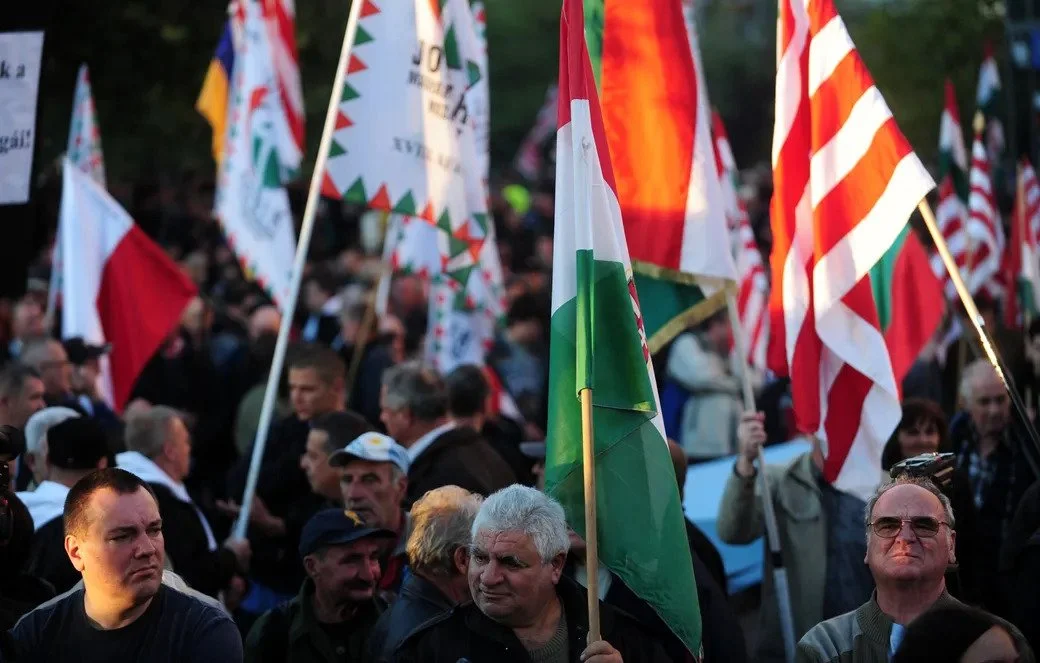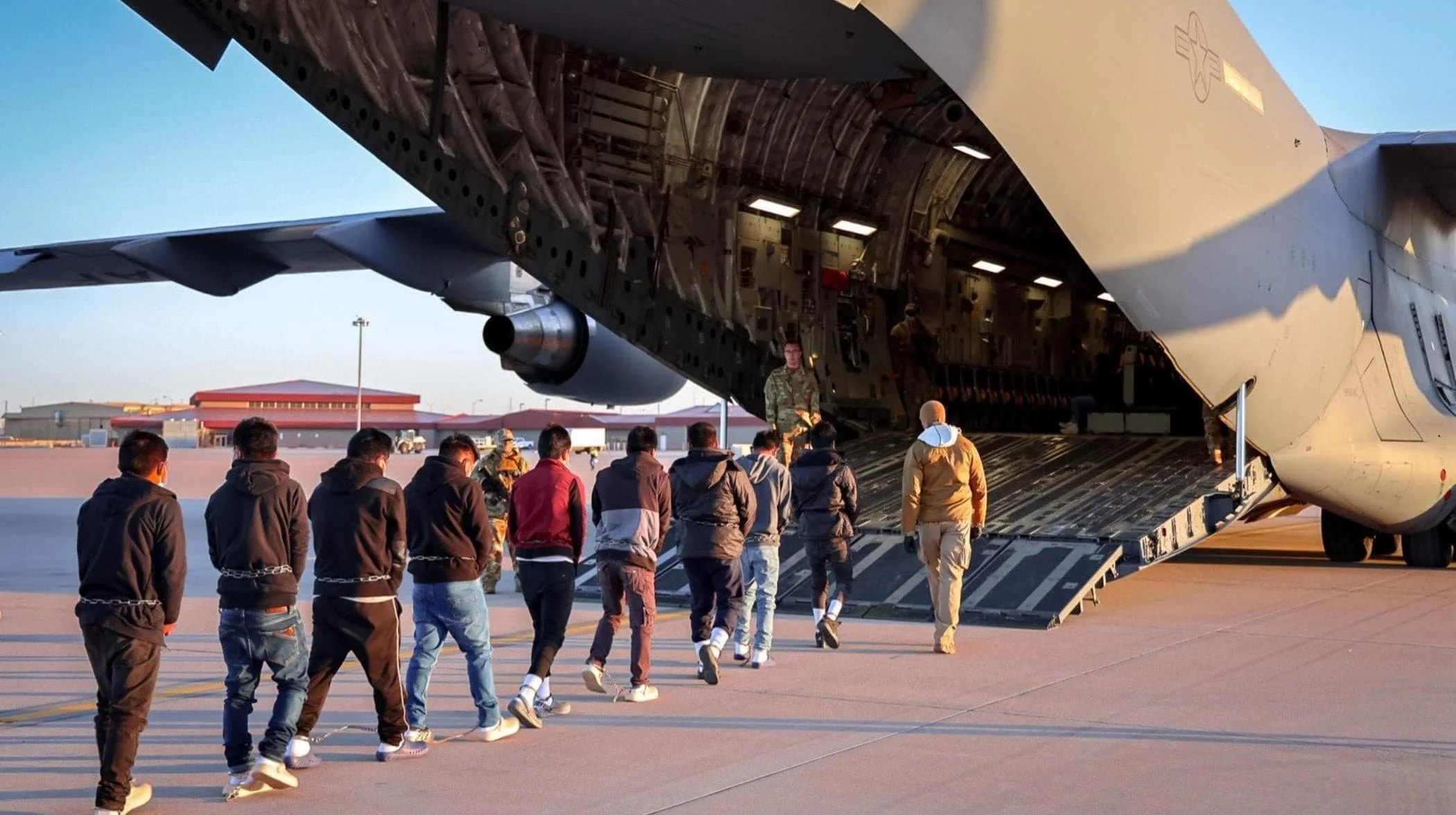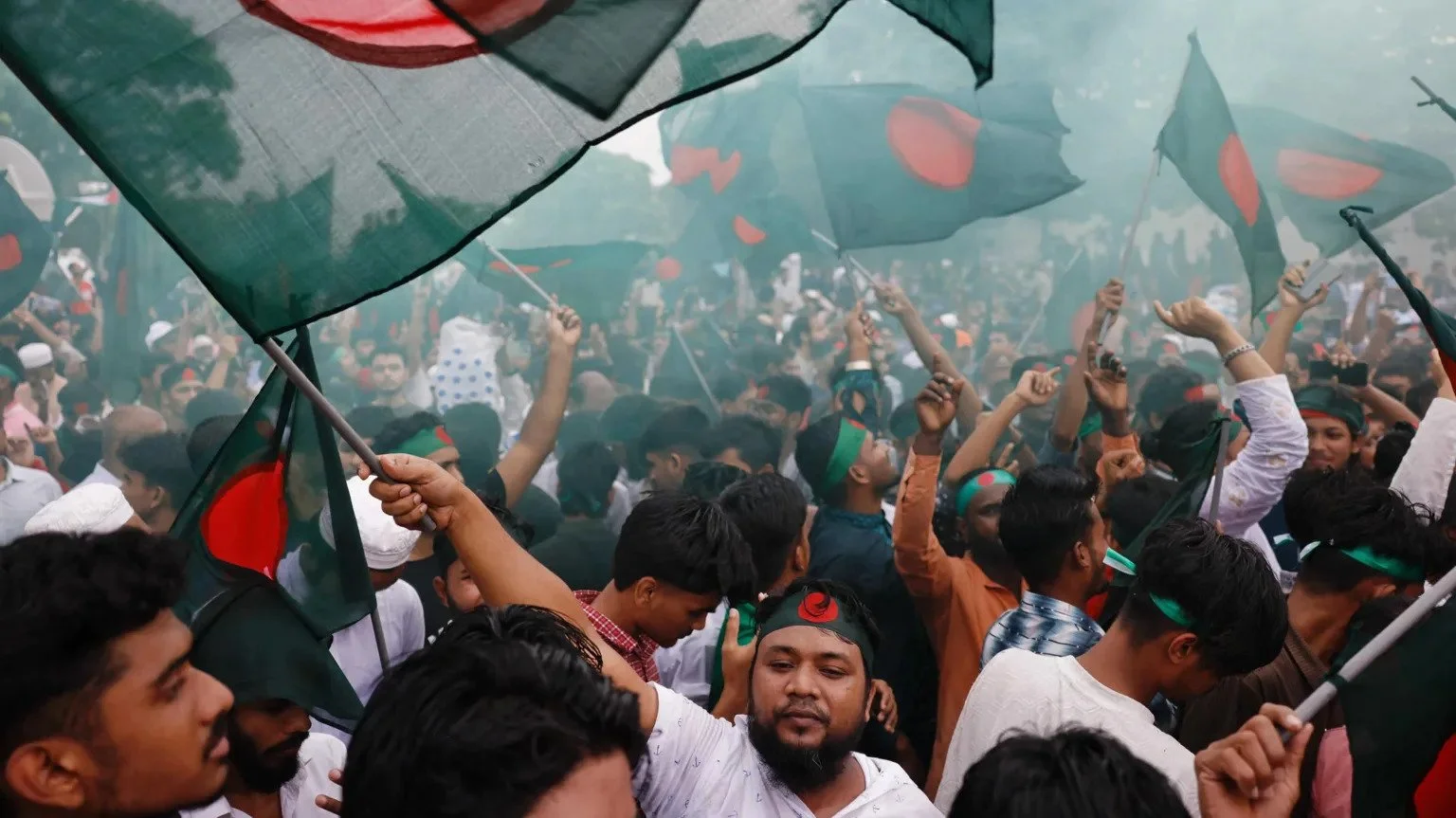
Steel and Votes: How the Steel tariffs will destroy American jobs and create Trump supporters
Contributing Editor Michael Donaher explores how the steel industry and declared tariffs will impact the realm of international trade.
Introduction
On March 8th, President Trump signed a 25% tariff on steel imported into the United States. The announcement came in the aftermath of a Section 232 Investigation by the Department of Commerce which investigated the impact of imports on national security. The findings of the report suggest that the President institute tariffs on both steel and aluminum to protect American industry. The signing took place at a small ceremony in the White House, featuring workers from steel production plants -- those who the President, and the tariff’s supporters, claim will benefit from this policy. Conspicuously absent from the ceremony were workers from steel intensive industries - a group that comprises hundreds of thousands of jobs more than that of the US economy than steel producers.
US allies and trading partners responded strongly to the tariff announcement. Director of the International Monetary Fund (IMF) Christine Lagarde said she feared escalation to a trade war and French President Emmanuel Macron called the tariff policy “economic nationalism” . Yet lost in the whirlwind of a disrupted and disturbed geopolitical stage is the impact these tariffs will have on American workers. They are very much a follow-through on Trump’s part -- a reflection of his long-held disdain for China and other countries who he believes engage in unfair trading that hurts US industry. In a 2016 rally in Fort Bend, Indiana, then-candidate for President Trump said the Chinese were “raping our country,”ostensibly a response to their unfair trade practices which he claims threaten American business.
A Brief History of Trade Regulations
Unfavorable trade practices by foreign actors have long been the subject of controversy in the US. According to the Economic Strategy Institute (ESI), a firm specializing in globalization and trade analysis, many US trading partners engage in a tactic referred to as “dumping” where they intentionally undercut domestic market rates to receive a more favorable advantage from domestic buyers. Since 1980, ESI notes that there have been over 40 cases of dumping from many countries, including: Russia, Brazil, South Korea, and Japan. The ESI report alleges that firms based in these countries are typically beneficiaries of subsidies and other support from their government. In a model that simulated steel price dumping during the 1990s, weighing the benefits steel consumers receive with the losses the producers endure, ESI found that if there had been no anti-dumping duties imposed, the economic losses would have outweighed the gains.
This report is proof that price dumping and unfavorable trade policies a real threat to US economic interests. However, there are a few key details that distinguish anti-dumping as a tactic from the practices the Trump Administration alleges to be common. Currently, companies can accuse foreign competition of price dumping to the International Trade Commission (ITC), which then directs the matter to the Department of Commerce for an investigation. If the Commerce Department finds dumping to have occured, than U.S. Customs and Border patrol establishes Countervailing duties (CVD) - a tax on a specific good from a specific firm or country. For example, there are CVDs on clad steel plates from Japan, or Frozen Warmwater Shrimp from India. There are countless others from roughly 30 different countries. This process is appropriate given the scope of the problem as ESI defines it: “Based upon historical experience, injurious dumping is modeled as an intermittent or periodic practice that is employed by foreign companies in only some years.”
The Trump tariffs on steel and aluminum are clearly an aggressive strategy. Lawmakers on both sides of the aisle have responded quite clearly, including Republican policymakers. Many responded to the tariff’s announcement with their own take on how this may help or hurt American workers. Greg Gianforte, the lone Representative in the House for the state of Montana and notable Trump ally in Congress, expressed dismay in the aftermath of the announcement: “These tariffs are a bad idea, because they could lead to Montana agricultural products being shut out of foreign markets. They also will drive up costs for America’s manufacturers and serve as a tax that increases prices for Montanans.” Likewise, House Speaker Paul Ryan stated: “I disagree with this action and fear its unintended consequences.” Although a political outsider in more ways than one, it is rare to see this President break from the consensus of his party on such a specific policy stance.
The Politics of Steel
There are a few theories that can explain why the President broke from his party and instituted this policy. According to the Bureau of Labor Statistics (BLS) data and a figure in the Economist magazine, five states in particular hold the most jobs in steel production; Michigan, Indiana, Illinois, Ohio, and Pennsylvania. Of these, Michigan, Ohio, and Pennsylvania are known to be battleground swing states during President elections - keys to winning the electoral college and being elected President. It is no secret that these states were key to President Trump beating Secretary Clinton. The numbers don’t lie; the President won 65 of the 85 total electoral votes across these states. Knowing that many working-class manufacturing workers reside here, this policy may be an attempt to improve the lives of these workers, therefore galvanizing the base that was so crucial to the Trump victory in 2016, this time for 2020.
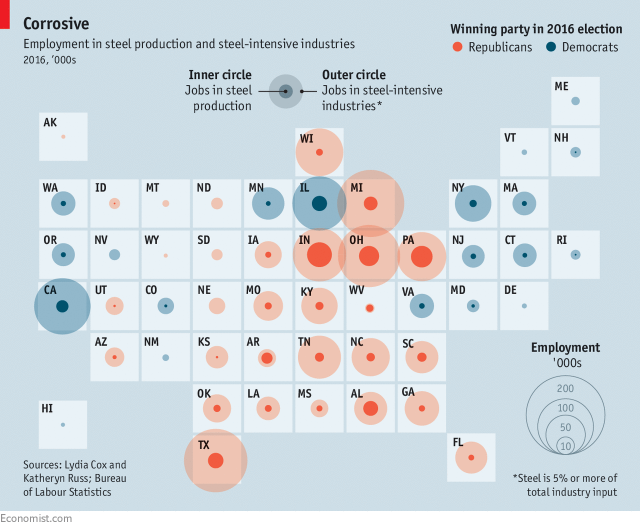
Figure from the Economist depicts steel intensive and steel production by US State.
There is one key oversight to adopting this point of view: according to the aforementioned date from the BLS, the number of Americans working in steel-intensive industries, which consists of firms that use steel as an input to production, far outweigh those working in steel production alone. In each of the five previously mentioned states, the number of Americans working in steel-intensive industries is more than 50% greater than those working in steel production. The likely impact the tariff will have on these workers is far from good - in fact, most experts contend the outlook is grim.
Tori Whiting, a trade Economist for Conservative think-tank the Heritage Foundation, finds the fact that 17 million Americans working in automotive manufacturing and construction, industries that rely on steel as an input, to be incredibly problematic as they will be punished from the tariffs. She stated: “These potential tariffs may put small groups of manufacturers on life support, but they will jeopardize the jobs of millions. The president has a responsibility to protect all American workers rather than a select few…”. Annie Lowrey of the popular liberal Atlantic Magazine found similar issues, concluding that the President’s characterization of the tariffs to be smart economic and national security policy to be far from the truth.Lowrey echoes the fears of IMF Director Lagarde, contending that US allies will read the tariffs as “flimsy policy” and will engage in a “tit-for-tat” trade strategy that will harm American business.
Conclusion
Experts, thought leaders, policy wonks, and demagogues alike seem to have rallied behind the notion that the steel and aluminum tariffs are bad policy. They are almost guaranteed to bolster one industry at the cost of hindering a much larger swath of others. Despite this, there remains a very palpable fear amongst working class Americans -- a reflection of a painful reality that the post-industrial era will continue to rob Americans of their manufacturing jobs, their way of life, and thus their livelihood. President Trump appears to be making an attempt to bring this sentiment into the mainstream, and as a result, carry his unexpected and unprecedented Presidency into a second term.
Remembering Conflict-Related Sexual Violence in Kosovo: Nationalism, Feminisms, Counter-Memory, and Justice
Staff Writer Celia Lohr discusses the atrocities of sexual violence in Kosovo, and the policy initiatives to serve victims justice.
Recent Commemorations & Historical Context
On June 12th, 2015, Pristina unveiled a new monument and temporary exhibition in its city center to commemorate women victims of sexual violence during the Kosovo War. The first of their kind, Heroinat and Mendoj për ty depart markedly from the silencing and stigmatization of survivors common in Kosovo’s ongoing nation-building process.
The creator of Heroinat (Heroines) combined several portraits of women taken during the Kosovo War to depict the face of a single Kosova woman fashioned out of 20,000 brass medals to represent the war’s estimated 20,000 women victims of sexual violence. The “the heroine of Kosovo” is the country’s first monument dedicated to a woman aside from Mother Theresa.


More images can be found at these images' source here.
On the same day as the monument’s unveiling, a small group of women hung 5,000 dresses on clotheslines in an installation titled “Mendoj për ty” (Thinking of You) covering Pristina’s soccer field. Collected from across Kosovo, the dresses metaphorized “airing one’s dirty laundry.” Here, they symbolized the mass rape of women during the war, and confronted the lasting silencing and stigma of survivors of these atrocities.

Image from the Kosova Press

Image from the London School of Economics and Political Science
Following several wars in the Balkans, the Kosovo War lasted from February 1998 until June 11th, 1999. On June 12th, NATO officially entered Pristina and Kosovo became a United Nations Protectorate for the next 9 years until it declared independence in 2008. As with all wars, the conflict in Kosovo disproportionately affected women. The total number of women and men who suffered sexual violence during the war will never be known. However, brutal, systematic sexual violence committed primarily by the Yugoslav army and Serbian police and paramilitaries against ethnic-Albanian Kosova women left permanent scars that have never been properly addressed. Rapid escalation and brutality, poor documentation, severe stigmatization of survivors, and a wish to respect the dead all contribute to the lack of certainty, but estimates range from 20,000 to 40,0008. During the 78-day airstrike campaign – in which NATO dropped over 6,000 tons of ordnance – Kosova Albanian women testified that they “feared the Serbian police and paramilitaries far more than the bombing.”
In a country currently involved in transitional justice and nation-building, Heroinat and Mendoj për ty should not be overlooked. Their command of attention at all scales, local to global, indicates an unfolding competition to shape the collective memory of the Kosovo War. Heroinat and Mendoj për ty forward two feminist discourses which depart markedly from the silencing and stigmatization of survivors of conflict-related sexual violence in Kosovo, legitimized by a patriarchal nationalist narrative. But to what extent are these commemorations subversive to Kosovo’s patriarchal nationalist discourse? And what impacts might they have on the future of justice for survivors of conflict-related sexual violence in Kosovo?
Collective Memory, Public Consciousness, and Commemoration
Acts of commemoration organize history and assign significance to events and figures, creating a repertoire of shared experiences and reifying the collective memory of a community – or in the case of a nation, creating a “national narrative.” While “remembering” has played an important role throughout human history, large-scale and top-down efforts to link memory, morality, and identity to “the nation” emerged only within the last 150 years. As newborn nation-states, like those during the collapse of Yugoslavia, struggled to achieve their autonomy and/or imperial ambitions, they found themselves “requiring national narratives of loyalty, timelessness, and belonging beyond the individual or local region.” In order to construct these national narratives, the states have sought to ground collective identity in collective memory: answering the question of “who we are,” in part, by answering the question of “where we come from.” Thus, commemoration can allow states to intentionally construct historical narratives in ways that guide identity formation, sharpen group boundaries, and establish and legitimate political and social order.
Yet, just as states use memory to consolidate power, so too can marginalized groups whose experiences the dominant nationalist discourse may have erased. These “counter-memories” aim to contest the manipulation of the past, as well as provide alternative interpretations of it. Commemorations in this light can constitute a force for resistance, redirecting attention to “forgotten” or silenced histories. The recent rise of memory studies has produced evidence to support commemoration and other memory-based processes (public testimonials, naming streets after the dead) as integral to positive, lasting peace. Heroinat and Mendoj për ty, therefore, can be viewed as part of the imagery of social discourse, a powerful tool to communicate who and what should be remembered, and to ultimately shape popular consciousness by encouraging individuals to accept these messages as their own.
Kosovo’s National Narrative & Stigmatization Survivors of Sexual Violence
Kosovo’s patriarchal nationalist discourse necessitates the erasure of women’s experiences during the war and perpetuates the stigmatization and mistreatment of survivors of conflict-related sexual violence, evident in top-down institutional approaches that deny survivors’ agency.
The end of the Kosovo War gave way to a reasserted sense of nationalist traditionalism (characterized by a fusion of masculinity, militarism, and nationalism) proffered by the former Kosovo Liberation Army (KLA) members who then comprised the ruling political elite. Key elements of this discourse included the “admiration of heroism, along with glorification of epic events, values, and figures of the ‘liberation war,’ [and the] honoring of fallen KLA fighters as ‘national martyrs.’” Countless memorials were erected following the war, honoring founding members of the KLA , martyrs, and even NATO. Missing from this surge of commemoration was any reference to the victims of sexual violence during the conflict. This omission is consistent with communicative memory scholar, Aleida Assmann’s, findings that nationalist collective memory “is receptive to historical moments of triumph and defeat, provided they can be integrated into the semantics of a heroic or martyrological narrative. What cannot be integrated into such a narrative are moments of shame and guilt.” In Kosovo’s national narrative, as in other patriarchal nationalist narratives, women remain seen as custodians of cultural and ethnic heritage, whose task is to use their bodies to produce soldiers, implying that their enemy is not simply the othered ethnic group, but its women. Thus, the experiences of at least 20,000 women cannot be neatly assimilated into the national narrative, especially when wartime sexual violence carries the symbolic humiliation and destruction of “nation” and society. In cases when wartime sexual violence is recognized, the political memory of women as victims becomes a tool to further the nationalist cause through a singular focus on the ethno-nationalist membership of the perpetrator and a possible fetus, thereby “dismissing both the raped woman and the crime committed against her.”
This dominant national narrative promotes both the extension of a militarized ethnic conflict and subordination of women to the nationalist cause. This said, it is also important to understand the appeal of joining an ethno-nationalist movement for women. Membership and supporting roles in the KLA gave women opportunities to enter the public, political, and military spheres to which they had previously been denied access. Indeed, women’s roles during the war included active members of the KLA, messengers, cooks, nurses, members of underground networks, and cross-ethnic anti-nationalist peace movements. But these contributions remain absent from the dominant narrative of the Kosovo War because memorializing women as agents in conflict departs from the strict gender roles and order of post-conflict society envisioned by patriarchal nationalist discourses. As Neluka Silva so succinctly summarizes, “interpellating [women] as ‘national actors’ and foisting a ‘nationalist’ label on them as mothers, daughters, educators, workers, and even fighters is not necessarily empowering if it merely reaffirms the boundaries of culturally acceptable feminine conduct and exerts pressure on them to articulate their gender interests solely within the terms of reference set by nationalist discourse.”
This being the case, feminist actors within a national framework have created positive effects for women in Kosovar society. Heroinat and Mendoj për ty were both completed following a decade of international and civil society efforts to recognize and assist survivors of conflict-related sexual violence. In 2014, President Atifete Jahjaga, Kosovo’s first elected president and the first female president in the Balkans, established the National Council for the Survivors of Sexual Violence during the Kosovo War and spearheaded one of the most important amendments to a law securing pensions and services to those harmed in the war. While best known for offering between €144 and €286 per month to survivors of sexual violence, this amendment also accomplishes the following: designates “sexual violence victims of the war” as a distinct category alongside the existing recognized groups KLA martyrs, injured “invalid” civilians, and their family members; establishes rights to receive health services abroad, priority employment in the public and private sector, and residential care and collective social housing; eliminates the requirement to prove degree of bodily harm in terms of percentage; creates a government commission of representatives from the Office of the Prime Minister, the Ministry of Labour, the Ministry of Justice, Ministry of Health, from the Institute for War Crimes, clinical psychologist, psychiatrist, lawyer, and a representative from a civil society organization who has experience in supporting and protecting sexual violence victims; and enables petitioners to apply through multiple channels including the Ministry of Labour and Social Affairs, through various NGOs, and as individuals.
While President Jahjaga’s amendment was a critical development towards justice for survivors, the majority of top-down institutional approaches to date appallingly exclude survivors and deny their agency. In a study of the literature on women in conflict, Azza Karam explains that in post-conflict situations, “notions of victimhood and what women have suffered seem to be rallied as legitimate excuses to limit women’s agency in the peace-building process.” This finding certainly holds true in the case of Kosovo. A report published in 2016 by UN Women revealed that survivors were often excluded from justice and peacebuilding processes, largely due to the assumption that their requests for confidentiality and anonymity indicated a desire for non-inclusion. In a broader analysis of Kosovo’s gender relations, the report found that, “despite a strong gender-equality legal framework in Kosovo, in practice, women’s participation remains limited in decision-making processes, especially at the community level.” So, while some of Kosovo’s governing authorities have expressed a willingness to address the needs of survivors, their efforts have been hindered by the larger failure to involve women and survivors in justice and peacebuilding processes.
Moreover, initiatives by the United Nations Interim Administration Mission in Kosovo (UNMIK), the Kosovo Force (KFOR), and the European Union Rule of Law Mission in Kosovo (EULEX) were largely successful at conflict management, but not at peacebuilding. This failure replicated itself in the various systems of courts, tribunals, and truth commissions established after the conflict, most notably in the International Criminal Tribunal for the Former Yugoslavia (ICTY). In name, these bodies valorized criminal prosecution and administrative reconciliation, yet practically failed at promoting deeper reconciliation between ethnic groups or delivering justice to perpetrators of sexual violence. The limits of these top-down approaches have yet to be remedied: At the time of this writing, the ICTY convicted only four men in connection to wartime sexual violence during the Kosovo War, and Kosovo’s domestic court system convicted none.
Long after the war ended, the day-to-day reality facing survivors remains stark. Once their identities are known, women face intimidation violence, and ostracism from their families and communities. Mistrust in local authorities, combined with a lack of proper documentation of crimes, further compels women to remain silent. Many refrain from seeking mental and physical healthcare due to fear of being identified as a survivor, and therefore fall into a cycle of discrimination in terms of their access to basic services and employment once identified. In 2017, 31 out 40 women interviewed by the U.S. Agency for International Development expressed concern about collecting the government pension extended by President Jahjaga’s amendment for fear that explaining the source of the funds would identify them as survivors. The dynamics of Kosovo’s patriarchal nationalism when codified, ritualized, and embedded in public and private life, perpetuates the lasting stigmatization and mistreatment of survivors of conflict-related sexual violence.
Heroinat and Mendoj për ty
Returning to commemorations as points of power affirmation or contestation, Heroinat and Mendoj për ty represent two significant efforts to combat lasting stigmatization of women survivors of conflict-related sexual violence in Kosovo and to foreground women’s pasts, presents, and futures in Kosovo’s public consciousness. These “counter-memories” keep the reality of mass sexual violence in the public eye and thereby emphasize an ongoing need for justice.
Heroinat illustrates the paradoxes between nationalism and feminism in Kosovo. Its accompanying description states that the monument is dedicated to “ethnic-Albanian Kosova women,” and specifically to those who suffered sexual violence during the war period. It is a narrow focus, but rightly so. Heroinat acknowledges the intersections of gendered violence and ethnic conflict that uniquely affected Kosovo’s ethnic-Albanian women following years of oppression under the Milošević regime. Furthermore, its permanent location in the heart of Pristina’s centralizes the experiences of women that have been silenced and stigmatized, and reclaims a prominent public place in the name of survivors.
At the same time, keeping in mind the government-sponsorship of the monument, elements of Heroinat reaffirm nationalist notions of women as “the mother of the nation, the martyr, and the heroine.” The material composition of the monument – brass medals – carries a militarized meaning of women’s identities, reinforced by the language used to describe the mass rape of women as “contribution and sacrifice,” presumably as soldiers “sacrificed” their lives. By portraying victims’ suffering as akin to “national duty,” the creator of the monument implies a level of consent that sanitizes the atrocity of wartime sexual violence, and refocuses attention on “the nation.” Heroinat’s militaristic tone further embeds ethno-nationalist divisions by reminding audiences of perpetrators’ identities: Serbian police and paramilitaries, and primarily ethnic-Serbian Yugoslav soldiers. In reality, sexual violence continued long after the war’s official end and has since been perpetrated against ethnic-Albanian women as well as minority populations, including “revenge rapes” against Serbian women living in Kosovo.
Finally, following Heroinat’s reveal, the government made no attempt to transfer ownership to the public or to women’s organizations capable of maintaining them, or to involve those affected by sexual violence. Most interviewees of a small study of responses to Heroinat perceived the monument as a “throwaway political gesture rather than an offer of genuine support” for survivors. Additionally, they expressed disappointment in the lack of facilitation of a larger societal discussion accompanying its construction. Unfortunately, these oversights perpetuate the cycle of top-down failures and denial of survivors’ agency. But, despite these shortcomings, Heroinat remains a powerful step towards recognizing and de-stigmatizing survivors of sexual violence during the Kosovo War, even if through a nationalist filter.
Mendoj për ty embodies a more globalized feminism alongside the national feminism of Heroinat. Mendoj për ty symbolically subverts Kosovo’s militaristic, patriarchal national narrative in several ways. First, it utilizes the metaphor of “airing dirty laundry,” yet the clean dresses bore no stain or stigma. Second, Alketa Xhafa-Mripa, the project’s designer and a refugee of the war, collected dresses from multiple regions of Kosovo, thus allowing survivors to participate without compromising their anonymity. Third, the location of Mendoj për ty in a soccer field, a traditionally male-dominated place, challenges gendered, patriarchal notions of public life. Finally, Xhafa-Mripa dedicated the demonstration to survivors of conflict-related sexual violence in Kosovo, and extended solidarity to all survivors, transcending imagined ethno-national borders in opposition to strict ethno-nationalist conceptions of place.
Heroinat and Mendoj për ty embody the heterogenous feminisms active in Kosovo which arose to contest a patriarchal nationalist discourse that both erases the experiences of women during the Kosovo War and perpetuates stigmatization and mistreatment of survivors of conflict-related sexual violence at communal and institutional levels. These commemorations shed light on counter-memories’ potential to catalyze changes in popular consciousness, a necessary condition for meaningful societal change towards ensuring agency of survivors. Heroinat and Mendoj për ty have made clear that nation-building in Kosovo must not come at the expense of justice for its women.
Build Trust, Not Missiles: Transatlantic Efforts in Upholding the Nonproliferation Regime
Staff Writer Dayana Sarova examines the EU’s role in the preservation and maintenance of the JCPOA.
Half a century after the signing of the Nuclear Nonproliferation Treaty, the purely rhetorical approach of the UN Treaty on the Prohibition of Nuclear Weapons and threats of forceful, “fire and fury” measures constitute the world’s disorderly response to the gloomy prospects of a nuclear armageddon. Much like during the Cold War, the lives of millions of people are at stake, and countries consumed by the nuclear race are spending billions of dollars to get ahead of one another. The undergoing development of hypersonic missiles is a challenge similar to that posed by the emergence of intercontinental ballistic missiles and cruise missiles in the 1960s. What today’s world is lacking, however, is the kind of structural order the bipolar system provided. If back in the day the race was between the Soviet and the American blocks, the nuclear proliferation of today is more complex - and so should be the measures to hinder it. One place to start is confidence-building and risk-reduction on global, regional, and bilateral levels. Uncertainty and mistrust among nuclear-armed states are the primary impediments the Euro-Atlantic and global community is facing in upholding a sound nonproliferation regime. The European Union, with its experience in negotiating the Iran deal and the reputation of a trustworthy broker, can make a meaningful contribution to refining the outdated way we deal with nonproliferation.
In the transatlantic region, Russia and the United States are playing a dangerous nuclear blame game amidst an ongoing political and diplomatic crisis. Numerous nuclear transparency arrangements exist between Moscow and Washington, such as the U.S.-Russia Agreement on Notification of Launches of Intercontinental Ballistic Missiles or the Memorandum of Understanding on Notifications of Missile Launches. Nevertheless, Russian-American cooperation on arms control and nonproliferation has been declining since 2013. Mutual accusations of violating the 1987 Intermediate-Range Nuclear Forces continue on both sides of the Atlantic and will be difficult to prove or disband in the future without new, more effective enforcement and verifications mechanisms. An obstacle to achieving an agreement on those mechanisms is the lack of trust that contaminates Russia’s relations with the U.S. and the rest of the Western world. The number of channels of communication available to the two countries to hold a constructive dialogue on many issues beyond nonproliferation is shrinking with the reciprocal expulsion of dozens of diplomats. Reinvigorating the Joint Data Exchange Center (JDEC), designed to share early-warning data on missile launches and encourage information exchange among Russian and American scientists, is a potential avenue for restoring communication between the two countries through Track II diplomacy. JDEC was established in 1998 to facilitate the exchange of information on missile launches and early warning, with a potential establishment of a multilateral notification system for the launch of ballistic missiles. JDEC built upon the successful establishment and operation of a special U.S.-Russia command post, the Center for Y2K Strategic Stability at Peterson Air Force Base, Colorado Springs. The American and Russian personnel monitored data that reflected any ballistic missile activity around the world. The center served to ensure that potential computer glitches in either nation’s missile warning systems did no lead to an accidental launching of a nuclear warhead. Furthermore, the center was equipped with direct telephone lines – a lesson learned by the U.S. and the USSR back in 1963, when the Cuban Missile Crisis showcased the disastrous consequences lack of communication can cause. However, the JDEC and the Center for Y2K Strategic Stability, as promising as they were, were products of the “Bill and Boris” era when personal comradery between President Clinton and President Yeltsin translated into major improvements in the U.S.-Russia relationship. This era is long gone and not likely to make a comeback any time soon, considering the current “worse-than-the-Cold-War” political climate.
Mistrust in persisting among former Cold War rivals is a long-standing leitmotif of transatlantic relations. There are, however, emerging threats that the regional, and global, nonproliferation regime has never faced before. Among the new classes of challenges to conventional approaches to nonproliferation and defense is hypersonic missiles. Due to their low-altitude flight, high speed, and maneuverability, hypersonic missiles can evade existing radar sensor technology that enables missile defense. By the virtue of these characteristics, hypersonic missiles increase the risk of inadvertent nuclear escalation, leaving decision-makers with compressed response time and increasing the likelihood of destabilizing countermeasures. The Trump administration has recently requested additional funding for hypersonics research, primarily to increase the number of flight tests and improve U.S. offensive abilities. This is largely a response to President Putin’s announcement that Russia now possesses an “invincible” nuclear delivery system that can reach “anywhere in the world,” as well as to China’s rapid advancement in hypersonic technology development. China, Russia, and the U.S. are all sharing their part in a dangerous upsurge of the hypersonic race. A recent RAND report estimates that there is less than a decade left to substantially curb the proliferation process, but the current trend is that of further acquisition, not abolition, of offensive hypersonic capabilities.
While some risk-reduction and transparency nonproliferation initiatives are already in place, they have proved insufficient. The set of confidence-building and risk-aversion measures introduced by the 2002 Hague Code of Conduct against Ballistic Missiles is in need of reform. The Code fails to cover cruise missiles, which are more difficult to track on the ground or in flight than ballistic missiles, and, much like hypersonic technology, can circumvent defense installations. The European Union, which assumed the role of “universalizing” the Code and engaging in discussion with other states in the drafting process, can play the same instrumental role in negotiating multilateral instruments to curb the proliferation of new classes of nuclear delivery systems. Moreover, the HCOC membership is lacking the one nuclear-armed state on everyone’s mind today: North Korea. A regional, or bilateral, intra-Korean initiative similar to the Hague Code framework could help ease tensions, introduce some ground rules for the Kim regime, and lay foundation for future political dialogue, to move closer to solving the threat North Korean nuclear program presents for both transatlantic and global actors.
The North Korean case is a vivid example of the Euro-Atlantic divide on nonproliferation. While Americans view it primarily as a national security and defense issue, the European Union tends to approach it as a more abstract proliferation and normative compliance challenge. Reconciling these differences to make improvements on the long-term denuclearization of the Korean peninsula will take a holistic framework, which would have to engage the U.S., the EU, Russia, and China, apart from the two Koreas. The Europeans do not have any obvious, immediate stakes in striking a deal with North Korea in a way they did in the JCPOA. However, their reputation of an honest broker, a lesser military threat than the U.S., and a major financial and banking power makes the European Union a credible mediator of any talks that might that place in East Asia. Moreover, transatlantic cooperation can prove useful in constructing a regional normative framework with effective monitoring and verification mechanisms. Denuclearization, as acknowledged by many analysts, is on the table only in the long-term. More importantly, bringing countries into abolishing their nuclear programs requires an environment different from that of uncertainty, mistrust, and suspicious that exist now among relevant East Asian actors: the two Koreas, China, Russia, and the U.S. To create an attitude of cooperativeness in the region, it is necessary to introduce confidence-building and risk-aversion measures that would further countries’ belief that confrontation is more costly for national interests than cooperation, especially in the nuclear sphere, where the risks are extremely high for everyone.
The challenges transatlantic nations face in maintaining the global and regional nonproliferation regime, as versatile as they are, all stem from the lack of trust major nuclear powers have toward one another. The frameworks introduced by U.S.-Russia bilateral arrangements and multilateral agreements, such as the Hague Code, should be revitalized and adjusted to the new reality the world is facing today. In this reality, North Korea is not disarming any time soon, and new types of weapons are posing threats incomparable to those we faced before. The international community should take a pragmatic, realizable approach that encompasses confidence-building, norm-construction, and risk-aversion initiatives, bringing us closer to global zero, even if in incremental steps.
Author's Note
I would like to acknowledge the invaluable contribution of the 2018 American University Schuman Challenge Team, Suzy Clayes, Luke Theuma, and Kris Trivedi, to the research work that made this article possible, and to my understanding and knowledge of transatlantic cooperation on nonproliferation.
The Fate of Kyrgyzstan Institutionalism
Staff Writer Jonathan Scolare examines the status of Kyrgyzstan’s inclusion in regional and international institutions.
When discussions arise over multilateralism and international institutions, organizations such as the North Atlantic Treaty Organization (NATO), the Organization of American States (OAS), the European Union (EU), and, of course, the United Nations (UN) are often the central focus. Little, if any, attention is given to non-Western-centric international bodies, leaving out many regional and cooperative initiatives. One such region is Central Asia, a region void of official organizations to unite the five former Soviet republics. Additionally, the region has never experienced a culture of institutionalism or liberal democracy. Kyrgyzstan had its first peaceful transition of power between leaders without a revolution in October 2017, but this event was the first of its kind, not only in the former Soviet republic, but also in all of Central Asia. Additionally, in the lead up to the October elections, Kyrgyzstan and Kazakhstan experienced a border spat, causing a massive logistical headache for trade and migration between the two states. However, the diplomatic rhetoric between Almaty and Bishkek has changed in recent times, reflecting a warming of relations in the region. None of this is to say that Central Asia is ripe for international liberalism. Still, the five Central Asian republics, with especial emphasis on Kazakh-Kyrgyz relations, highlight the importance of regional cooperation despite the presence of heavyweight neighboring actors like China and Russia.
The aforementioned border dispute between Kazakhstan and Kyrgyzstan took place weeks before the Kyrgyz elections when then-President Almazbek Atambayev lashed out at the neighboring country for allegedly backing presidential candidate Omurbek Babanov. Almaty rebutted by drastically increasing border security, maintaining “the increased scrutiny had to do with concerns about contraband and smuggling of goods from China via Kyrgyzstan and other weaknesses in Kyrgyzstan’s veterinary and sanitary controls on exported goods.” However, this standoff had been brewing in the discussion rooms for several years. Since joining the Russia-led Eurasian Economic Union (EEU) in 2015, the benefits have been unevenly felt in Kyrgyzstan. Those who work outside of the country were optimistic. Up to 25-30% of Kyrgyzstan's GDP comes from income earned outside of the country, almost entirely from workers living in Russia, who saw the EEU as a way for the Kremlin to cut red tape around Kyrgyz workers. On the other side of the economic picture, small business owners feared the mandatory tariffs EEU members place on non-members. For Kyrgyzstan, that meant an increase in prices of cheap goods from neighboring China. This disparity has led to economic anxiety for some citizens, with mixed rhetoric coming from Bishkek. These feels culminated in backlash towards Kazakhstan, who was already suspicious of the amount of contraband goods flowing from China to Kazakhstan via Kyrgyzstan.
Newly elected Kyrgyz President Jeenbekov was quick to reverse the diplomatic squabble made by his predecessor and mentor. On November 30, Jeenbekov and Nazarbayev “agreed to work out a plan to resolve the two-months bottleneck at the shared border. Starting December 4, all vehicles started passing the Kazakh-Kyrgyz border without any delays.” Kazakh-Kyrgyz relations were thus normalized. Several weeks later, the two men reconvened to discuss and sign a slew of diplomatic and economic documents “aimed at the further deepening the Kazakh-Kyrgyz cooperation. Those include the treaty on the demarcation of the Kazakh-Kyrgyz state border and the agreement on the state border regime,” President Nazarbayev stated. On the surface, it was a sign of diplomatic realignment and reestablishing or relations between the two republics. However, it was also an indication of how bilateral cooperation was possible without outside interference. Russia and China, both of whom have much at stake in Central Asia due to the region’s rich supply of oil and natural gas, did not need to step in to settle the dispute. Rather, both parties saw it as a regional issue that required a regional solution.
This sense of regional self-reliance was seen again in the March 2018 Central Asian summit of all five of the former Soviet republics of Central Asia in Astana. It was the first summit between all the heads of state in nearly a decade and the first since the death of the divisive Uzbek leader Islam Karimov in September 2016. The move was a shock to the international community. President Nazarbayev described it as a “new mood” and confidently stated “There is no need to call an outsider to resolve issues of the Central Asian nations, we are able to resolve everything ourselves -- that is why we are meeting.” However, the official title of the summit was a consultative meeting, “in an obvious effort not to raise eyebrows in Moscow. No documents from the meeting were adopted.” While it is by no means liberal institutionalism’s most recent crowning achievement, the Central Asian republics are learning that there is far more to gain collectively than when divided. The added decision that such consultative meetings take place each year in late March adds to the optimistic rhetoric of budding multilateralism in Central Asia. It is a declaration, albeit a soft one, to China and Russia that the five republics are capable of functioning as a single unit.
Looking to the future, the role of this consultative structure is unlikely to expand in scope. Russia still plays a major role in all political decisions. However, that is the extent to which the Kremlin’s influence is seen in 2018. China’s One Belt One Road Initiative may still be in an embryonic stage, but the potential benefits for the region are profound. As Marlene Laruelle of the George Washington University Central Asia Program writes in China’s Belt and Road Initiative, “[Beijing] is the only country that can mobilize huge investment in the region, far beyond what Western countries and Russia can offer.” On the other hand, these investments do not necessarily benefit the entire country as a whole. Corruption is still very prevalent in Central Asia, so the funds may instead go to the political elite and oligarchs. Regardless, the One Belt One Road Initiative will undoubtedly reshape the geopolitical landscape. Whether or not that leads to greater regional autonomy, one involving formalized institutions, or a down a path of an elite flushed with foreign investment funds with no multilateralism to speak of is yet to be seen. That being said, those two options are not mutually exclusive.
The five Central Asian republics, with especial emphasis on Kazakh-Kyrgyz relations, highlight the importance of regional cooperation despite the presence of heavyweight neighboring actors like China and Russia. Economic anxieties seeped their way from small business owners up to Bishkek decision makers, resulting in a diplomatic row with Kazakhstan. The issues have since resolved, although the back and forth rhetoric over the merits and losses of Kyrgyzstan joining the EEU is still fervent. Regardless, Kazak-Kyrgyz relations are back on track and the latter is continuing to implement reforms to meet the former’s request on imported goods. Additionally, there is a new diplomatic aura emerging from Central Asia. It is not necessarily analogous to European integration, but a step towards multilateralism nonetheless. Whether or not that step becomes a trek relies heavily on how China’s investment in the region changes the geopolitical landscape.
Challenges to Democracy in Latin America: Sources and Solutions
Guest Writer Reagan Williams explores the ramifications, challenges, and future of Latin American democracies.
A region once characterized by its dictatorships, Latin America has enjoyed relatively stable democratic growth over the last few decades. With the exceptions of Venezuela and Cuba, all Latin American countries are now considered free or partly free on Freedom House’s Freedom in the World Scale. Despite this dramatic transformation, Latin American countries still face a variety of challenges that threaten democracy. The region’s principal challenges to its democracies are their delegative nature, “unrule of law,” and clientelism. While the degree to which each of these challenges affects democracy varies, all three pose a threat. The first part of this paper examines definitions of democracy and the democratic trajectory of Latin America in terms of those definitions. The second half of the paper breaks down the challenges of delegative democracy, unrule of law, and clientelism. Finally, I conclude by offering potential solutions to these challenges.
Definitions of democracy are widely debated by scholars. Some argue that a government is democratic if it holds free and fair elections, while others contend that a government must maintain a certain level of representation to be truly democratic. Some argue that democracies require a margin of equality, and still others assert that exercise of the rule of law is a critical qualification. The degree to which each of these components exists in Latin American democracies varies. However, under the most basic electoral definition (which requires a country to hold free and fair elections) the majority of the region qualifies as democratic. This may seem like a low bar, but just a few decades ago, between 1964-1990, eleven countries in Latin America (Ecuador, Guatemala, Brazil, Bolivia, Argentina, Peru, Panama, Honduras, Chile, Uruguay, and El Salvador) were ruled for significant periods of time by long-term military governments. In 1974, five counties—Cuba, Chile, Panama, Peru, and Bolivia—were ranked as “not free” by Freedom House, outnumbering the “free” countries. In 1978, only three of twenty countries (Colombia, Costa Rica, and Venezuela) were democratic. In the 1980s, the tide began to shift as Argentina, Brazil, and Chile transitioned to civilian rule. Between 1974 and 1994, the number of free countries in Latin America doubled. By 2004, Cuba and Haiti were the only remaining authoritarian governments. With the exception of Venezuela, trends toward democracy have remained positive in the region over the past few decades. However, there is still progress to be made and challenges to be overcome.
One key challenge to democracy in Latin America is the lack of horizontal accountability. This ties into the argument that a democracy ought to maintain a certain level of representation. While some democracies are “horizontal,” that is, the elected leaders face checks and balances within the government, others are strictly “vertical,” wherein the leader answers to the people at election time but is then free to rule unchecked. In his chapter in the book Reflections on Uneven Democracies: The Legacy of Guillermo O'Donnell, Lucas González distinguishes between “delegative” and “representative” democracies, with delegative democracies lacking horizontal accountability and representative democracies ideally having both horizontal and vertical accountability. He uses various characteristics of delegative democracies (e.g. the president is taken to be the embodiment of the nation, the policies of his government need bear no resemblance to his campaign, and other institutions are considered impediments to the exercise of power) as indicators to classify each country. González classifies Argentina, Ecuador, and Colombia as recurring delegative democracies, Brazil and Peru as eroding delegative democracies, Venezuela, Bolivia, and Paraguay as intensifying delegative democracies, and Chile and Uruguay as stable representative democracies. This categorization demonstrates one analysis of the quality of democracy in Latin America. While all aforementioned countries are “democratic,” only two are considered by González to be representative. González finds that countries that face dire economic conditions and low pubic confidence in democracy are most likely to be delegative. As such, the implementation of neoliberal reforms in the 1990s (designed to curb inflation) might seem like a potential solution to the delegative nature of Latin American democracies. However, as Michael Walton argues, many Latin American countries were not in fact stabilized by neoliberal reforms and continued to experience high wealth inequality throughout and following their implementation. This lack of stability actually contributes to the delegative nature of some democracies. Additionally, as Michael Kurtz explains, democratic participation and political organization declined in the aftermath of neoliberal reforms. According to Kurtz, this is because free-market reforms disenfranchise poor people, create barriers to collective action, and increase the informal sector. All of these factors are likely to reduce the public’s confidence in their democracy, considering they can hardly access it, and in turn, bolster delegative democracies.
While formulating solutions for poor economic conditions is a complex challenge, low public confidence in democracy is easier to address. As it stands, this low confidence becomes a self-fulfilling prophecy; when citizens doubt the legitimacy or value of their democracy, they are unlikely to participate or challenge overreaches of power. Initiatives designed to educate, inform, and inspire citizens to be active members of their democracy might boost their confidence in it. However, to truly break the cycle, such efforts would have to be undertaken in conjunction with a strengthening of checks and balances. Again, though, institution strengthening (for example, giving the legislature more control over lawmaking, ensuring a strong judicial branch, etc.) is more likely to occur if an active public pushes for it and pushes back against an unchecked executive.
Another challenge facing Latin American democracies is the “unrule of law.” As Daniel M. Brinks and Sandra Botero point out in Reflections on Uneven Democracies: The Legacy of Guillermo O'Donnell, “democracy and the rule of law appear inextricably linked.” Without the rule of law, who is to stay that a democracy is even meeting the lowest bar of free and fair elections? As such, nominally democratic states must be evaluated by the extent that the rule of law operates throughout the country. Fortunately, as Brinks and Botero contend, Latin America has come a long way in terms of the law’s ability to “effectively guide social interactions” as “a source of both rights and responsibilities.” However, Brinks and Botero argue that the extent to which the rule of law exists varies from the national to subnational level. So while many Latin American democracies have made substantial progress in instituting the rule of law at the national level (through the establishment of formal laws), it does not hold to the same extent in all parts of a country. Guillermo O’Donnell highlights the prevalence of “brown areas” in Latin America, where the rule of law and democratic practice do not necessarily apply. These areas often reflect impoverished demographics. Other scholars, such as Edward Gibson, have examined the phenomena of subnational authoritarianism, wherein certain parts of the state are ruled by provincial authoritarian regimes, despite being located within a nationally democratic country.
Providing some instances of the subnational variation of the rule of law, Brinks and Botero examine Indigenous and Afro-Descendant land rights in Brazil. While indigenous and afro-descendant groups have seen progress in the incorporation of their demands into legal regimes, these rights are not realized in reality. They contend that this is because Brazil lacks the necessary ancillary institutions to make the formal recognition of these rights effective. For example, afro-descendant groups in Brazil have to be formally recognized by a state agency to be eligible for a communal land title; these titles are rarely granted, even to officially recognized groups.
In another example of the unrule of law, Brinks and Botero point out that gender-based violence prevails in many parts of Guatemala despite the enactment of several laws designed to protect women from different forms of violence. Compared to Argentina (where there are similar formal laws), Guatemala suffers from a significantly higher rate of gender-based violence. In this case, Brink and Botero point out that the difference is that Argentine women have historically successfully organized and earned political clout. These examples demonstrate that without political backing and reduced marginalization, these groups will not see their formal rights exercised in practice. As with the challenge of delegative democracies, increased political participation can be a potential solution to the unrule of law. If marginalized groups are able to organize and maintain a presence in the political sphere, its possible that they could gain the backing necessary to enforce formal laws in practice. However, as mentioned earlier, neoliberal reforms reduced political participation, making it more difficult to challenge the unrule of law. As Alejandro Portes and Kelly Hoffman argue, these market-oriented reforms also increased income inequality and contributed to the expansion of the “informal sector,” a large portion of the population that is excluded from formal jobs that are regulated, provide benefits, and allow for unionization. Members of the informal sector cannot organize in the way the formal sector can, making it all the more challenging to fight back when the rule of law is not exercised.
Finally, a key challenge to democracy in Latin America is clientelism (and more broadly, the poverty that sustains it). Clientelism is defined by Susan Stokes as the delivery of “material goods in return for electoral support.” As explained by Ezequiel Gonzalez Ocantos and Paula Muñoz, a clientelistic relationship is characterized by an asymmetric power dynamic; it involves a patron and a client. The patron (typically either a public official or a candidate for public office) has control over resources that the client (typically a poor voter) needs. Often there are “brokers” that operate between the two, delivering the goods and enforcing the elicited support. According to Gonzalez Ocantos and Muñoz, the extent of clientelism varies across the region; it is most likely to exist in traditional (rather than mass) societies, competitive political environments, closed economies, and societies with a small middle class and large undeveloped areas. They also point out that the longer that clientelism occurs, the more stable it becomes. It is sometimes even perpetuated by voters themselves, who organize into groups or ethnic blocs to guarantee their continued receipt of resources from the patron.
Political figures and parties in Latin America are savvy when it comes to using clientelism to stay in power. An excellent example of this is the Independent Democratic Union (UDI) in Chile. Despite Chile’s positive categorization as a representative democracy, clientelistic practices persist. Juan Pablo Luna explains that by employing a strategy of dual-representation, the UDI represents the programmatic preferences of the business and conservative sectors (its core constituency) and then uses their private funding to target poor, segmented non-core constituencies through clientelism. This allowed the UDI to maintain power despite the small size of their core base. Luna argues that this type of party-voter linkage strategy (non-programmatic exchanges of non-state funded benefits for votes) creates socially-skewed representation by disproportionately representing the interests of those who provide the funds.
The effects of clientelism are not so obviously all negative, however. In his book Poor People’s Politics, Javier Ayuero demonstrates through field research in Argentina that clientelism can function as a problem-solving network in poor neighborhoods. Examining the relationship between the Peronist government in Argentina, municipality officials and brokers, and poor citizens living in the shantytown of Villa Paraiso, Ayuero followed several individual brokers and describes the way in which they maintain a close inner circle for distribution of information and resources as well as a wider circle of beneficiaries and supporters (aka “clients”). The goods, provided by the government, are distributed by the brokers and their inner circles through programs like Plan Vida. In this instance of clientelism, brokers do not overtly elicit votes. Rather, they establish long-term relationships wherein beneficiaries depend on brokers for basic goods (food, medicine, jobs, etc.) in order to nurture loyalty that translates into political support. If the beneficiaries do not attend rallies or support the party, they stop receiving the resources. As Ayuero highlights, clientelism can work as a solution to the needs of the poor. Consequentially, this complex problem-solving network is deeply rooted, given that the clients themselves contribute to the structure in order to survive. While this network is no substitute for long-term, sustainable structural change to the system of poverty and inequality in Latin America, it offers an immediate solution to an immediate problem and it is difficult to fault clients for participating and therefore perpetuating the practice.
Further research needs to be done to determine how harmful clientelism is for democracy, but its restriction on the freeness and fairness of an election is obvious. Moreover, it contributes to the cycle of poverty, by giving the poor only the bare minimum needed to survive and denying them to ability to elect candidates with programmatic platforms designed to alleviate poverty and inequality in the long-run. As this paper demonstrates, poverty and inequality create further challenges to democracy by marginalizing certain groups and, in turn, inhibiting the rule of law. Moreover, poverty is correlated with reduced political participation, which contributes to the delegative nature of several Latin American democracies.
Latin America has made incredible democratic progress over the last three decades. Democracy has become more stable and more valued across the region. Despite these advances however, many democracies in the region face notable challenges. Delegative democracies are common; while they still entail free and fair elections, their executives face little to no accountability once elected and are not necessarily beholden to the people (or even to his/her party of base). Despite increased efforts to pass formal laws designed to protect and represent the interests of traditionally marginalized groups, the rule of law does not extend to all cities or people. A lack of political backing and organized political participation inhibits the institution of new norms and the informal execution of formal legislation. Implementing programs (whether administered by the government or NGOs) designed to educate and organize marginalized voters or members of the informal sector could work to boost public confidence in democracy and earn these groups political backing. These effects will promote governmental accountability at the executive level and provide support for the rule of law throughout the country. Finally, clientelism continues to persist throughout the region and will likely continue to so long as poverty and inequality remain high. While the poverty and inequality rates are lower now in the region than in the past few decades, the poorest still cannot attain basic resources necessary for surviving or carrying out day to day activities. While eradicating poverty requires long-term economic solutions (that will double as a solution to delegative democracies), smaller steps can be taken in the short-run to combat clientelism. The institution of social programs (like Bolsa Familia, for example, in Brazil) that successfully provide people with basic needs (that are currently being met by patrons) is one possible solution. If the standard of living of the poor is raised, clientelistic practices become more expensive and consequentially a less efficient means of obtaining political support. Overall, democracy is making gains in Latin America but it has serious hurdles to overcome. At the core of these challenges are poverty, inequality, and lack of political participation. Designing programs and policies to tackle these deeper issues (which are all linked to one another) will improve the quality of life for poor Latin Americans and have the external benefit of alleviating the complex challenges of delegative democracies, the unrule of law, and clientelism.
Sovereignty, Secessionism, and State Rights: Examining Security Implications of the EU's Response to Post-Soviet States’ Self-determination Movements
Marketing Director Andrew Fallone explores the ramifications of Westphalian norms for international organizations when recognizing post-Soviet states.
Intro
Relegated to icy obscurity, de facto states suffer from international institutions that operate on Westphalian norms in a post-Westphalian political landscape, and their fate may tip the scales of international geopolitics to come. The result of decades-old conflicts, de facto states are unrecognized governments that operate autonomously within sovereign, or de jure, states’ internationally recognized borders. Millions of citizens rely on de facto states that lack international recognition and credibility, yet these states must nevertheless provide government institutions for their citizenry. The Peace of Westphalia, in 1648, is the origin of modern conceptions of national sovereignty that international institutions rely upon, wherein each nation is entitled to independently rule its own territory, yet non-state actors such as de facto states lack recognized sovereignty while still ruling over their lands. Although the dilemma of de facto states is not limited to Eurasia, ranging from Anjouan in the Comoros islands and Puntland in Somalia to better known examples such as Palestine and Taiwan, the fall of the Soviet Union and ambiguous parameters for self-determination caused protracted conflicts to emerge within many post-Soviet states. As these conflicts persist, new state identities emerge that further deter and obfuscate lasting peace. The long timespan of these conflicts allows for independent national identities to be constructed, territorialized, and politically mobilized. In the post-Soviet sphere, new states won their own sovereignty, yet were quick to deny the same right to self-determination to groups within their new territories, and such is the case in the Pridnestrovian Moldavian Republic (Transnistria), the Republic of Abkhazia (Abkhazia), the Republic of South Ossetia (South Ossetia), and the Republic of Artsakh (Nagorno-Karabakh). International institutions operate on the norms of sovereignty outlined in the Peace of Westphalia, yet the existence of de facto states prove that we live in a post-Westphalian world where non-sovereign actors play a significant role. Without international recognition, these states can neither issue recognized passports nor formally create trade agreements with other nations. Observers often essentialize civilians of de facto states into a single monolithic entity, ignoring the heterogeneity of their political beliefs and preferences. Analyzing the context and impact of de facto statehood and denied self-determination in Transnistria illustrates the problems caused by international institutions that operate on Westphalian norms and elucidates the importance of de facto states for the future of international politics.

Table created by Sebastian Relitz
Frozen, Secessionist, Self-Determination Movements
The frozen status of Transnistria’s self-determination movement allows space for state institutions to become entrenched, impeding the conflict’s eventual closure. Transnistria is a self-declared nation on the eastern banks of the Dniester River within Moldova, with a capital city, Tiraspol, and a population of roughly 500,000 inhabitants. Transnistria’s national history is nuanced, as it perennially existed at the juncture between nations. In 1917, the precursor to Transnistria’s parent state Moldova formed, the Moldovan Democratic Republic of Bessarabia, yet this state did not include territory east of the Dniester River, and thus did not include Transnistria. The next year, two more small regional states were combined with Bessarabia, creating ‘Greater Romania.’ Its creation brought with it an aggressive campaign of Romanianization, with a Romanian public schooling program, language tests, and loyalty oaths. As a result of Transnistria’s exclusion from the territory of Greater Romania, it did not undergo the same process of Romanianization, and the cultural ramifications of this persist today. Following the Second World War, the USSR created the Soviet Socialist Republic of Moldova with territory from Moldova and Bessarabia, now including Transnistria. After its creation, many ethnic Slav industrial workers migrated to Transnistria to work in its budding industrial sector, deepening the demographic divide between Moldova and Transnistria by contributing to a broader Russification. The Soviet administration promoted the development of unique cultural identities, promoting the use of the Cyrillic alphabet and positing “Moldovan” as a language independent from the Romanian that it is almost identical to.
As Soviet dominance faded in 1989, the Popular Front formed in Moldova as an amalgamation of the manifold Moldovan nationalistic groups. Pressure from the Popular Front pushed the USSR to declare Latin script the official letters used in Moldova. In the final days of the USSR, Transnistrian leaders supported the August 1991 Soviet coup, hoping to reverse some of the liberal policies enacted under the policy of perestroika, while Moldovan leaders opposed the coup due to their increasingly divergent nationalistic aims. When the pro-Romanian government in Moldova declared independence on August 27th, 1991, local governments in the east felt that shifting away from their Russia identity and shifting back to Latin letters was intolerable. A mere six days after Moldova declared independence, Transnistria declared its own independence on September 2nd, 1991. Steven Roper explains the cultural divide demarcated by the Dniester River in the Regional & Federal Studies journal as “…a conflict between Moldovans and a regionally concentrated Russophone population that has a ‘Soviet’ identity.” While the Moldovan nationalists were afforded the right to self-determination and their sovereignty became internationally accepted, the new Moldovan government acted in their own self-interest and did not extend such rights to the Transnistrian population in order to preserve their own territorial integrity. After Transnistrian political leaders were kidnapped by the Moldovan government, Transnistrians took up arms, and were supported by the former Soviet 14th army that was stationed in Transnistria. Aided by Russian manpower and weapons, Transnistrian paramilitary groups raced to stockpile arms and munitions. The 14th Army’s commander, General Gennadii Yakovlev accepted a position as Transnistria’s Minister of Defense, further complicating regional geopolitical loyalties. Military clashes in 1992 along the Dniester River that killed more than 100 people galvanized nationalist Moldovans in the Moldovan parliament to push for more decisive military action. The conflict escalated surrounding the control of the Transnistrian city Bender, and more than 1,000 were killed after Russian brokered ceasefire negotiations failed upon the Russian negotiators’ refusal to withdraw the 14th army, claiming that it would act as a peacekeeping force. Following these heightened hostilities, Russian and Moldovan actors signed a ceasefire in July, 1992. The ceasefire stipulates a tripartite peacekeeping force, the Joint Control Committee (JCC), made up of six Russian, three Moldovan, and three Transnistrian battalions. The disproportionately large presence of Russian and Transnistrian forces outnumbered the Moldovan peacekeepers, resulting in the protracted, frozen conflict that persists today.

Map of Transnistria and Moldova today
As is often the case with separatist regions, Transnistria constituted the majority of Moldova’s economy, yet financial tribulations seriously impaired Transnistria’s monetary self-sufficiency in the two decades following the ceasefire. The majority of Moldova’s manufacturing and energy plants at the time existed in Transnistria. Although Transnistria composes only 14 percent of Moldova’s total population, it produced 25 percent of the nation’s industrial products, almost 90 percent of the nation’s electricity, and all of the nation’s large electric machinery. While Transnistria is only 8 percent of Moldova’s total land area, some figures list its industrial production as high as 40 percent of Moldova’s total output. Furthermore, Transnistria’s foreign trade more than doubled from 1998 to 2008, growing from 200 percent of its GDP to 409 percent. While this paints an encouraging picture of Transnistria’s economic potential, changes in the international economy damaged Transnistria’s economic independence. Russia’s economic contractions in the 1990s damaged the economies of many post-Soviet states that relied heavily on trade with Russia, and Transnistria’s industrial output plummeted to a third of its 1990 level by the end of the millennium. Inflation in Transnistria ran rampant as money was minted to meet budget shortfalls, and in 1994, the Transnistrian ruble was revalued to equal 1,000 of the old rubles. Still, the value of the currency continued to plunge, skyrocketing the exchange rate from 257 Transnistrian rubles per U.S. dollar in 1994 to 1,100,000 Transnistrian rubles per dollar in 1999. In the year 2000, Transnistria again revalued its currency so that one ruble equaled one million of the previous rubles. Labor migration and changes in international demand for Transnistria’s main exports, such as steel, resulted in Transnistria’s deficits growing from 20 percent of its budget in 2008 to more than 70 percent of the budget in 2012. Transnistria also faces difficulty with its stamps and currency, as no other state recognize their de facto statehood. Such economic travails placed Transnistria in a perilous position. Unable afford the price of its energy bills, Transnistria now relies on Russia for its energy, with a $6 billion debt to the Russian energy giant Gazprom. As ersatz collateral for such debt, Transnistrian leaders pawned substantial portions of its infrastructure, and thus sovereignty, to Russian oligarchs with ties to Gazprom. The Moldova Steel Works in Transnistria, which represents more than 60 percent of Transnistria’s exports, and Moldavskaya GRES, Transnistria’s largest power plant, are now both controlled by Russian companies. This is an example of the soft power that Russia wields in much of the post-Soviet world. Transnistria lauds its welfare program as superior to that of Moldova, yet its welfare and pension programs are significantly supported by Russia, as is evidenced by the local slang for such pension funds, “Putinka.” Russia further gave Transnistria US$7 million of humanitarian assistance in 2009. Russia also donated the Kolbasna munitions depot to Transnistria, which provided many of the weapons used during Transnistria’s conflict the Moldova. In 1994, the depot contained 42,000 tons of equipment, yet today it contains half that amount, pointing to undocumented Transnistrian sales of weapons likely resulting from its economic hardship. Indeed, by the data on the number of tons of poultry imported into Transnistria, the average Transnistrian would eat 12 times as much chicken as the average German, but the majority of this meat is likely sold again through underground meat sales. These facts contributed to the development of an international perception of Transnistria as a ‘black hole’ for the sale of illegal goods, yet an EU mission’s investigation found this perception to be untrue. Still, the precipitous decline in Transnistria’s economic independence has serious and legitimate geopolitical ramifications, with economic reliance on Russia impeding rapprochement with the Moldovan government.
Transnistria also experienced similar political tumult. For two decades after its independence, Transnistria was controlled by Igor Smirnov, who ruled in a dictatorial fashion, with the Ministry of State Security and the intelligence service acting as secret police and impeding free elections. Political opposition to Smirnov was weak and superficial, with one ‘opposition’ party controlled by Smirnov’s son and fashioned to facilitate the control of Transnistria’s ruling party. Smirnov mobilized his political hegemony for his own personal gain, with a significant stake in the “Sherrif” store chain, which controlled (and still controls) much of the consumer spending in Transnistria, with grocery stores, sports stores, liquor stores, and a professional soccer team. Today, Transnistria still must rely on Moldova’s de jure government to enable its international trade, with Moldova forcing Transnistrian companies to register in the Moldovan capital of Chisinau in order to receive their customs certificates. This lack of autonomy impairs Transnistria’s political independence, with Helge Blakkisrud and Pål Kolstø explicating in Post-Soviet Affairs that “No matter how hard Tiraspol pretends to represent an independent state, its ability to conduct licit trade with the outside world still depends on Chisinau.” Transnistrian politics is also heavily influenced by the Kremlin, and following dissatisfaction with Smirnov’s use of Russian financial aid in 2011, Russia did not endorse Smirnov in the 2011 Transnistrian presidential elections. While Russia backed the former vice-President and Supreme Soviet Speaker Kaminsky, the ousted Supreme Soviet Speaker Schevchuk won, heralding the first transition of power in Transnistria’s history. In 2016, Vadim Krasnoselsky was elected president of Transnistria. Despite these economic and political hardships, Transnistrians believe that they enjoy a far better quality of life than Moldovans, and thus are unlikely to sway from their staunch rejection of reunification.
Transnistria’s situation is not identical to that of the de facto states in the Southern Caucuses, Nagorno-Karabakh, South Ossetia, and Abkhazia, yet its story serves as a case study for the difficulties that post-Soviet de facto states face on the international stage.

Sovereignty and State Rights in a Post-Westphalian World
De facto states such as Transnistria’s experience are evidence of the problems that result from the contrast between subnational self-determination movements’ and international institutions’ approaches to sovereignty. While de facto states argue that they too should be afforded the same right to self-determination that their de jure states enjoy, de jure state governments argue that local stability must be a first priority and posit that territorial cohesion is essential to such stability. Despite international perceptions of de facto states as ‘black holes’ for smuggling and international trafficking, the protracted nature of these frozen conflicts forces de facto states to develop their own institutions, with Helge Blakkisrud and Pål Kolstø further elucidating that “even if we were to accept the argument that the secessionist agenda was initially driven by shadowy economic interests rather than ethnic or regional discontent—that is, by greed and not by grievances—the time factor will eventually transform the secessionists into state-builders.” De facto states’ shift towards state-building enhances their local support, and thus entrenches their ideas of independent sovereignty, relying on Weberian ideas of legitimacy that are grounded in public support. As state institutions grow, identity politics becomes involved in groups’ battles for the right to self-determination. Administrations in de facto states, such as Transnistria, work diligently to construct a national demos, or sense of communal identity. For minority populations who are seeking to secede from a larger state, asserting their membership to the de facto state gives them a sense of security. Furthermore, de facto states’ militarization give their populations ideas of terrestrial borders, further engraining their ideas of their state’s legitimacy. As conflicts persist across multiple generations, Michael S. Bobick of the Center for Russian and East European Studies posits that “The ideological foundations of these geopolitical divisions are obscured by local demands and grievances against the central government, while the latent idea of empire slowly shifts geographic boundaries of Europe and Eurasia.” As the grounds for sovereignty are gradually obscured, sovereignty itself becomes a central political issue for de facto states, allowing one political party to assert a monopoly over the concept of independent sovereignty. Appealing to mutually enticing sentiments such as state sovereignty and self-determination allows political parties like that which Smirnov controlled for 20 years to invoke the social cohesion necessary to achieve a limited level of legitimacy provided by the popular support they mobilize. This mobilization of the beliefs of the majority population is often used by outside observers as a basis for a monolithic representation of a de facto state’s political goals. While some observers argue that the conflict over Transnistria’s sovereignty is rooted in politicized regionalism, that representation of ‘Transnistrian regionalism’ ignores the heterogeneity of political beliefs within de facto states. In Transnistria, ethnic Moldovans are seriously underrepresented in parliament, hovering around 25% of the total representation. One such ethnic Moldovan, Grigoriy Marakutsa, held the post of speaker in the Transnistrian parliament for three consecutive terms, yet his support for Transnistria was rooted in a desire to maintain the elite position he occupied during the Soviet regime. Many former members of the former Soviet nomenklatura share this sentiment, yet the multifaceted foundations of their political beliefs are too often essentialized by external observers into an invented single Transnistrian belief. Finally, de facto states often valorize their wars of independence, using opposition to an oppressing ‘other’ as the basis for the national identities they construct. Such a valorization of war has significant political ramifications, for it promotes hero worship and perpetuates the power of militaristic leaders, such as Smirnov and many of his chief advisors. De facto states’ self-determination movements’ frozen statuses provide time for their governments to entrench popular political support through various means in order to justify their secession.
Beyond its foundations in popular support and public good delivery, sovereignty is also largely performative. Michael S. Bobick conceptualizes sovereignty as composed of both performances of state functions and performances amongst the plebiscite. These performances center on portraying functional democratic institutions, for democracy is widely used as a prerequisite for legitimacy by international institutions. Moreover, Kosovo’s internationally recognized sovereignty led Eurasian de facto states to believe that sovereignty can be earned through democracy and human rights promotion. In order to demonstrate the existence of such democratic values, Transnistria established the Che Guevara School of Political Leadership in 2005 to consolidate state ideology and train new democratic leadership. Transnistrian authorities also extensively utilized media in an attempt to construct a narrative of Transnistrian independence and win greater popular support. Additionally, numerous questionably legitimate websites administered by the Transnistrian government promoted Transnistria’s membership in a supposed “International Council for Democratic Institutions and State Sovereignty” and published propaganda in order to create the appearance of statehood. Examples of other former de facto states achieving international recognition after concerted media campaigns promoting their sovereignty, such as East Timor, encouraged Transnistria to work to replicate such success through state-run media campaigns. Transnistria further lauds its participation in multilateral organizations such as the Community for the Democracy and Rights of Nations (composed of Transnistria, Abkhazia, South Ossetia, and Nagorno-Karabakh) as a basis for its independent sovereignty. In 2006, Smirnov joined the leaders of Abkhazia and South Ossetia on Russian TV to argue for the legitimacy of their claims of self-determination. Yet, while the members of the Community for the Democracy and Rights of Nations all recognize one another’s sovereignty, their claims are not supported by international institutions. The performative sovereignty enacted by the Transnistrian government illustrates the difficulty that de facto states incur in achieving international support for their self-determination movements.
While de facto states wait for international recognition, they must find new ways of justifying their independence. The Russian military played a key role in justifying such sovereignty, because its intervention in Eurasian de facto state’s struggles for independence inhibited the de jure states from achieving a decisive victory, thus providing de facto states with the necessary time to establish state institutions. Upon reaching a stalemate, de facto states channel large portions of their revenue into national defense in order to exert territorial control and establish their borders. After achieving territorial integrity, de facto states must demonstrate their ability to provide for their polity, and they enact this through economic development and welfare programs. In the post-Westphalian world of de facto states, corporations gain significant power because they allow de facto states to function through international commerce and enable third track economic diplomacy. The absence of any baseline for sovereignty and the difficulties that de facto states encounter seeking international recognition force them to resort to the various strategies discussed above to craft the appearance of legitimacy.
Reaction of International Institutions
International institutions cast de facto states into a pariah status, in which the conflicts that de facto states are party to are recognized but their own individual sovereignty is not. Michael S. Bobick elucidates that “From an international position of power, de facto states are dismissed as illegitimate rogues.” While Russia argued that international institutions who recognized Kosovo’s sovereignty must now also recognize the existing de facto states, institutions hesitate to provide de facto states such legitimacy. In 2006, the European Parliament adopted the Declaration on Moldova without a single dissent vote, which called for support for Moldova in mitigating the conflict with Transnistria and preserving territorial integrity. The European Union assigned a Special Representative for the conflict in Transnistria, yet their work bore no fruit and the conflict persists. The most significant step taken by an international institution came in 2009, when the Political and Security Committee of the Council of the EU endorsed a nonpaper Non-Recognition and Engagement Policy (NREP) towards Abkhazia and South Ossetia. Romanian scholar Alexandra Sabou describes how the policy is intended to allow Europe to interact with de facto states without providing them with recognition, clarifying that “The policy is built on two pillars: a legal one - the firm nonrecognition standpoint of the international community towards Abkhazia and South Ossetia and a civic one - the engagement with them in the framework of non-recognition.” Such action is detrimental to the eventual resolution of any of the conflicts over de facto states’ sovereignty, as it prolongs the current status quo. In 2010, Angela Merkel met the then Russian President Dmitry Medvedev in Mesenberg, and the two nations agreed upon a memorandum calling for the establishment of an EU-Russia Political and Security Committee, and stipulating a 5+2 style negotiation to resolve the Transnistrian conflict. That same year, EU leaders at the French-German-Russian summit in 2010 arranged a reopening of negotiations after more than 6 years, which occurred in Vilnius and were followed by a second meeting in Dublin. Almost a decade after these meetings, no results emerged from such negotiations, predicating the necessity of a new approach to de facto states’ status by international institutions.
Outlook for the Future
As the world nears three decades since the fall of the USSR, it is important to consider the ways that international actors may alter the status of de facto states. Nina Caspersen identifies four possible routes of action for de facto states seeking international recognition after Kosovo: If continuing to pursue independent sovereignty, states can shift their focus to great-power support, or maintain their strategies of earned sovereignty; if abandoning independent sovereignty, states can seek recognition as an autonomous region of their de jure state, or improve the status quo in their nations through international engagement. Transnistria remains steadfast in its resolve to achieve independent sovereignty, but the way that it attempts to achieve this sovereignty will depend on actions taken by Russia and the European Union.
Russia views de facto states as opportunities and is likely to continue to invoke every advantage it has to maintain the allegiance it enjoys from Transnistria, Abkhazia, and South Ossetia. The lack of significant international recognition led Abkhazia to pursue recognition from international apostate states, turning to nations such Russia, Venezuela, Nicaragua, and Nauru. The other de facto states are likely to follow Abkhazia down this path if international attitudes surrounding their sovereignty do not change. The Western perception of de facto states as ‘black holes’ damages potential collaboration between de facto states and the West, likely resulting in increased Russian collaboration. Transnistria plays an important strategic role for Russia following Moldova’s neighbor Romania’s entrance into NATO in 2004 and ascension to the European Union in 2007. These developments increased Russia’s interest in maintaining its relationship with Transnistria greatly, as the state now serves as a perceived buffer against Western influence, and as an obstacle to potential NATO military action through the region. Russia’s support for de facto states is emboldened by the policy’s past success in Georgia and Ukraine. Russia will likely build new Forward Operating Locations for its military in the de facto states that it supports. De facto states themselves are now also emboldened to assert their sovereignty following Russia’s willingness to intervene on their behalf. This intervention is not limited to military action; in 2005, Russia flexed its economic muscle to support Transnistria, imposing a wine ban that caused Moldova to lose more than $180 million. Russia’s subsidization of Transnistrian pensions is also unlikely to end, given the affects that the marginal sum provides them, as Transnistrians now associate their independence movement with the Russian state and cultural sphere. The decades following the ceasefire in Transnistria fostered a symbiotic relationship between Transnistria and Russia, wherein Russia provides Transnistria with financial support and Transnistria provides Russian oligarchs with new business opportunities and Russia with heightened geopolitical power. De facto states also have the potential to join the Eurasian Economic Union, with Elizaveta Egorova and Ivan Babin hypothesizing that “Russia may amend the EEU with political and military agreements in order to tip the balance of power in the region in its favor and secure its borders.” Such economic integration would deepen the divisions in nations such as Moldova, with the disparate governments within Moldova aligning with different great powers. If de facto states continue to pursue their independence and European institutions continue to refuse to acknowledge their sovereignty, Russia’s geopolitical strength will increase.
The European Union’s approach to de facto states in the east has failed to yield any beneficial results, and thus a new approach must be adopted. The European Union failed to establish a policy towards post-Soviet de facto states until almost two decades after they emerged, and that latency provided Russia with an opportunity to edge European influence out. Sebastian Relitz, of the Institute for East and Southeast European Studies, aptly describes the differences in European and Russian actions towards de facto states, explaining that “While the EU struggles to find an effective policy of engagement, Russia is pursuing a policy of increasing economic, financial and political integration.” The EU generally follows the policy of improving the de jure state’s institutions, hoping that increased state capacity for the recognized states would allow them to reassert their control over the de facto states, yet the divisions that emerged from the protracted nature of these conflicts makes this approach infeasible. Although the European Commission’s EU-Moldova European Neighborhood Policy (ENP) Action Plan correctly characterizes the conflict as a serious regional security threat, the EU’s prioritization of a single Moldova impeded conflict resolution efforts. The ENP provides significant potential for the EU to leverage resources to promote collaboration with de facto states. Furthermore, the funding made accessible by the European Neighborhood and Partnership Instrument (ENPI) could be used to incentivize certain European Union objectives for de facto and de jure states, supporting not only economic and political development, but also conflict transformation efforts. While the European Union aimed to foster heightened economic interdependence between Transnistrian and Moldovan elites, the Russian oligarch’s control of Transnistrian infrastructure limits the depth of such new partnerships. The EU launched the European Union Border Assistance Mission to Moldova and Ukraine (EUBAM) in 2005, using funds from the ENPI to combat structural inadequacies, but EUBAM’s overemphasis on consolidating Moldovan and Transnistrian trade regimes obscures other important considerations necessary to resolving the conflict. The European Union must acknowledge the trade alliance between Russia and Transnistria and other de facto states that has developed after decades of EU non-recognition and focus on strengthening de facto states democratic institutions and infrastructures if it hopes to resolve their secessionist conflicts peacefully. With the failure of economic attempts to offset Russia’s regional power, the EU must either consider recognition or hard power intervention. Recognizing Transnistria and other de facto states would allow them to take part in European initiatives such as the EU’s Eastern Partnership, which works to expand the work of the ENP in Armenia, Azerbaijan, Georgia, Moldova and Ukraine. Such efforts may provide greater opportunities for de facto states to align themselves with Europe, but recognition remains a prerequisite for such opportunities to arise. If Europe continues to delay action on de facto states, the divisions between them and their de jure states will continue to deepen. During the Mesenburg negotiations between European and Russian leaders, European leaders explicitly expressed that they were “waiting for the Russian government to make the Transnistrian leadership flexible and more amenable to negotiation, which would signal Russian willingness to confirm its good will with practical measures,” yet this approach is a thinly veiled justification for European inaction. In the face of such destabilizing Russian actions, EU must adopt an approach that combines top-down institutional recognition of de facto state actors’ popularly supported claims of self-determination. Recent political changes in Tiraspol, such as the first two transitions of power in Transnistria’s history, present the EU with an opportunity to resolve the deeply ingrained self-determination struggles of de facto states, but in order to take advantage of this opportunity, Brussels must adopt a new approach to recognizing state sovereignty.
Conclusion
De facto states’ existence proves that non-state actors are a relevant and important part of international geopolitics, yet international institutions’ reactions to de facto states are rooted in antiquated Westphalian norms, eroding the power of actors such as the European Union in post-Soviet de facto states. Nine Caspersen encapsulates the necessary approach to de facto states’ existence, instructing that “rebels cannot be reduced to warlords and rebel-controlled areas should not be seen as areas where anarchy prevails.” The long time span of de facto states’ self-determination struggles results from the lack of a ‘hurting peace,’ as conceptualized by Ira William Zartman, for neither side of the stalemate incurs enough harm to motivate them to alter the status quo. The entrenched status quo enables de facto states to form their own functional state institutions, thus only further ingraining their ideas of independent sovereignty. International institutions’ lack of recognition for de facto states has serious implications, meriting a reconceptualization of the grounds for statehood. De facto states’ civilian populations’ ideological stances are commonly homogenized, stifling the minority opinions that exist within de facto states. Local political leaders in de facto states utilize their tenuous position to mobilize and maintain popular support founded on their existential struggle, thus damaging the health of democratic institutions in de facto states. Furthermore, the persistently ambiguous status of de facto states leads their populations to constantly reify their independence, depicting their de jure states’ populations as a cultural ‘other,’ marginalizing minority populations within de facto states and breeding unnecessary antagonism. Finally, the lack of recognition of de facto states by the European Union and other international institutions allows Russia to exert a disproportionately large geopolitical influence, through both hard and soft power actions. These hardships are not limited to Transnistria, but are instead present in all post-Soviet de facto states, and a new path must be theorized to preserve regional security for the time to come.
Security Bazaars and Hybrid States in Somalia
Contributing Editor Gabe Delsol elucidates the nuances of the disparate security marketplaces in Somaliland and Puntland.
Somalia suffers from instability dating back to the outbreak of its civil war in 1986, due to violence sustained by clan militias, warlords, jihadists, and international armed forces. The Somali Federal Government (SFG) struggles to project power outside of the capital of Mogadishu. State security services are fragmented, and often operate under the influence of local elites. As a result, Al Shabab is making territorial gains in rural south- and central-Somalia, occasionally carrying out deadly attacks in urban centers. Although certain regions of Somalia have become unstable due to the lack of state presence, others have flourished as a result. After state capacity collapsed in the 1990s, many local governments joined forces with communal authorities and private businesses to supply public goods such as power, water, and waste collection. In addition to public goods, informal governance also provides security, and nowhere is this more noticeable than in Somaliland and Puntland. Despite their lack of international recognition and limited external support, they have emerged as the most stable and prosperous regions of Somalia. Although they both share similar state institutions and face the same security threats, Puntland suffers far more violence than Somaliland. The security institutions of these de facto states highlight important lessons about the potential for informal governance to thrive in the face of weak central states. Comparing them reveals how security in hybrid states is mediated by both international and local forces, and provides important lessons for Western actors in Somalia.
Somaliland and Puntland are products of the ongoing Somali civil war (1986-present), which resulted in the collapse of Siad Barre’s Cold War-era regime. During the war, the regime targeted the Isaaq clan, which makes up 80% of Somaliland’s population. Approximately 100,000 Isaaq civilians died and most northern cities were destroyed. In response, the Somali National Movement (SNM) was created, and managed to drive out the Somali army by 1990. In 1991, SNM leaders and politicians met in Boroma to declare the creation of the Republic of Somaliland. Since then, Somaliland has developed an effective system of governance. Democratic elections are held consistently, and civil society is active. Somaliland rarely experiences violence, and is considered one the safest corners of the Horn of Africa.
Unlike Somaliland, Puntland considers itself a unit of Somalia, albeit a highly independent one. It emerged as an autonomous state at a clan conference in 1998, which established a power sharing agreement between Harti sub-clans, the Majeerteen, Dhulbahante and Warsangeeli. Puntland’s formal security and state institutions closely mirror Somaliland’s. However, Puntland has yet to hold competitive, direct elections. The Majeerteen dominate the civil service, and most politicians use political office for patronage and personal enrichment. The police are corrupt, and are distrusted by the public. Other security institutions, formal and informal, compete on behalf of clan elites and foreign backers. This crowded security arena is unable to effectively combat terrorism, and inter-elite violence is common.
Somaliland and Puntland share several characteristics in their approach to state (and security) building. Both are de facto states; they lack international recognition, despite their functioning formal institutions, such as civil service, tax collection, and security forces. Absent access to most formal markets, these states depend on remittances and customs for revenue. As a result, de facto states rely closely on informal institutions to function. Somaliland’s upper legislature, the guurti, draws on clan elders to represent local interests. Police in both Somaliland and Puntland enforce xeer (traditional clan law) in addition to their regular policing duties. This hybrid governance is crucial for providing public goods and building trust in post-conflict states.
In addition to their similar approach to governance, Somaliland and Puntland face the same security threats. The ongoing Yemeni civil war across the Gulf of Aden has significantly increased the circulation of arms and non-state armed groups in the region, and jihadists groups based in central Somalia are looking to expand northward. Al Shabab and the splinter Islamic State in Somalia (ISS) have launched attacks into Puntland, a new and worrying trend. While Somaliland has so far foiled terrorist attacks on its territory, the region is becoming more dangerous. As a result of this fragile security environment and their violent past, Somaliland and Puntland have formidable security structures. More than half of state revenue goes to defense and security.
While Somaliland and Puntland are both de facto states with similar security concerns, security actors in both states face different incentives. One key difference is the role of local elites. Somaliland was created on a framework of consensus - the state is populated by the same sub-clan, which experiences relatively little internal competition. The police effectively cooperate with informal clan actors without appearing impartial, given the close level of cooperation between traditional and formal institutions. Moreover, clan interests overlap with those of the business class and civil society. Security services are supported by informal and formal elites, providing them with legitimacy. Elite buy-in in hybrid states ensures that formal and informal security services cooperate, providing much needed stability in post conflict zones. Puntland’s power structure is much more fractured. The Majerteen sub-clan dominates politics and controls most formal security services. As a result, other clans hold little trust in the state, and instead rely on informal security services, including clan militias and Al Shabab, to provide security. High levels of competition and inequality within formal sectors of de facto states create rifts and competition between formal and informal security services, generating instability.
Another difference between Somaliland and Puntland is the degree to which external actors are present. Interactions between foreign states and domestic security services functions like a bazaar. Since foreign states pursue their own interests, they tend to select one security actor who can best help them achieve their goals. In the case of Somaliland, the state’s independence from Somalia has isolated it from most external sources of funding. As a result, what little assistance does come in is usually in the form of salaries for police rather than equipment. These funds are small enough to have little influence on the incentives facing domestic security institutions. Puntland, on the other hand, is a perfect example of a crowded and highly competitive security bazaar. Since Puntland is formally attached to the Somali state, several foreign states are present. These external backers have different mandates and interests, and due to the already fractured nature of Puntland, empower different institutions to compete for funding. The United State’s focus on counterterrorism has made it a natural partner for the Puntland Intelligence Agency (PIA) which receives significant backing from the CIA. China invests in coastal bases for the Puntland Maritime Police Force (PMPF) who protect Chinese commercial interests from piracy. While these external sources of funding may not appear mutually exclusive on the surface, when combined with the hybrid-nature of Puntland’s state, they generate instability. On one hand, external funding changes the incentives of the big men who head security services. If revenue comes from external sources, they have little reason to be accountable to the population. In addition, external funding risks creating a security dilemma. For the Dhulbahante and Warsangeeli sub-clans, external support tips the balance in favor of the Majerteen who control the state. As a result, other clans turn to informal groups for security, such as clan militias and Al Shabab.
This security dynamic can be seen in police forces in both states. Puntland and Somaliland draw on colonial administrations and the Barre regime as models for their centralized system of policing. In Somaliland, police are mostly concentrated in major cities, and rely on trusted informal security actors to maintain peace and dispense justice in rural areas. They are subordinate to clan elders, and implement xeer in an impartial manner. The only major donor active is the United Nations Development Program (UNDP), which pays salaries for the police. Combined with the annual $11.5 million domestic spending on a police force of 6,800, incentives for corruption is low. Somaliland enjoys an effective and accountable policing system thanks its complementary approach to informal institutions, elite-level agreement, and the non-disruptive nature of international assistance. Puntland’s police do occasionally engage with xeer, but most clans choose to use daraawiish (clan militias) for policing due to inter-clan competition. External support for security institutions has come the expense of the police. While state spending on the well-equipped sectors like the PIA and PMPF has gone up, the police have had their salaries cut. As a result, they often turn to bribes and extortion, and enjoy little trust or support. Puntland’s police services lack of accountability stems from their substitution by informal actors at the local level, inter-elite competition that politicizes government institutions, and competing international interests.
U.S. foreign policy could learn important lessons from security institutions in Somalia’s de facto states. Under the Trump administration, U.S. assistance to Somalia is securitized, and drones and special forces are operating with increasing frequency. Traditional U.S. security assistance has approached security sector reform with a state-centric view. This involves creating centralized formal security institutions, which hold a monopoly over force. In Somaliland, effective security institutions developed thanks to their partnership with decentralized and informal security groups. U.S. policy should be more willing to engage with informal security actors, given their high levels of local legitimacy. Moreover, any sort of foreign assistance must always be contextualized - if security institutions are dominated by one group, then external assistance could increase the divide between formal and informal sectors. The case of the PIA shows how state-centric U.S. security assistance can backfire in hybrid states. The PIA’s counterterrorism mandate has turned it into a lethal force thanks to CIA backing. However, it often acts with impunity, killing suspects without any evidence. These tactics have eroded public support for Puntland, further increasing elite’s reliance on coercive security institutions to maintain power. Meanwhile, the police have less funding and the divide between the state and non-Majerteen clans is growing. If Washington is to effectively counter al Shabab and promote accountable governance in Somalia, it must develop ties with informal security actors.
Unrest Over Austerity Measures in Tunisia
Staff Writer Gabriel Piccolo examines the political landscape of unrest in Tunisia.
Unrest erupted across Tunisia following a government decision to implement a new finance act on January 1st, 2018. The government’s actions mainly targeted the wealthy but also triggering higher prices for people of middle and lower classes throughout the country. It lifted Tunisia’s value-added tax from 18% to 19%, making the consumption of taxed goods and services more expensive. Thousands gathered in public spaces across Tunisia to protest the decision. According to Al Jazeera, “Protesters torched government buildings, looted shops and blocked roads, prompting the army to deploy some 2,100 troops to different parts of the country,” (Al Jazeera). Tunisia has unquestionably made progress since initiating the Arab Spring in December 2010. It would be a shame to have it reversed due to public impatience and a harsh miscalculated government response.
Austerity measures were adopted by the government in response to World Bank requests that the country act urgently to fix its budget deficit, which swelled to 6% of its GDP in recent months. The IMF committed to providing Tunisia with $2.8 billion in loans to achieve sustainable economic growth and stability. The loans were provided on the condition that the country’s governing bodies implement significant social and economic reforms. As mentioned earlier, the finance act elevated prices of basic consumer goods including bread and fuel, cars, phone calls, internet and hotel accommodation. The IMF should provide additional recommendations to the Tunisian government and its Finance Ministry to help resolve the budget deficit without increasingly burdening the Tunisian people. Steps to improve the country’s deficit are crucial to establishing lasting stability.
According to statements released by the United Nations, since the beginning of the protests, which began immediately following the decision to implement the act, more than 778 people have been arrested. A spokesperson for the Tunisian Interior Ministry stated that at least 151 people were arrested on charges of vandalism and looting. Tunisians should not use the unrest as an excuse to commit crimes and foster instability in the country following the significant progress it has made since protests began in 2010 over corruption and the desire for basic freedoms which were then uncommon throughout Tunisia and the wider MENA region.
Government military and police forces quickly responded to the protests using rubber bullets and live ammunition to disperse masses in public areas and near government buildings. At least one person was reportedly killed in the western city of Tebourba. Protests that turned violent in other cities resulted in multiple injuries as well which exacerbated unrest. The Tunisian government should refrain from arresting people arbitrarily and should respect the Tunisian people’s right to peaceful protest, demonstrations, and assembly. Tunisian security forces should be ordered to respond to the protests with calculated caution and restraint. Threat miscalculation and the use of force has stimulated civil unrest in the region before in countries such as Syria. Great caution should be exercised in order to prevent escalations in violence and social unrest.
Protests began peacefully in the Tunisian city of Sidi Bouzid. They quickly spread to other parts of the country, with the largest demonstrations occuring in the capital, Tunis. People chanted, waved Tunisian flags, and held banners demanding the Tunisian government abandon the act. The majority of protesters were young Tunisian students and activists who, in calling for reform, demanded progress and government accountability sparking the conflagration that came to be known as the Arab Spring in 2010. Tunisia is widely revered as the only country to emerge from the Arab Spring as a stable democracy. However, the country has experienced sluggish economic growth, fueling public dissatisfaction. The Tunisian President was quoted as saying, “2018 will be the last difficult year for Tunisia,” (Reuters). Through the most recent protests, Tunisians have clearly demonstrated an understandably impatient yearning for progress.
In response to mass detentions, students and activists from around the country railed against the government, encircling official buildings and overflowing public squares demanding the release of protesters arrested during the past week. Rupert Colville, a spokesperson for the UN Office on Human Rights stated to press in Geneva, Switzerland, "We're concerned about the high number of arrests, some 778 people we understand have now been arrested since Monday, and around a third of those arrested were between the ages of 15 and 20 - so very young." Governments around the world have responded to the protests by encouraging peace, reform, and restraint. Both France and the United States have voiced their concerns over the deadly use of force against civilians. Such action carried out by the Tunisian government could result in heightened tension between government affiliates and Tunisian society.
According to Al Jazeera correspondent Hashem Ahelbarra reporting from Tunis, “People on the streets were enthusiastic about the movement's momentum. People here say that they want to continue to take to the streets in order to put more pressure on the government to scrap the austerity measures," (Al Jazeera). Protesters have also used the protests to express discontent with the government for failing to stand by promises to improve living standards, reduce poverty and lower high unemployment rates. The government would be wise to pursue options that will address the budget deficit without imposing too steep a cost on the middle and lower class. This could be achieved by encouraging investment and consumption through reduced taxation of goods and services and private sector deregulation. The heightened economic activity such steps would encourage would provide the Tunisian government with greater tax revenues which could be used to improve its budget deficit without increasing prices for a population that already struggles with poverty.
Progress in Tunisia will come in time. Its people are determined and hopeful to achieve the rights and prosperity they were promised in 2011. Just as they brought about change then, they will so today. It is important that the government reminds people it is working for and not against them. Though plodding, the country has made a great deal of progress since the revolution in 2011. According to an article from The Economist Intelligence Unit,
“The dictatorship that repressed opposition parties, jailed political dissidents and curtailed free speech and human rights has been replaced by a pluralistic political system with over 200 registered political parties, freedom of speech and assembly, and free and fair elections, underpinned by a progressive constitution. (EIU)” If this progress is not hindered by unrest, progress will continue. The international community should continue to encourage dialogue between the Tunisian government, the private sector, the public sector, activist groups, and perhaps most importantly, students. Caution should be exercised in responding to civilian unrest in order to prevent unnecessary and dangerous escalations in violence. The international community and its institutions must be prepared to support Tunisia’s progress. Tunisia is a prime example of what can be achieved when people voice their concerns about changes in political and economic policy, and the government responds through thoughtful reform. The country should continue to lead by example this way. If it does, the Tunisian people will see the progress for which they have yearned. At the moment, the protests are likely to continue.
After Grenfell: Social Housing, Collective Action, and the Politics of Fire and Health
Contributing editor Angela Pupino discusses the ramifications of achieving safe, healthy, and affordable housing in the United Kingdom.
Early in the morning on June 14th, 2017 the Grenfell Tower public housing apartment building went up in flames, leading to the death of at least 71 people. The fire quickly made international news. The sight of a massive tower block, home to low-income renters who qualified for social housing, burning in London was jarring. In the months that followed, think pieces emerged from across the political spectrum condemning social housing policies and governmental failings in London and across the world. The scale of the tragedy is massive: a burned-out tower block looms over London and it appears likely that authorities will never know exactly how many died. But as the parliamentary inquiry into the fire began and other global tragedies replaced Grenfell in the headlines, the world’s attention has waned.
In London, the activist push to gain justice for victims and survivors and prevent a similar tragedy from happening again is only beginning. This is often the case with victims of trauma, who frequently organize in attempts to receive compensation for their experiences or change policies. 9/11 survivors and first responders famously advocated for healthcare benefits. And more recently survivors of the school shooting in Parkland, Florida, began organizing in an attempt to prevent further gun violence.
Grenfell is no different. In the face of institutional failings both before and the fire, activism on the part of survivors and the friends and families of victims has become a powerful form of political pressure and community support. Grenfell Connect has compiled resources, news, and updates for survivors and families. The hashtag #Women4Grenfell leads a silent march on the 14th of every month in memory of those who died and also to draw awareness to the continued need for justice. The Grenfell Muslim Response Unit has worked to support grieving families and ensure that victims have funerals. Grenfell United is gathering petitions and support for more comprehensive care for traumatized survivors as well as a public inquiry into the causes of the fire that includes the voices of those impacted.
How did one fire expose failings in the United Kingdom’s social housing system and galvanize social movements in London? Understanding the political ecology of fire and the political determinants of health can help to shed light on this issue.
The Politics of Fire and the Political Determinants of Health
In order to understand the political mobilization following the tragedy at Grenfell, it is necessary to conceptualize the politics of the fire itself. Additionally, it is important to explore how politics may have impacted the health and safety of those who called Grenfell Tower home.
Urban fires have become increasingly rare since the end of World War II. The massive reduction in urban fires has lead to an increase in scholarly research into the causes of modern urban fires. The concept of the political ecology of fire was first widely explored by historian Stephen Pyne. In Flammable Cities: Urban Conflagration and the Making of the Modern World, Bankoff, Lübken, and Sand argue that urban fires are inherently political. These fires have the ability to strengthen or undermine a government’s authority and change the way that metropolitan areas are governed. Similarly, the allocation of resources to fight and prevent fire and the distribution of vulnerability to fires are political issues.
The circumstances that led to the tragic fire at Grenfell have been well documented. Residents of the tower block repeatedly complained that the building would not be safe in the case of fire. Renovations completed in May of 2016 did not address many complaints about fire safety, but did add new exterior cladding to the building. Critiques of these renovations only to the outside of the building have centered on class politics in the community surrounding Grenfell Tower. The 2015 English Indices of Deprivation, a measurement of relative deprivation at the local level in England, show that although the borough of Kensington and Chelsea is one of the richest in the United Kingdom, the specific area where Grenfell Tower is located is one of the poorest. Residents argued that by making the outside of the building more visually appealing, rather than making the inside safer for residents, the council was trying to appease wealthy neighbors around the Tower.
Michael Marmot’s Social Determinants of Health hypothesizes that an individual’s health is impacted by social and environmental factors such as socioeconomic status, education, access to care, and the physical environment where that individual lives. But public health scholars are paying increasing attention to possible political determinants of health. According to Ilona Kickbusch from the Graduate Institute for International and Development Studies in Geneva, political determinants provide a way to analyze how “different power constellations, institutions, processes, interests, and ideological positions affect health within different political systems and cultures and at different levels of governance”. After the Grenfell fire, public health scholars like Dr. Martin McKee called for public health officials to commit to “making the invisible visible” by focusing on the political determinants of health.
Politics and Social Housing in the United Kingdom
The political ecology of the Grenfell fire includes the United Kingdom’s housing system. In the United Kingdom in particular, housing policies have a history of favoring landlords over tenants since the government of Prime Minister Margaret Thatcher enacted a number of key changes to the UK’s housing law. For example, Section 21 of the Housing Act of 1988 repealed previous policies that protected tenants from evictions. In housing built after 1989, landlords do not have to provide justification for ordering the eviction of their tenants. This can be especially problematic in cases where landlords want to evict existing or rent-controlled tenants in order to replace them with higher-paying tenants. In some cases, the ease of evictions in the UK has resulted in landlords evictions tenants for making repair requests. “New Labour” politicians in recent years have also passed legislation that has impacted the fire safety of the United Kingdom’s social housing stock. The Regulatory Reform Order of 2005 allowed for a “responsible person”, a designation that includes landlords or owners, to assess a building’s risk of fire themselves, as opposed to a licensed professional or fire marshall.
It is no secret that London is currently undergoing a shortage of affordable housing. According to London’s Mayor Sadiq Khan, only 738 social housing units were constructed in the city in 2014. That same year, only 3% of permits for housing construction was for social housing. Over 243,000 households were on London’s waitlist for social housing in 2017.
The Future of Safe and Affordable Housing
Following the tragedy at Grenfell, city councils across the UK began to enact policies to make their social housing safer. Cities including Nottingham and Swansea began mandating the installation of sprinkler systems in public housing. Overall, the BBC estimates that UK housing associations plan to introduce £660 million in fire safety improvements. But these measures will do little to address the underlying institutional issues within the United Kingdom’s social housing system that allow these safety concerns to continue. Policies are still in place that allow renters to be evicted for reporting safety hazards to their landlords.
Ultimately, the safety of affordable housing in London and across the United Kingdom will not improve until policymakers recognize that urban fires in 2018 are inherently political, and ignoring the political determinants of health will allow more people to be injured and harms by such fires in the future.
Fault Lines in the Groundwork: The Shortcomings of New Public Management in Asian Nations
Marketing Director Andrew Fallone explains the fallacy of uniformly advocating for the increased role of private industry in governments in Asia.
It would be foolhardy to roll a die six times and expect the same outcome. So too it is illogical to assume that a specific theory of government will have the same results in every context in which it is implemented. New Public Management (NPM) is a government theory that attempts to revise the role of the government, taking a ‘results focused’ approach to measure the success of government operations. It attempts to achieve this by cutting government costs through a privatization of government service providers, changing the role of civil servants to that of ‘public managers,’ whose success is at the mercy of the free market. Traditional theories conceptualize the role of civil servants as public administrators, who are responsible for coordinating and providing designated services to their government’s constituents, and who are subservient to a higher bureaucratic authority. NPM reconceptualizes the role of public servants as public managers, empowered with greater autonomy and achieved through widespread decentralization, deregulation, and downsizing. Yet, NPM’s use of the free market to control the provision of government services is a dangerous endeavor, for when a private actor fails to provide such services, there is no other institution for constituents to turn to except for other private actors that have an equal propensity to fail. In Asia, NPM reforms have risen to prevalence based on their success in the Global North. Due to the vastly different environments and contexts of governments across Asia, New Public Management cannot be relied upon to achieve the same results it did in the Global North.
Understanding New Public Management
Traditional views of public administration theorize the government as a provider of civil services, while New Public Management revises the role of the government to be the coordinator of the provision of civil services. Traditional theories of government are largely based on the theories of German political theorist Max Weber, who posited that control is exerted from the top down. Thus, the government, in Weber’s eyes, aims to create a system that enables its constituents to live happy, healthy, productive lives. In this model of governance, the civil servant who is responsible for providing for certain components of the public good is directly subservient to their superior. Weber argues that civil servants must be the opposite of politicians, for while politicians passionately debate how the public good should be provided for, bureaucrats are to execute the orders of their superiors without political conscience. This is not to say that the civil servant is a husk of a human operating robotically; rather, they are meant to apolitically serve the people’s best interests, as laid out by their superiors. The bureaucrats administering civil services must be apolitical because they cannot risk varying their provision of services based on the vacillations of political thought. Instead of being amoral, they are constantly pursuing the moral good of adequately providing for the public. This necessitates providing for the good of all constituents equally, unburdened by partisan bias. While we often hear complaints concerning ‘bureaucrats,’ we cannot fault the civil servants, for they are a necessary part of any polity that provides for a large nation of constituents. While NPM intends to decentralize government in order to increase its effectiveness, decentralization does not necessitate privatization. Thus, the bureaucracy criticized by proponents of New Public Management is a necessary part of any government. Indeed, decentralization can be achieved by creating further reaching levels of public administrators, who are directly a part of the government. As postulatedby scholar James P. Pfiffner, “Similarly the exhortations to devolve or decentralize within government does not mean abandoning bureaucracy as a form of organization. It merely means shifting some functions from a large, centralized bureaucracy to smaller or geographically separated bureaucracies.” Pfiffner forwards that, through a multi-level bureaucracy, the ‘customer focused’ service can be achieved without privatizing the provision of necessary civil services. In opposition to such conjecture, New Public Management turns to the private market to achieve the same decentralization and downsizing.
A Frayed Framework
New Public Management theorists laud NPM as a universal theory, capable of enhancing the outcomes of any government while simultaneously lowering costs. NPM attempts to achieve these ends by privatizing the provision of government services. NPM theorists hypothesize that actors that are contracted to provide such services and fail will be surpassed by actors who are more capable of providing for the public good. In reality, market-lead capitalism as a form of government is anarchy, for each enterprise inherently privileges the good of itself over the good of the public. NPM arises from the junction of desires to curb government growth: a push for privatization, a want for automation, and a desire for a more international approach to governance. In practice, the theory suffers from the ‘cargo cult’ phenomenon, wherein its spread persists despite repeated demonstrations of its failures. The aims of NPM to increase productivity, reactivity, and flexibility by delegating greater discretion to public servants are meritorious. Yet, the methods through which NPM attempts to achieve these goals yield results that differ depending on the context that they are enacted in.
Allocating public funds to employ private contractors in nations with limited public administration budgets spawns more risks than benefits. While decreased regulation and increased privatization may work well in highly industrialized service economies with a relatively small population, such as New Zealand and Liechtenstein, the failings of NPM become clear in nations where the populace demands more from their government. Traditional administrations’ bureaucrats are held accountable by their superiors, whereas, in NPM, any public manager’s “decisions are acceptable as long as they legally produce the goods or services under contract,” as is further elucidated by Professor Pfiffner. Yet, therein lies the problem, for when such contractors fail to produce goods or services, there is no reliable contingency plan, and no goods are provided to the constituents. A key component of the discussion surrounding NPM is the amount of trust that can safely be placed in the private market to provide for crucial services that support the public good. In traditional administration, the most highly qualified candidates are hired, while in NPM it is left up to the invisible hand of the free market. Instead of measuring performance based on traditional measures, NPM quantifies success by an actor’s ability to achieve a goal at a given cost. This can result in contractors cutting corners and utilizing stop-gap measures to provide the services that they are hired to. It is necessary to analyze case studies to understand if New Public Management is capable of successfully operationalizing the free market to provide for the public good.
Understanding the Implications
In Asia, New Public Management’s reforms were undertaken by modernizing economies in order to cut costs while more effectively responding to citizen demands. Certain Asian nations attempted such revisions of the role of government in order to entice greater Foreign Direct Investment. These governments hoped that “Small government” would encourage foreign interestdue to its low levels of regulation and the high potential for private industry growth, but constituents were hurt in the process. In the Research Journal of Business Management, Thai Scholar Kulachet Mongkol utilizes a compelling metaphor to demonstrate the failings of NPM in Asia: Imagine that Asian nations are sitting down to dinner in a restaurant. Singapore and Malaysia are enthusiastic diners, with long experience creating and adapting their public bureaucracies; the Philippines, Thailand, and Indonesia are ‘cautious diners,’ for they have limited experience with privatization but still rely on central control; and Vietnam, Laos, and Cambodia are diners unfamiliar with the menu. This metaphor illustrates the variety of different contexts that NPM is hypothesized to be broadly beneficial in. Clearly, given the vastly different circumstances of different Asian nations, NPM cannot be expected to yield the same results in each context. While NPM is theorized to be universally applicable, its outcomes depend largely on the preexisting government in the state attempting to implement it. Figure 1, below, demonstrates the incongruity of anticipating the same results from NPM in radically disparate environs. The differences outlined between the “Reform leaders” and the “Reform laggards” are clearly abundant, illustrating the absurdity of expecting the reforms of NPM to achieve the same results in both contexts.

Graphic created by Ramanie Samaratunge, Quamrul Alam and Julian Teicher.
Indeed, the strongly centrally and controlled and slowly growing Sri Lanka, and the deeply intertwined public and private sectors of Bangladesh, cannot expectto see the same results from NPM-oriented reforms as Singapore and Malaysia, both of which have successful export-oriented economies that enjoy a high level of growth. The success of NPM heavily relies on a mature private sector. Furthermore, NPM creates new ‘consultocrats,’ as termed by Hood, who leach government money that could be spent on providing services to people. These ‘consultocrats’ are similar to what development scholars term ‘beltway bandits,’ profiting off the industry that has developed from the privatization of government services. In the United Kingdom, the Committee of Public Accounts estimated that close to 18 percent of all government spending on management consultants wasted. NPM can only operate universally when it is utilized by governments with the same goals and objectives, such as EU states, but when it is used by disparate actors, it unsurprisingly yields different results.
The guiding principles of NPM emerged from the highly advanced Organisation for Economic Co-operation and Development member state economies, yet these economies contrast drastically with those discussed in Asia. NPM doesn’t achieve its desired results when states lack the necessary expertise and reliable information systems. In governments with weak internal oversight, NPM can also fall victim to corruption and nepotism due to the awarding of contracts. In Bangladesh, law enforcement officials revealed a ring of unscrupulous public managers who compiled a list of candidates specifically designated for appointments and promotions. Governments that are hoping to grow their private sectors cannot rely on their private sectors to govern, for those are the sectors themselves that are intended to grow. In Sri Lanka, the 13th amendment to the constitution and the Provincial Council Act No. 42 intended to create a government that was more responsive to the needs of its people by establishing independent provincial councils entrusted with broad autonomy and powers. Yet, because these councils lacked significant bureaucratic support, they did not have the political guidance necessary to enact effective, ultimately failing to achieve their objectives. Similarly, without effective enforcement in nations utilizing private contractors, there is no insurance that contracts will be satisfactorily fulfilled. In nations where citizens anticipate the failure of public services, the ‘invisible hand’ of the free market will fail to regulate failing private actors, for citizens will not complain about contractors failing to meet their needs. Thus, New Public Management cannot be relied upon to deliver the results it was lauded for in OECD economies when utilized in Asian economies.
Conclusion
New Public Management is not malignant in its conception but can be counterproductive when implemented in the improper context. To be successful, NPM must be used in small nations where the private sector is already highly developed. When nations that do not have the capacity to ensure that the contracts they allot will be satisfactorily fulfilled, NPM will inhibit the provision of government services. The role of government is to provide for the good of the people, and that role must stand the test of revisionist ideologies such as New Public Management that attempt to shift that responsibility to private actors.
Rising and Falling Powers: Will the United States Peacefully Exit the Global Stage?
Staff Writer Kevin Weil explores the theoretical and philosophical foundations of a world order absent of U.S leadership.
“A man may die, nations may rise and fall, but an idea lives on.”
– John F. Kennedy, 1963
Since the close of World War II, the United States maintained a strong international presence, strengthened the international order, and took the lead on global free trade, the pursuit of human rights, and the spreading of democratic ideals. As the champion of liberty and democracy, the U.S. upheld this liberal world order over 70 years. Recently, however, the rise of nationalism and protectionist policies in the United States call the viability of the global order into question. Indeed, it is hard to wrap our minds around a world in which the United States is not a global superpower. Taking a step back and removing the American-centric veil reveals the stark reality of international politics – a political reality in which the United States’ global influence is contested by rising nations, specifically China. In this scenario, international conflict has the potential to be a likelihood or an inevitability, especially as the United States and China pursue their respective interests.
The United States’ status of preeminence and stability within international politics is beginning to wane. Following the dissolution of the Soviet Bloc in the early 1990s, the United States gradually lost interest in maintaining its global influence. The lack of a power balance leaves little incentive to proactively engage in global affairs and, consequently, no overarching need to reconcile a state’s interests with the global common good. To this extent, the sentiment driving the election of President Trump and his “America First” platform was predictable. A substantial aspect of Trump’s 2016 presidential campaign sought to capture the American peoples’ disinterest in pursuing global initiatives as a leading superpower. Both during his campaign, and during his current administration, Trump denounces the continued engagement and reliance on international pacts like NAFTA and the Paris Climate Accords and instead calls for fairer and more reciprocal global exchanges that benefit the United States. Concerns about whether a liberal world order will endure the United States’ exit from the national stage are valid. U.S. leadership spearheaded the past 70 years of international achievements. Yet, the resurgence of nationalism, protectionism, and an overall retraction of U.S. involvement in global affairs opens the potential for new global leadership.
Dr. Graham Allison, Director of Harvard’s Belfer Center for Science and International Affairs, recently published a book that addresses the current competition between the United States and China and more broadly the universal conflict between rising and ruling international powers. The work, entitled Destined For War, refers to this concept as the “Thucydides’s Trap.” According to Allison, it was the Athenian historian Thucydides who was the first to articulate the likelihood of conflict between a rising power and a ruling one in his work The History of the Peloponnesian War. In discussing a regional conflict between the city-states of Athens and Sparta, Thucydides writes that “It was the rise of Athens and the fear that this instilled in Sparta that made war inevitable.” Allison identifies sixteen of these Thucydidean conflicts throughout history that reflect the underlying issue of the Peloponnesian War: a rising power challenging a ruling one. Out of those sixteen conflicts, Allison notes, twelve erupted in war – and predicts the next to be between the United States and China.
Throughout his book, Dr. Allison adopts an idea called “applied history” to support his argument as to why the rise of China is a threat to the United States. Applied history, Allison claims, allows key political actors to make rational decisions with reverence to historical precedents and parallels. Indeed, Allison does well to illuminate the potential conflict he foresees between the United States and China through historical analogues. Allison provides several historical examples of nations facing Thucydides’s Trap, ranging from political influence, land and sea power, and global economic dominance. Interestingly enough, the only example that Allison characterizes with a domain of “global power” is between the United States and the Soviet Union following the Second World War, a scenario that did not result in war. Allison’s analysis ultimately seeks to answer the question: how can the key political actors in the United States and China avoid Thucydides’s idea of “inevitable war” that the United States and the Soviet Union avoided during the second half of the Twentieth Century?
In answering this question, Allison diverges from the Thucydidean perspective that war is inevitable. He understands war as an increased likelihood between the United States and China, especially as both President Trump’s and Xi Jinping’s policy initiatives ignore issues of international importance in favor of their own respective national interests. Destined for War, as Allison frames it, attempts to uncover the root of the impending problem. He introduces his book with the humble and reflective words of Theobald von Bethmann Hollweg, Germany’s chancellor during the First World War: “Ah, if we only knew.” Although war may not be inevitable to Allison, the likelihood of potential conflict is a compelling reason to reflect on the past. In this regard, an international conflict will constitute the transition of global influence from the preeminent power to the rising power. Whether this transition will be voluntary and peaceful is questionable, given that the United States and China are pursuing their respective interests with firm determination. Both states are certainly determined to bolster and extend their spheres of influence, as President Trump proposes a military parade and Xi Jinping continues to expand economic influence into the South China Sea. Certainly, diplomatic sentiment and the potential for peaceful transition becomes an afterthought as both nations appear committed to their respective visions.
Analyzing the relationship between the United States and China with international schools of thought helps to clarify the circumstances surrounding the two nations. Thucydides writing is actually understood as a prominent example as a realist school of thought. Dr. Allison applies these realist ideas to historical events. Thucydidean realism demonstrates how key international actors, like world leaders and states, see “politics as power” as a means to create opportunities and increase influence – typically by force. This idea would explain global affairs like Vladimir Putin’s military intervention in Ukraine, as well as Xi Jinping’s naval response to the territorial dispute in the South China Sea. Realists see the ultimate objective of states as the rational maximization of power. Those with a more liberal-minded perspective of global affairs are concerned with the viability of the liberal world order that the United States forged following World War II. Thomas Wright, Senior Foreign Policy Fellow at the Brookings Institute, understands the liberal order as incredibly fragile and malleable to the behavior of President Trump, Vladimir Putin, and Xi Jinping, writing in a recent Brookings Institute blog that “It is the combination of Trump, Xi, and Putin that makes the present situation so dangerous.” From this school of thought, the world order is threatened by key individual actors all following ambitious visions for their states.
The concept of “politics as power” is often dismissed as base and amoral, while engaging in diplomacy and embracing a common humanity are often hailed as great international achievements. Both of these schools of international theory are too often seen as distinct and mutually exclusive. In actuality, aspects of each theory build off of one another. This implies that realists see value in alliances and international treaties, but will not rely on these pacts if it conflicts with a state’s interests. Likewise, liberals understand that fear is a compulsory factor in human behavior but try to reconcile this drawback by encouraging trust building. Certain political realities, however, make a faithful implementation of either of these theories difficult within international relations. The existence of a world order and its demands on the state are restraining and unattractive to many, like President Trump. Trump’s election signaled a shift in the United States’ interests, but the liberal order will not cease to exist. Accepting the reality of a world order guided by China’s political, cultural, and economic norms is equally unattractive to states that have grown accustomed to U.S. leadership. In such a likely case, the U.S. will need to become accommodated to its new global role of limited influence.
As the United States continues to decrease its global influence, which President Trump seems intent on doing to achieve his “America First” initiative, the issue remains whether there will be a peaceful transition of political, cultural, and economic influence. The Cold War offers an interesting example of a situation in which peace was desired, but the political reality of the situation impeded its achievement. With the Soviet Union challenging the United States’ superpower status, the world watched as each power deterred the other with weapons of mass destruction. Fear of mutually assured destruction (MAD) checked the other power from acting irrationally. Yet, even at the most critical period of the Cold War, the Cuban Missile Crisis, President Kennedy made explicit choicesthat increased the risk of war: publicly confronting Soviet Premier Khrushchev, threatening airstrikes, and offering an ultimatum that, if denied, would require the U.S. to respond with force. Kennedy certainly desired a solution to the bitter tensions between the United States and the Soviet Union, but also understood the devastation that violent international conflict would bring. He used the tense backdrop of the Cold War as a basis to advance global cooperation and embrace “the most important topic on earth: world peace.”
President Kennedy presented his concept for a new world order to the American University Class of 1963, speaking of a renewed political order:
“genuine peace, the kind of peace that makes life on earth worth living, the kind that enables men and nations to grow and to hope and to build a better life for their children–not merely peace for Americans but peace for all men and women–not merely peace in our time but peace for all time.”
Even on the brink of war, Kennedy balanced his realist approach to the Soviet Union’s encroachment on Cuba with an optimistic vision for a self-sustainable world order free from the United States’ guidance. As peace and order were sought in the face of global violence, Kennedy understood the importance of balancing respective interests with a common good. However, this occurred under a balance of power. Today, the United States’ authority continues to wane and countries will continue to seize opportunities to gain the regional influence that the U.S. is relinquishing.
Whether this observable tension between the United States’ self-interests and China’s interests of power will come to physical war has still unknown. Both countries can make efforts to avoid such conflicts, but the actions of President Trump and Xi Jinping indicate that there will be an eventual collision of interests. If anything, it is important to hold historical events in reverence and to recognize their value. In a rapidly changing world, history provides a sound basis for reason and gives meaning to Thucydides’s History “as a possession for all time.”
The Sochi Dialogue; A Pathway for Russian Neo-Revisionism in the Levant
Executive Editor Caroline Rose examines the growth of Russian revisionist action in Syria, reflected in the Sochi Dialogue.
“Victors do not investigate their own crimes, so that little is known about them…”― Noam Chomsky
On the eve before the Syrian Congress of National Dialogue on January 30th, 2018, representatives of the Assad regime’s main opposition group, the Syrian Negotiation Commission (SNC), arrived to their terminal at the Sochi International Airport. As the group’s representatives met with their Russian hosts and prepared to be escorted to the conference, they sighted promotional billboards mounted atop the baggage claim caravels displaying the Syrian Arab Republic’s flag—the primary symbol of the Assad regime. The offended SNC representatives refused to step outside the airport and denied their invitation on spot, citing the conference’s disingenuity to any resistant forces in the way of Assad. Within an hour, the most important opposition delegation invited to Sochi was booked on the next flight to Ankara.
Two days prior, a Turkish mission—ironically coined “Operation Olive Branch”—invaded the Kurdish northern province in Afrin, Syria. The Turkish government issued a statement citing the Sochi Conference’s deference; the inclusion of Syrian Kurds in diplomatic dialogue without consent from the Erdogan government, was a red line for Turkey. Turkish intervention in Afrin was strategically designed to blockade Syrian Kurdish Peoples’ Protection Units (YPG) representatives from attending the dialogue, crippling the Kurds with reconnaissance airstrikes and ground force invasion. Turkey’s sortie triumphed. The YPG’s spokesman, Fawza al-Yussef announced that Turkey—one of the conference’s hosts—violated the talks’ principle of political dialogue and that no YPG official, under any circumstances, would attend the talks.
While the conference was quick to invite several local leaders of the ethnic Kurdish community and hosted the regime’s ‘Loyal Opposition’ delegation, Sochi was barren of any contrariety or deliberation. The television screens in the conference lobby—purposed to broadcast the delegates’ speeches and statements—were turned off at the start of the opening ceremonies. Journalists present at the dialogue grew concerned of the lack of interaction with the conference’s host, the Russian government, and lack of access to what little dialogue took place. Many within the international community regarded Sochi as an emblematic failure—a diplomatic disaster that began before the conference commenced, rooted in a conflict far more complex than its proponents realize. Yet, within the contextual framework of Russian neo-revisionism in the Levant, the conference brought unparalleled success.
The Neo-Revisionsist Vision
While Sochi proved to be a diplomatic failure from its start, it still achieved a number of Russian objectives that, in the long-term, seek to revise the regional order and political expectations in the Levant. While Russian forces initially sought to ‘fill’ the political vacuum in the dawn of the Syrian civil war, they recognized immense capital if Russia were to become a major proponent in the region, eclipsing the United States. Russia’s objective aligns with what Richard Sakwa deems “neo-revisionsim.” Vladimir Putin’s government does not seek to unilaterally challenge or undermine current embedded frameworks of the regional order; rather, Moscow has made its mission to alter decades of Western dominance in the Middle East and ensure Russian strategic interests are equally recognized.
Shrouded Objectives
The Syrian Congress of National Dialogue at Sochi was designed by the Russian, Turkish, and Iranian governments to serve as a complimentary step—possibly a diplomatic alternative—to ongoing reconstructive talks in Geneva, serving as the eighth round of the Astana negotiations. The talks were originally hailed among members in the international community for its diverse guest list; Sochi called on not only the twenty-member SNC delegation, but also upon participation from the Syrian Kurds, a force that had been absent in diplomatic talks despite their integral role in the civil war. The inclusion of the Kurdish Democratic Union Party (PYD) in the dialogue was a watershed in reconstruction efforts, sowing seeds of optimism among many negotiators and lending confidence to Russia’s emerging role as a diplomatic heavyweight in the Levant.
In advance of Sochi, experts and policymakers overlooked the dialogue’s ulterior intent to manipulate the lack of “strategic incoherence” embedded in the policies, agendas, and objectives of Syria’s actors. Dr. Aaron Stein of the Atlantic Council introduced the concept of strategic incoherence in the wake of Operation Olive Branch, pointing to the tunnel-visioned policies of the Syrian crisis’ most valuable players, unengaged in adequate multilateral coordination. Syria’s disaster has yielded local actors the latitude to pursue diverging aims: while the United States’ regional strategy has primarily focused on driving out the Islamic State of Iraq and Syria (ISIS) through cooperation with YPG and Peshmerga militias, Turkey has made its mission to stave Kurdish territorial influence, no matter the cost. While Iran and Russia have dually empowered the Assad regime to keep its reins on power in Damascus, with the Islamic Revolutionary Guards Corps’ (IRGC) and Russian ground forces assisting pro-government Shabiha factions and Shi’a paramilitaries, they contradict an international community that insists upon Assad’s removal. Disorder has reigned supreme in Syria since 2012, and the Russian government has capitalized upon elements of discontinuity and strategic incoherence to pave its own path to a new Levantine order.
Sochi, while a diplomatic breakdown, was an invaluable diplomatic measure of distraction for the Russian government. While Moscow’s chief diplomats arranged Sochi’s diverse guest list—to great fanfare—pro-Assad’s militant factions prepared dropped mortar shells and rockets on the besieged enclave of East Ghouta, displacing an estimated 30,000 civilians and isolating individuals from international aid convoy trucks and supplies. While Russians forces present in Syria have offered the city’s residents a safe passage out from the bombardment in what it calls a “humanitarian corridor,” Moscow has not ceased its assistance to retake eastern Ghouta, deploying warplanes in a series of bombing and ground assaults.
An Impossible Order
While many experts have lamented the retracted international role in Syria, enabling Russia to capitalize upon its goal empowering its geopolitical stature in the region. Alina Polyakova of the Brookings Institution defined Moscow’s chief objective as one that transcends ISIS’s defeat and securing Assad’s grip on power; “preserving Assad’s rule was always less about Assad, and more about safeguarding what Putin saw as another domino in a series of U.S.-orchestrated revolutions in Russia’s backyard.” Russian President Vladimir Putin was reportedly agitated by U.S. interventionist strategies in Libya and Iraq during the Bush and Obama administrations, and recognized the strategic value in hybridized, low-cost, asymmetric proxy war. The lack of political coherence is attractive to Putin’s foreign policy agenda; Syria’s geostrategic position between East and West, as well as their warm-water ports, satisfy Russia’s overarching political and economic interests. Securing Assad in Moscow’s corner will retain Russia as a major influencer in the regional order.
While the Russian government has flexed its ability to redefine the Levant under its own terms, there is no certainty that this political order can survive. Moscow has pursued shuttle diplomacy with Israel and Iran, constructed alternative diplomatic dialogues outside of the Geneva Conference, and has established multiple frameworks for a new Syrian constitution and federal elections. It has proven its ability to serve as a power broker in a time of crisis. Yet these reforms cannot remain permanently in place; while the Assad government has maximized its territorial control, opposition still remains in tact and the regime’s repeated use of chemical weapons—facilitated by Moscow—will remain sealed in the memories of the conflict’s survivors.
How the U.S. Senate Committee on Foreign Relations Influences American Foreign Policy: A Case Study
Guest Writer Reagan Williams explores the mechanisms the U.S. Senate Committee on Foreign Relations dichotomies domestic sources for conducting international relations.
When discussing the history, effectiveness, or future of United States foreign policy it is essential to consider the organization and motivations of the actors who shape it. These actors primarily include (but are not limited to) the President of the United States, the U.S. Department of Defense, the U.S. Department of State, the U.S. Intelligence Community, and the U.S. Congress. While the foreign policy positions and actions of the President and these federal agencies are widely discussed in the media, the actions of Congress get less attention. Congress’ ability to impact U.S. foreign policy is seen as lesser than that of the President or these agencies. Congress is primarily perceived and criticized by the media and the public as a domestic actor. However, given that Congress is the sole entity capable of declaring war and that the President needs two-thirds of the Senate’s approval to ratify any treaty, Congress can actually play a critical role in the development of U.S. foreign policy. This article provides a brief overview of the United States’ position on and actions in Iran in regards to their nuclear program in order to analyze the process by which the U.S. Senate, and in particular the Senate Committee on Foreign Relations (SFRC), influences U.S. foreign policy. The article begins by offering a brief history of Iran’s nuclear program and a description of the SFRC structure. The second half of the article outlines the foreign policy tools of the Senate, examining the use of resolutions, bills, confirmation hearings, additional hearings and official statements, treaty ratification, and budgetary powers, respectively, to affect U.S. foreign policy on Iran.
For more than a decade, the focus of U.S. foreign policy toward Iran has centered on Iran’s nuclear program. In 2002, the National Council of Resistance of Iran revealed that Iran was developing undeclared nuclear facilities. Iran denied this allegation. Still, according to The Nuclear Threat Initiative, Iran entered into talks with France, Germany, and the UK to avoid referral to the UN Security Council (UNSC). As a result of these talks, Iran signed the Additional Protocol Resolution created by the International Atomic Energy Agency (IAEA), interrupting their enrichment activities. In 2005, Iran rejected a long-term agreement proposed by France, Germany, and the UK, declaring its intention to resume uranium conversion activities. The following year, the UNSC passed Resolution 1696, “which demanded that Iran suspend enrichment activities, banned the international transfer of nuclear and missile technologies to Iran, and froze the foreign assets of twelve individuals and ten organizations involved with the Iranian nuclear program.” In 2008, The UNSC reiterated this positionwith Resolution 1835, after Iran continued enrichment activities, refused to fully cooperate with the IAEA, and turned down an economic incentives package offered by the P5+1. In September 2009, Iran notified the IAEA of its intention to construct a second enrichment facility. At talks with the P5+1 the following month, Iran agreed to IAEA inspections; however, negotiations broke down after Iran reneged on a fuel exchange deal with France and Russia. After Iranian President Mahmoud Ahmadinejad announced a deal to build ten additional enrichment facilities in 2009, the U.S. House of Representatives passed a billpermitting President Obama to impose sanctions on companies supplying gasoline to Iran. As The Nuclear Threat Initiative outlines, actors continued to take these kinds of multilateral and unilateral actions on Iran in the following years as various attempts at negotiations continued to break down. In 2010, for example, the UN Security Council imposed another set of sanctions on Iran’s nuclear investment. In November 2011, the IAEA published a report outlining “possible military dimensions” to Iran’s nuclear program. Also in 2011, the U.S. Congress added the Menendez-Kirk amendment to the National Defense Authorization Act, requiring President Obama to sanction the Central Bank of Iran in an effort to economically pressure Tehran into compliance over its nuclear program. In 2012, President Obama expanded sanctions with the Iran Threat Reduction and Syria Human Rights Act.
A few years ago, there was a turning point in U.S.-Iran relations. In June 2013, Hassan Rouhani was elected as the new President of Iran. According to the BBC, in September 2013, Rouhani and President Obama had the first phone conversation between the two positions in three decades. After the call, President Rouhani tweeted “In phone convo, President #Rouhani and President @BarackObama expressed their mutual political #will to rapidly solve the #nuclear issue.” This exchange indicated a willingness on each side to begin negotiations. In July of 2015, the P5+1, the E.U., and Iran agreed on a Joint Comprehensive Plan of Action (JCPOA) to guarantee that Iran’s nuclear program remains peaceful. On January 1, 2016, the JCPOA was implemented and the IAEA and Secretary of State John Kerry verified Iran’s compliance with the Action Plan. The U.S., in turn, lifted the nuclear related sanctions previously imposed on Iran.
What was the role of the Senate in the last few years? While President Obama was negotiating the deal and Secretary Kerry verifying Iran’s compliance with it, what was the SFRC doing? To understand the work of the SFRC, it is important to first understand the Committee’s structure and role within the Senate. The SFRC is comprised of members of both the majority and minority parties of Congress. In the current 115th Congress, the SFRC is chaired by Republican Senator Bob Corker. Including Senator Corker, there are eleven Republican members of the SFRC. Led by ranking member Senator Bob Menendez, there are currently a total of 10 democrats on the SFRC. The Committee contains several subcommittees, organized into regional and thematic groups (e.g. the subcommittee on Near East, South Asia, Central Asia, and Counterterrorism subcommittee, or the subcommittee on Western Hemisphere, Transnational Crime, Civilian Security, Democracy, Human Rights and Global Women’s Issues). The SFRC considers, debates, and reports treaties and legislation and has jurisdiction over diplomatic nominations. Their debates influence how the Senate executes its Article I powers over U.S. foreign policy. Article I enables the Senate to provide countervailing research and new insight through committee hearings or studies, ask questions and advocate alternative ideas, conduct investigations, confirm (or refuse to confirm) ambassadors and secretaries, ratify (or refuse to ratify) treaties, review, alter or reject executive branch policies, and control the budgetary allocations for various policies and programs.
Over the past several years, the Senate has implemented these powers in the case of Iran in several ways. First, the Senate has passed over two dozen resolutions regarding Iran since 2013. These resolutions cover topics ranging from Iran’s nuclear program to its human rights abuses. While this alone may imply that the Senate has been highly involved in the development of U.S. policy on Iran, Congressional resolutions do not actually wield any legal power. Rather, such resolutions are a way for Congress to express its opinions on an issue and in doing so, hope to influence the actions of the executive branch. The first of the Senate’s resolutions on Iran’s nuclear capabilities was submitted with bipartisan support and referred to the SFRC in the 113th Congress in February 2013. This resolution, S.Res. 65, supports “the full implementation of United States and international sanctions on Iran and [urges] the President to continue to strengthen enforcement of sanctions legislation.” S.Res. 65 points out that “Iran has engaged in a sustained and well-documented pattern of illicit and deceptive activities to acquire a nuclear weapons capability,” that 74 senators called on President Obama in 2012 to be prepared “to take military action against Iran if it continues its efforts to acquire a nuclear weapon,” and that Iran’s acquisition of nuclear weapons poses a “tremendous threat” to the United States. While S.Res. 65 was the first Senate resolution passed solely to address Iran’s nuclearization, they had begun to make mention of the threat even in 2012. S.Res. 574, sponsored by Senator Kirsten Gillibrand, called on the U.N. to “implement existing United Nations Security Council (UNSC) resolutions sanctioning Iran and to take additional stronger unilateral diplomatic and economic measures to prevent the Government of Iran from obtaining nuclear weapons.” Also in 2012, Senator Lindsey Graham sponsored S.Res. 380, a resolution that again references UNSC resolutions on the matter as well as expresses Senate support for U.S. foreign policy aimed at preventing Iran from acquiring nuclear weapons.
Since 2012 and 2013, Senate Resolutions on Iran have grown firmer in their language and more blatant in their calls to action on the part of the President. In January 2015, S.Res.40 of the 114th Congress affirmed the Senate’s support of the efforts of U.S. and the P5+1 to reach an agreement to prevent Iran’s acquisition of a nuclear weapon as well as the re-imposition of sanctions should Iran violate a reached agreement. In September 2015, Senator Ted Cruz sponsored S.Res.238 to express the Senate’s disagreement with the start date of their 60-calendar day period to review the JCPOA due to receiving insufficient materials at the specified start date. In December of 2015, the Senate passed a joint resolution (S.Con.Res.26) expressing the right of states and local governments to uphold economic sanctions against Iran. However, the joint resolution specifies that such regulations may “in no way interfere with the conduct of United States foreign policy.” In 2016, S.Res.414 was written to offer the Senate’s advice on U.S. action in the case that Iran violates the JCPOA. In this resolution, the Senate proposes that if Iran violates the JCPOA, then the U.S. ought to seek the reinstitution of several UNSC resolutions and Council of the European Union regulations concerning “restrictive measures” against Iran as well as re-impose nuclear-related sanctions and additional punitive sanctions. As these examples demonstrate, the SFRC utilized their power to issue resolutions to continuously make their opinions (both along and across party lines) and policy recommendations regarding Iran known over the last several years.
In terms of hard legislative power (i.e. bills or joint resolutions) Congress can “regulate commerce with foreign nations,” “declare war,” “raise and support armies,” “provide and maintain a navy,” and “make rules for the government and regulation of the land and naval forces” as dictated by Article I of the Constitution. With regard to Iran’s nuclear programs, the Senate has passed dozens of bills since 2013. In 2014, Senator Corker sponsored S.2650, a bill which legislates that the President must submit to Congress any agreement with Iran regarding its nuclear program within three days of entering into it. It also provides for “a 15-day review period by the SFRC and the House Committee on Foreign Affairs and a subsequent 15-day period in which a joint resolution of disapproval may be introduced in the House and in the Senate for expedited consideration.” The day after the introduction of S.2650, S.2667 was introduced. S.2667, the Iranian Sanctions Relief Certification Act of 2014, ensures that the President certifies to Congress before (and every 60 days thereafter) any waiver of sanctions is executed and that such a waiver will not facilitate Iran’s ability to promote terrorism, build nuclear weapons, or violate human rights. In March of 2015, Senator Barbara Boxer sponsored S.669, the Iran Congressional Oversight Act. This bill requires the President to report to Congress “at least once every 90 days” in regards to Iran’s compliance with the JCPOA. Also in 2015, Senator Corker sponsored another bill, S.615, the Iran Nuclear Agreement Review Act (INARA) of 2015, allowing Congress to review any agreement made by the P5+1 with Iran to prevent Iran’s acquisition of nuclear weapons. In 2016, the Senate passed S.3339, the JCPOA Enforcement Transparency Act, requiring the President to notify certain congressional committees within 20 days of “all past decisions made by the Joint Commission or the Technical Working Group under the JCPOA… and of each subsequent decision made by such commission, such working group, or any subsequent working group established under the JCPOA within 30 days after such decision is made.” Unlike the various resolutions passed over the last several years, these bills do more than voice the Senate’s position or offer additional research on the issue–the bills legally require that the executive branch take specific actions in order to keep Congress informed and involved in U.S. foreign policy on Iran.
The Senate has the unique authority to confirm Presidential nominees for positions within the executive branch that can impact foreign policy. The SFRC has utilized this authority in order to vet appointees’ positions on Iran. More generally, the SFRC often uses this role to facilitate a discussion on the most pressing matters of U.S. foreign policy (recently emphasizing the growing animosity between the U.S. and Russia as well as the threat of a nuclearized North Korea or Iran) in the presence of various government officials, scholars, and the media. For example, in Secretary Tillerson’s hearing, the importance of maintaining sanctions and preventing Iran’s nuclearization was discussed at length. Senator Chris Coons asked Secretary Tillerson how he believed the U.S. could strengthen its hand against Iran as well as how the U.S. would sustain “the current level of visibility we have into Iran’s nuclear program and how would that make us safer or stronger” if the U.S. were to withdraw from the agreement under the new administration. Senator Coons again referenced Iran by discussing a section of the JCPOA later in the hearing. While Secretary Tillerson confirmed his desire to do a “full review” of the JCPOA, he agreed with the SFRC about the end goal of ensuring that any use of nuclear weapons in Iran is strictly peaceful. Likewise, in the confirmation hearing of UN Ambassador Nikki Haley, Senator Corker took the opportunity to express his view that Iran is violating the JCPOA. In the hearing, Senator Marco Rubio pointed out that the Obama administration “attempted to use the United Nations … to go around Congress on the Joint Comprehensive Plan of Action and attempt, as they claim, to create a binding, legal obligation under what they claim to be international law related to a flawed Iran nuclear deal.” Senator Rubio followed this by asking Ambassador Haley her view on this “use of the Security Council… to go around the Senate’s constitutional role to provide advice and consent on treaties.” Haley’s response assured Senator Rubio of her dedication to including Congress, and the Senate in particular, in any joint action with the UN. Senator Tim Kaine asked whether the Ambassador supported backing out of the JCPOA to which she, like Secretary Tillerson, said she supported a review of the details of and Iran’s compliance with the agreement. Senator James Risch later used the hearing to voice his opposition to Senator Kaine’s support of the JCPOA, arguing it is not tough enough on Iran. Through these comments and questions, the SFRC was able to turn the hearing itself to a place of debate on U.S. foreign policy toward Iran.
The SFRC has also used other hearings, official statements, and the press as platforms for addressing the JCPOA. In hearings, members of the SFRC have questioned both the Obama and Trump administrations with regard to the JCPOA. At a full committee hearing in December of 2014, the SFRC listened to the testimonies of the president of the Institute for Science and International Security, a Harvard Research Director, and a Hudson Institute Senior Fellow. Senator Humphrey also pointed out in his Foreign Affairs piece that “the body of fact and insight developed by a committee hearing or study can be drawn upon for informed criticism or for advocating new policies.” This particular hearing examined the Joint Plan of Action (JPOA) and various options and limitations for a final comprehensive deal between the P5+1 and Iran. The hearing was also used to discuss the regional impact and concerns. The testimony of Michael Doran, the Senior Fellow from the Hudson Institute, was particularly critical of the Obama Administration’s bias toward and overly optimistic (in his opinion) presentation of its relationship with Iran. Currently, the Trump administration continues to stall action on the JCPOA, agreeing in January to again waive key sanctions lifted by the U.S. as part of the JCPOA. In September 2015, SFRC Ranking member Senator Ben Cardin penned an op-ed for the Washington Postcriticizing the JCPOA and ultimately concluding with his decision to vote against it. However, having eventually come to support the final version of the deal, in October 2017, Senator Cardin released a statement stressing the importance of the JCPOA and urging President Trump to uphold the deal. Conversely, but similar to the positions of Secretary Tillerson and Ambassador Haley, many Republican members of the SFRC continues to support a review of the deal. A week after Senator Cardin’s statement, Senator Corker released a statementexplaining the efforts of the SFRC, in conjunction with the State Department and the National Security Council, to “develop a legislative strategy to address bipartisan concerns about the JCPOA without violating U.S. commitments.” As these examples illustrate, Senators can utilize both their official platforms as well as the public platform created by their celebrity in order to express an opinion, provide information, or sway opposition. Conversely, behind closed doors, the staff of the SFRC can use their positions to express Senate opinions, exchange information, or sway opinions in individual meetings with foreign officials, other government agencies, international organizations, or private companies.
The Senate is the sole actor capable of ratifying treaties. However, in the case of the JCPOA, dissent within the Senate about the deal’s terms turned a two-thirds ratification of the agreement into an insurmountable hurdle. As such, the JCPOA is not a treaty, but was actually negotiated as a political agreement by President Obama. The Article II Constitutional limitations on the President to pass a treaty do not completely hold at the international level. As Iulia Padeanu argues in the Yale Journal of International Law, the JCPOA operates the same as a treaty would as per the rules of the Vienna Convention on Diplomatic Relations. Moreover, as explained by NYU professor David Golove, the Senate’s passage of the Iran Nuclear Agreement Review Act of 2015 (INARA) framed President Obama’s decision to pass the JCPOA as an exercise of joint legislative and executive power. While their passage of INARA limited the Senate’s ability to criticize Obama’s exercise of executive power, it allowed them to have some influence in the matter. Still, this case offers an example of the limits of the Senate’s foreign policy influence.
Finally, the Senate can impose its budgetary power to influence U.S. foreign policy. Congress’ budgetary power is at times perhaps its greatest foreign policy tool. Former Secretary of State Dean Acheson once correctly noted that in “one aspect of foreign affairs Congress is all-powerful. This is in the establishing and maintaining of those fundamental policies, with their supporting programs of action, which require legal authority, men and money.” In the case of the JCPOA, however, Congress’ budgetary power has not come into play. According to the New York Times, $1.7 billion was given to Iran by the U.S. following the deal, but the money was only indirectly linked to the JCPOA. The payment was for “a decades-long dispute” over Iranian payments to the U.S. for military goods that were never delivered following the 1979 Iranian revolution. Consequently, the SFRC has had to fully enact its other legislative powers to compensate for its inability to exercise budgetary influence. The SFRC has used its legislative power to push for a greater influence on the waiving of sanctions on Iran. The President has the power to lift sanctions he himself imposed and can suspend congressionally imposed sanctions. However, Congress must approve any permanent waiver of congressionally enacted sanctions. The lengthy timeline of such an approval process is another reason Congress decided to pass INARA. Again, as reported by the New York Times, there was enough bipartisan support for INARA in 2015 that Senator Corker was able to champion it, feeling hopeful that he could muster a congressional override of Obama’s likely veto of the bill. Moving forward, should President Trump decide that the JCPOA is not in the best interest of the U.S., the 60 day review period legislated by INARA will be triggered. Georgetown professor Colin Kahl speculated in a Foreign Policy Executive Roundtable podcast that the administration’s rationale behind decertifying the deal is that it will create leverage to renegotiate the terms of the deal. However, as Kahl points out, the administration has not demonstrated a real ability to control Congress and once the power is given over to Congress, the easiest move is to re-impose sanctions. A reimposition of sanctions only requires 50 votes while any other action on Iran would require 60. Again, Congress’ budgetary power has not afforded them hard power in the case of Iran, but they have been able to exercise some influence legislatively with regard to sanctions.
Congress is principally regarded as an entity that impacts the domestic landscape. While the Senate’s ability to deal directly with international issues is limited, it can use the powers it is allocated by the Constitution in creative ways to influence some parts of U.S. foreign policy. As is evident in the case of U.S. policy on Iran, the Senate, and the SFRC in particular, has used each of its different powers as well as its unofficial platforms to impact the shaping of the JCPOA. While such actions can leave the executive and legislative branches in gridlock, as was nearly the case in 2015 when President Obama struggled to gain support for the JCPOA, it can also provide a check on plenary executive power abroad. In an increasingly globalized and intertwined world, its important that the SFRC, and the Senate more broadly, continue to exercise its powers to shape U.S. foreign policy. Global challenges–climate change, migration and refugee flows, terrorism, and new nuclear powers–affect Americans regardless of whether the U.S. prefers to be involved with these challenges or their accompanying actors. As representatives of those Americans, Senators have to wield every source of their foreign policy powers to address these challenges accordingly.
Finding Hell in Libya: The Failure of the EU’s Human Rights Regime
Guest Writer Olivia Valone critiques the European Union's retracted role in the humanitarian crisis in Libya.
It is six years since the fall of Gaddafi, and there is still no strong functioning central government in Libya. Instead, Libya is divided between armed warlords and militias, all of whom commit human rights abuses that particularly target refugees. Entering Libya through other countries on the way to Europe, refugees are mistreated, raped and sold as slaves. Jean-Claude Juncker, the President of the European Commission, said “I cannot sleep soundly at the thought of what happens to those people in Libya who have been looking for a better life and have found hell in Libya.” The EU’s response to the refugee situation in Libya is hypocritical, because it ensures that, through cooperation with the Libyan Coast Guard, refugees are not able leave Libya for Europe.
Up to a million migrants reside in Libyan camps, where they run the risk of being sold into slavery or later dying on their journey to Europe. The EU’s involvement in the containment of refugees in Libya raises the question of whether the EU is committed to upholding human rights in formulating and implementing foreign policy. The current situation of EU involvement in Libya, combining security policy with human rights concerns, brings the role of the EU in the international human rights regime into question. The EU itself is not legally included in the international human rights regime, despite the commitment of EU Member States to the United Nations human rights doctrine. In this article, I first examine the EU’s global normative role and the existing legal instruments (or lack thereof) institutionalizing human rights within the EU. This is done with a specific focus on external or “third country” dimensions of the issue. Then, I will examine the situation of EU migration policy in relation to Libya and the international human rights implications of EU policy-making. Finally, I will discuss the fallacy of the EU as a “global champion of human rights” as a result of institutional inability in the case of Libya.
In the Treaty of Lisbon, the European Union expresses oreign policy as an interplay of politics and values. On the common foreign and security policy, the Treaty’s Article 21 of Chapter 1 emphasizes the key role of human rights:
“The Union’s actions on the international scene shall be guided by… the universality and indivisibility of human rights and fundamental freedoms, respect for human dignity, the principles of equality and the solidarity, and respect for the principles of the Charter of the United Nations and international law… It shall promote multilateral solutions to common problems, in particular in the framework of the United Nations.”
As the first article in the chapter on “External Action of the Union,” this message shows a picture of a humanitarian organization, as many see it. In addition to the already established close ties to human rights organizations, the European Commission is also discussing the integration of human rights principles into the EU’s external development policy. According to the “EU Action Plan on Human Rights and Democracy 2015-2019“, the EU will place human rights at the heart of the EU Agenda, focusing in particular on cooperation with the UN and other human rights groups. Yet, are there any pre-existing structures to implement the EU’s international human rights objectives in foreign policy actions?
The 1953 European Convention on Human Rights saw the creation of the European Court of Human Rights, which is now the most active human rights enforcement body in Europe, and is an essential example of the collapse of international human rights. Since the court only handles cases of abuse amongst member states, it reflects the issue of human rights institutionalization and the exclusion of extraterritorial human rights obligations in Europe. This trend is also reflected in other EU human rights commitments, such as the Maastricht Treaty, the Charter of Fundamental Rights of the EU, and the Treaty of Amsterdam. The Treaty of Maastricht, in agreement with the European Convention on Human Rights (ECHR) and the constitutional traditions of the Member States, was an introduction to ensuring human rights in Europe. In 2000, with the adoption of the EU Charter of Fundamental Rights (GRU), the European Union placed democracy and human rights at the heart of EU internal and external policies. This charter should preserve and strengthen the rights of the European Convention on Human Rights, but it is does not have the strength of a treaty that has been signed by each EU member state, and it only applies within the European Union. As a result, a disconnect developed between European human rights law and international human rights, and the obligations of the member states to the UN rights regime is not included in European law. The EU is generally seen as a Western normative power, but with a growing role in international economy and politics on the world stage, the problem of institutional human rights structures becomes increasingly evident, especially on the issue of migration controls.
The 1997 Amsterdam Treaty extended human rights in the European Union to protection against racism, xenophobia and discrimination based on sex, ethnicity, religion, age or disability, but only within the European area. This also consolidated EU cooperation on migration and asylum under the supranational first pillar and entrusted the Commission with the task of negotiating migration with third countries. Lavenex argues that this submission to the internal authority to enact and implement common laws on border control and asylum has led to an extension of standards to third countries. The EU’s common external migration policy has focused on external border control and has sought to restrict migrants’ access, particularly through cooperation with third countries to carry out migration controls. Through border controls, combating smuggling of migrants, and displacing migrants into third countries, the approach reflects a preventive approach to controlling migration flows. Another preferred method of the EU is the targeted use of development assistance to support the reception and support of refugees in third countries, which has been criticized by human rights activists as a “milder alternative to migration control measures” with its own humanitarian problems. It essentially enables the EU to restrict the flow of migration without rejecting internal normative legitimacy.
The EU implemented these external migration control methods in Libya through the EU marine and development aid of “Operation Sophia”. As a humanitarian endeavor of the EU, Operation Sophia was initiated in 2015 as a response to the humanitarian crisis of refugees drowning off the Libyan coast on the smuggling route to Europe. Sophia is one of three other EU operations in the Mediterranean that aim to disrupt smugglers and prevent the loss of life at sea. With the approval of the United Nations, the EU provided assistance and training to the Libyan Navy and the Coast Guard to combat smuggling, stop departures, dispose of ships and return refugees to Libya. The problem was and is that the migrants in Libya are face arrest, brutality, and persecution, trapped between traffickers and the Coast Guard. As a result of this policy, migrants in Libya face continued poor living conditions, and the number of deaths at sea has not declined, but rather has led to the use of more dangerous vessels.
The migration crisis challenges the core values of the EU, and some have even said its existence. Within the EU, there is little success at reaching a cooperative solution to refugee distribution, but there are certain guaranteed rights for those refugees. Yet, are these same rights present when implementing migration policy internationally? EU policy at work in Libya represents a legal grey area of human rights law, where the jurisdiction of the European Court of Human Rights may not extend and the application is thus “nonexistent at worst, and uncertain at best.” The response with Operation Sophia allows a method of migration control that is consistent with human rights law, but at the same timeprevents situations in which the EU would be formally obligated to apply human rights law. In terms of EU human rights law, the Operation is not in line with two principles of the European Convention on Human Rights: the non-refoulement principle and the right to life. Under the non-refoulement principle, which is also a part of the UN human rights regulations, an individual may not be returned to a place where he faces persecution. As a result of Operation Sophia, refugees may be deprived of the right to life as “collateral damage” during the disposal of smuggling vessels.
Scholars argue that the EU’s militarization of foreign policy, particularly in the case of migration policy, creates tension with third countries and also undermines the EU’s normative power and legitimacy. As a response to the situation in Libya, the German government has promised to give 120€ million to go to the improvement of the situation of refugees. This is simply a continuation of the economic development support of the EU to the end of keeping the refugee population in Libya. Since Libya is what could be called a weak state with little central control, it has little capacity to carry out and commit to the intended programs. The dispersal of monetary resources does not foster the internalization of norms and human rights protections, which is especially problematic in countries with deep socio-economic struggles and political instability like Libya. Also, under UN human rights criteria, internationally coordinated security maneuvers to support developing countries military capacity, such as those of the the Libyan Navy and Coast Guard, does not qualify as development cooperation. Although financial support is not very effective in the case of Libya, it is still more legitimate in terms of human rights.
In a report on the EU and International Human rights law, the UN called out the Charter of Fundamental Rights of the EU for not encompassing all of the rights protected in UN treaties, as well as lacking a competence to develop and implement a human rights policy outside of Europe. The internal legal order of the EU makes a point not to infringe on human rights when it acts, but does not have the capacity to protect and promote the realization of human rights when dealing with third parties. The gap between rhetoric and action in the EU’s commitment to human rights has become particularly apparent in the case of European migration policy in Libya, which highlights the lack of institutionalization of human rights and weakens the legitimacy of the EU’s status as an international normative power. In the meantime, we will see if Juncker’s rhetoric about Libya turns into a more humanitarian policy towards Libya, but it is more likely that we will see a continuation of financial and military support for Libya.
Building Walls in the Sand: The Dangers of Securitizing Borders in the Sahel
Staff Writer Gabriel Delsol examines the border security ramifications with trafficking organizations in the Sahel.
In October of 2017, an armed group ambushed and killed four American Green Berets near Tongo Tongo, Niger. The news of their deaths revealed the quiet expansion of the American Global War on Terrorism (GWOT) into sub-Saharan Africa. Along with France, the United States is increasing its posture in the Sahel, building military bases, flying surveillance drones, and deploying special forces. Since the near-collapse of the federal government in Mali in 2013, Western security circles have adopted the language of “ungoverned spaces” to describe the threat in the Sahel. According to this analysis, Sahelian states and their security forces are too weak to patrol their territory, inviting the presence of a web of human traffickers, drug dealers, and terrorists who risk spreading instability into Europe. Washington and Paris are now pushing for Sahelian states to expand their coercive power and secure their borders with the assistance of Western special forces and intelligence. In doing so, they pose threats to long-term stability in the region; blurring lines between armed groups and civilians, alienating local communities, and ignoring the root causes of conflict in the region.
The G5-Sahel Joint Force
The G5 Sahel Joint Force (FC-G5S) is a 5,000 strong force made up of troops from five Sahelian states – Burkina Faso, Chad, Mali, Mauritania, and Niger. With the help of French President Emmanuel Macron, the newly created force has the backing of both the African Union and the UN Security Council. With some reluctance, the United States pledged $60 million in support. An additional $165 million will come from the EU and Saudi Arabia. The Joint Force’s mandate will include counterterrorism, law-enforcement, and enforcing state authority.
The FC-G5S will have to coexist with other security interests in the region. Since 9/11, AFRICOM’s presence on the continent has expanded. It now has a functioning drone base in Agadez, Niger, from which special forces train Sahelian soldiers in advanced counterterrorism tactics. France has 3,000 troops, based in N’Djamena, Chad, as part of a lengthy counter insurgency campaign. The UN peacekeeping mission MINUSMA is based in Bamako, Mali, and seeks to stabilize the country after the 2013 rebellion. It is frequently targeted by insurgent groups and lacks sufficient funding. As a result, MINUSMA holds the title of the world’s most dangerous peacekeeping mission, having lost 150 blue helmets so far.
Frames of Conflict in the Sahel
The threat that these security organizations seek to contain doesn’t emanate from one organization, but an array of destabilizing factors and autonomous groups. Under French colonialism and after independence, power shifted from powerful trading communities in the north, including the Tuareg, to southern populations . Political power and the rent that accompanies it are overwhelmingly concentrated in the south. Moreover, the emphasis of the state in the current international system ensures that most developmental assistance and security programs are distributed through Bamako, and therefore favor southern populations. Tuareg separatists have called for greater autonomy and statehood, resulting in frequent rebellions.
Jihadi groups like Al Qaeda in the Islamic Maghreb (AQIM) and its affiliates have been active across the region since 2004, and pose a serious threat to MINUSMA operations and state forces. The region’s unofficial trade routes, which connect communities divided by postcolonial borders, are used by traffickers of arms, drugs and migrants. This creates a rich source of revenue, worth $3.8 billion annually, in an otherwise resource-poor area, and many local elites and civil servants engage in rent-seeking behaviors. Sahelian states are unable or unwilling to invest significant resources into the development of periphery areas, where alternative and traditional sources of governance regulate order.
Borders and Space in the Sahel
Cross-border movement remains a way of life, despite the spread of the western state system. Unlike European states, who had to consolidate control over their territory and develop standing armies to control scarce territory, African states have always enjoyed abundant land. This not only made for less interstate warfare, but also weakened the relationship between the core (the state) and the periphery. Instead of exchanging security for taxation and labor, pre-colonial African states offered a greater degree of autonomy to nebulously defined borderlands. In Baz Lecoq’s analysis of space in the Sahel throughout history, he focuses on the Tuareg concept of ihenzuzagh to describe to fluid and expansive surface which allowed for the free passage of goods and people, sustaining otherwise isolated communities, without the direct control of any specific empire or state. Beginning under French rule and continuing with the creation of post-colonial states, this undefined space was divided into administrative units, and once abundant resources shrank or became inaccessible. Today, Sahelian space is contested – between the governments, regional and western, who seek to expand state power and demarcate borders – and between the assorted communities and social groups who make their lives through cross border trade and movement.
The FC-G5S would address the old problem of borders and state power with a new regional focus. With international funding, Western material and intelligence, Sahelian states will focus their new security strategy on cementing existing borders.
A Sandstorm of Troubles
With more than twenty active armed groups operating in the Sahel, it is unclear how the FC-G5S will shape its mandate. Armed groups include AQIM and its jihadi affiliates, criminal organizations, Tuareg separatists (some of whom are in active peace talks with their governments), militia groups, and mercenaries, some of whom are soldiers of Sahelian governments. These groups have gained significant power since the fall of the Qaddafi regime, which saw the widespread proliferation of small and large arms across Western Africa. The FC-G5S will be unlikely to deal with these different factions in the same way. Since the French intervention, most jihadi groups have fled urban areas and now operate out of border towns and rural areas. For these isolated areas, they provide protection to communities abandoned by the government, and launch effective attacks on state targets and UN peacekeepers. They will be difficult to intercept due to their fluid nature, and defeating them will require the goodwill of rural communities. Criminal networks in the region are also unlikely to be affected by the FC-G5S’s activities. Most of them are tied to patronage networks based in state capitals, and some are directly related to influential national leaders. Therefore, the most powerful transnational networks will be largely unaffected. However, Tuareg separatist organizations are likely to be targeted by the FC-G5S. Their often hostile relations to the state and cross-border ties make them easily associated with the task force’s counterterrorism mandate. On November 7, 2017, Task Force soldiers arrested dignitaries of the Coordination of Azawad Movements (CMA), an umbrella groups of Tuareg organizations already in peace talks with the Malian government. Exacerbating tensions with already marginalized Tuareg communities will undermine regional stability.
The greatest risk however, comes from the securitization of the communities who rely on porous borders for their livelihoods, and who have been mostly ignored by the federal government. Given the lack of development in the periphery of most Sahelian states, local communities depend on both licit and illicit trade for income. Heavy government interdiction will result in greater poverty and further marginalization of groups already distanced from the government. Despite the focus by western security circles on ungoverned spaces, the reason for the rise in non-state armed groups in the Sahel stems from their ability to merge with local power structures.. AQIM’s success was based in part on how successfully fighters married into local families, in turn gaining accessing the kinship based trading routes. By merging with local structures, AQIM gained the popularity it needed to eventually establish control over the region. This highlights the power that the local plays in determining power in the Sahel. By cutting off key economic ties, and therefore targeting social institutions, the FC-G5S will further damage the trust of those living in border regions, and ultimately undermine its own goals.
The Way Out
Rather than investing completely in the military capacity of states, the FC-G5S should adopt community-based policing practices and regional development. The Sahel is experiencing a demographic transition, in which high fertility rates continue while mortality rates drop. Creeping desertification is making once abundant land sparser, and a new generation will have to deal with poverty and low government investment in education.
In this context, security policy in the Sahel should be oriented around providing opportunities and mediate conflict through non-militarized means. Frequent conflict between pastoralists and farmers will continue to grow, and the violence generated, often conflated with insurgent violence, will require mediation from locally respected sources. For criminal networks and terrorist groups to lose the support of local communities, Sahelian states should use western funds to invest in infrastructure, education and climate change adaptation, These approaches should not only focus on top-down policies. Local governments can and should provide context-specific development solutions using local expertise. Politics (and political violence) in the Sahel remains local, and so should the priorities of the G5 Sahel.
NATO À La Carte, And Other Ways France Tried to Resist American Hegemony
Staff Writer Dayana Sarova discusses the French use of NATO as a mechanism to stave American encroachment in Europe.
In his most recent book The World America Made, Robert Kagan offers an account of the peculiarities that characterize the world order led by the United States. Among the most outstanding of them is the unprecedented acceptance of American leadership. The United States never goes to wars without a handful of allies on its side: even the unpopular invasion in Afghanistan was eventually joined by more than forty nations. Moreover, states with no geopolitical stakes in the initiatives the U.S. takes support them out of mere belief in American commitment to human rights and democracy. Even the security dilemma was effectively defied by the U.S., claims Kagan, since America’s arms buildup in the 1980s and 1990s was accompanied by significant reduction in military capabilities in many world regions. The world portrayed by Kagan’s work depicts the U.S.’ having decisively won the “hearts and minds” of so many wealthy and powerful countries that the American order is nearly impossible to undermine. In the reality, however, there are many doubts about the necessity and legitimacy of American leadership. Apart from Washington’s long-standing rivals, such as China, Iran, and Russia, one of the closest and most powerful allies of the U.S., France, is accustomed to renouncing the American order, and has been doing so for decades. France’s uneasiness with U.S. preeminence was never pronounced enough to shatter the world order, let alone give a reason to coin France as a revisionist state. However, this persisting suspicion of American power coming from one of its most trusted partners has shaped France’s foreign policy, as well as French-American relations, in a few profound ways. Beginning with Charles de Gaulle’s call for a “Europe of Europeans,” Paris was oftentimes a reluctant and confrontational ally. This hesitancy to stand by U.S.’ side dispels any illusion about the cohesion of American order, which, at some point or another, has failed the test of legitimacy in the eyes of not only its rivals but its closest friends.
When the French-American alliance was born in 1778, it was born out of parallel self-interest, not shared ideals. More than two centuries later, the two countries’ self-interests remain similar, and their cooperation in military, political, and intelligence areas are strong. Yet, it was not always consistent. U.S.-French relations went through several major crises that unsettled the Western alliance and showcased France’s persistent frustration with being subordinate to America. During the Cold War days, President Charles de Gaulle’s vision of a Europe led by Europeans instead of Americans created an additional divide, and this time within the Western block. An unparalleled initiative undertaken by de Gaulle to withdraw French troops from NATO and expel NATO forces from France shattered confidence in the Alliance’s ability to counter the Soviet military. De Gaulle, however, saw NATO primarily not as a defense mechanism against the USSR but as a “hated symbol of U.S. hegemony.” Distancing from it was a way to emancipate France from American influence and pursue an independent foreign policy. The General’s decision to demand the removal of NATO headquarters from Paris forced the relocation of 100,000 U.S. and NATO personnel and over one million ton of supplies and equipment – perhaps the least of the problems America was facing in dealing with France at the time. The four immediate successors of de Gaulle did not deviate from his foreign policy, and Paris remained partially withdrawn from the Alliance for forty-three years. When Nicolas Sarkozy, one of France’s most pro-American leaders, did choose to reverse the de Gaulle’s decision and return to NATO in 2009, the elite and media opposition to the alignment with the United States and rapprochement with NATO was still strong.
But before France returned to NATO as a full-fledged member, it made several attempts to undermine the organization’s influence on the continent, which ultimately undermined American power. After the disappearance of the U.S.’ main geo-political rival with the collapse of the USSR, France revived its calls for a European security system built free of American influence. As hesitant as the French were to endorse NATO’s expansion that was initiated by the U.S., they had little ability to counter it. What the could do is endorse proposals that countered NATO’s enlargement. France waged what Marie-Claude Plantin of the University of Lyon calls a kind of “guerrilla warfare” against any changes to strengthen American influence in the region. Plantin, in her book The Future of Nato, describes how the French government initially voiced opposition to initiatives as moderate as the North Atlantic Cooperation Council, due to a belief that it to be a political tool for Americans to exercise control over Europe. During his term, French President Mitterrand chose the Western European Union as the organization to counter U.S. military monopoly in the region. Eventually, Franco-German units, later joined by Belgium, Luxembourg, and Spain, were supposed to form the nucleuses for an independent European military force, but it later became evident that the U.S. military predominance and, consequently, NATO, could not easily be uprooted. After failing to shift focus from NATO to the EU/WEU tandem, Mitterrand attempted to Europeanize the North Atlantic Alliance. This undertaking, too, had little success, and the French leadership was compelled to accept NATO’s primacy in the matters of European security.
Today, the United States and France are undoubtedly long-standing allies with many interests and values. Nevertheless, what created major divides between the two countries in the past were principal disagreements over important international issues.. These divides not only disrupted the bilateral relationship between the two nations but also shattered confidence in one of the U.S.’ most important military alliances. While clashes of interest between rival powers are natural, such turbulences in a relationship with what many see as a traditional American ally are more alarming. Even though President Macron and President Trump now appear to be on the same wavelength about French-American relations, it was American unilateralism and arrogance that have always ignited French dissent of U.S. foreign policy – and the current administration appears to be susceptible to both. Macron’s pragmatism, for now, outweighs traditional geopolitical uneasiness with which France treats its relationship with the U.S., but as Kagan remarks, the wide acceptance America enjoys should never be confused with “helpless tolerance of U.S. predominance.” French historical resistance of American hegemony was ever hardly an attempt to drastically rewrite the rules of the game, yet it is not to be discounted as mere whims of French nationalism, or ego clashes of presidential regimes. If the U.S. is interested in preserving its primacy, it should keep an eye on its friends as much as on its enemies. Ultimately, the world America made might not have rivals powerful enough to undermine it, but does it have admirers enthusiastic enough to sustain it?
The Fate of the Temporary Protection Status in El Salvador
Staff Writer Stephanie Hernandez identifies the key challenges in the preserving the Temporary Protection Status for El Salvadoran migrants under the current administration.
Salvadorans are the largest group of foreigners to benefit from Temporary Protection Status (TPS), a humanitarian program created by Congress in 1990 to allow populations suffering from war or catastrophe to live and work in United States. The Secretary of Homeland Security has the power to extend TPS protection as a result of ongoing violent conflict, environmental disasters, or other “extraordinary or temporary conditions”. In 2018, the Trump administration ended TPS for Salvadorans, leaving the community forced to choose between returning home or risking deportation.
Now, nearly 200,000 Salvadorans, many of whom have lived in the United States for over a decade, must leave the country by 2019 unless they can find another protection program. Most Salvadorans came to the U.S. in 2001, the year El Salvador was hit by a 7.6 magnitude earthquake that left thousands dead or homeless. Due to a lack of government funds, the rebuilding process stalled, and it took several years to rebuild damaged roads, buildings, water systems, and hospitals. Thanks to international assistance, most infrastructure has since been restored, allowing Washington to claim that TPS is no longer justified.
Yet major problems remain. El Salvador’s path to stability is thwarted by gang violence, corruption, and low economic growth. The violence stems from conflict between MS-13 and Barrio 18, two rival gangs who trace their origins to the United States. In the 1990s, civil war led thousands of Salvadorans to flee to the United States. Salvadoran gangs formed in California as self-defense groups. Following a deportation program by the U.S. government, these fully formed gangs returned to El Salvador, where low police presence and a lack of reintegration programs led to further violence. Gang presence has since grown, and El Salvador has become one of the most dangerous countries in the world as a result. This trend has only been exacerbated by the mass-migration of unaccompanied minors throughout Central America. If forced to return to El Salvador, mothers, fathers, and children could face extortion, rising gang violence, kidnappings, coerced service to gangs and sexual violence.
The mass return of Salvadorans would also lead to economic harms. Salvadorans in the US currently act as a source of economic growth for their home country through the remittances they send home every year. The Salvadoran economy is too weak to provide employment or resources needed to sustain returnees. While the unemployment rate is at 7%, more than 40% of workers are underemployed and 66% work in the informal sector. Despite having an annual workforce entry rate of 60,000, the economy only creates 11,000 jobs a year. The entry of so many returnees would displace less skilled Salvadorans, increasing poverty and risking greater violence and immigration.
Ending TPS for Salvadorans will also damage the American economy. There are few Americans willing to take jobs currently held by Salvadorans in the service, construction, and child care industries. A study by the Immigrant and Legal Resource Center found that stripping Haitians, Salvadorans, and Hondurans of their TPS status would, over 10 years, deprive Social Security and Medicare of $6.9 billion and shrink GDP by $45.2 billion. Ending this humanitarian protection program would cost employers billions in turnover costs and reduce government revenue for social programs.
Finally, this policy will damage thousands of Salvadoran families who would be torn apart. Economic opportunities for Salvadorans and their children would be limited after stripping away their work permits, leaving most children to live in poverty without the economic support from their parents. Children born with in the US would be separated from their parents. Those who stay illegally risk abuse at the hands of their employers.
Ending TPS for Salvadorans risks tearing apart families, exposing them to violence, and generating economic harms. Salvadorans with TPS status consider the United States to be their home. Knowing very little about the current state of their home country, they would seem like foreigners in their own country. The Trump administration should extend the TPS program while working with the Salvadoran government to stabilize the country.
Forgetting Franco: The Creation of a New Spanish Identity
Contributing Editor Claire Spangler examines the nationalist undertones of Franco revivalism taking place around a historic symbol: the Franco flag.
In October 1st, 2017, Catalonia, the northeastern-most autonomous community of Spain, voted for independence. The vote was riddled with violence and controversy, as the referendum was not legally recognized, and was disputed by the Spanish government. Across Catalonian communities, including the city of Barcelona, voters, protesters, and police came out in great numbers. Many citizens displayed their sentiments by hanging symbolic flags from their balconies, lighting the city ablaze in color. Similarly, halfway across the country in the capital city of Madrid, the same phenomenon was also appearing. Spain has a troubled history with their flag. A remnant of the Franco regime, the flag was never redefined after the transition to democracy. The Catalonian referendum ignited a renewed and unprecedented return of Spanish nationalism: a formerly right-wing sentiment. Given Spain’s history with Franco symbols, it is apparent that the flag has been reborn with a new identity, one dependent on, and contrasting, the rise of Catalonian Nationalism.
Background
It is called the “Red Effect” when Spaniards display the official Spanish flag in full force. Since the fall of Franco, it has only appeared following soccer victories such as the 2010 World Cup win. Across Spain, the Spanish flag was waved and displayed from balconies to celebrate the great victory. In other countries, flag displays are nothing to note, perhaps even commonplace, yet Spain has a uniquely controversial relationship with its flag. The flag is colloquially referred to as “La Rojigualda,” and flies with two red stripes on either side of a wider yellow stripe, which hosts the Spanish coat of arms on the left side.
Every day the flag is flown alongside European Union flags on government buildings and hotels. However, it is very rare to see the flag in non-official capacities, save for following soccer victories. This is due to the sordid history of La Rojigualda, as a former symbol of Spain’s former dictator, Francisco Franco. As explained by Marian Ahumada Ruiz, a professor of constitutional law for the Autonomous University of Madrid, the Spanish flag “has historically proved a problem because of the way it was appropriated and politicized during the Spanish Civil War and the subsequent dictatorship of Francisco Franco.” Indeed, during the days of the Franco regime, the flag was displayed across the country as a symbol of the unity that Franco campaigned for. The flag was only slightly different then, displaying the slogan “One, Great, Free” over the eagle of St. John and the yoke and arrow— all symbols of Franco’s supporters.

The Spanish Flag
However, the basic stripes and coat of arms were the same. Standing as a symbol of the oppressive and violent regimes of Francisco Franco, supporters of the flag have been labeled as right-wing radicals in the years since the democratic transition. This conflict goes beyond the flag, as all forms of Spanish nationalism have been associated with Franco. When the Franco regime rose to power after a bloody civil war, it enforced a specific Spanish identity. Regional languages, flags, and customs were prohibited as a single, unified Catholic-Spanish identity was promoted. Nationalism was enforced by the military and all autonomous regions of Spain were stripped of their historic autonomy and regional cultures and were forcefully united under Franco. Thus, nationalistic sentiments became irrevocably intertwined with the Franco regime— one that many were eager to put in the past.
Spain’s transition into democracy is unlike most regime changes. Following the death of Francisco Franco 1975, Spain was free to begin the democratic process, starting with the question of how to leave Franco’s era behind and move into the 20th century where they were already behind by European standards. The political parties at the time decided to focus all Spanish attention and resources on building the Spanish economy and rejoining the contemporary world. Thus, matters of the past were purposely forgotten. Spain did not have the time or resources to address the many Spaniards who had supported and committed violence at the word of Franco. Neither did those in power want to drag their freshly liberated country through the still fresh horrors of the civil war. The Pact of Forgetting allowed the country to move forward, granting amnesty to those who participated in Franco’s regime, and leaving all Spanish collective memories in the past. Thus, there were no public channels for commemoration: the civil war is not recognized each year, and the many remnants of former nationalistic elements have been wiped clean, such as the national anthem. (The anthem was once sung in Castilian Spanish, a propaganda piece to force Basques and Catalonians to speak Castilian instead of their own regional languages, which Franco banned.) Instead of lingering in the past, Spaniards dove into their new era of modernity. As explained by William Chislett, “over the last 40 years Spain has enjoyed an unprecedented period of prosperity and peaceful co-existence, even taking into account the prolonged recession that ended in 2014. The changes have been profound; the country propelled its political, economic and social modernization into a much shorter period than any other European country.” In many ways, Spain left its past behind and created a relatively prosperous country that allows for the freedoms of its citizens. Furthermore, Spain has gone further than many other countries in embracing the times we are now living in. It was a leader of the gay rights movement, passing a very liberal law in 2005 allowing for gay marriage. Spain is also a leader in women’s equality with women making up 40% of parliament. Both are impressive milestones, considering Spain was once a deeply Catholic country where being homosexual was illegal and women could not sign legal documents. In many ways, Spain is recognizable from what it once was. Yet, in October, the familiar red and gold stripes burned brightly across Spain, reminding the county and the world of the man who Spain has so quickly and passionately left behind.
The Red Effect of 2017
In the decades since the fall of Franco, the Spanish flag is primarily used in official capacities. With few exceptions, the Spanish flag has been treated like all memories of the Franco era: erased from the Spanish identity. However, with the potential secession of Catalonia from Spain, there is currently an unprecedented resurgence of the flag. Apartment buildings and protesters in the streets are draped in the red and yellow stripes, promoting Spanish unity in a way that hasn’t been since Franco’s political rallies. Madrid, in particular, was ablaze with the “La Rojigualda,” as nearly every building displayed their opinion of the Catalonian movement. Spaniards also changed their profile pictures to the image of the flag— the modern day political expression. This rise in nationalism is in tandem with rising Catalonian Nationalism. Barcelona, the largest city in Catalonia, is similarly draped in flags -although here the ‘Estelada’ flag is flying high.
The Catalonian Independence flag, the ‘Senyera Estelada,’ or the Estelada for short, is the official Catalonian flag’s (the Senyera) yellow and red stripes, with an additional superimposed blue triangle with a white star on the left side.

The Senyera
This flag, unlike the Senyera flag, is in favor of separation from Spain and is waved and hung by Catalonian separatists. The flag is currently very visible in Catalonia and Barcelona in particular. The Senyera, on the other hand, can be interpreted a number of ways. Some see the Senyera, the traditional flag of the region, as being pro-Catalonia in Spain, or simply as pro-Catalonia, regardless of the outcome of the independence movement. However, the Estelada is the more visible independence symbol. Indeed, the more vocal the Catalonian Secessionist Movement has become, the pro-unity crowd has become more prominent as well. This includes both counter-protesters and the rise in popularity of the Spanish flag.
Oppositional Identity Creation
It is common for nationalist movements to feed off one another. It was the rise of Franco and subsequent oppression of the Catalonian people that fostered today’s secessionist movement. Today, the Catalonian movement is creating a new form of Spanish nationalism. Joan Culla, a Catalan historian, stated, “Nationalist movements need to feed off each other. It’s both unfortunate and normal that the escalation of Catalan nationalism, particularly in recent days, will fuel a Spanish nationalism.” Many consider this rise of the counter-protesters an attempt to drown out the original party’s voices. However, it is more nuanced than that. Identities created in opposition to another identity are simpler to establish. This is common in former colonies when they gain independence. Post-colonial identity creation, as exposed by Andrew Fallone, is the creation of an identity that it purely in opposition to that of the former sovereigns. This identity creation is formed as a means of distinguishing themselves from the colonizers. While Spain and Catalonia are not in this predicament of colonizer and colonized (as related to this instance), the same identity crisis is unfolding amidst Catalonia’s bid for independence. The Catalonian Secessionist Movement’s highly visible campaign is forcing the pro-unity opposition to also become highly visible. The pro-unity crowd is feeling the same pressure that former colonies do, in the need to distinguish themselves and make themselves visible, as well as finding an identity that the country can rally behind. After Franco, being Spanish was difficult for people to accept, as they saw ‘Spanish’ as Franco perpetuated it. Thus, after his fall, the Spaniards sidestepped their confused identity— even going so far as to not refer to Spain as Spain, but as ‘the country’ instead: a social aspect of the Pact of Forgetting. This collective amnesia has left the question of what it means to be Spanish unanswered for decades. The Catalonian situation is a vehicle for Spain to answer this question. Spaniards are now able to find a Spanish identity in the flag and in pro-unity sentiments.
Alternatives
An easy alternative explanation for the rising popularity of the La Rojigualda is that Spain is reverting to its conservative past. Nationalist sentiments are often associated with the far right, as seen in movements in America, Germany, Britain, and France. Often, shows of nationalism are associated with the national flag: a symbol of the nation. However, Spain is uniquely divergent from this form of flag waving. Unlike other countries where national flags are growing in visibility, Spain has no far-right party. While the leading party, the Popular Party (PP), was created by former Francoist officials, it is conservative with support from the right wing: it is not a right-wing party itself.
Conclusion
The rise in Spanish Nationalism cannot be simplified as ideas of the far right, as it can be in other countries at the moment. Instead, Spanish nationalism emanates from a larger sentiment. Spaniards are finally creating their own identify, albeit in opposition to the Catalonian secessionist identity. With this, the world can expect to see changes in how Spain reconnects with its forgotten past. Likely changes may be as small as reincorporating lyrics into the national anthem. However, larger impacts may come as well, like the potential disbanding of ETA. Further strengthening of Spain as a whole maybe be seen in other political and cultural situations as well. Only time will tell what may come out of the newfound “Spanishness.”
Trump’s Tax Cuts are Overly-Optimistic, Likely to Inhibit Long-Term Growth
Contributing Editor Michael Donaher examines the Trump administration's tax cut plan and ramifications in both Congress and international markets.
In December of 2017, President Trump signed the “Tax Cuts and Jobs Act”. Aimed at lowering taxes and spurring economic growth, this legislation contains many components that are highly controversial. Those most notable are the cuts in the corporate tax break and a shift in the tax collection scheme for multinational companies. Although aimed at simplifying the U.S. tax code and attracting more companies to America, the prospect of these aims coming to fruition are at the very best optimistic. The consequences of this bill have the potential to suspend economic progress and burden the United States economy with debt for generations.
Currently, any company that is headquartered in the United States is subject to the corporate tax rate of 35% on all of its earnings, including those made overseas. However, while all American-made earnings are taxed the year they are made, overseas income is only taxed if and when it makes its way into the United States. Critics of this system and proponents of the tax bill have long argued that this practice has discouraged investment in America. Recently, The Tax Foundation compared the American tax structure to Organization for Economic Cooperation and Development (OECD) member countries, and found that this model can partially explain why American-based companies flock to countries with a territorial based model. The result is the exclusion of America from the work of these businesses, a phenomenon referred to as the “lock-out” effect.
While the Trump tax bill could address this problem, many critics of the plan have been quick to point-out that instituting a territorial-based model could actually exacerbate the practice of companies offshoring their assets. The Center for American Progress published a September 2017 article on their website warning that the effect of such a change would result in the loss of American jobs and decreased wages. A serious claim, the article cites a figure from the U.S. Bureau of Economic Analysis (BEA) that indicates over half of previously reported foreign income resides in just seven countries with extremely low corporate tax rates. This data suggests that instituting a territorial-based system would only reinforce movement of income to countries with more business-friendly tax systems and have serious consequences on the American economy.
Economists and policymakers don’t have to search very hard for an example of how companies might actually respond to such a change. A 2011 reportpublished by The Tax Policy Center found that when the U.S. government instituted an income repatriation tax holiday in 2004, multinational corporations based in the U.S. were not as generous as proponents of the holiday predicted. Whereas policymakers who supported the holiday anticipated investment in American capital stock and job creation, instead, the report found that most companies bought more shares of company ownership or paid dividends to their shareholders.
Aware of the impact this change may have, Republican lawmakers who crafted the Tax Cuts and Job Acts legislation made last-minute changes to the bill before it was passed to impose a one-time 15% repatriation tax on foreign income moving back into the US. As a result, any of the estimated $2 trillion that is held overseas–if repatriated to the U.S, would be taxed at this rate once the law is instituted. This change came towards the end of the negotiations for the tax bill, after concerns were voiced as to how the bill would impact the deficit. Instituting this tax rate was a natural compromise; lawmakers cut the foreign tax rate in the hopes that it would spur investment the territorial-based model offered, while raising revenue that would have been sunk without it.
While reducing the tax rate companies pay on their income as it moves back into the United States does not resolve the many concerns that a territorial-based model presents, it does address a larger issue: how the tax cuts will create debt. Concerns with the cost of making these tax cuts have underscored the entirety of the tax reform debate. In general, two theories have prevailed: the first comes from the bill’s proponents, who argue that the anticipated growth the cuts will spur will create jobs, broaden the tax base, and therefore raise any revenue lost from lowering the initial rate. Critics on the other hand are far less optimistic; they argue that a lower rate will in lead to decreases in the national revenue, leading to future government budget constraints, inevitable cuts, and possibly even economic downturn in the future.
It is important to note that the fiscal conservatives who support the tax cuts rest their credibility on an optimistic prediction of growth offsetting future debt. Shortly after The Congressional Budget Office (CBO) estimated that the tax bill would result in $1.5 trillion in additional debt over a 10 year span, Secretary of the Treasury Steven Mnuchin claimed that if GDP grows at 2.9% over this same period of time, that growth will offset any revenue shortfalls. While supporters of the bill have rallied around this narrative, what this statement fails to capture is how rare this kind of growth is. According to the BEA, in only one year since 2010 has the U.S. had a growth rate of 2.9% or higher, and after President Bush signed similar albeit less extensive tax cuts during his Administration, 2005 and 2006 alone measured growth above 3 %. This, of course, was followed by a startling declining in growth and the Great Recession.
The CBO estimates that from 2009 to 2019, the Bush Tax cuts will amount to $3 Trillion in additional national debt. Just as these cuts have materialized into a greater burden of debt, the CBO projections show that Trump’s will only add to this. While the United States has a stable credit history, this does not shield it form the drawbacks of slipping further into debt. Foreign Policy magazine reported that before the bill was passed, adding the projected debt would hinder the creditworthiness of the US government and raise interest rates, thus increasing the cost of borrowing. This makes the cost of funding the government grow, thus only worsening the present situation by adding more debt with interest.
Additional costs to borrowing will likely impact the day-to-day government function, particularly in areas of the budget that see the most funding, like national defense. The Brookings Institute found in a 2012 report that adding debt of comparable size to that which already exists would hinder the the creditworthiness of the US government, leading to higher interest rates and a higher cost to lending. Former Chairman of the Joint Chiefs of Staff Mike Mullen called the national debt the single greatest national security risk, echoing concerns cited in the Brookings report that the increased cost of defense spending could jeopardize US leadership abroad. What’s clear from these analyses is that Republican lawmakers and other proponents of the bill have put their blind trust into an overly optimistic projection and corporate altruism. What is not so clear is how strongly these changes will impact future budgetary constraints, economic growth, and US leadership on a global scale.
It is helpful to contextualize this legislation to better understand how this may shake world economic power dynamics. While the US economy is strong, automation continues to sweep the nation, threatening the jobs and therefore the livelihood of millions of working class people. This makes the offshoring of multinational companies, and any bill that might incentivize this behavior, of particular concern. Further, as our population ages, we are reminded of the future financial burden that comes with increasing costs to health care and entitlements. Finally, our young people who will govern over the aftermath of these irresponsible spending measures have their own mountain to climb in the form of student loan debt, which was most recently reported at about $1.5 Trillion in total.
The United States has a debt problem that doesn’t look like it will be solved anytime in the near future. This tax bill, through increasing the national debt and shifting from the global taxation scheme has the ability to rewrite the global economic order. Whereas the current administration touts its first and only major legislative victory as a major step towards economic renewal in the United States, almost every other sign indicates otherwise.
The Arctic Theater; Revisionism Through Exclusive Economic Zones
Staff Writer Jonathan Scolare sheds light on Russian encroachment in the Arctic zone.
In August 4, 2015 a mini-submarine commanded by famed Arctic explorer Artur N. Chilingarov touched down on the ocean floor at the exact location of the North Pole. The underwater pod gathered soil from the seabed and planted a Russian flag made of titanium in the soot. It was a signal to the world of Russia’s interest in the region. While, historically, Moscow has focused on the mineral wealth stored in the arctic, it has since changed focus to oil and natural gas exploitation. With melting ice caps, longer summers, and new technologies that allow for safer passage through the treacherous waters, including a growing fleet of icebreakers, resource exploitation has become much easier in the area. However, other states have also noticed the growing potential in the North. This growing attention has set the stage for an Arctic standoff, with multiple actors vying for access. At the literal center of this standoff is a gap formed by the Exclusive Economic Zones (EEZ) of each country. The North Pole, along with its trove of untapped natural resources, is located in this hole. According to longstanding international law, this area cannot be claimed by any state, but countries have made claims that it belongs to them. Russia has the longest coastline and the largest EEZ in the Arctic, but to what extent it’s Zone reaches is a point of contention in the international community. Russia has already made leaps and bounds in asserting its claim over the region with only the Law of the Sea to stand in its way. It is this revanchism that is making the Kremlin rather than the North Atlantic Treaty Organization (NATO) the King of the North.
The definition of Exclusive Economic Zone is, “sovereign rights for the purpose of exploring, exploiting, conserving and managing natural resources, whether living and nonliving, of the seabed and subsoil.” Every country that has a coastline has an EEZ that extends into the ocean. The limit of the zone is the continental shelf on which the state is located. Under the 1982 United Nations convention, the Law of the Sea, a nation may claim an exclusive economic zone over the continental shelf abutting its shores. In 2007, around the same time Russia planted its flag on the North Pole, Russia claimed that its shelf “extends far north of the Eurasian landmass, out under the planet’s northern ice cap.” This claim is based off of the belief that “The Arctic has always been Russian” according the Chilingarov, who was tasked to prove this when he gathered soil deposits from the seabed. Russia submitted the proposal in spring of 2016. The United Nations (UN) has yet to announce its verdict. It should be noted, however, that should Russia be granted the area it has claimed, it would only own the seabed and the resources lodged within, not the water above. Given the potential for the Arctic to become a great source of natural resources, for not only Russia, but also Denmark and Canada, a standoff is imminent, possibly involving military means. The Kremlin has already taken the initiative in building up its military presence in the area, including re-opening ports and increasing military drills in the region.
One strategy Russia has implemented to protect and fulfill its territorial ambitions in the region is the building up its northern naval fleet while also updating the existing military presence there. In the past few years, “Russia unveiled a new Arctic command, four new Arctic brigade combat teams, 14 new operational airfields, 16 deepwater ports, and 40 icebreakers with an additional 11 in development.” This buildup is to show a proactive role in claiming the region as part of the Russian Federation. While it may not be ‘officially’ Russian territory, or part of its EEZ, a strong military presence in the Arctic would give Moscow a stronger case that the Arctic is in the Russian zone of sovereignty. Katarzyna Zysk, an associate professor at the Norwegian Defense University College, explains, “There are three basic drivers: military-strategic calculations, economic development, and domestic objectives.” These three goals can be seen in one of the founding documents of Russian Arctic policy: “Russian Federation Policy for the Arctic to 2020.” In it, Moscow outlines how it seeks to use the Arctic “as a strategic resource base of the Russian Federation providing the solution of problems of social and economic development of the country.” This excerpt alludes to Russia’s economic dependence on natural resources such as oil and natural gas that provide trade income for the Kremlin. While this action plan was written before the current economic ailments plaguing Russia broke out, this quote is nonetheless relevant. Tapping into such resources would provide more income for Moscow.
In recent years Russia has rebuilt Soviet-era naval bases and airstrips on several Arctic islands near Alaska, while also implementing modernization efforts on existing forces. Professor Zysk notes that “As a result of the military modernization, Russia is today better prepared to participate in complex military operations than a decade ago, especially in joint operations, strategic mobility and rapid deployments.” Moscow is prepping for all three of these situations. In the event of a conflict with the U.S., Russia believes that the Arctic will become a major target due to the latter’s exposed border to NATO countries. Such an event is unlikely, however, considering that NATO’s role in the Arctic is at the moment “uncertain and unfocused,” although it should be noted that every country that has stake in region is a NATO member-state, Russia notwithstanding. Simultaneously, Canada and Norway have all conducted military and naval operations in the Arctic to stage their capabilities and demonstrate their sovereignty. The Kremlin is already showing its strength and prodding other countries’ airspace. In 2014 alone Norway “intercepted 74 Russian warplanes conducting air patrols on its coast,” a nearly 50 percent increase from the previous year. The United States, meanwhile, has been more modest in this regard as the Arctic policy has a lower tier status in US national interests. In sum, while Russia is strengthening its military presence in the Arctic, it is doing so in such a way that it does not create an armed run-in with any other NATO member-state in the region.
Next, Russia’s interest in natural resources found in the Arctic, such as oil, natural gas, and precious minerals must be explained. As explained before, resource extraction is one of the main objectives of the Kremlin’s interests in the region. “Regarding Russian territories in the Arctic, it is estimated, that 90 percent of her gas and 60 percent of her oil can be found there. Moreover, there is up to 90 percent of the hydrocarbon reserves, as well as nickel, cobalt, copper and platinum metals.” Such a high density of industrial elements and energy sources make the region a lucrative area of investment for Russian businesses. However, these percentages are just estimates. It is unclear and nearly impossible right now how much of what is embedded in the Arctic soil. Permafrost makes it excruciatingly difficult to test what lies underground and technology has not come far enough to create conditions in the ice-laden waters to sample the seabed for anything. Russia did sign a pact with U.S-based oil giant ExxonMobil for “joint ventures” in the Arctic, but these plans were scrapped in 2014 with the onset of Western sanctions. This partnership, however, is only one example of a 90-year history of resource exploration in the Arctic. Over the past few decades, “more than 400 onshore oil and gas fields have been discovered north of the Arctic Circle,” although roughly a quarter of them are not yet in production. Global oil prices and Western sanctions are hurting Russia’s economy. When it comes to low oil prices, Russia has two options: diversify its exports, so that the Kremlin’s export-related income is not as reliant on petroleum; or find and tap into more oil reserves. The latter option is more conceivable since the infrastructure is already set up to due so. Thus, the Arctic becomes that much more important to solve Russia’s energy needs and economic woes.
The Arctic has a great deal of untapped resource reserves that presently cannot be extracted due to climatic and technological difficulties, but climate change and rapidly advancing technology is changing that. What’s more, the Kremlin sees the Arctic as an emerging field in which Russia can assert its sovereignty and strength. In addition to new ships, including a small armada of icebreakers, Russia is also modernizing its existing military presence in the region. Placing a Russian flag at the North Pole seabed showed to the world that Russia was staking its claim as the King of the North.
Recent Articles